The AI SDLC: Shipping Software With Agents in the Loop
An AI SDLC is the usual way software gets planned, built, tested and released, with AI agents doing some of the work in each step. People still approve every handoff. Keep agent changes small, write the tests first, have a person review every change, and compare speed and breakage before and after.
Roll out one team at a time.
AI SDLC: faster code is not faster delivery
Sixteen experienced developers expected AI tools to make them about 24 percent faster. Researchers at METR tracked them on 246 real tasks in code they knew well. With AI allowed, the tasks took 19 percent longer.
Afterward, the developers still believed they had been 20 percent faster. Felt faster. Was slower.
Feeling fast is free. Measuring takes work. This guide shows you how to run an AI SDLC you can actually measure.
An AI SDLC is the software development lifecycle with AI agents doing work inside each step, while people own every gate.
The short version fits on a sticky note. Small changes, tests first, a person on every merge, and one team at a time.
Developers expected to be faster with AI, and the clock said slower
- Faster they expected to be 24
- Faster they believed they were afterward 20
- Longer the tasks actually took with AI allowed 19
METR randomized trial: 16 experienced open-source developers, 246 real tasks, early 2025. METR now marks these results as out of date.
What is an AI SDLC?
An AI SDLC is the normal path a code change walks, with agents doing more of the walking. The software development lifecycle itself is old. Code gets written in development, tested, reviewed in staging, then released to production.
Staging is a near-exact copy of the live system, so tests there mean something. Rejected work moves back a step, and accepted work moves forward. Jack Stanley and Erik Gross lay out this sequence plainly in The Project Management Handbook.
Agents change who does the work inside each step. They draft a plan from a ticket, write code against tests, and summarize what changed.
They do not change who signs off between steps. People own the gates.
Think of an agent as a very fast new hire. Nobody lets a new hire ship to customers on day one.
For the buying and setup side, see our guide to AI coding agents for enterprise teams.
Agents work inside each step, and people own every gate
- Plan Agent drafts the task card from a ticket. Gate: a person approves the scope.
- Develop Agent writes code against tests written first, on a branch that lives under a day.
- Test Automated tests run on every change. Gate: a red test sends it back.
- Review in staging A person who did not write or prompt it reviews the change in a copy of production. Gate: recorded approval.
- Release The automated pipeline ships it, with a way back. Gate: a person decides when.
Environment sequence from Stanley and Gross, The Project Management Handbook. Agent roles and gates are ours.
Agents change who drafts the code, not the rules every change follows
| What agents change | What stays the same |
|---|---|
| Who writes the first draft | Only small changes |
| How fast drafts appear | Every change is checked in |
| How many changes reach review | Every step is tested before it moves on |
| Who summarizes the change | A person approves every merge |
Right column restates the CI/CD conditions in Stanley and Gross. Left column is ours.
The Prove-Transfer-Scale method rolls out AI coding agents one team at a time. Prove: one team and one kind of work, with lead time, deployment frequency, time to restore and change fail rate recorded for four weeks before agents and four weeks with them. Transfer: a written playbook (task card, review checklist, permissions, log of agent mistakes) run by a second team with the first team helping.
Scale: wider rollout only after two teams moved the four numbers the same way, under the same rules: small changes merged within a day, tests first, a person who did not write or prompt the change approves it, and production changes only through the automated pipeline.
What did the METR and DORA research find?
Two research groups looked hard at AI and software delivery. Their findings point the same way.
METR ran a randomized trial on real work, so its result carries weight. Still, METR now marks those early results as out of date. Its follow-up update says developers are likely faster now, but that the new data is weak.
So the 19 percent is not the lesson. The lesson is that people misjudged their own speed by 39 points: 20 percent faster in their heads, 19 percent slower on the clock.
DORA is Google's long-running research program on software delivery. Its 2024 report found AI adoption raised individual productivity, flow and job satisfaction.
Delivery told a different story. A 25 percent rise in AI adoption went with an estimated 1.5 percent drop in delivery throughput and a 7.2 percent drop in delivery stability.
The report's advice sounds boring. Small batch sizes and robust testing still decide results. Boring works.
Here is our reading. Agents make code cheap, so changes get bigger, and big changes get skimmed instead of reviewed.
That is not a tool problem. It is a batch-size problem.
Code got better while delivery got less stable
Estimated change that went with a 25 percent rise in AI adoption
| Measure | Estimated change |
|---|---|
| Documentation quality | +7.5% |
| Code quality | +3.4% |
| Code review speed | +3.1% |
| Delivery throughput | -1.5% |
| Delivery stability | -7.2% |
DORA, Accelerate State of DevOps Report 2024, as summarized in the Google Cloud announcement.
Cheap code grows the batch, and big batches break
- Code gets cheap Agents draft more, faster.
- Changes grow More files touched per change.
- Review thins Big changes get skimmed, not read.
- Failures rise More hotfixes and rollbacks.
Our reading of the DORA finding, not a DORA claim.
Measure four delivery numbers before you add an agent
Before any agent touches your code, write down four numbers. They come from Accelerate, the research book from Nicole Forsgren, Gene Kim and Jez Humble.
Lead time is how long a change takes from commit to running in production. Deployment frequency is how often you ship. Time to restore is how fast service comes back after an incident.
Change fail rate is the share of releases that need a hotfix, a rollback or a patch. The first two measure speed. The last two measure stability.
Do you have to trade one for the other? No.
In the 2017 survey data, high performers deployed 46 times more often than low performers. Their lead time was 440 times faster, they recovered 170 times faster, and their changes failed one fifth as often.
Speed and stability rose together. The teams that built quality in got both.
Chip Huyen applies the fail rate to AI systems in AI Engineering. Her rule: if you cannot say what share of your changes fail, make your system easier to see into first.
No baseline, no result. Just a story.
Four numbers tell you whether agents help or hurt delivery
| Number | What it measures | Where to pull it | Measures |
|---|---|---|---|
| Lead time | Commit to running in production | Version control and deploy log | Speed |
| Deployment frequency | How often you ship to production | Deploy log | Speed |
| Time to restore | How fast service returns after an incident | Incident log | Stability |
| Change fail rate | Share of releases needing a hotfix, rollback or patch | Deploy log plus incident log | Stability |
Definitions from Forsgren, Humble and Kim, Accelerate. Where to pull them is ours.
High performers were faster and more stable at the same time
- More frequent deploys 46
- Faster lead time from commit to deploy 440
- Faster recovery from downtime 170
- Lower change failure rate 5
Accelerate, 2017 survey data, high performers compared with low performers.
Felt faster, measured slower, and METR now calls the study out of date
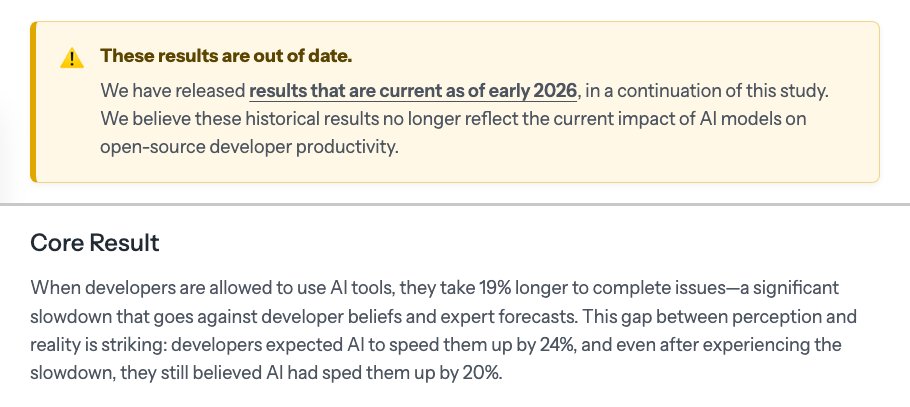
- METR itself marks this early study as out of date. We say so too.
- With AI allowed, real tasks took 19 percent longer.
- Before the study, they expected to be 24 percent faster.
- Afterward they still felt 20 percent faster. That 39-point gap is the lesson.
Screenshot of the METR early-2025 developer productivity study page, taken 2026-10-18. The 39-point gap is our arithmetic.
Keep every agent change small enough to merge in a day
Small batches are the cheapest safety tool in software. The Accelerate research says exactly how small.
Teams that did well kept fewer than three active branches open at once. Each branch lived less than a day before it merged. They never froze code to stabilize it.
A pull request is a proposed change that waits for review before it merges. Agents push against every one of those limits, because writing code costs them almost nothing.
So they happily open a pull request that touches twenty files. That's not a pull request. That's homework for whoever reviews it.
Our rule: one task card per agent branch, and the branch merges or closes within a day. If the change will not fit in one sitting of review, split the card.
The same goes for the task itself. If you cannot size it, break it down before anyone starts, human or agent.
Small means merged within a day
| Rule | What the research found | Our rule for agent work |
|---|---|---|
| Active branches | Fewer than three at a time | One agent branch per task card |
| Branch life | Under a day before merging | Merged or closed within a day |
| Code freezes | None | None. Small changes ship when tests pass |
| Task size | Too big to size means split it | Too big for one review sitting means split the card |
Branch findings: Accelerate, trunk-based development. Task-size rule: Stanley and Gross. Right column is ours.
Write the test before the agent writes the code
Tests written first check the code. Tests written after just agree with it.
That is the idea behind test-driven development. AI Engineering applies it to AI work and calls it evaluation-driven development. Decide how you will grade the work before you build it.
The team behind one of the first big AI coding assistants worked this way. In Prompt Engineering for LLMs, John Berryman and Albert Ziegler write that their oldest code was the evaluation, and that it let them move fast.
Their test is worth copying. Take code with passing tests, delete one function body, let the AI rewrite it, and run the tests again.
Who owns the tests matters too. In the Accelerate data, tests that developers wrote and maintained predicted performance, and tests owned by QA or an outside firm did not.
So the agent may draft tests, but a developer owns them. Unreliable tests go into a separate quarantine suite or get deleted, because a test nobody trusts is noise.
Give every agent task the same card. A user story names who wants what and why, plus one measurable line that defines done.
Put the card inside the agent's job spec, and grade the output the way you would evaluate any AI agent.
Example: an agent task card has one measurable line that defines done
| Field | Example |
|---|---|
| User story | As a shopper, I want to save my cart so that I can finish checkout later. |
| Acceptance line | A saved cart reloads with every item and quantity after logout. |
| Test written first | Log in, add 3 items, log out, log in: the cart shows the same 3 items. |
| Out of bounds | No changes to payment code or the database schema. |
| Reviewer | A developer who did not write or prompt the change. |
User story and acceptance criteria format from Stanley and Gross. The example and the last two fields are ours.
A person reviews every change, and the agent never merges its own
Who should approve agent changes? A peer, not a committee.
Accelerate compared four approval setups. Approval by an outside body, like a manager or a change board, went with slower delivery and showed no link to fewer failures.
Teams using peer review did better, and the authors pair it with an automated pipeline that rejects bad changes. They call outside sign-off a form of risk management theater.
We turn that into three rules for agents. First, someone who did not write or prompt the change runs the code review and records the approval.
Second, changes reach production only through the automated pipeline. Third, agents get least privilege: no production credentials, no secrets in prompts, no power to merge.
Do not rely on a polite instruction to keep an agent in line. Berryman and Ziegler warn that a model told to double-check first will still skip it some of the time.
A prompt is a request. Code is a lock.
Block risky actions in code, and make a person sign off. Write the full list into your AI governance framework.

Approval boards slowed teams down and did not make releases safer
| How changes get approved | Result in the research |
|---|---|
| Outside body, such as a manager or change board | Lower delivery performance, no link to fewer failures |
| Approval only for high-risk changes | No link to performance |
| Peer review | Higher delivery performance |
| No approval process | Higher delivery performance |
Accelerate, change approval findings. We still require peer review on every agent change.
Agents draft and propose; people merge and release
| Action | Agent alone | With a person |
|---|---|---|
| Draft code and tests on a branch | Yes | Not needed |
| Open a pull request | Yes | Not needed |
| Merge to the main branch | Never | Peer approval, recorded |
| Deploy to production | Never | Only through the pipeline |
| Touch production data or secrets | Never | Never through an agent |
Our permission rules, following the review and pipeline findings in Accelerate and the approval advice in Huyen, AI Engineering.
A safe agent change is small, tested first, merged the same day and merged by a person
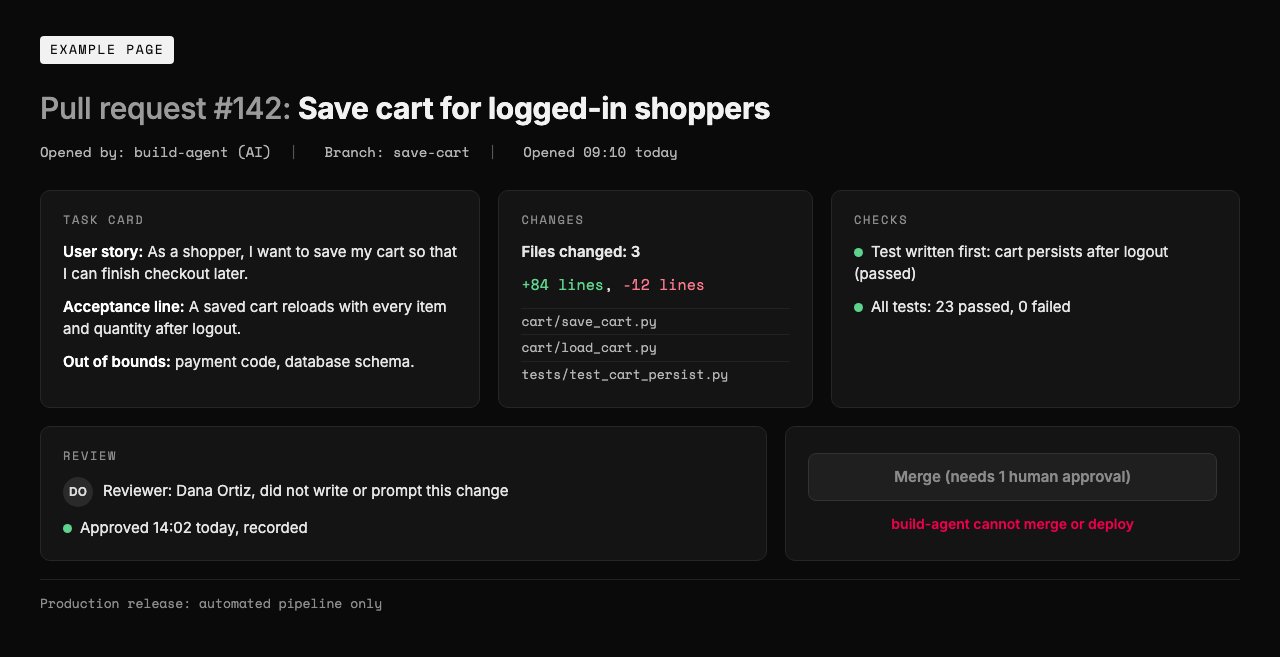
- Small enough to review in one sitting.
- Opened this morning, merged today. Under a day.
- The test existed before the code did.
- Reviewed by someone who did not write or prompt it.
- The agent proposes. A person merges.
Example page built for this article with a made-up brand. Names, times and counts are invented.
Prove, Transfer, Scale: roll out one team at a time
The Prove-Transfer-Scale method is our rollout order for AI coding agents. Each stage answers one question before the next one starts.
Prove. Pick one team and one kind of work. Record the four numbers for four weeks before agents, then for four weeks with them.
Transfer. Write the playbook: the task card, the review checklist, the permissions, and a log of what the agent got wrong. A second team then runs it, with the first team helping.
Help one team at a time. Matthew Skelton and Manuel Pais set that as a firm rule in Team Topologies: close collaboration with at most one other team at once.
Scale. Roll out wider only after two teams moved the four numbers the same way. Later teams use the playbook without hand-holding, under the same guardrails.
Expect a dip in the middle. In the Accelerate data, middle-tier teams spent more time on rework than the lowest tier.
How to roll out AI coding agents badly in four easy steps:
1. Buy seats for the whole company on Monday.
2. Count logins and call it adoption.
3. Let agents merge their own work to save time.
4. Learn what broke from your customers, and hope like hell nobody asks for the numbers.
Skip a stage and you scale a feeling, not a result.
Each stage earns the next
- Baseline Weeks 1 to 4 Record the four numbers with no agents.
- Prove Weeks 5 to 8 One team, one kind of work, agents on, same four numbers.
- Transfer Next A second team runs the playbook with the first team helping.
- Scale After two teams agree Wider rollout, same rules, same numbers.
Our rollout method. One-team-at-a-time collaboration follows Skelton and Pais, Team Topologies.
Middle-tier teams spent the most time on rework
Share of time spent on unplanned work or rework, by performance group
- High performers 21
- Low performers 27
- Middle performers 32
Accelerate, survey data on unplanned work and rework (the J-curve).
Which work should AI agents take first?
Start where mistakes are easy to spot and cheap to undo. Move to harder work only after the team knows how the agent fails.
The research backs that order. Huyen cites McKinsey data showing about twice the productivity on documentation and 25 to 50 percent more on writing and refactoring code, with minimal gains on highly complex tasks.
She also explains why coding took off first. You can run code and check it.
Work you can verify is work you can hand over. Work you cannot verify stays with a person.
Good first work: tests for existing code, small bug fixes, documentation, routine updates. Poor first work: security code, billing logic, and large changes across many parts of the system.
The log of agent mistakes from this stage is the most valuable page in your playbook. Not the prompts. The mistakes.
Easy to check first. Hard to check later.
Start where mistakes are easy to see and cheap to undo
- Second wave Small interface changes, internal tools. Review closely.
- Start here Tests for existing code, small bug fixes, documentation, routine updates.
- Keep human-led Security code, billing logic, data migrations.
- Agent drafts, person drives Large refactors behind full test coverage.
Our sorting. Productivity spread by task type from McKinsey data cited in Huyen, AI Engineering.
Your developers say they are faster. Check the four numbers
They may be right. They may also be standing in the gap METR measured.
Believe them? Doubt them?
Neither. Measure.
Ask about behavior, not labels. The Accelerate team never asked whether people practiced continuous integration, because everyone says yes. They asked whether tests run when code is checked in.
Then read the four numbers together. Faster lead time with a flat change fail rate is a win you can transfer.
Faster lead time with a rising fail rate means the batches grew or the review got lighter. Faster to write. Slower to trust.
Speed has a price tag too. For the cost side, see controlling AI token spend.
Read speed and stability together before you decide
| What the four numbers show | What it usually means | What to do |
|---|---|---|
| Lead time down, fail rate flat or down | Agents are helping | Transfer the playbook |
| Lead time down, fail rate up | Batches grew or review got lighter | Shrink task cards, tighten review |
| Lead time flat, fail rate flat | Agents are not on the slow step | Find the step where work waits |
| Lead time up, fail rate up | Agents are adding rework | Stop and go back to easier work |
Our decision rule, built on the four numbers from Accelerate.
Run it with AI this week
Paste the prompt below into your preferred AI. It asks about your team, then drafts your baseline, your agent rules and your Prove plan.
It will not invent your numbers. Those come from your version control and your incident log.
1. Pull the four numbers for the last four weeks, before any new agent work starts.
2. Pick one team and one kind of work that is easy to check and cheap to undo.
3. Write the first five task cards, each with its test, and turn on required review for agent branches.
Rules in place? Next, wire them into your agent harness so they run on every change. Or have us build the system with the gates already in place.
Remember the developers who felt 20 percent faster? Let the four numbers drive, and let the feeling ride in the back seat.
Paste into your preferred AI. It asks about your team, then drafts your baseline, agent rules and Prove plan.
Act as a software delivery coach. Help me set up an AI SDLC for one team: AI agents do work, people own every gate.

Ask me one question at a time, with the example:
1. What does the team build, and how many people are on it? (Example: a web app, 6 developers)
2. What are our four delivery numbers today: lead time from commit to production, how often we deploy, time to restore after an incident, and the share of releases that need a hotfix or rollback? (Example: 2 days, 3 times a week, 4 hours, 12 percent) If I do not know one, tell me how to pull it from version control and our incident log.
3. Which kind of work should agents take first? (Example: tests for existing code)
4. Who reviews code today, and can agents merge or deploy? (Example: one peer review, no)

Then write, in plain words:
A. Baseline plan: record the four numbers for four weeks before agents, then four weeks with them.
B. First work type: rate my choice on two things, easy to check and cheap to undo. Suggest a safer one if it fails either.
C. Agent task card: a user story, one measurable acceptance line, the test written first, and what is out of bounds.
D. Batch rule: one task card per branch, merged or closed within a day.
E. Review and permission rules: a person who did not write or prompt the change approves it; production changes go only through the automated pipeline; agents get no production credentials, no secrets and no merge rights.
F. Decision rule: move to a second team only if lead time improved and change fail rate did not rise. If speed rose and failures rose too, shrink the task cards and tighten review first.
G. An outline of the playbook for the second team, including a log of agent mistakes.

Never invent my numbers. Ask me for them. If you can browse, check the DORA metrics guide for current definitions and tell me if anything changed.
End with: Next three actions: 1. 2. 3.

Filip Kovacevic is the founder of Anar Agency in Phoenix. He spent five years running SEO, Meta ads, email, and content for medical practices across the United States, and now does the same work for healthcare, home-service, legal, and professional-service businesses, alongside AI implementation. More from Filip →
Talk it through in 15 minutes
Bring one question from this article. We will tell you what we would do, whether or not you hire us.
Book a 15-Min Chat →