Experience vs Experienced: How to Build Authority When You Are New

To build authority fast when you are new, talk about what you have seen, not only what you have done. Describe patterns you watched up close in jobs, client accounts or your trade. Say plainly that you saw them.
Then show the work on screen. Never present something you watched as something you did.
How to build authority fast when you are new: talk about what you have seen
Picture two surgeons. One finished training last year and has done three operations. The other has done three thousand.
The new one talks all the time. He talks about the cases he watched, the wards he worked on and the patterns he noticed.
The veteran says nothing unless you ask. His diplomas hang on the wall. Diplomas do not talk.
Which one do most people pick? The talker. They pick him because they can hear him, not because he is better.
That is how to build authority fast, and honestly. You talk about what you have seen, and you say that you saw it.
This guide is for anyone new at selling a skill. That includes a new agency, a freshly independent consultant, or a skilled pro who hates bragging. It is not for anyone who wants to fake a track record.
The surgeon who talks wins the patient, even with fewer operations
| Surgeon A: 3 operations | Surgeon B: 3,000 operations |
|---|---|
| Talks about cases he watched | Says nothing unless asked |
| Shares patterns from the wards | Lets the diplomas on the wall speak |
| Easy to hear | Easy to miss |
| Often gets picked | Often loses the patient |
Illustration of the Seen-It Ladder. Not a study.
The Seen-It Ladder ranks five kinds of credibility, from paper to proof on screen
The Seen-It Ladder is a ranking of five kinds of credibility, from the one buyers weigh least to the one they weigh most. Most new businesses think there is only one kind, a track record. Since they have none, they freeze.
Rung 1: paper. Degrees, licenses and certificates. Economists call this signalling: a costly sign that stands in for skill nobody can see.
Paper is required in licensed trades. Some buyers pay well just for the comfort of a certificate. On its own, it is still the bottom rung.
Rung 2: background. This is what buyers see around you: your setting, your tools and how you look on camera.
Rung 3: done. Results you produced yourself. This rung is strong, and a newcomer has the least of it.
Rung 4: seen. This is what you watched up close, such as accounts you worked on under someone else, a trade you grew up in, or launches you followed step by step.
Rung 5: shown. The work itself, on screen. A recorded walk-through is hard to argue with.
Why does seen sit above done? Because you have seen far more than you have done. Having seen a lot sounds like expertise, and buyers pay an expert to take the guesswork out.
Much of what experts know was never written down. They picked it up by being near the work, which researchers call tacit knowledge.
Studies of apprentices describe the same path. Newcomers learn at the edge of real work, next to people who know it. Researchers named this legitimate peripheral participation.
Five kinds of credibility, from least weight to most
- 1. Paper Degrees, licenses, certificates.
- 2. Background Your setting, your tools, how you look on camera.
- 3. Done Results you produced yourself.
- 4. Seen What you watched up close. Most newcomers have plenty.
- 5. Shown The work itself, on screen.
Our method, as set out in this guide.
The rungs a newcomer can reach this week are seen and shown
| Rung | Time to get it | Hard to fake? | New business has it? |
|---|---|---|---|
| Paper | Months to years | Medium | Sometimes |
| Background | A day | Low | Yes, with effort |
| Done | Months to years | High | Rarely |
| Seen | Already yours | Medium | Usually |
| Shown | An hour per video | Very high | Yes |
Our assessment, not a study.
The Seen-It Ladder ranks five kinds of credibility from least to most weight with buyers: paper, background, done, seen and shown. A newcomer is short on done and usually rich in seen. Say what you saw, and say that you saw it.
Use true counts, patterns and common mistakes. Show the work on screen, in a setting that fits the claim. Never turn seen into done, and never invent a number.
Say what you saw, and say that you saw it
Seen is the rung people abuse. Buyers rarely ask which parts you did and which parts you watched. So the job of keeping them apart falls on you.
Our rule is simple. Things you did get "I did." Things you watched get "I saw" or "I worked on."
Nothing gets made up. Not a number, not a client, not a result.
For example, a junior who worked on dental accounts can honestly write this: "On the dental accounts I worked on, the offices that called new leads back the same day booked more patients."
That line is specific, useful and true.
Compare it with this line: "I have helped dozens of dental offices grow." If you were the junior, it is false. One question on a sales call breaks it.
Sooner or later a buyer asks, "What did you actually do?" Have a true answer ready, and the question helps you instead of hurting you.
The law draws the same line. The FTC says ad claims must be truthful and backed by evidence, and claims about your own experience are ad claims.

The same experience, said three ways: only two are allowed
| The line | Claim type | Allowed? |
|---|---|---|
| "I ran the ads for one dental office and booked 14 calls." | Done | Yes, if you did it |
| "On the dental accounts I worked on, the offices that called back the same day booked more." | Seen | Yes, if you watched it |
| "I have helped dozens of dental offices grow." | Made up (for a junior) | No |
Example lines, written for this guide.
How do you build credibility with no experience? Climb the ladder in five steps
You build credibility with no experience by listing what you have seen, saying it in true sentences, and showing it on screen. Here are the five steps.
Step 1: list every place you have been near the work. Jobs, internships, a family business, client accounts you touched, groups you read every day. Write a count next to each one.
Step 2: write ten patterns. One line each: what you saw happen, to whom, and how often. If you cannot say how often, write "more than once" and stop there.
Step 3: count something public. For example, picture opening thirty local roofer websites on your phone and counting how many hide the phone number. That is only an example, so publish the real count you get.
Step 4: turn each pattern into a post. One pattern, one post, one lesson. Ten patterns cover two working weeks of daily posts.
Step 5: show one on screen. Record yourself walking through a public page or ad, pointing at what you saw. A free review of the buyer's own account does the same job, and we cover it in audit lead magnets.
What counts as seen? More than you think. Ads you study, pages you take apart, and feeds you scroll every day all count, as long as you say where you saw it.
Out of ideas? Collect them, do not invent them. Your inbox and your feed are full of material.
Five steps from a list of places to a post you can publish
- 1. List the places Every job, account and group where you were near the work. Add a count.
- 2. Write ten patterns What happened, to whom, how often. No invented numbers.
- 3. Count something public Open thirty pages, count one thing, publish the real count.
- 4. One pattern, one post Ten patterns cover two working weeks.
- 5. Show one on screen Record a walk-through of a public page or ad.
Our method, as set out in this guide.
Three sentence frames keep seen and done apart
A sentence frame is a fill-in line that tells the buyer what kind of claim you are making. Frames save you from two bad habits: bragging and hiding.
The count frame. "I have worked on [number] [businesses like yours], and here is what I keep seeing." Use your real count.
A small true number beats a big vague one. Twelve is a fact. "Dozens" is a guess.
The pattern frame. "Every time a [type of business] does [X], [Y] follows." Use it only if it really happened every time you watched.
The mistake frame. "The most common mistake I see [type of business] make is [X]." This one works on day one, because seeing is all it claims.
Which frame should you start with? The mistake frame. It needs no count, no client and no permission.
Three frames, and the one to start with on day one
| Frame | Fill in | Needs a count? | Rung |
|---|---|---|---|
| Count | "I have worked on [number] [businesses like yours], and here is what I keep seeing." | Yes, a real one | Seen |
| Pattern | "Every time a [type] does [X], [Y] follows." | No, but it must be every time | Seen |
| Mistake | "The most common mistake I see [type] make is [X]." | No | Seen |
Our method, as set out in this guide.
One post, with what you saw and what you did kept apart
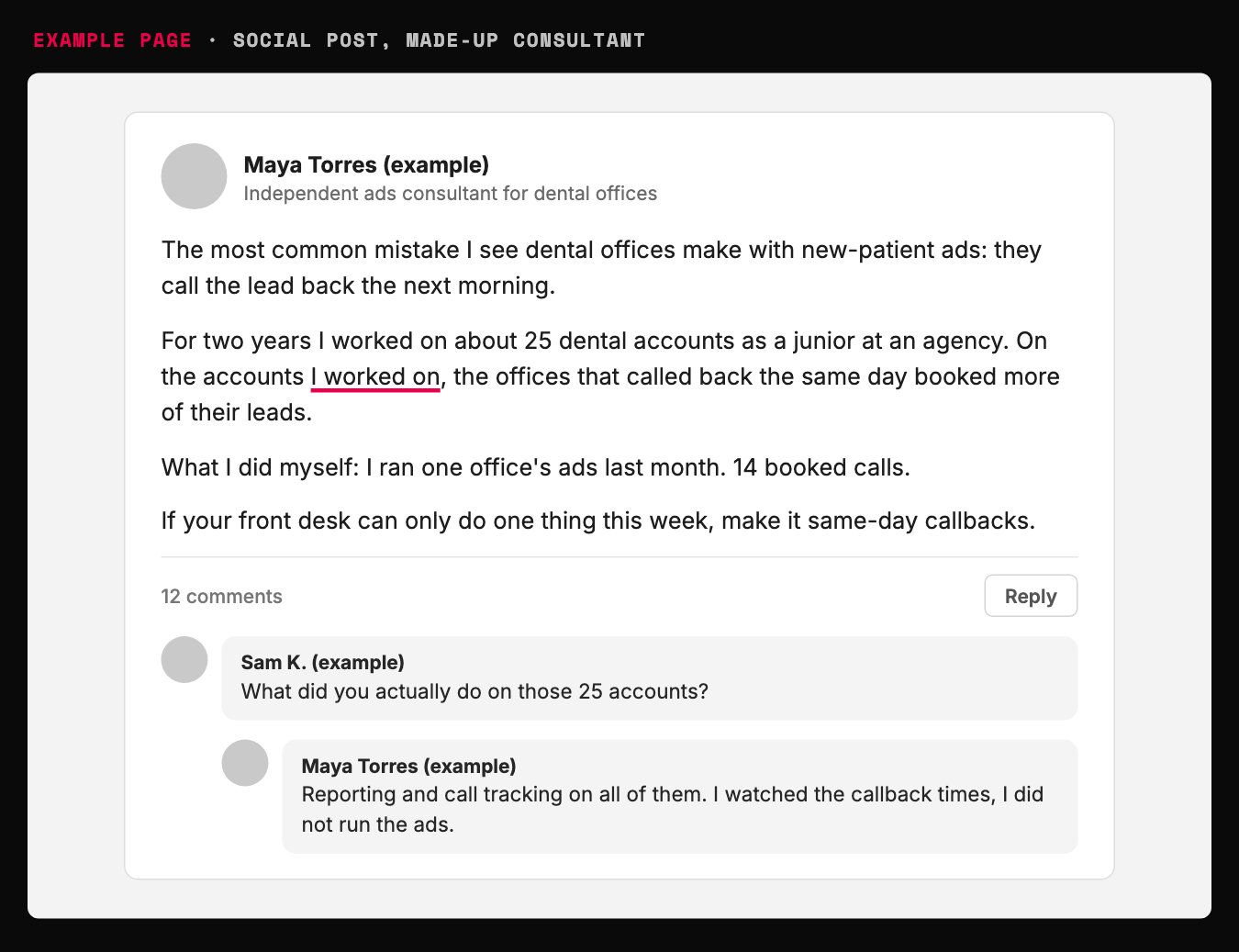
- The mistake frame. It claims only what you saw, so it works on day one.
- A seen line, labeled as seen.
- A real count beats dozens. Use your own number.
- Done things get their own sentence, with the real number.
- A true answer ready for the question every buyer asks.
Example page built for this article with a made-up brand
Big names mean nothing to a local buyer. Counts and patterns do
Famous names often fall flat with local buyers. They care about businesses like theirs, not brands they have never heard of.
For example, one marketer spent three years running ads for a large online brand. At local events, the dentists who owned four or five offices did not know the brand. His record was real, but to that room it meant nothing.
The fix is translation. Swap the brand name for a count and a pattern the room recognizes.
"I ran ads for a famous online brand" becomes "I have managed budgets bigger than most local offices spend in a year, and here is what I saw work for offices your size." The record is the same. Only the words are new.
Only use the second line if it is true. Translation changes the words, never the facts.
Swap the famous name for a count the local room recognizes
| Before: the big name | After: businesses like yours |
|---|---|
| "I ran ads for a famous online brand." | "Here is what I saw work for offices your size." |
| Asks the buyer to know the brand | Starts from the buyer's own business |
| Sounds like a far-off world | Sounds like their street |
| Facts stay the same | Facts stay the same |
Example lines, written for this guide. Use the after line only if it is true.
Skilled pros lose to talkers. Add the rungs above paper
Doctors, lawyers and engineers often hate bragging. They let the diplomas speak. The talker down the street gets the client.
Their marketing job is to add the rungs above paper. That means saying what they have done, what kinds of cases they have handled, and what they have seen across thousands of patients or files.
Healthcare adds a rule. Patient stories need written consent, and privacy law covers the details. Talk about case types and patterns, never a patient someone could identify.
We know this ground. Filip, our founder, ran operations for five years at a marketing agency serving medical practices, including ten vein clinic brands. That sentence is a seen line too.
For the search side of this, see what Google checks for experience and expertise.
Real experience only wins when someone hears about it
- The silent veteran Diplomas on the wall. Loses clients to talkers.
- The trusted expert Real record, said out loud. Where you want to be.
- Invisible New and quiet. Nobody knows you exist.
- The honest newcomer Little done, lots seen, says which is which.
Our method, as set out in this guide.
Show it on screen, in a setting that fits the claim
Rung five is showing the work. That can be a recorded walk-through, a screen share, or a page you rebuilt for practice. It is the hardest rung to fake, so it persuades.
Rung two matters here too. People judge a stranger in seconds, a habit researchers call thin-slicing.
In one well-known study, strangers rated teachers from short silent clips. Their ratings came out close to those of students who had sat through the class.
Picture a sales video shot outside: cheap earbuds, wind in the mic, a wrinkled shirt. Every word can be true. The setting still makes the words harder to believe.
This effect has a name: the halo effect. One impression colors every other one, for better or worse.
Fix the setting before you hit record. You want a quiet room, a clean screen, and the work in the frame.
When you do have done results, put the real numbers on screen. Ours: our own lead ads to med spa owners cost about $19 per lead, and a broad business-owner audience cost $181.
Our niche lead ads cost about a tenth as much per lead as a broad audience
Anar's own Meta lead ads, cost per lead by audience, May to November 2025
- Med spa owners 19
- Contractors (about $60 to $62) 61
- Broad business owners 181
Source: Anar's own Meta ad account, pulled 2026-09-22. About $9,190 spent across 16 campaigns.
The setting argues for you or against you before you speak
| Setting that undercuts you | Setting that backs you up |
|---|---|
| Outside, wind in the mic | Quiet room, clear sound |
| Cheap earbuds, wrinkled shirt | Plain, tidy, nothing distracting |
| Talking about work nobody can see | The work itself in the frame |
| A phone held at arm's length | A steady camera at eye level |
Our checklist, based on the halo effect and thin-slicing research.
Where people get stuck with seen lines
Most people get stuck in one of three places. Each has a clear sign and a quick fix.
Too obvious. Every post starts with "I have seen." Readers notice the frame, and it starts to sound like a trick.
Lead with the pattern and mention the seeing once.
Corporate words. Lines like "I architect scalable growth systems." Nobody talks like that.
The fix is the bar test: if you would not say it to a friend at a bar, do not write it.
That kind of language has a name, jargon, and buyers read it as hiding.
The old trophy. You lead with one big result from years ago. A sharp buyer asks when it happened, and why you do not have one now.
Pair the old result with something you saw this month.
Three stuck points, each with a quick fix
| Stuck point | The sign | The fix |
|---|---|---|
| Too blatant | Every post opens with "I have seen" | Lead with the pattern, mention the seeing once |
| Corporate words | "I architect scalable growth systems" | The bar test: say it like you would to a friend |
| The old trophy | One big result from years ago | Pair it with something you saw this month |
Our method, as set out in this guide.
How do I get clients with no case studies? Stop waiting for permission
You get clients with no case studies by showing what you see, every week, until buyers can tell you know the work. Waiting keeps capable people invisible for years.
How to stay invisible for three years in four easy steps:
1. Wait for testimonials before you post anything.
2. Work for free to build a portfolio. Then do it again.
3. Buy one more certificate.
4. Let your diplomas do the talking. They will not say a damn word.
Results do not arrive by waiting. They come from clients. Clients come because they could see you knew the work.
Buyers face a gap here. They know less about your skill than you do, which economists call information asymmetry. Seen lines and shown work close the gap.
Search engines want the same thing. Google's guidance on helpful content asks whether a page shows first-hand expertise, such as having actually used a product or visited a place.
Need proof you can borrow? Credit it, and stack it with the Proof Grid.
Need a safe first step for the buyer? Try a quick-win offer.
Four weeks from an empty page to your first shown work
- List and write Week 1 List the places, write ten patterns, run the prompt.
- Post daily Week 2 One pattern a day, mistake frame first.
- Show it Week 3 Record one walk-through of a public page.
- Offer a look Week 4 Offer a free review of one buyer's own page or ad.
Our plan. Results vary by trade and audience.
Google asks the question your buyer asks: have you been near this work?
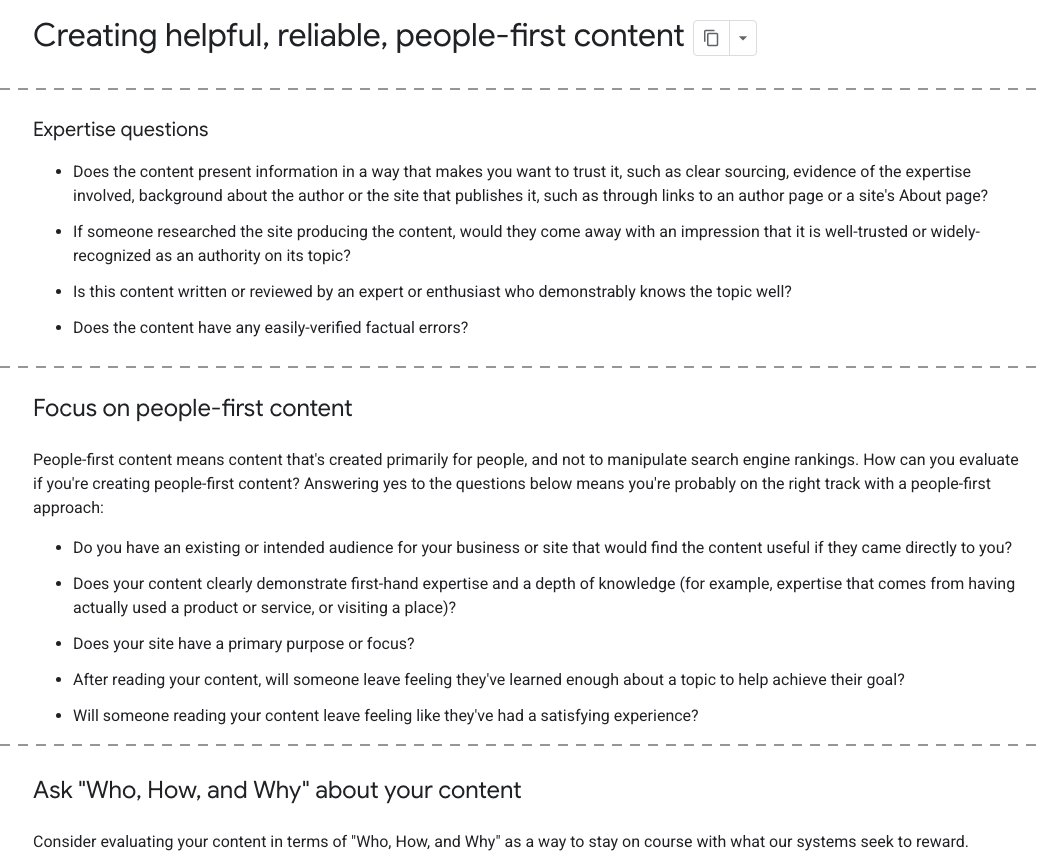
- Google asks for first-hand expertise. A seen line, stated as seen, is exactly that.
- Say who you are and where you have been near the work.
- Who made it is one of three questions Google tells you to ask.
- A free public page. Read the whole list before you write your about page.
Screenshot of Google Search Central, Creating helpful, reliable, people-first content, taken 2026-10-17
Find your seen lines with AI: the copy-paste prompt
Paste the prompt below into your preferred AI. It asks five questions about where you have been and what you have done.
Then it sorts what you have onto the five rungs. It writes ten lines, each tagged done or seen, and it never invents a number.
Check every line before you post it. If a line says more than you did, cut it.
Want a second pair of eyes on the result? Send it to us.
Paste into your preferred AI. It asks where you have been near the work, then writes ten lines tagged done or seen.
Act as a positioning editor. Help me write true credibility lines with the Seen-It Ladder.

Ask me one at a time, with the example:
1. What do you sell, and to whom? (Example: Meta ads for local dentists)
2. Where have you been near this work? Jobs, client accounts, a family business, communities. Give counts. (Example: two years as a junior at an agency, about 25 dental accounts)
3. What have you done yourself, with real numbers? (Example: one client, one launch, 14 booked calls)
4. What patterns did you see more than once? (Example: offices that called new leads back the same day booked more)
5. What could you show on screen? (Example: a walk-through of a public ad)

Rules:
- Five rungs, lowest to highest: paper, background, done, seen, shown.
- Done things get "I did". Seen things get "I saw" or "I worked on". Never turn seen into done.
- Never invent a number, client, result or count. If I give no number, write "often" or "more than once", or ask me.
- Use my counts in "businesses like yours" form. Never lead with famous names my buyer would not know.
- Plain words. If I would not say it to a friend at a bar, rewrite it.
- No fake scarcity, no income claims, no guarantees.

Output:
My ladder: what I have on each rung
Ten lines: each tagged done or seen, with its frame (count, pattern or mistake)
Three post ideas from the strongest lines
One thing to show on screen this week
The question a buyer will ask ("What did you actually do?") and my true answerWrite ten seen lines this week
1. Run the prompt and keep the ten lines that are true word for word.
2. Post one a day for two weeks, starting with the mistake frame.
3. Record one walk-through of a public page and post it in week two.
Want the full map of where credibility comes from? Read the four sources of credibility. Turning one recorded talk into a stack of posts is in the founder content engine.
Remember the two surgeons. Be the one who talks, and make every word true.
Say what you saw. Show what you say.

Filip Kovacevic is the founder of Anar Agency in Phoenix. He spent five years running SEO, Meta ads, email, and content for medical practices across the United States, and now does the same work for healthcare, home-service, legal, and professional-service businesses, alongside AI implementation. More from Filip →
Talk it through in 15 minutes
Bring one question from this article. We will tell you what we would do, whether or not you hire us.
Book a 15-Min Chat →