E-E-A-T Checklist: How to Prove Who Wrote Your Page and Why to Trust It

E-E-A-T stands for experience, expertise, authoritativeness and trust. Google says it is not a ranking factor by itself. It describes what Google tries to reward: pages where a stranger can tell who wrote them, how that person knows, and why the page exists.
Check those three things on your key pages, starting with the author.
E-E-A-T checklist: can a stranger tell who wrote this?
Picture a nice-looking blog for an agency that serves health practices. Two posts. A smiling photo of the founder at the top of each one.
You click his face. Nothing happens. No name to click, no bio, no page about him.
So who is he? Why trust what he says about running a practice? You give up and hit the back button.
That is how a stranger checks a page. Google checks it the same way. It has never met you either.
This E-E-A-T checklist (people also type it as EEAT) fixes that. E-E-A-T stands for experience, expertise, authoritativeness and trust.
It is not a score. There is no plugin for it. Google's own guidance says E-E-A-T itself is not a specific ranking factor.
What Google's systems look for is proof a stranger can check: who wrote this, how they know, and why the page exists.
Our checklist for those three questions is the Author Proof Check. Twelve checks, about fifteen minutes a page, and a prompt at the end that runs it for you.
Proof beats polish. Every time.
A stranger trusts the page they can check
| Anonymous post | Checkable post |
|---|---|
| A photo with no name | A name that clicks through to an author page |
| No dates | Published and Last updated dates |
| Claims with no source | A link for every outside number |
| The pitch in the first line | The answer first, then the offer |
| The theme's default author page | Credentials and links to real profiles |
Our comparison, built on Google's who, how and why questions.
What does E-E-A-T stand for? Four words for what a stranger checks
E-E-A-T is four words for the proof a reader looks for before they believe a page.
Experience means you did the thing. Your own cases, your own numbers, and how you reached your view in real life.
Expertise means you know the subject. It shows up in the details a beginner would not know to mention.
Authoritativeness means other people point to you. Credentials, profiles and mentions that live outside your own site.
Trust means the page is accurate, honest and safe. Google calls it the most important of the four. The other three feed it.
Google added the first E, for experience, at the end of 2022. It wanted to tell two kinds of pages apart: ones by people who did the thing, and ones pieced together from other pages.
Which letter matters most for a small firm? Experience.
A competitor can copy your layout and your headlines. They cannot copy your numbers.
Trust is the letter that counts; the other three feed it
| Letter | Plain meaning | What a stranger checks |
|---|---|---|
| Experience | You did the thing | Your own cases, numbers and dates |
| Expertise | You know the subject | Details a beginner would miss |
| Authoritativeness | Others point to you | Credentials, profiles and mentions elsewhere |
| Trust | The page is accurate, honest and safe | All of the above, plus sources and contact details |
Google Search Central, Creating helpful, reliable, people-first content. Plain meanings are ours.
The Author Proof Check is a twelve-point test of whether a stranger can verify a page, four checks under each of Google's three questions. Who: a real byline, a bio box, an author page that links both ways, and credentials with links elsewhere. How: your own dated proof, a source for every number, visible dates, and a line on how it was made.
Why: the answer before the pitch, value for non-buyers, real contact details, and markup that names the author. Fix Who first, then automate the score on every new post.
Is E-E-A-T a ranking factor? Not by itself, and raters do not rank you
E-E-A-T is not a ranking factor by itself. Google says its systems use a mix of signals to find content that shows it.
Those systems give it even more weight on topics that could hurt someone's health, money or safety. Google calls these Your Money or Your Life topics, or YMYL.
Then there are the raters. Search quality raters are people who score results against a public set of guidelines. Google says they have no control over how pages rank.
Here the SEO world and Google disagree. Many SEO agencies say a human review can hold a YMYL site back, or push it to page two, when no real experts show up.
Google says rater data is not used directly in ranking. Nobody outside Google can prove either side.
Our decision rule: build every page as if a careful person will check it. Google's systems look for the same proof. So does every buyer who reads you before they call.
Either way, the work is the same: show real proof.
Google says raters do not rank you; build as if someone checks anyway
| Claim | Who says it | How sure | What to do |
|---|---|---|---|
| E-E-A-T is not a ranking factor by itself | Google's guidance | Google's own statement | Stop paying for scores and plugins |
| Systems weigh it more on health, money and safety topics | Google's guidance | Google's own statement | Raise your bar if you give that kind of advice |
| Raters have no control over rankings | Google's guidance | Google's own statement | Treat raters as a model of a careful reader |
| A manual review can cap a site, or drop it to page two, when no real experts show up | Many SEO agencies | Unproven; Google says rater data is not used directly | Do not wait to find out. Show the proof. |
Google Search Central, Creating helpful content. The last row is a common SEO-industry claim we have not verified.
Google's own words: no E-E-A-T score, trust first, and raters do not rank you
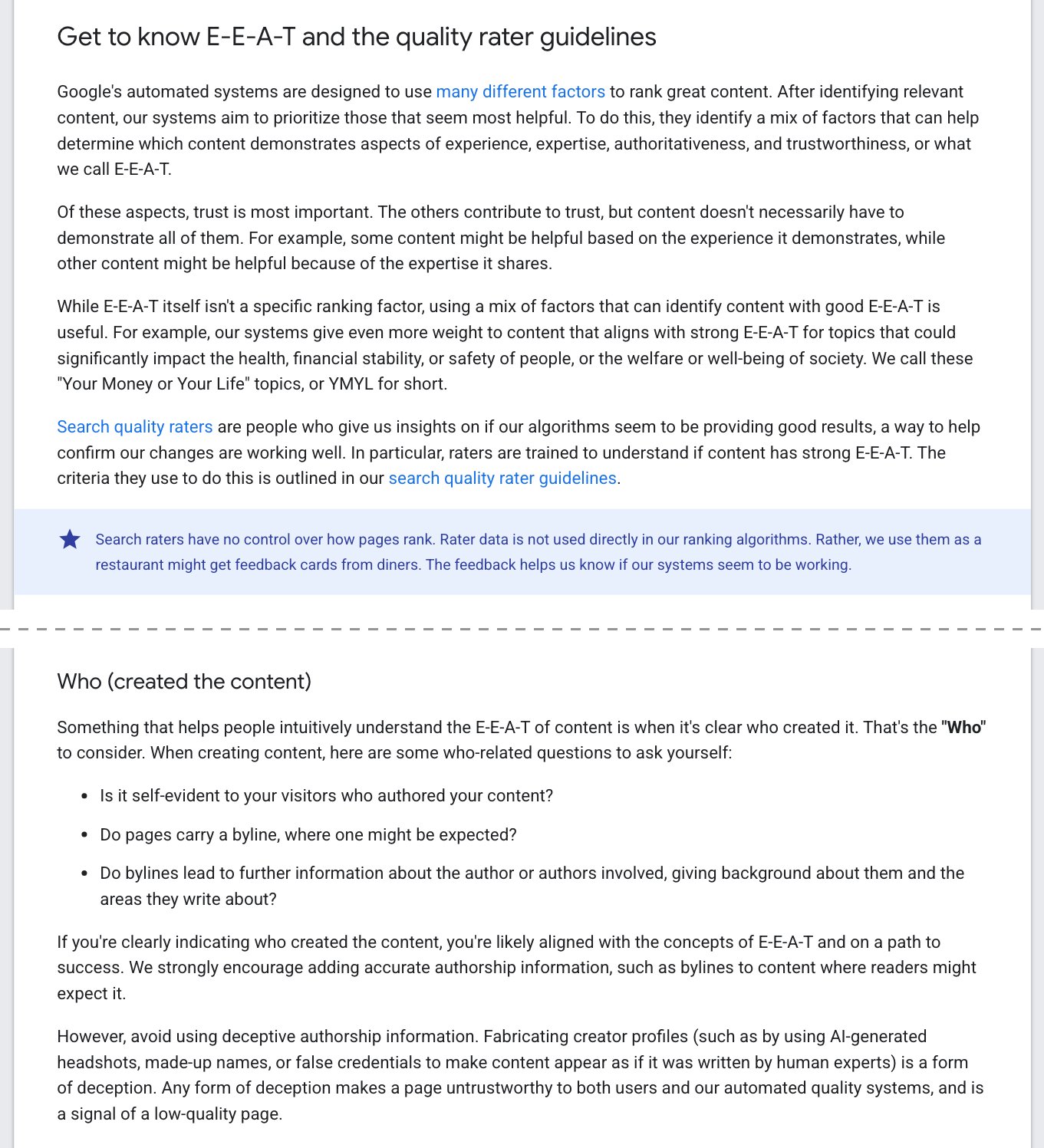
- Trust matters most. The other three feed into it.
- E-E-A-T is not a score Google adds up. It is a set of signals.
- Raters check Google's results. They do not rank your page.
- A byline should lead to a page about the author.
- Made-up authors or fake headshots count as deception.
Screenshot of Google Search Central, Creating helpful, reliable, people-first content, taken 2026-10-17
Run the Author Proof Check: three questions, twelve checks
The Author Proof Check is our twelve-point test of whether a stranger can verify who wrote a page, how they know, and why it exists.
Four checks sit under each of three questions: who, how and why. Google asks site owners to judge their own pages by the same three questions.
Run it on three pages first. Pick the ones a buyer reads before they call, not your whole blog.
Step 1: open the page like a stranger. Use a private browser window. Start a timer.
Step 2: find the author in about seven seconds. That is our rule of thumb for a reader who is not trying hard.
No name you can click by then? Count it as a fail.
Step 3: score all twelve checks. One point each. Fix every failed check in the Who group first.
Why the Who group first? Without a real person, the rest of the proof has no owner. A great number from nobody is still from nobody.
Step 4: check every new post before it goes live. The prompt at the end does the scoring for you.
Four steps from a stranger's first look to a fix list
- 1. Open it like a stranger A private browser window and a timer.
- 2. Find the author in about 7 seconds No clickable name by then counts as a fail.
- 3. Score the 12 checks One point each. Fix the Who group first.
- 4. Check every new post Run the prompt before anything goes live.
The Author Proof Check, as set out in this guide.
Twelve checks, four under each of Google's three questions
| Group | # | Check | A pass looks like |
|---|---|---|---|
| Who | 1 | Real byline | A person's name near the top, never "Admin" |
| Who | 2 | Bio box | Photo, one or two lines of real experience, links |
| Who | 3 | Author page, both ways | Lists every post; every post links back |
| Who | 4 | Credentials and links | LinkedIn, other profiles, places quoted |
| How | 5 | Your own proof | Your numbers, screenshots or cases, dated |
| How | 6 | Sources | A link for every outside number |
| How | 7 | Visible dates | Published and Last updated |
| How | 8 | How it was made | A line on AI help where a reader would wonder |
| Why | 9 | Answer first | The question is answered before the pitch |
| Why | 10 | Value for non-buyers | Something usable without hiring you |
| Why | 11 | Contact details | A real way to reach a real firm |
| Why | 12 | Author markup | Article author links to the author page |
The Author Proof Check, our checklist. Who, how and why are Google's questions.
Who wrote this? Put a real, checkable person on every post
Every post needs a real name in the byline and a short bio box. Google asks whether a byline leads to more about the author. Yours should.
The bio box is small. A photo, one or two lines of real experience, and links to the author page and LinkedIn.
What happens when the person is fake? In November 2023, the news site Futurism reported that Sports Illustrated had run product reviews under writers who did not seem to exist.
One writer's headshot was for sale on a site that sells AI-made faces. After reporters asked questions, the profiles disappeared from the site.
The magazine said an outside company had made the articles and that it had ended the partnership. The magazine had decades of good name behind it. That month, the story was a writer who never existed.
Google now names this directly. Making up creator profiles, with AI headshots, invented names or false credentials, counts as deception. Deception makes a page untrustworthy.
AI makes faking cheap. Anyone can make a fake face, a fake name and a fake site in an afternoon.
So a real person who is easy to check is worth more than ever. Fakes got cheap. Real proof did not.

Invented writers turned a set of product reviews into the story
- The report Nov 27, 2023 Futurism reports reviews under writers who do not seem to exist. One headshot is for sale on an AI-face site.
- Profiles vanish After questions The writer profiles disappear from the site.
- The magazine answers The response It says an outside company made the articles and that it ended the partnership.
- Google names it Now Made-up creator profiles count as deception in Google's guidance.
Futurism, November 27, 2023; PBS NewsHour; Google Search Central, Creating helpful content.
A real author is one a stranger can look up
| Fake author | Real author |
|---|---|
| Stock or AI-made headshot | A real photo |
| A bio with no links | A bio that links to an author page and LinkedIn |
| Credentials nobody can look up | Credentials you can check elsewhere |
| Gone when someone asks | Still there next year |
Our comparison. Google's guidance names fabricated creator profiles as deception.
The post points to the author page, and the author page points back
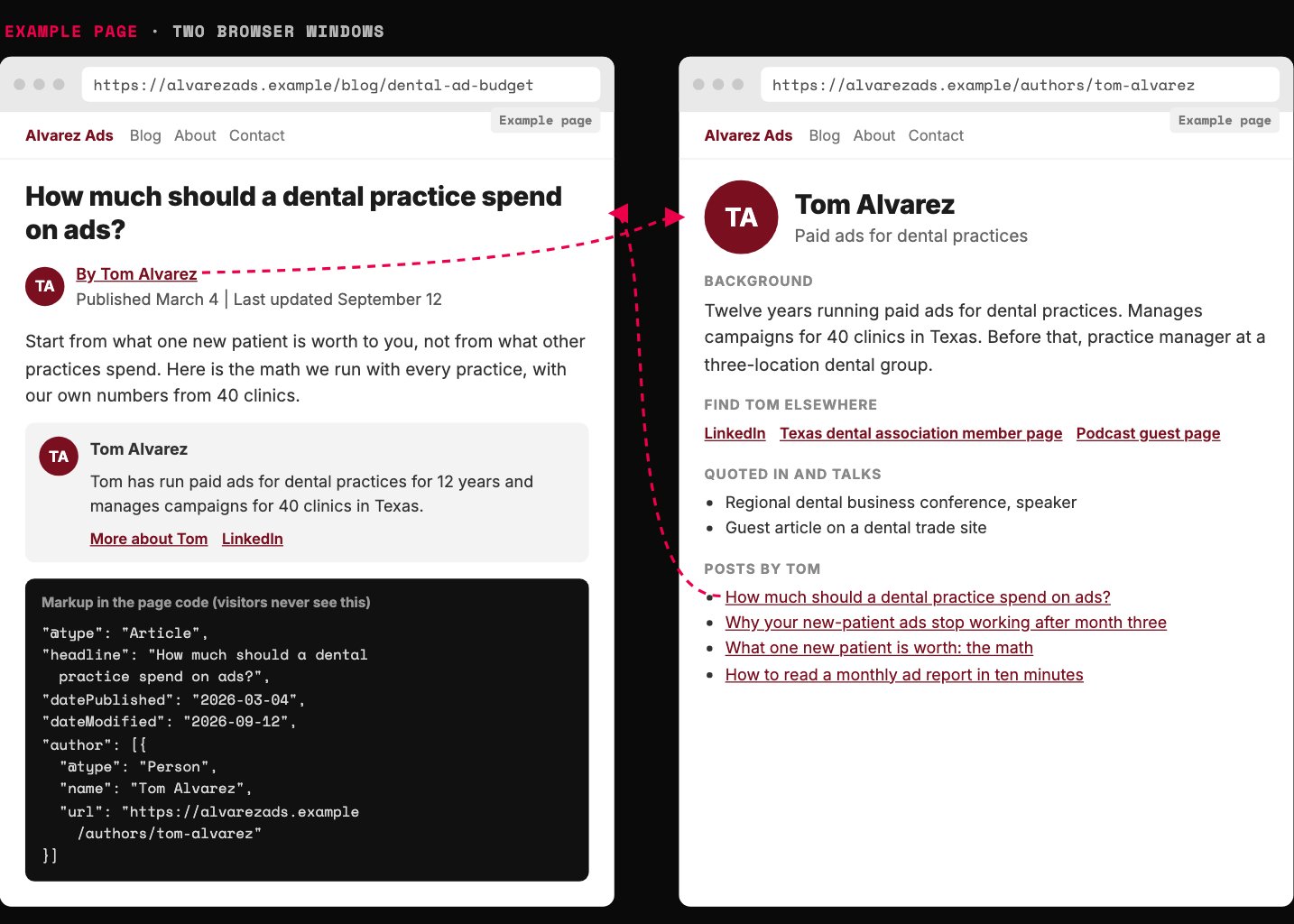
- The byline links to the author's own page on the site.
- Readers see when it was published and when it was last checked.
- A short bio that says why he knows this topic.
- The markup names the same author and points to the same page.
- The author page lists his posts and links back to each one.
Example page built for this article with a made-up brand
Build an author page that links both ways
An author page is one page about one writer that lists every post they wrote. Each post links to it, and it links back to each post.
That two-way link is the point. The post says who wrote it. The author page shows that person is real and what else they wrote.
Put five things on it: credentials, background, why they can write on this topic, links to LinkedIn and other profiles, and places they were quoted or spoke.
For example, one personal-development blog had ten years of posts and an author page. The page listed every post, which was good.
The rest was the theme's default template. No credentials, no background, no links out. A page that says nothing proves nothing.
Several writers? Add an author index: one page with a short profile for each writer, linking to their author pages.
Then add markup, hidden labels that tell Google what a page is. Google's Article markup guide has an author field that can link to the author page. The author page itself can use ProfilePage markup to describe a Person.
Want Google to connect that person to profiles across the web? That is the job of a knowledge panel home base.
Google's current rules for bylines, markup and dates sit in the dated box below.
Post and author page point at each other, so the person is easy to check
- The post The byline names the writer and links to the author page.
- The author page Lists every post and shows credentials.
- Profiles elsewhere LinkedIn and other profiles link back.
- The markup The Article author field points to the author page.
The Author Proof Check, as set out in this guide.
The bio box introduces the writer; the author page proves them
| Piece | Bio box (on every post) | Author page (one per writer) |
|---|---|---|
| Photo | Yes, small | Yes |
| Experience | One or two lines | Full background and credentials |
| Links | Author page and LinkedIn | LinkedIn, other profiles, places quoted, talks given |
| Posts | This one | Every post they wrote, linked |
| Markup | Article author with a link to the author page | ProfilePage with the person as the main subject |
Our checklist; Google Search Central, Article and ProfilePage structured data.
How do you know? Show proof a competitor cannot copy
The How group checks your evidence. Your own numbers, screenshots and cases, each with a date, are the E for experience in action.
Link a source for every outside number. A number with no source is a claim. A number with a source is something the reader can check.
Put a visible date on the page, labeled Published or Last updated. Google asks for a visible date, and so does any reader who wonders if the advice is stale.
Used AI to help write it? That is allowed. Google's guidance on generative AI says it can help with research and structure.
Churning out many pages that add nothing breaks Google's spam policies. So check every AI draft for facts. Say how the piece was made when a reader would wonder.
Think you have no proof? You do. It is in your own work, and we cover how to collect it in where content actually comes from.
Then stack it where a reader can see it. Our guide to building a proof stack shows how.
Opinions are cheap. Receipts are not.
Anyone can copy a claim; only you have your receipts
| Claim | Proof |
|---|---|
| "We get great results" | Your number, the date, and how you got it |
| "Industry-leading" | A dated screenshot from your own work |
| "Studies show" | A link to the study |
| No date anywhere | Published and Last updated dates |
| A silent AI draft | A line on how it was made, facts checked |
Our comparison.
Why does this page exist? Answer before you sell
Google says the why question is perhaps the most important one. The right answer is that the page exists to help the person reading it.
So the answer comes before the pitch. A reader who never hires you should still leave with something they can use.
Show real contact details too. A firm you cannot reach is a firm you cannot trust.
You may think YMYL is only for doctors and banks. It is not.
A consultant's page tells an owner how to spend ad money or which software to bet on. That is advice about money.
Nobody outside Google can see whether it treats your page as YMYL. Assume it might. The checklist costs you nothing either way.
How to fail an E-E-A-T check in four easy steps:
1. Sign every post "Admin." Mystery is a brand.
2. Use a stock photo for the founder. Nobody will spot the same face on a dentist's site.
3. Leave the author page as the theme's default. Blank pages build character.
4. Pitch the service in the first line. Never answer the question.
Calling that expertise is bullshit. It is a logo with a blog attached.
Trust is built from many small signals. We break them down in the four sources of trust.
High-stakes advice with thin proof is the risky corner
- Ahead of most Low stakes, strong proof. Keep it up.
- Where you need to be High stakes, strong proof. Named experts, easy to check.
- Gets by for now Low stakes, thin proof. Fix the Who group anyway.
- The risky corner High stakes, thin proof. Fix this first.
Our judgment, based on Google's note that its systems weigh E-E-A-T more on YMYL topics.
Guest authors: cite them, tie them in, and watch for overlap
Guest experts help, most of all on health and money topics. But only if a stranger can check them too.
Give each guest a byline and an author page. No page for them? Link to their site and LinkedIn inside the post.
Ask each guest to link to the post from their own site. That ties the person to the post from their side as well.
Then watch for overlap. Guests tend to write about what you already cover.
Two pages on one topic can split the ranking, so neither does well. SEO people call this cannibalization.
Our rule: when one of your top pages drops, check the newest guest posts for the same topic first.
For example, one software company for therapists was getting about seven guest articles a month from industry experts. Strong proof. It also meant seven new chances a month to repeat a topic it already covered.
Every guest gets a byline, a page and a link back
| Ask for | Why it matters |
|---|---|
| A byline and an author page | A stranger can check who they are |
| Links to their site and LinkedIn | Ties the post to a real person |
| A link from their own site to the post | Ties it from their side too |
| A topic you do not already cover | Two pages on one topic split the ranking |
| A share to their own audience | More people see it, and some may link to it |
Our checklist.
Score your page with AI: the copy-paste prompt
Paste the prompt below into your preferred AI, along with the page text or its URL. It scores all twelve checks and tells you what to fix first.
It never invents a credential, a number or a date. If it cannot see something, it asks you or marks it unknown.
Run it on every new post before it goes live. That is the whole automation: one paste, one score, one fix list.
Want a second pair of eyes on the result? Send it to us.
Paste into your preferred AI with the page URL or text. It asks three questions, scores twelve checks and gives you a fix list in order.
Act as a strict page reviewer. Score one web page with the Author Proof Check.

Ask me one at a time, with the example:
1. The page URL, or paste the full page text. (Example: https://yourfirm.example/blog/ad-budget-guide)
2. Who wrote it, and where is their author page? (Example: Dana Reyes, /authors/dana-reyes)
3. Does the page give advice about health, money or safety? (Example: yes, it tells owners how to spend on ads)

If you can browse, read the page and its author page yourself, and check Google's current pages on helpful content and Article structured data for changes. If you cannot see something, ask me or mark it UNKNOWN. Never invent a name, credential, number or date.

Score 1 point per check.
WHO
1. A real person's name in the byline, easy to find near the top.
2. A bio box: photo, one or two lines of real experience, links.
3. The name links to an author page that lists every post by that person, and each post links back.
4. The author page shows credentials and links to profiles elsewhere.
HOW
5. The writer's own numbers, screenshots or cases, each dated.
6. A linked source for every outside number.
7. A visible date labeled Published or Last updated.
8. A line on how the page was made, including AI help, where a reader would wonder.
WHY
9. The page answers the question before it sells.
10. A reader who never buys still leaves with something to use.
11. Real contact details on the site.
12. Article markup names the author and links to the author page.

Rules:
- A made-up, stock or AI-made author fails every WHO check.
- Fix order: WHO fails first, then HOW, then WHY.
- Health, money or safety topic: mark every WHO or HOW fail as urgent.
- Suggest fixes only with facts I give you. No fake reviews, credentials or quotes.

Output:
Score: __/12
Fails: [check number, what is missing, the exact fix]
Fix first: [one item]
Next three actions: 1. 2. 3.
Run it this week
1. Pick your three most important pages. Run the prompt on each one.
2. Fix the Who group first: byline, bio box, author page, links both ways.
3. Add dates, sources and a line on how each page was made. Then run the prompt on every new post.
Once readers can see who wrote your pages, structure the blog itself. Start with how to structure a blog that ranks, or see what AI answer engines actually cite.
Remember the founder photo nobody could click? Give him a name, a page and a reason. Then the stranger stays.
Google will never shake your hand. So hand it proof.
Fix three pages this week, then check every new post
- Pick three pages Today The ones a buyer reads before they call.
- Fix Who This week Byline, bio box, author page, links both ways.
- Fix How and Why This week Dates, sources, a line on how it was made, answer first.
- Run the prompt Every new post Score it before it goes live.
The Author Proof Check, as set out in this guide.

Filip Kovacevic is the founder of Anar Agency in Phoenix. He spent five years running SEO, Meta ads, email, and content for medical practices across the United States, and now does the same work for healthcare, home-service, legal, and professional-service businesses, alongside AI implementation. More from Filip →
Talk it through in 15 minutes
Bring one question from this article. We will tell you what we would do, whether or not you hire us.
Book a 15-Min Chat →