What AI Answer Engines Actually Cite, and How to Map Your Own
AI search engines mostly cite pages that answer the exact question asked. Which pages depends on the question. Broad studies put encyclopedias, forums and video near the top.
On business buyer questions, we found ordinary company pages and comparison posts led, and forums barely showed up. So list the sources cited for your own buyers' questions, then be there.
Everyone says AI cites Reddit. Check your own questions first.
Every newsletter about AI search says the same thing. The engines love Reddit and YouTube. So go post there.
We believed it. We almost built a plan on it.
Then we did the boring thing and checked. We asked four AI assistants the questions our buyers actually ask, and we read every source they cited.
Forums barely showed up. Video never showed up at all.
Not low. Zero.
So what do AI engines cite? Mostly pages that answer the exact question. Which pages depends on the question, so the only safe move is to map your own.
This guide shows you how. Our numbers sit in one dated box, because they will change. The method will not.
The advice tells you what is popular. Your map tells you where to be.
| The advice you keep hearing | What you check instead |
|---|---|
| "AI engines love Reddit and YouTube" | Which sources get cited for your ten buyer questions |
| Measured across millions of questions about everything | Measured across the questions that bring you customers |
| One study, one moment | Your own map, redrawn every 90 days |
Anar's method.
How do AI search engines choose which sources to cite?
AI search engines cite pages they fetched before they wrote the answer. If a page is never fetched, it cannot be cited.
The pattern has a name. Retrieval-augmented generation means the system first pulls documents that match the question, then writes from them. A 2020 paper by Patrick Lewis and colleagues named it.
Chip Huyen's AI Engineering explains how such retrievers rank pages. That is retrieval in general. It is not proof of how any one engine ranks.
Keyword retrieval matches the exact words. An old method called BM25 scores a page by how often the question's terms appear, adjusted for page length. It is still a strong baseline.
Meaning retrieval matches ideas. It turns text into lists of numbers called embeddings, so "price" can match "cost."
The catch? It can blur exact terms like product names and error codes.
So production systems often run both. The book calls the mix hybrid search.
There is one more step, and it can happen first. The engine may not even search your buyer's words.
Google says its AI features can use query fan-out: several related searches across subtopics, run before the answer is written. Your page competes on the engine's searches, not only the buyer's sentence.
No retrieval, no citation. Everything else is commentary.

An answer with sources is built in five moves
- Question The buyer types a full sentence.
- Searches The engine may rewrite it or fan it out into several related searches.
- Retrieve Keyword and meaning retrieval pull candidate pages.
- Write The model writes the answer from what it pulled.
- Cite Some of the pulled pages appear as sources. Pages never pulled cannot.
Retrieval-augmented generation in general (Lewis et al.; Huyen, AI Engineering); fan-out from Google's AI features page. Not any one engine's ranking.
Keyword retrieval catches exact terms. Meaning retrieval catches plain questions.
| Keyword retrieval | Meaning retrieval |
|---|---|
| Matches the exact words | Matches the idea, so "price" finds "cost" |
| Good at product names, codes, prices, places | Good at questions typed as sentences |
| Misses synonyms | Can blur exact terms and codes |
| Your page needs the buyer's exact terms | Your page needs the plain question and its answer |
Retrieval trade-offs from Huyen, AI Engineering, chapter 6. The page advice is ours.
The Citation Map is a list of every source AI assistants cite for your buyers' questions, sorted into four types. Write ten unbranded questions in your buyers' words. Ask each one five times, in a fresh chat, in each assistant your buyers use.
Copy every cited link into one table and sort it: answer pages, comparison pages, directories and forums, plus other. Count each domain once per answer and work first on the biggest type. List every domain cited in three or more answers as a target.
Trust a zero only with 30 or more answers behind it, and redraw the map every 90 days.
Big studies describe the whole internet, not your market
The Reddit advice did not come from nowhere. Large studies keep finding the same famous names near the top.
Pew Research Center found Wikipedia, YouTube and Reddit were the most linked sources in one big search engine's AI summaries. A synthesis of public datasets by 5W found Wikipedia and Reddit leading the top sources of two popular AI assistants.
Those studies average millions of questions about everything. Movies, phones, sports, how to fix a faucet.
For that mix, forums and encyclopedias really are the top sources. The studies are not wrong.
But you do not sell to everyone asking everything. You sell to a few people asking a few specific questions.
In our own run of business buyer questions, the mix flipped. Ordinary company pages led, comparison posts came second, and forums were a rounding error.
One run, two markets, one day. The dated box has the numbers and the limits.
A league average does not tell you how your team plays. The internet's average is not your market.
An average across all questions tells you little about your questions
| Big public studies | Your Citation Map |
|---|---|
| Millions of questions about everything | Ten to fifty questions about what you sell |
| Forums and encyclopedias near the top | Whatever answers your buyers' questions near the top |
| Useful for the internet's habits | Useful for your next page |
Pew Research Center; 5W. The right column is Anar's method.
The Citation Map: list every source cited for your buyers' questions
The Citation Map is a list of every source AI assistants cite for your buyers' questions, sorted into four types. It turns a trend into a fact about your market.
Step 1: write ten questions. Use your buyers' own words from sales calls, emails and support tickets, with no brand names. A customer truth system makes this easy.
Example: "How much does a bookkeeper for a dental office cost?" Not "best bookkeeping software."
Step 2: ask each question five times in each assistant your buyers use. Start a fresh chat every time. SparkToro's research found AI tools rarely give the same list of brands twice.
Ten questions, three assistants, five runs. That is 150 answers.
Step 3: copy every cited link into one table. One row per link: question, assistant, run, URL and domain.
Step 4: sort each link into one type. Answer pages, comparison pages, directories and forums. Government, university and encyclopedia pages go in an "other" bucket.
Step 5: count the share by type. Count each domain once per answer, so one long answer cannot swamp the map. The biggest type is where you work first.
Step 6: list every domain cited in three or more answers. Those are your targets. The directory to join, the comparison author to contact, the answer page to beat.
Redraw the map every 90 days. Engines change their taste fast. A map is only true on the day you drew it.
Want the weekly version, with mention rates and a tracker? That is the AI search visibility system. The map comes first.
Six steps from ten questions to a list of targets
- Write ten questions Your buyers' words, no brand names.
- Ask five times each Fresh chat, every assistant your buyers use.
- Copy every link Question, assistant, run, URL, domain.
- Sort by type Answer, comparison, directory, forum, other.
- Count the shares Each domain once per answer. Biggest type first.
- Name the targets Every domain cited in three or more answers.
Anar's method.
Each type of source has its own way in
| Type | What it looks like | How you get in |
|---|---|---|
| Answer page | A company or publisher page that answers the question in its first lines | Write or fix your own page for that exact question |
| Comparison page | "Best of" lists and "X vs Y" posts | Publish a fair one, or send the author real numbers |
| Directory or review site | Listings and reviews for your trade | Claim and complete the listing; ask real customers for reviews |
| Forum or video | Community threads and videos | Answer real threads as yourself, only if your map shows them |
| Other | Government, university and encyclopedia pages | Cite them on your page; you rarely get into them |
Anar's method.
A finished Citation Map: every link typed, shares counted once per answer, targets listed
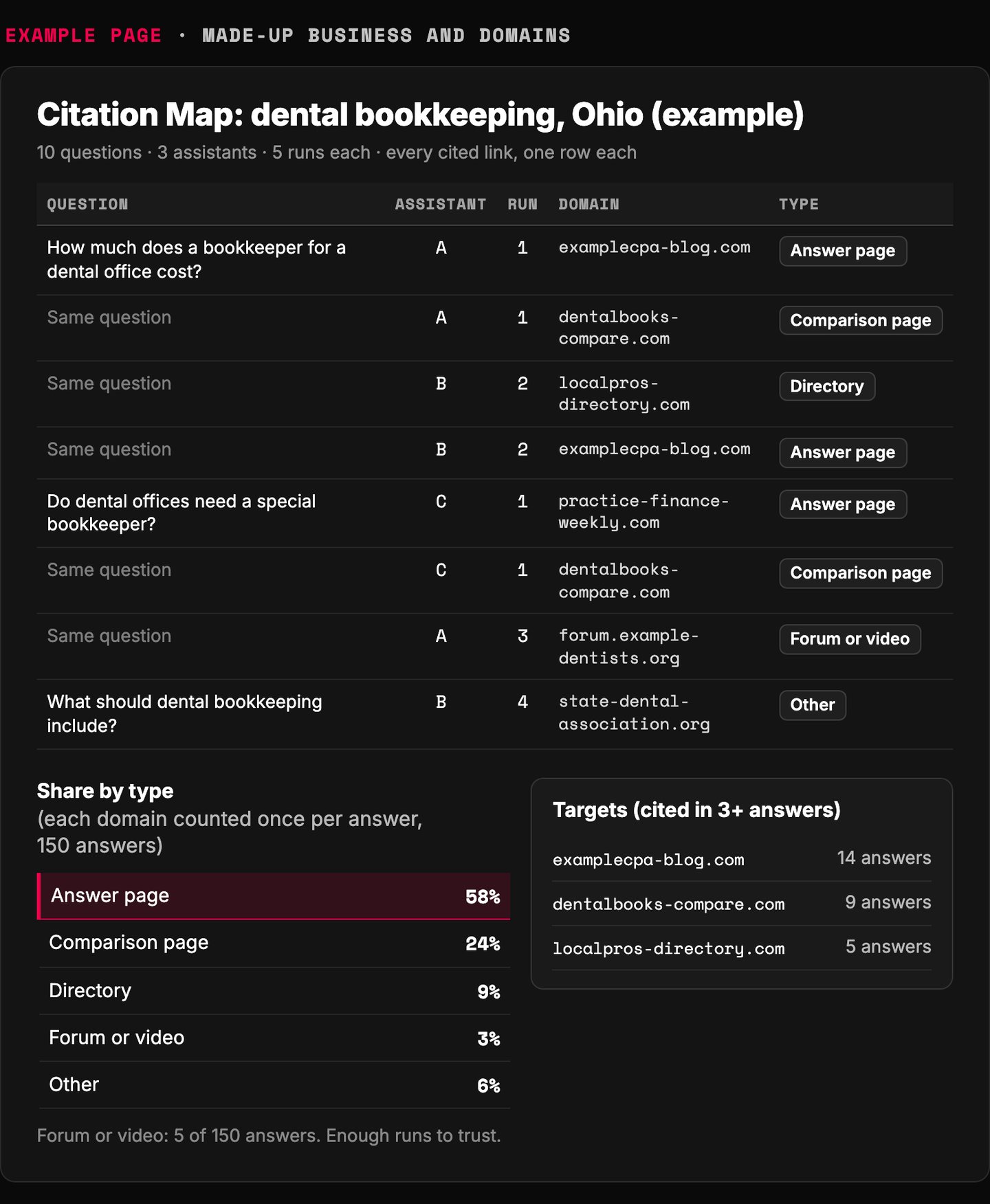
- Every link gets one of four types, plus other.
- The biggest type is where you work first.
- One long answer cannot swamp the map.
- Domains cited in three or more answers are your targets.
- Ten questions, three assistants, five runs each.
Example page built for this article with a made-up business, 2026-10-18. The domains, rows and shares are invented to show the method, not measured data.
Answer pages get cited because a retriever can find the answer
An answer page wins when a retriever can find the exact answer inside it. That is a writing job, not a hack.
Chip Huyen's book also describes a method called contextual retrieval. It works on chunks, the slices a page is cut into, often one section each. Before indexing, teams attach to each chunk the questions it answers and a short note on where it sits.
The book's example is a password-reset article tagged with lines like "I forgot my password." Some teams also told the author their systems work best when the data reads as questions and answers.
Our reading: write that into the page yourself. Put the buyer's question in the heading and the answer in the first sentence under it.
Hard? No. It is the same page in a better order.
Busy humans want the same page. Writing for Busy Readers by Todd Rogers and Jessica Lasky-Fink reports that readers mostly land on headings and first sentences.
In their test with 46,648 newsletter subscribers, adding headings more than doubled clicks on the later topics. The army calls the habit bottom line up front.
The authors do not study AI. The link to retrieval is our inference, but one page that serves both readers is a cheap bet.
Keep the exact terms too. Prices, places, product names and model numbers are what meaning retrieval can blur and keyword retrieval can catch.
Then add proof. In the GEO study, rewriting pages with quotations, statistics and cited sources raised their visibility in AI answers by about 30 to 40 percent.
Keyword stuffing made it worse. The gains also varied by topic, which is one more reason to map your own market.
Our E-E-A-T checklist covers the trust half of the page.
Quotes, statistics and sources raised visibility. Keyword stuffing lowered it.
Visibility score in AI answers after each rewrite method (position-adjusted word count, overall)
- Keyword stuffing 17.7
- No change 19.3
- Unique words 20.5
- Authoritative tone 21.3
- Easier to read 22.0
- Technical terms 22.7
- Cite sources 24.6
- Fluency 24.7
- Add statistics 25.2
- Add quotations 27.2
Source: Aggarwal et al., GEO: Generative Engine Optimization, Table 1 (GEO-bench).
The page a retriever skips, next to the page it finds
| Hard to retrieve | Easy to retrieve |
|---|---|
| Heading: "Our approach" | Heading: "How much does a dental bookkeeper cost?" |
| The answer sits in paragraph four | The answer is the first sentence |
| "Affordable rates" | "$450 to $900 a month for one location" (example) |
| Sections that say "as mentioned above" | Each section makes sense alone |
| Numbers with no source | A source and a date on every number |
Example. Retrieval logic from Huyen, AI Engineering; reading behavior from Rogers and Lasky-Fink, Writing for Busy Readers. The rewrite is ours.
Question in the heading, answer in the first sentence, a source on every number
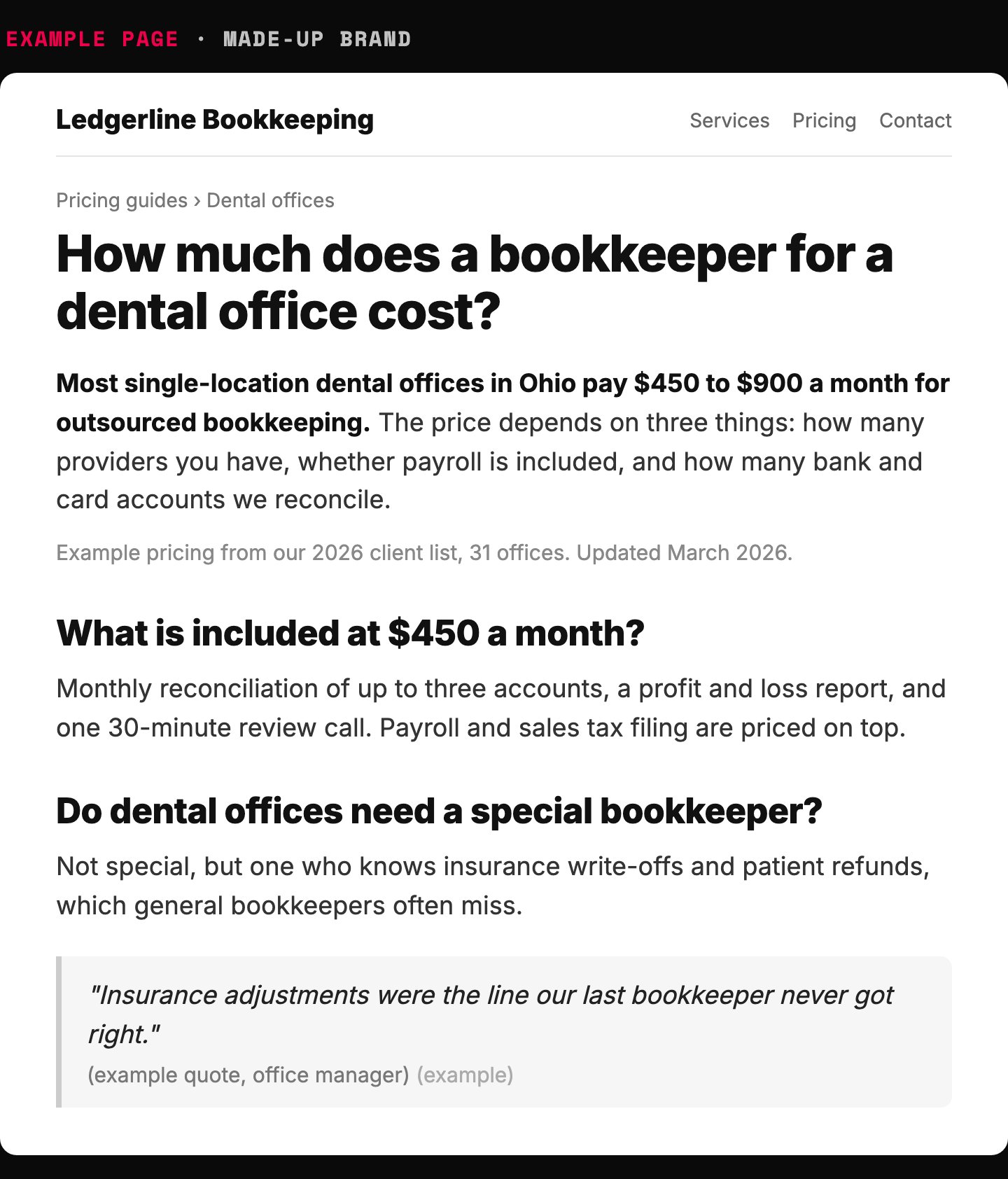
- The buyer's exact question is the heading.
- The answer is the first sentence, with real terms: a price, a place, a unit.
- Every number carries its source and a date.
- Each section answers one question and makes sense alone.
- A quotation is proof a reader and a retriever can both use.
Example page built for this article with a made-up brand, 2026-10-18. The firm, prices, client count, quote and dates are invented to show the structure.
Should you write a best-of list with your company at number one?
Only if you would publish it with a competitor at number one. Comparison posts are a big share of what gets cited, which is exactly why people game them.
How to waste a quarter on AI citations in four easy steps:
1) Read one study about the whole internet.
2) Post in forums your buyers never read.
3) Publish a best-of list where you win every category.
4) Check once. Screenshot the win. Call it a damn strategy.
A ranking where the judge wins every year is not a ranking. It is an ad with a trophy.
Google's helpful content guidance warns against pages made mainly to gain search rankings. Its spam policies name attempts to manipulate generative AI responses as spam.
Engines also change their minds fast. The dated box shows one assistant's taste for Reddit falling off a cliff in a single month.
Do not answer with fifty thin pages for fifty prompts either. Our guardrails for programmatic pages draw that line.
The durable version is a fair comparison. Include real competitors, real prices and your sources, and say who each option suits best.
Harder to write. Harder to dismiss.
A fair comparison lasts. A list you always win does not.
| Trophy list | Fair comparison |
|---|---|
| Your company wins every category | Each option is named for the buyer it suits |
| Competitors appear only to lose | Real competitors, real prices, real limits |
| No sources | Sources and dates on every claim |
| Built to get picked | Built to help someone choose |
Anar's rule, in line with Google's helpful content guidance and spam policies.
Count your runs before you trust a zero
A zero in five answers does not mean never. It means you have not asked enough.
Douglas Hubbard and Richard Seiersen's How to Measure Anything in Cybersecurity Risk gives a simple fix for small samples. Count hits and misses, add one free hit and one free miss, and read the result as a range.
Their example: one hit in six tries gives a 90 percent range of about 5 to 52 percent. Wide? Very.
The same math works on citations. That transfer is ours, not theirs, and it is the rule of succession at work.
Zero in 10 answers still allows nearly one in four. Zero in 30 allows about one in eleven. Zero in 150 allows about 2 percent.
Our rule: trust a zero only with 30 or more answers behind it. Under 30, write "not enough runs."
Where do people get stuck? Four traps, all in the table below.
All four come from trusting a map built on too little. Each fix is cheap.
One hit in six tries could mean almost anything
- Hits in the book's example 1
- Bottom of the 90 percent range 5
- Top of the 90 percent range 52
Source: Hubbard and Seiersen, How to Measure Anything in Cybersecurity Risk (5.3 to 52 percent, uniform prior).
Zero in 10 answers still allows nearly one in four
Zero hits: the top of the 90 percent range for the true share, by number of answers
- 5 answers 39.3
- 10 answers 23.8
- 20 answers 13.3
- 30 answers 9.2
- 50 answers 5.7
- 150 answers 2.0
Our arithmetic: one free hit and one free miss (uniform prior), as in Hubbard and Seiersen. Top of range = 1 - 0.05^(1/(answers + 1)).
Four traps, and the fix for each
| Symptom | Cause | Fix |
|---|---|---|
| The map changes every time you redo it | One run per question | Five runs per question in each assistant, fresh chat each time |
| One forum looks huge | One answer cited the same domain many times | Count each domain once per answer |
| You chase a source your buyers never see | The map came from one assistant | Ask in each assistant your buyers use |
| You drop a type after one zero | Fewer than 30 answers behind it | Write "not enough runs" and keep asking |
Anar's method.
Run the Citation Map with AI this week
The prompt below builds the map in your preferred AI. If it can browse, it runs the questions. If not, it hands you the table and the sorting rules.
It never invents a link. A map built on made-up citations is worse than no map.
This week, do three things. Write your ten questions on Monday. Run the prompt and sort the links by Wednesday.
By Friday, fix or write the answer page for one question where you appear in no cited type. Then set a reminder for 90 days out.
Not sure your buyers ask AI at all? The Ask-Ratio shows where they ask. If your pages are not even being seen, start with the page-two problem.
Or have us draw the map with you as part of our SEO work.
We almost built a plan on forums because a study said so. Ten questions and one afternoon showed us where our buyers' answers live.
Draw the map first. Then plant your flag where it points.
The Citation Map is a loop, not a one-time check
- Ask Ten questions, five runs each
- Collect Every cited link in one table
- Sort Four types, plus other
- Act One page, listing or comparison
- Redraw Every 90 days
Anar's method.
Paste into your preferred AI. It asks four questions, then runs or sets up the map and lists your gaps.
Act as a careful research assistant. Build my Citation Map: a list of every source AI assistants cite for my buyers' questions, sorted by type.

Ask me these one at a time, and show the example:
1. What I sell, and to whom. (Example: "Bookkeeping for dental practices in Ohio.")
2. Ten questions my buyers ask before they contact anyone, in their words, with no brand names. (Example: "How much does a bookkeeper for a dental office cost?") If I have fewer, help me draft more from my sales emails, and mark them as drafts.
3. Which AI assistants my buyers use. (Example: "The three I use most.")
4. My website and three competitors' websites.

Then:
1. If you can browse, run each question 5 times in a fresh search and record every cited link. If you cannot, give me a blank table (question, assistant, run, URL, domain) and tell me how to collect the links myself. Never invent a citation, a link or a share.
2. Sort every link into one type: answer page (a company or publisher page that answers the question), comparison page ("best of" or "X vs Y"), directory or review site, forum or video, or other (government, university, encyclopedia).
3. Count each domain once per answer. Show the share by type, with hits and total answers next to each share.
4. Where fewer than 30 answers sit behind a number, write "not enough runs" instead of a share. Never call a zero a zero under 30 answers.
5. List every domain cited in 3 or more answers. Mark where my site and each competitor appear.

Output:
A. The map: one row per type, with count, share and top domains.
B. My gaps: the questions where I appear in no cited type.
C. Three actions, largest type first: the answer page to write or fix, the directory to join, or the comparison author to send real numbers to. No paid placements, no fake reviews, no lists that rank me first by default.
D. Today's date, and a line telling me to rerun the map in 90 days.
Filip Kovacevic is the founder of Anar Agency in Phoenix. He spent five years running SEO, Meta ads, email, and content for medical practices across the United States, and now does the same work for healthcare, home-service, legal, and professional-service businesses, alongside AI implementation. More from Filip →
Talk it through in 15 minutes
Bring one question from this article. We will tell you what we would do, whether or not you hire us.
Book a 15-Min Chat →