How to Track AI Search Visibility: Count a Mention Rate, Not a Rank

AI search visibility is how often AI assistants name or cite your company when buyers ask about what you sell. The answers change on every run, so one check proves nothing. Track a mention rate instead: run a fixed set of buyer questions many times a week, count the share that name you, then improve one page at a time.
How do you track AI search visibility?
A founder asks an AI assistant to name the best roofer in her city. A competitor gets named. She does not.
She sends a screenshot to her team with three question marks. Next morning, a colleague asks the same question. She is named first.
Which screenshot is true? Neither. Each one is a single roll of the dice, and the assistant rolls again every time someone asks.
AI search visibility is how often AI assistants name or cite your company when buyers ask about what you sell. It is not a rank, because the answer gets rebuilt on every run.
So you track it like any other rate. Freeze a set of buyer questions, run each one many times, and count the share of runs that name you.
Then change one page and count again. That weekly loop is the whole system. Nothing fancy.
It is also a textbook marketing engineer job, as our guide to what a marketing engineer is explains. An agent does the counting. A person makes the call.
Hunting a trick to force your name into the answer? Wrong article.

A screenshot is one draw. A mention rate is the pattern
| Screenshot habit | Mention rate |
|---|---|
| One question, asked once | A fixed question set, run many times |
| Reports a position in the answer | Reports the share of runs that name you |
| Panic or celebration, by luck | A range that says how sure you are |
| Nobody knows which page mattered | One page changed, so you know which one moved it |
Mention-Rate Loop, Anar
A single check tells you almost nothing
One AI answer is a sample of one. You would not judge an ad on one click, so why judge an assistant on one run?
SparkToro measured how much the answers move. In their study, volunteers ran 12 prompts through three popular AI tools a combined 2,961 times.
The chance of getting the same list of brands twice was below 1 in 100. The same list in the same order came closer to 1 in 1,000.
Their conclusion is the base of this system. A position in an AI answer means almost nothing. How often you show up across many runs is a fair metric.
That matches an old rule of analytics. In Lean Analytics, Alistair Croll and Benjamin Yoskovitz say a good metric is a rate, compares one period with another, and changes what you do next.
A screenshot fails all three tests. A mention rate passes all three.
Rank is the vanity number here. Rate is the real one.
AI tools almost never give the same brand list twice
- runs of 12 prompts across three AI tools 2961
- chance of the same brand list twice (less than) 1 in 100
- chance of the same list in the same order (about) 1 in 1,000
SparkToro research by Rand Fishkin and Patrick O'Donnell, published January 2026
A mention rate passes the tests a screenshot fails
| Test of a good metric | Screenshot of one answer | Mention rate |
|---|---|---|
| It is a rate or ratio | No, one event | Yes, runs named over runs asked |
| It compares periods | No, one moment | Yes, this week against last week |
| It changes what you do | Only your mood | Yes, it picks next week's page |
Tests from Lean Analytics, Croll and Yoskovitz; applied to AI answers by Anar
The Mention-Rate Loop measures AI search visibility as a rate, never a rank. First confirm that the search crawlers of every assistant you track can read your site. Freeze a set of 25 to 50 unbranded questions built from buyer jobs, each tagged high or low buyer value.
Every week, run each question several times on each assistant, log every answer and citation, and count the share of runs that name you, read as a 90 percent range from hits and misses. Fix one page for the high-value question with the lowest rate, keep the untouched questions as a comparison, and call a change real only when the new range clears the old one.
Step zero: make sure AI crawlers can read your site
No count matters if the engines cannot read your pages. Check access first. It takes about ten minutes.
Most AI companies run two kinds of robot. A search crawler fetches pages to answer questions today. A training crawler collects pages to build future models.
They are separate choices. You can say no to training and yes to search, but blocking a search crawler can drop you from that engine's answers, as the crawler help pages say.
Then check two more layers. Your robots.txt file is the rule sheet crawlers read first. A firewall or bot-blocking rule can still turn a crawler away when robots.txt lets it in.
Crawler names and switches change. They sit in the dated box below, so this section stays true.
Check the door before you count who walks in.
Four checks before you count anything
- Search crawlers allowed Every assistant you track can fetch your pages for live answers.
- Training crawlers decided Allow or block them on purpose. It is a separate choice.
- Firewall checked No bot rule turns away a crawler that robots.txt lets in.
- Pages indexable The pages you want cited are indexed and allowed to show a snippet.
Anar's access checklist, built from the crawler help pages and Google's guide listed in Sources
Build the question set from buyer jobs, not categories
The questions decide what your number means. Ask the wrong ones and you measure a market nobody shops in.
Write 25 to 50 unbranded questions, the kind a buyer asks before they know your name. Pull them from sales calls, support tickets and reviews, which is the job of a customer truth system.
Write them around the job, not the category. Clayton Christensen's team makes the point in Competing Against Luck: nobody walks into a shop asking for the yellow fats category. They come with a job to get done.
Buyers type their job into an assistant too. "Best roofing company" is a category. "How do I know if my roof needs replacing or just a repair" is a job.
The same book describes brands that pop into mind the moment a job shows up. Our reading: an AI answer works the same way, and names the company most clearly tied to the job.
Tag each question with buyer value. High means the person asking is close to buying. Low means they are just curious.
Then freeze the list for a quarter. Swap questions every week and you are moving the goalposts. Your trend line means nothing.
Write the question a buyer types, not the category you sell in
| Category question | Job question |
|---|---|
| Best roofing company near me | How do I know if my roof needs replacing or just a repair |
| Top roofing contractors | What does a roof replacement cost for a two-story house |
| Roofing services | Will my insurance pay for hail damage on an old roof |
Example questions written by Anar. The job framing is from Competing Against Luck, Christensen et al.
Each question gets an ID, a source and a buyer value
| ID | Question | Where it came from | Buyer value |
|---|---|---|---|
| Q03 | Can a roof be repaired in winter | Support ticket | Low |
| Q07 | How do I know if my roof needs replacing or just a repair | Sales call | High |
| Q12 | What does a roof replacement cost for a two-story house | Search Console query | High |
| Q19 | How long should a new roof last | Review | Low |
Example set for a made-up roofer, Anar. Freeze the list for a quarter
Read the mention rate as a range, not a point
Your mention rate is the share of runs that name you or cite your page. Named in 3 of 20 runs is a 15 percent rate.
But 20 runs is a small sample. So we never report the rate alone.
Douglas Hubbard and Richard Seiersen give the reason in How to Measure Anything in Cybersecurity Risk. They argue that a measurement is any observation that cuts your uncertainty, stated as a number. It does not have to remove the doubt.
Their tool for small samples is the beta distribution, a standard way to turn hits and misses into a range. Add one to your hits, add one to your misses, and two spreadsheet formulas give you the 90 percent range.
Their own example: one hit in six gives a range of about 5 to 52 percent. Wide? Yes.
Useless? No. Before any data, the same math says 5 to 95 percent, so six observations cut the range nearly in half.
In a spreadsheet, the low end is =BETA.INV(0.05, 1+hits, 1+misses). The high end swaps in 0.95.
Here is our rule, run on made-up counts. Before your rewrite, a question names you in 0 of 20 runs, a range of 0.2 to 13 percent. After it, the question names you in 6 of 20, a range of 17 to 49 percent.
The two ranges do not overlap, so the move is real enough to act on. At 3 of 20, the new range would run from 7 to 33 percent and overlap the old one.
That is not a win yet. Keep counting.
More runs buy a narrower range. That is the real budget question: how sure do you need to be, and what does each run cost?
Six observations cut the range nearly in half
- 90% range before any data 5 to 95%
- hits in the book's sample 1 of 6
- 90% range after those six 5 to 52%
How to Measure Anything in Cybersecurity Risk, Hubbard and Seiersen, 2nd edition, beta distribution chapter
More runs buy a narrower range
Width of the 90 percent range, in percentage points, at the same 20 percent rate
- 5 runs (1 named) 52
- 20 runs (4 named) 29
- 50 runs (10 named) 18
- 100 runs (20 named) 13
- 200 runs (40 named) 9
Anar's math on made-up counts: beta distribution with one added hit and one added miss, method from How to Measure Anything in Cybersecurity Risk, Hubbard and Seiersen, 2nd edition
The Mention-Rate Loop: change one page a week
The Mention-Rate Loop is a weekly cycle. Ask the fixed questions, log every answer, count each rate as a range, fix one page, and count again.
Ask. Run each question several times on every assistant your buyers use. Thirty questions, four assistants, five runs each is 600 answers a week.
That is a job for an agent, not an intern.
Log. Save every answer and every cited link with the date, the assistant and the run number. Save the full text too, because next quarter you will want it.
Count. Work out the rate and range for each question. Note which competitors were named, since their rate is your benchmark.
Fix. Pick the high-value question with the lowest rate. Rewrite or build the one page that should answer it.
Why only one page? You cannot run a true split test on an AI engine, because you cannot divide its users into two groups.
The authors of Trustworthy Online Controlled Experiments describe a design for that case: the interrupted time series. Measure many times before a change and many times after, then compare what happened with what the before predicted.
They also name its weak spot: anything else that changed at the same time. An engine update can move every question at once.
So we keep the untouched questions as a comparison group. If the fixed question moves and the rest stay flat, the page did it. If everything moves, the engine did.
How to fool yourself about AI visibility in four easy steps. Step one: ask one question once and screenshot it.
Step two: rewrite ten pages in the same week, so nobody knows which one worked. Step three: swap the question list when the numbers look bad.
Step four: report a rank to the board. Congratulations, you built a damn expensive mood ring.
Ask, log, count, fix, then ask again next week
- Ask The same frozen questions, several runs on each assistant
- Log Every answer, every cited link, date and run number
- Count Rate and 90 percent range per question
- Fix One page, for the high-value question with the lowest rate
- Compare Did the fixed question move while the others stayed flat?
Mention-Rate Loop, Anar
Copy these columns and a spreadsheet is enough
| Column | What goes in it |
|---|---|
| Run | Date, assistant, run number |
| Question | ID and text from the frozen set |
| Named | Yes or no, and the exact words used about you |
| Citations | Every cited link and its type: company page, comparison, directory, forum |
| Yours | Which of your pages were cited, if any |
| Competitors | Who else was named |
| Action | The page changed this week and the date it went live |
Anar's tracker template
A filled-in week: raw runs become one rate, one range and one call
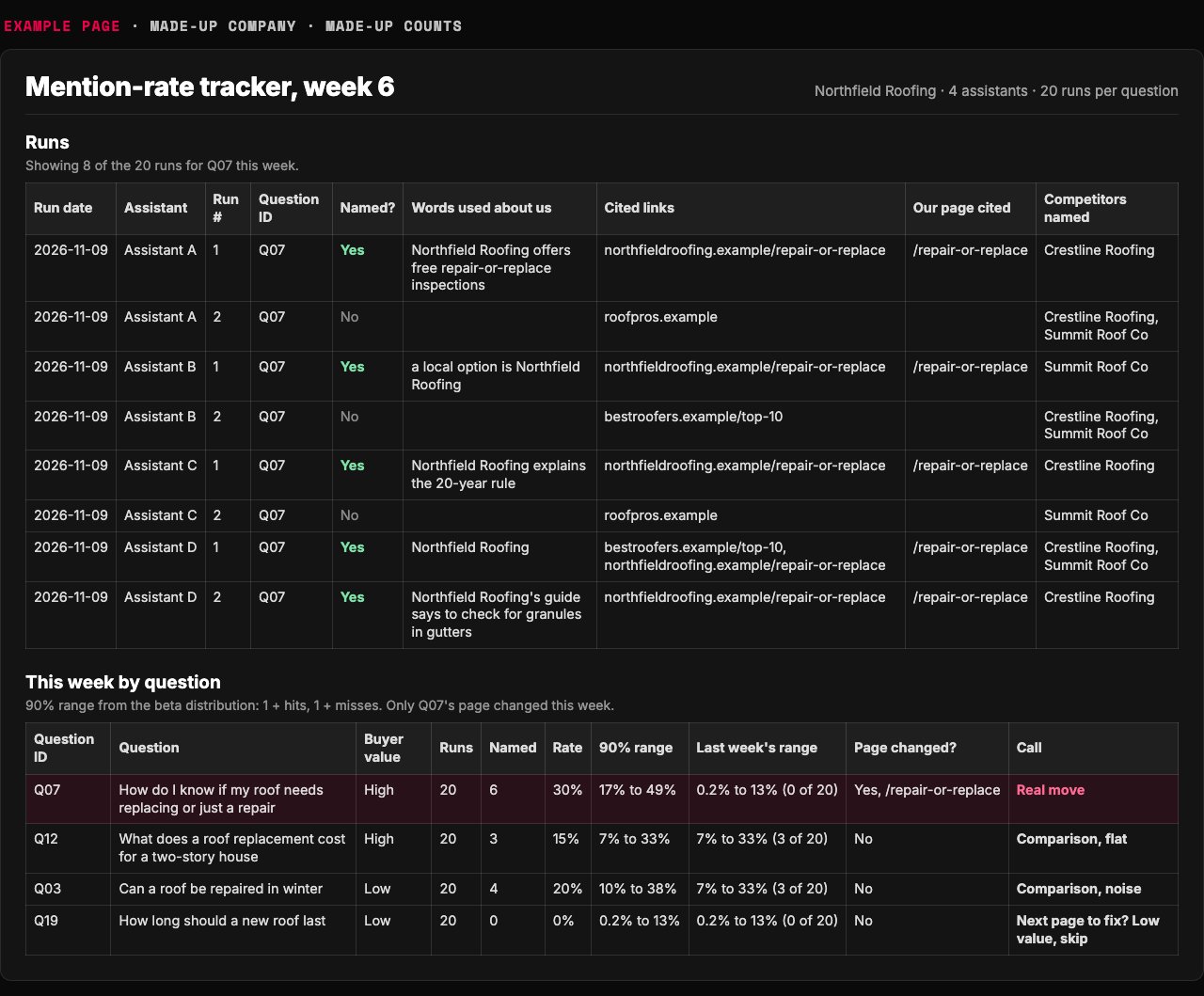
- One row per run. A yes means the answer named you or cited your page.
- Report the range, not just 30%. Twenty runs is a small sample.
- Last week's range sits fully below this week's. That is why the call is a real move.
- Untouched questions stayed flat, so the page change gets the credit, not an engine update.
Example page built for this article with a made-up company and made-up counts. Ranges use the beta distribution from section 4 (0 of 20 gives 0.2% to 13%; 6 of 20 gives 17% to 49%; 3 of 20 gives 7% to 33%; 4 of 20 gives 10% to 38%).
Why changing one page can move an AI answer
AI assistants that search the web find pages first and write second. No engine publishes how it ranks, but retrieval systems in general share a few habits.
Chip Huyen lays them out in AI Engineering. Term-based search, like the classic BM25 method, matches the exact words in a question.
Embedding search matches meaning. An embedding is a list of numbers that stands for what a passage means, so it finds pages that say the same thing in other words.
Each one misses something. Meaning-based search can blur exact terms like product names and codes, which is why the book suggests combining the two.
She also describes contextual retrieval: tag each passage with the questions it answers and a short note on the page it came from. A password help article tagged with "I forgot my password" and "I can't log in" gets found by people who never type "reset".
That is retriever design in general. It is not proof of how any public engine ranks your page.
Google's guide to its AI features pushes the other way on one point. It says you do not need to chop pages into chunks, add special AI files, or rewrite text just for AI.
Who is right? Both, if you write for the person first. Our decision rule: every section answers one question on its own, in the words buyers use, with your exact product names.
There is one controlled test of page edits. In the GEO study, adding quotations, statistics and cited sources raised a page's visibility in a test answer engine, while stuffing in keywords lowered it.
So the fix list is short. Put the answer in the first lines, add your own dated numbers, and source every claim. No tricks required.
Our E-E-A-T checklist covers the trust side. For which kinds of sites get cited at all, read what AI answer engines actually cite.
Two ways to find a page, and what each one misses
| Method | Finds pages by | Misses | What to write |
|---|---|---|---|
| Term-based search | The exact words in the question | Pages that use other words | The phrases buyers actually type |
| Embedding search | Meaning, even in other words | Exact names and codes | Your exact product and service names |
| Contextual retrieval | Tags: questions a passage answers, page context | Passages cut off from their page | Sections that stand on their own |
AI Engineering, Chip Huyen, chapter 6. Retriever design in general, not how any public engine ranks
Quotes, statistics and sources helped. Keyword stuffing hurt
Visibility score in a test answer engine, before and after each edit
- Add quotations 27.8
- Add statistics 25.9
- Cite sources 24.9
- No change 19.5
- Keyword stuffing 17.8
Aggarwal et al., GEO: Generative Engine Optimization, Table 1, position-adjusted word count on GEO-bench
Google's own guide: no special AI files, no chopped-up pages
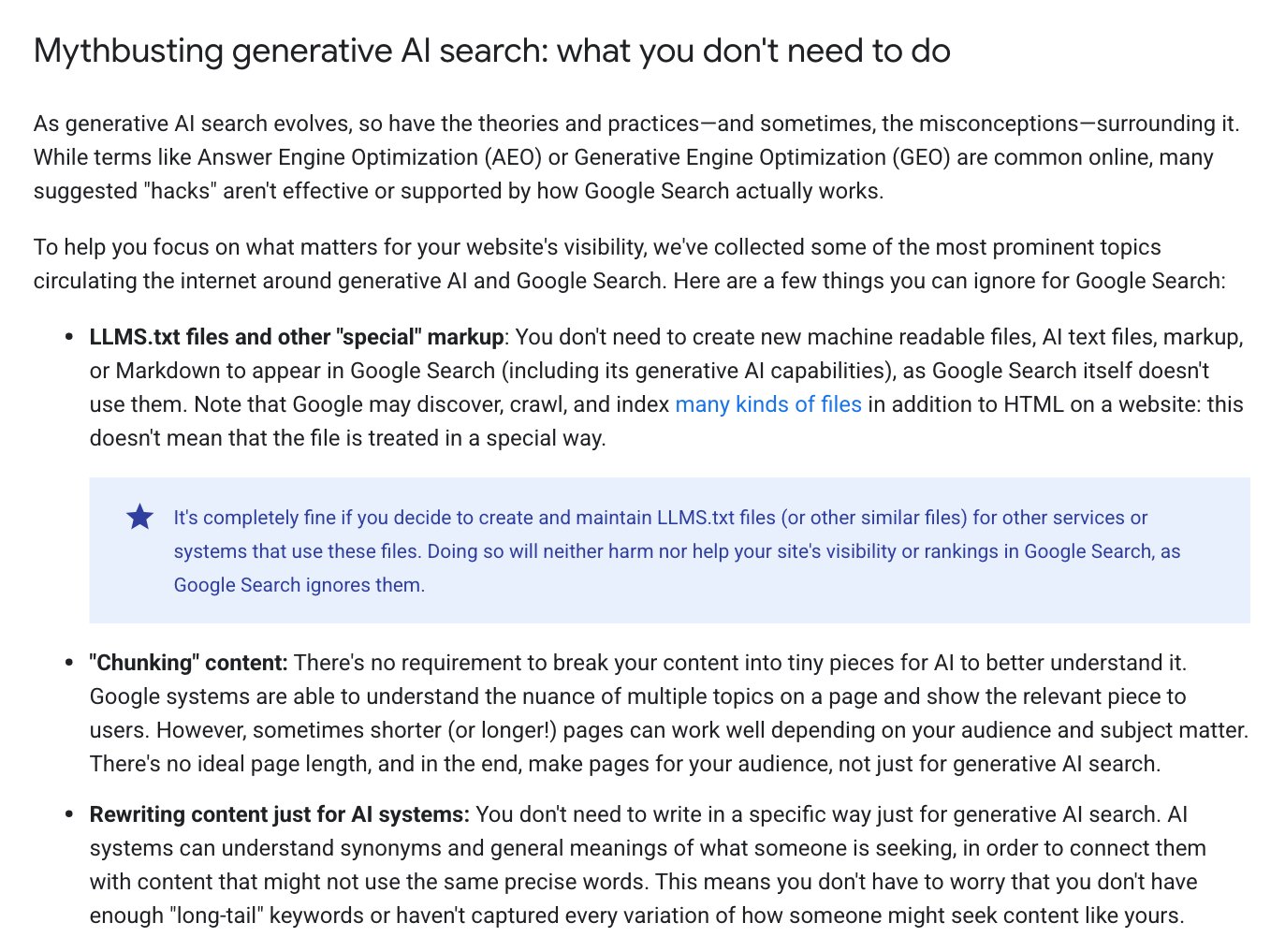
- Google says most AEO and GEO tricks do not work on its search.
- No special AI file is needed to appear in Google's AI features.
- No need to chop pages into tiny pieces. Write each section to answer one question for the reader.
- Write for the buyer first. Their exact words still help a reader and a term search.
Screenshot of Google Search Central, Google's Guide to Optimizing for Generative AI Features on Google Search, taken 2026-10-18. Pin texts are Anar's reading.
Who runs it: the agent counts, a person decides
This is a marketing engineering system because most of it is plumbing. An agent runs the questions, saves the answers and fills the table.
A person picks the page and approves the rewrite. The agent never publishes, because a wrong page on your site is a costly mistake.
Brief the agent like a new hire: which questions, which assistants, how many runs, where the table lives, and what it must never do. Our agent job spec shows the format.
The ranges then become one line in the Monday growth cockpit memo. The question, this week's range, last week's range, and the call.
Expect slow numbers. A rewritten page must be crawled again before any engine can use it.
Check where your buyers ask in the first place, too. Our Ask-Ratio analysis of Google vs AI assistants found the split changes a lot by topic.
And grade the system on what buyers did, not on how many answers it logged. That is the rule in how to measure a marketing engineer.
The agent does the counting. A person makes every call that is costly when wrong
| Step | Who does it | Why |
|---|---|---|
| Run the questions | Agent | Repetitive, and a wrong run costs little |
| Log and count | Agent | Math, checked by spot reads |
| Pick the page | Person | Needs judgment about buyer value |
| Rewrite the page | Agent drafts, person approves | A wrong claim on your site is costly |
| Publish | Person | Never automated |
Anar's split, using the rule to automate only when a wrong decision is cheap
Run your first week with this prompt
The prompt below reads one week of counts. Paste it into your preferred AI with your questions, hits and runs, and it returns rates, ranges and the one page to fix.
This week, write 25 questions in your buyers' own words. Run each one five times on the assistants they use, and log every answer.
Next week, fix one page. The week after, count again.
Rather have the system built inside your company? That is our marketing engineering work. If the page work is the gap, our SEO service handles it.
Remember the founder with two screenshots? She was asking the wrong question.
Not "are we in the answer?" but "how often?"
One screenshot is a single at-bat. A mention rate is the batting average.
Paste into your preferred AI. It asks for your questions and counts, then returns rates, ranges, real changes and one page to fix.
Act as a careful analyst of AI search visibility. Use only my answers and the rules below. Never invent a count, a rate or a competitor; if something is missing, ask me.

Ask one at a time, show the example, and wait:
1. What do you sell, and to whom? (Example: roof repair and replacement for homeowners in one city)
2. Did you confirm that the search crawlers of every assistant you track are allowed in robots.txt and not blocked by a firewall? (Example: yes for three, not sure for one)
3. Paste your fixed question list with an ID and a buyer value tag, high or low. (Example: Q07, high, how do I know if my roof needs replacing or just a repair)
4. For each question and assistant, give this week's runs and the runs that named you or cited your page, plus last week's. (Example: Q07, assistant A, 5 runs, 0 named; last week 5 runs, 0 named)
5. Which page did you change since last week, and for which question? (Example: the roof repair vs replacement page, for Q07)

Rules:
- Mention rate = runs that named or cited us / total runs. Never report a rank or position.
- Give every rate a 90 percent range from the beta distribution: alpha = 1 + hits, beta = 1 + misses, 5th and 95th percentiles. If you cannot run code, say the range is approximate.
- Call a change real only when this week's range does not overlap the old range for that question.
- Treat questions with no page change as the comparison group. If they moved by the same amount, credit the engine, not the page.
- If access is unconfirmed for an assistant, mark its zeros as not yet measured.
- Pick next week's page from the high-value question with the lowest rate. One page only.
- If you can browse, check each assistant's crawler help page for current crawler names and tell me if anything changed.

Show your math, then use exactly this format:
RATES AND RANGES (per question, all assistants combined):
CHANGES THAT ARE REAL:
CHANGES THAT ARE NOISE:
WHAT THE COMPARISON QUESTIONS DID:
PAGE TO FIX NEXT WEEK, AND WHY:
NEXT THREE ACTIONS:

Filip Kovacevic is the founder of Anar Agency in Phoenix. He spent five years running SEO, Meta ads, email, and content for medical practices across the United States, and now does the same work for healthcare, home-service, legal, and professional-service businesses, alongside AI implementation. More from Filip →
Want to know how often AI assistants name you?
Bring the five questions your buyers ask before they call. In 15 minutes we will show you how we would count them and which page we would fix first.
See how we build them →Want to do this work yourself? See how we train marketing engineers.