How to Become a Marketing Engineer in 30 Days, Technical or Not

To become a marketing engineer, spend 30 days on one real company and one number it tracks. Map its market, write one weekly decision down as clear rules, and build one system that runs it, with a person approving anything customers see. Then measure the number again.
Practice by testing yourself from memory, not by rereading.
How do you become a marketing engineer?
Ask how to become a marketing engineer, and most people start the same way. They spend a month watching.
Videos about agents, a course at double speed, threads saved for later. It all feels like progress.
Then someone asks what they built. The honest answer is a playlist.
To become a marketing engineer, you need a different month. One real company. One number it already tracks.
A marketing engineer is a marketer who builds systems: the data, rules, AI agents and automations that run the marketing every week. This guide is the training plan for that job, whether you code or not.
The Four-Receipt Month is our 30-day plan for it. Four weeks on one company, and each week ends with a file you can show someone: a market map, a written decision, a running system and a case study.
A week without its receipt is not finished.
The plan also grades you. You do the core task cold on day one and again on day thirty. The gap between the two is your real result.
It is not for software engineers who want marketing basics. It is not for anyone who needs a certificate by Friday.
Four weeks, four files you can show someone
- Week 1: market map One page: who buys, their pain in their words, what they buy instead, where they drop out, what to test. A source on every line.
- Week 2: written decision One weekly call the team makes by feel, written as inputs, rule, output, check and owner.
- Week 3: running system That decision, run by a system. A person approves anything customers see or that spends money.
- Week 4: case study and retest The number again, the same way. Then the day-one task redone cold, side by side.
Four-Receipt Month, Anar
Do you need to code to become a marketing engineer?
No. You need to write a decision down so exactly that a machine can run it and a person can check it.
The term is older than the hype. Gary Lilien and Arvind Rangaswamy have published marketing engineering textbooks since 1998. Their third edition says it was built for managers with little technical training.
Their book sorts marketing decisions into three modes. Conceptual marketing runs on gut feel alone. Marketing engineering adds data and a model, and keeps the manager's judgment in the loop.
Automated marketing hands the whole call to a system. So when should you automate? When a wrong decision is cheap.
When a wrong decision is costly, a person stays in charge.
So the line you cross is not code. It is moving one decision out of your head and onto the page. Today's marketing engineer then builds the system that runs it every week.
Marketers cross that line all the time. In Hacking Growth, Sean Ellis and Morgan Brown tell how a product marketer at BitTorrent, Annabell Satterfield, surveyed free users who never upgraded.
The top answer? They did not know a paid version existed.
The team added one upgrade button to the home screen, and upgrade revenue per day rose 92 percent. She later moved to the product team as Senior Product Manager for Growth.
She did not code that button. She brought the evidence. Soon an engineer came asking her for more ideas.
Does code still matter? Yes, later. AI coding agents now write most of it, and your job is to read what they did and test it.
Code is the easy half. Describing the work is the hard half.
The line to cross is the middle rung: a decision written as a model
- Conceptual marketing Gut feel and a mental model. Nothing written down.
- Marketing engineering Data and a written model inform the call. Your judgment stays in.
- Automated marketing A system makes the whole call. Right only when a wrong call is cheap.
Principles of Marketing Engineering and Analytics, Lilien, Rangaswamy and De Bruyn, 3rd edition, chapter 1
One survey of non-upgraders led to three big wins
- more upgrade revenue per day after one home-screen button 92
- more four- and five-star reviews after one well-timed prompt 900
- team revenue growth in one year 300
Hacking Growth, Ellis and Brown: the BitTorrent mobile team, as the authors report it
Become a marketing engineer in four weeks on one real company, against one number it already tracks. Day one: write the baseline and attempt the whole job cold for two hours. Week one ends with a market map, a source next to every answer.
Week two ends with one recurring decision written down as inputs, rule, output, check and owner. Week three ends with one system that runs that decision, with a person approving anything customers see. Week four ends with a one-page case study and the same cold attempt, redone.
Every morning, test yourself from memory before learning anything new. A week is done when its receipt exists.
Watching feels like learning. Testing yourself is learning.
Most training for this job fails for one reason: it is built for the feeling of learning.
In Make It Stick, psychologists Peter Brown, Henry Roediger and Mark McDaniel report that rereading is the top study habit. In some surveys, more than 80 percent of college students say they do it.
It feels great. The pages get familiar, and familiar feels like knowing. It is not.
Testing yourself works better. In one study they describe, readers who took a recall test remembered 50 percent more a week later than readers who did not. That is the testing effect.
Mixing topics also beats drilling one. Students who practiced geometry problems in blocks scored 89 percent during practice and 20 percent a week later.
Students who practiced the same problems mixed scored 60 percent, then 63. The mixed group felt worse the whole time. They won anyway.
Andy Grove pushed managers on this in High Output Management. Are you trying new tools with your own hands, or only reading about them?
Reading about a tool is not using it.
How to spend 30 days and learn nothing, in four easy steps. Step one: buy a course and play it at double speed.
Step two: reread your notes until they feel familiar. Step three: study one tool a week and never mix them.
Step four: post the damn certificate and call it a portfolio. Congratulations. You watched a very long trailer.

Mixed practice felt worse and won a week later
Share correct on volume problems for four geometric solids
- Blocked, during practice 89
- Mixed, during practice 60
- Blocked, one week later 20
- Mixed, one week later 63
Make It Stick, Brown, Roediger and McDaniel, reporting Rohrer and Taylor (2007)
What feels like progress is not what builds the skill
| Feels like learning | Builds the skill |
|---|---|
| Rereading notes until they look familiar | Writing from memory, then checking |
| Watching how someone else built it | Attempting it yourself first, then comparing |
| One tool per week, in a block | Market, data and build work mixed every week |
| A certificate | A day-one attempt next to a day-thirty attempt |
Learning findings: Make It Stick, Brown, Roediger and McDaniel. Marketing rows are Anar's
Day one: pick the company, set the number, attempt the job cold
Day one does three things. It picks the company, sets the baseline number, and records your cold attempt at the job.
Pick your own employer if you can, because the data is real and the result counts. Otherwise use a friend's business, a local service firm or a nonprofit.
Get the owner's yes in writing, including what you may read. Never paste customer names, recordings or exports into an AI tool without that permission.
Public data is enough for week one.
Then pick one number the business already tracks, such as booked calls, quote requests or qualified replies. Write down today's value and the date.
Next, give yourself two hours with no help and no tutorials. Write how you would move that number.
Name the decision you would change, the data you would need and the system you would build. It will be bad. That is the point.
Trying before you are taught is called the generation effect. A wrong first attempt makes the right answer stick better when it arrives.
Save the attempt in a repository, a project folder that tracks every change, and never edit it. On day thirty you do the same task again, cold.
Psychologists call this loop dynamic testing: test to find the weak spots, practice on them, then test again. Why bother? Because the second attempt is the only honest grade you get this month.
Do the same task on day one and day thirty, and practice the gap
- Test cold Day 1: two hours, no help. Write how you would move the number.
- Find the weak spots Mark every place you guessed, stalled or skipped.
- Practice the gaps Days 2 to 29: the receipts, aimed at what you missed.
- Test cold again Day 30: the same task, no notes. Compare line by line.
Dynamic testing as described in Make It Stick, Brown, Roediger and McDaniel; applied by Anar
Day one sets four things before any building starts
| What | Example | Why it matters |
|---|---|---|
| The company | Your employer, a friend's firm, a nonprofit | Real data makes the result count |
| Written permission | An email saying what you may read | No customer data reaches an AI tool without it |
| One number and its date | Quote requests, read on the 3rd | The case study is judged against it |
| The cold attempt | Half a page, two hours, no help | The baseline for your own skill |
Four-Receipt Month, Anar. Examples are illustrative
The daily rule: test yourself before you open the notes
The daily rule is simple. Before you learn anything new, write down what you learned yesterday, from memory.
Michael Young is the best case for it. He entered medical school without premed courses. The only biology class his college offered was a fishing class.
His first exam? A 65. A typical day brought about 400 slides.
He stopped rereading and switched to self-testing, with gaps between reviews. By his second year he had climbed from the bottom of a class of 200 to the high performers.
His rule fits on a sticky note. You always test yourself first.
Our version takes ten minutes. Each morning, write what you remember from the day before on a blank page. Then check your notes and study only what you missed.
Space it out. Leave at least a day between practice on the same skill, which the research calls the spacing effect, and keep coming back to old material once it feels easy.
Mix it up. Each week rotates three strands: market, data and build. Never one block per week.
Every Friday, write five sentences: what you did, how it worked, what you would change. Those notes become half of your case study.
That is the whole routine. Ten minutes and a blank page.
A medical student went from the bottom of his class to the top group
- his score on his first exam 65
- slides in a typical day 400
- students in his class; he joined the high performers by year two 200
Make It Stick, Brown, Roediger and McDaniel: the Michael Young case
Every day starts from memory, and every week mixes three strands
| When | What you do | Time |
|---|---|---|
| Every morning | Blank page: write yesterday's material from memory, then check and restudy the misses | 10 minutes |
| Monday | Market strand: reviews, calls, ads, the market map | The rest of your hour |
| Tuesday | Data strand: one export, split into segments | The rest of your hour |
| Wednesday | Build strand: the written decision or the system | The rest of your hour |
| Thursday | Rotate again, starting with your weakest strand | The rest of your hour |
| Friday | Five sentences: what I did, how it worked, what I would change | 15 minutes |
Anar's schedule, built on retrieval, spacing, mixing and reflection from Make It Stick, Brown, Roediger and McDaniel
Weeks one and two: map the market, then write one decision down
The first two receipts are a market map and a written decision. Both are writing, not code.
Week one is the audit. Read the site, the offer, the reviews, the competitors' ads, and any calls or tickets you were allowed to see.
The market map answers five questions on one page. Who buys, and what pain do they describe in their own words?
What do they buy instead, where do people drop out, and what would you test first? Every answer gets a source. A guess is fine only if it says it is a guess.
Want a longer list? The marketing engineering audit has 20 questions, and the customer truth system turns calls and reviews into a weekly memo.
Then run one drill: split a total into segments. In Lean Analytics, Alistair Croll and Benjamin Yoskovitz show a 13-row survey where the average gamer plays 8.85 hours a week.
Split by gender, the gap is under three hours. Split by age, it is six.
A pivot table found the real story in a minute. The average had hidden it.
Week two is the written decision. Pick one call the team makes every week by feel, like which leads get called first or which ad angle runs next.
Write it down as inputs, the rule, the output, the check and the owner. Five parts. That is the step from conceptual marketing to marketing engineering.
Keep it in a shared folder that every AI tool reads, the growth repo. How to brief an agent on that decision is in the agent job spec.
The 8.85-hour average hid a six-hour age gap
Average hours of video games a week, a 13-row survey example
| Age | Women | Men | All |
|---|---|---|---|
| 20 to 30 | 10.00 | 14.00 | 12.00 |
| 30 to 40 | 8.00 | 11.50 | 10.33 |
| 40 to 50 | 8.00 | 11.00 | 9.00 |
| 50 to 60 | 6.33 | 8.00 | 6.75 |
| 60 to 70 | none | 6.00 | 6.00 |
| All ages | 7.57 | 10.33 | 8.85 |
Lean Analytics, Croll and Yoskovitz: the pivot-table teaching example
A decision written down has five parts
Example, invented for illustration: which new leads get a call first
| Part | What you write |
|---|---|
| Inputs | The form answers, the lead source, the time it came in |
| Rule | Call within the hour if the job is in the service area and a budget was given; otherwise send the email sequence |
| Output | A ranked call list at 9 a.m. and 1 p.m. |
| Check | Every Friday, the owner reviews 10 random rows against the rule |
| Owner | The sales lead, who fixes the rule when it is wrong |
Anar's written-decision format; the line from gut feel to a model follows Principles of Marketing Engineering and Analytics, Lilien, Rangaswamy and De Bruyn, 3rd edition
The week-one receipt: five questions, one page, a source on every line
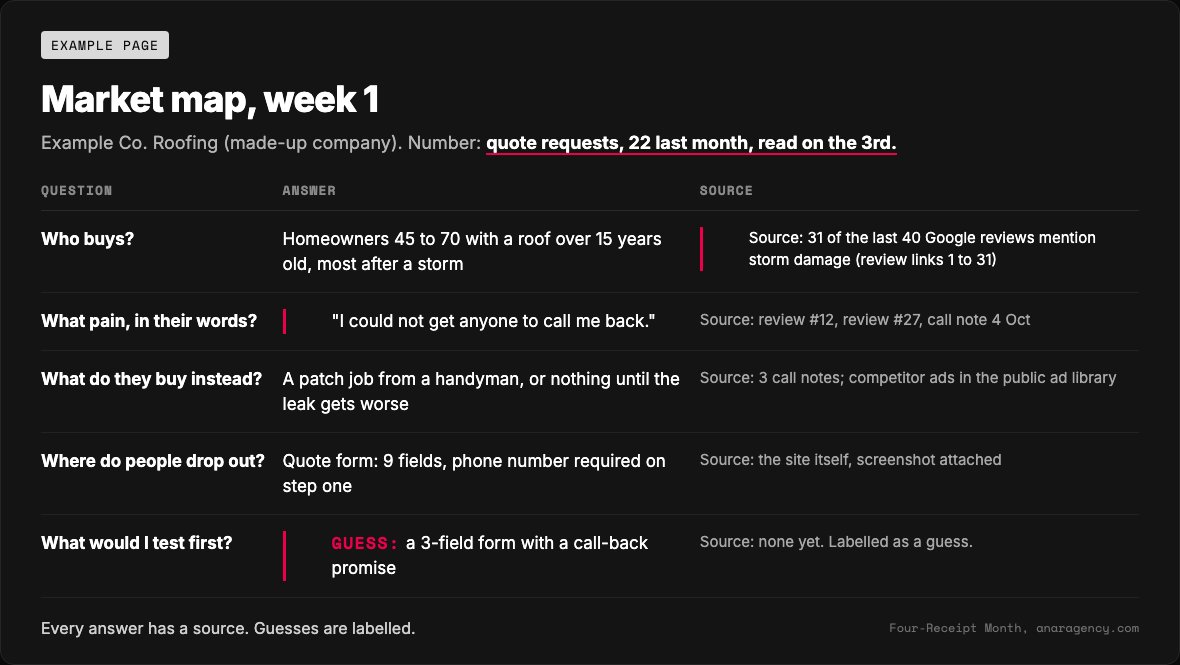
- Pain in the buyer's own words, copied, not summarized.
- A count plus links. Anyone can check it.
- Guesses are allowed. Hidden guesses are not.
- The number and its date go on the page before anything is built.
Example page built for this article with a made-up brand
Weeks three and four: automate the boring part, then prove it
Week three builds one system that runs the decision. Start with the boring part.
Team Topologies borrows a split from psychologist John Sweller. There are three kinds of cognitive load, the mental effort a task takes.
Intrinsic load is the skill itself. Extraneous load is the fiddly setup around it. Germane load is the thinking that adds value.
The book's advice is to remove the extraneous load, which can often be automated. In marketing, we read that as: automate the exports, the copying and the formatting first. Save your head for the judgment calls.
Keep a person on anything a customer sees or that spends money. That is the textbook's rule again: a costly wrong call gets a human.
Every time you reject an output, write one check that would have caught it. Investor Mohnish Pabrai built about 70 checks this way from a list of past mistakes, as Atul Gawande tells it in The Checklist Manifesto.
Test the system the way you would test a new hire, which how to evaluate AI agents walks through.
Week four is proof. Run the system for at least a week, then read the day-one number again, the same way.
Report small results as counts. Four replies from 30 messages is a count, not a rate. Do not dress it up.
List what else changed in those weeks, like a price change or a holiday. Then do the cold attempt again and put day one next to day thirty.
Automate the fiddly setup, and keep the thinking
| Load | What it is | Marketing example (ours) | What to do |
|---|---|---|---|
| Intrinsic | The skill itself | Knowing what makes an offer clear | Learn it and practice it |
| Extraneous | The fiddly setup around the task | Exporting the CRM, renaming files, pasting numbers into a deck | Automate it first |
| Germane | The thinking that adds value | Choosing which angle to test next | Protect time for it |
Team Topologies, Skelton and Pais, citing John Sweller (1988). Marketing examples are Anar's
Every rejected output becomes one check
| What went wrong | The check you add |
|---|---|
| A draft email offered a discount nobody approved | Every price or offer must match the offers file |
| The weekly count included test leads | Drop rows from the company's own email domain |
| An ad quoted a review that does not exist | Every quote links to its source row |
Example rows invented for illustration. Method: Pabrai's mistake list in The Checklist Manifesto, Gawande
What should be in a marketing engineer portfolio?
A marketing engineer portfolio is one page per system: what you found, what you built, what moved and what broke.
Use six parts: the company and the number, what the market said with proof, what you built, what moved, what did not work, and a 30-second version for a boss.
Add the day-one and day-thirty attempts side by side. Almost nobody shows a hiring manager how fast they learn. You will.
Get a second reader before you send it. In the original Dunning-Kruger studies, the weakest students scored around the 12th percentile and rated themselves near the 68th.
You are a bad judge of your own work this month. So is everyone.
Be honest about what thirty days buys. It moves you from interested to shipped, once.
That is enough for an internal move, an interview or a first paid project. It is not five years of experience.
The textbook makes the same point with a kitchen slicer that works perfectly on TV and badly at home. Its authors add that this skill is learned with a coach, not from a lecture.
One credibility rule from experience vs experienced applies. Never call a demo a production system, and never round "it ran once" up to "it runs every week".
Our marketing engineer training runs this month with a reviewer on every receipt.
One page per system, in six parts
| Part | What goes in it |
|---|---|
| 1. The company and the number | Who they are in one line. The number, its starting value and the date |
| 2. What the market said | Three findings, each with a quote, a link or a count |
| 3. What you built | The inputs, the rule, who approves, where the output lands |
| 4. What moved | The number after, with its date, and what else changed in those weeks |
| 5. What did not work | The output you threw away and the check you added |
| 6. The 30-second version | Three plain sentences for a boss, plus day one next to day thirty |
Four-Receipt Month, Anar
The same task done cold on day one and day thirty shows what you learned
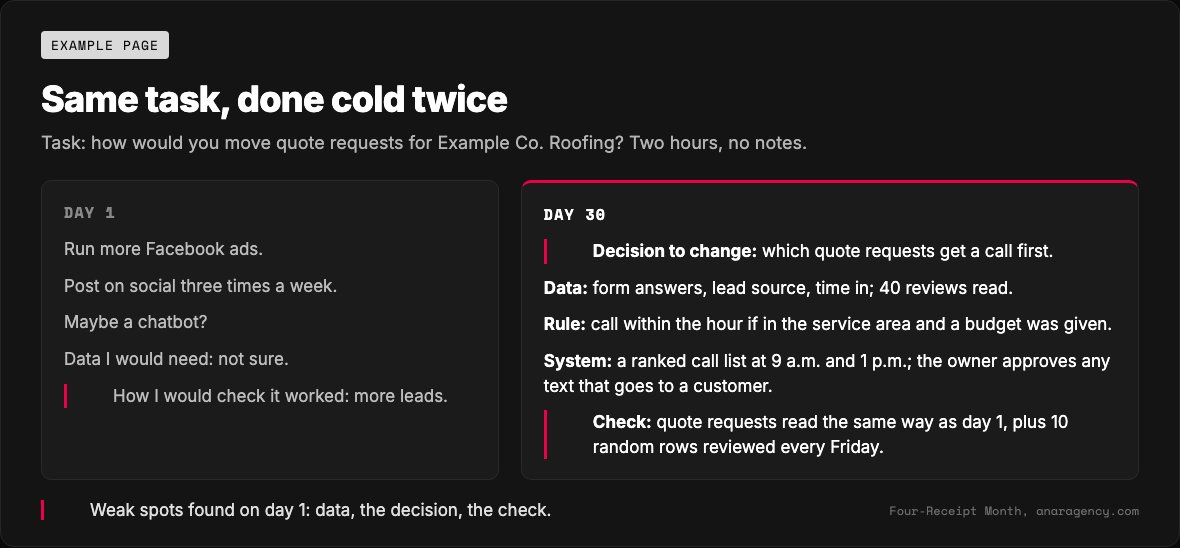
- Day one has no way to tell if it worked.
- Day thirty names one decision, not a list of channels.
- The same number, read the same way, plus a human spot check.
- The gap between the two columns is the real result of the month.
Example page built for this article with a made-up brand
Run the Four-Receipt Month with your preferred AI
The prompt below turns this plan into your own 30 days. Paste it into your preferred AI and answer its questions.
It sets the number and the baseline, schedules the receipts and the retest, and quizzes you each morning before it teaches anything new.
This week: get the owner's yes, write down the number and the date, and do the two-hour cold attempt. Then stop.
When the month is done, the first 90 days shows how one system grows into proof, and how to measure a marketing engineer shows how to grade it.
Remember the month of watching? Thirty days from now, you will have one system built, one number read twice and one task you can do cold.
Anyone can watch a riding lesson. The job goes to whoever got on the horse.
Paste into your preferred AI. It asks five questions, then builds your 30-day plan with daily quizzes, weekly receipts and a day-thirty retest.
Act as my 30-day coach for becoming a marketing engineer. Use only the rules below and my answers. Never invent a number; if you need one, ask me.

Ask one question at a time, show the example, and wait:
1. Which company will I work on, and do I have the owner's written yes? (Example: my employer, a roofing firm, yes by email)
2. What may I read, and what is off limits? (Example: reviews, ads, call notes; no customer exports)
3. Which one number does the business already track, its value today, and the date? (Example: quote requests, 22 last month, read on the 3rd)
4. How many hours a day can I give this? (Example: one hour)
5. Paste my cold day-one attempt: how I would move that number. (Example: half a page)

Rules:
- Four weeks, one receipt each. Week 1: a one-page market map with a source for every answer. Week 2: one recurring decision written as inputs, rule, output, check and owner. Week 3: one system running that decision. Week 4: a one-page case study.
- Every morning, before anything new, ask me three questions on earlier material. I answer from memory, then you correct me.
- Mix market, data and build work across each week. Never a whole week on one tool.
- Automate the dull setup work first. A person approves anything a customer sees or that spends money.
- Each output I reject becomes one written check.
- Small results are reported as counts, not percentages.
- On day 30 I redo the day-one task cold. Compare both attempts.

Show your math, then use this format:
NUMBER AND BASELINE:
WEEKLY RECEIPTS WITH DUE DATES:
DAILY ROUTINE:
WEAK SPOTS IN MY COLD ATTEMPT:
WHAT NEEDS A HUMAN APPROVAL:
DAY-30 RETEST DATE:
NEXT THREE ACTIONS:

Filip Kovacevic is the founder of Anar Agency in Phoenix. He spent five years running SEO, Meta ads, email, and content for medical practices across the United States, and now does the same work for healthcare, home-service, legal, and professional-service businesses, alongside AI implementation. More from Filip →
Want to run this month on a real company, with someone checking your work?
Our training runs the four weeks on live systems, with a reviewer on every receipt, and ends with a case study you can show anyone.
See the training →Hiring instead? See how we build the first system for you.