Market Maturity Stages: Read Your Market Before You Fix the Copy

Market maturity is the stage your market has reached, and it decides more than your copy does. Markets move through five stages: romance, infatuation, realism, accountability and stability. Count the sellers making the same promise and the steps in the sale that works.
That tells you the stage, the format to sell and what to stop doing.
Market maturity: why a good offer stops selling
Picture a webinar that filled every seat two years ago. Same ad today. Same slides, same offer, same price.
Now half the people who sign up never show. The ones who do show leave before the offer. So the team rewrites the headline, then the slides, then the button.
Nothing moves. The copy was never the problem. The market moved.
That shift is called market maturity. It means the stage a market has reached, from brand new to worn out, and it sets what buyers believe, doubt and pay for.
This guide shows you how to place your market in one of five stages in about 30 minutes. You count two things. Then you know what to sell, how to sell it and what to stop doing.
Our take: most offers do not die from bad copy. They die from good copy sent into a market that moved on.
The same webinar meets a different market two years later
| Two years ago: infatuation | Today: accountability |
|---|---|
| Two to five sellers with the same story | About ten sellers, one or two with real results |
| Two steps: sign up, then watch | Five steps before anyone buys |
| Buyers ignore the sales process | Buyers spot the sales process and say no |
| Selling feels almost too easy | Every sale takes work |
Our market maturity model. An example, not a measured case.
Decide where and when before you touch the copy
Four decisions shape every offer. We rank them from most important to least. We call that order the Maturity Ladder.
1. Where: the place you sell, such as Facebook, Google or YouTube. Each place has two layers: the posts people choose to follow, and the paid ads they doubt from the first second.
2. When: the stage your market is in right now. What worked three years ago can be dead today.
3. What: the format you sell: a book, a course, a webinar or coaching. The format is what creates the change the buyer pays for.
4. How: the way you sell it: a sales video, a webinar, a low-price first offer or a call.
Most teams spend their week on number four. They rewrite pages and scripts. Meanwhile numbers one and two decide the result.
Why does where matter most? A buyer on Google is searching for a fix. A buyer in a feed was looking at a friend's vacation a second ago.
Next is when. When an expert shares a success story, we ask when it happened.
A playbook that worked years ago worked in a different market. Check that the market still looks the same before you copy it.
For example, a room of 68 marketers was asked who would book a call after seeing a book-a-call page. Almost nobody said yes. They knew a sales pitch waits at the end of the call.
That is what a late market looks like. No headline fixes it.
Where you sell decides more than how you sell
Four decisions, from least weight at the bottom to most at the top
- 4. How The way you sell: sales video, webinar, low-price offer, call.
- 3. What The format: book, course, webinar, coaching.
- 2. When The stage your market is in right now.
- 1. Where The place you sell: Facebook, Google, YouTube, and which layer.
Our market maturity model.
People trust the posts they chose and doubt the ads they did not
| Organic layer | Paid layer |
|---|---|
| Posts, videos and groups people choose to follow | Ads placed in front of people |
| Starts the conversation | Joins a conversation already running |
| Trusted first | Doubted first |
| Builds loyalty over time | Has to earn attention every time |
Our market maturity model.
The Maturity Ladder ranks four decisions by weight: where you sell, when (the stage your market is in), what format you sell, and how you sell it. Markets move through five stages: romance, infatuation, realism, accountability and stability. Place yours by counting the sellers making the same promise (1 to 2, 2 to 5, 5 to 10, about 10 with 1 or 2 delivering) and the steps in the sale that works (1, 2, 3, 5).
Then sell the format the stage wants, from do it yourself to done for you, lead with its currency (the dream, the idea, the truth, trust, the brand), and use the stage to decide what to stop doing.
Every market moves through five stages
Markets move like a relationship. First the crush, then the honeymoon. Then the doubts, the hard work and finally the settled couple.
We use five stages, each with a season: romance (spring), infatuation (summer), realism (fall), accountability (winter) and stability. Each cycle starts with something new that works.
Romance: one or two sellers have a new way to get a result. Buyers are hopeful, so a one-step sale works: see the ad, then pay.
Hopeful buyers will believe almost anything. That is a reason to be careful, not a chance to overpromise. Romance usually lasts about one to two years.
Infatuation: two to five sellers tell the same story with small changes. Selling feels almost too easy, and a two-step sale works: sign up, then watch.
Realism: five to ten sellers now fight for the same buyers, and buyers start to find the bad news. The sale needs three steps: watch, book a call, talk to someone.
Accountability: about ten sellers tell the story, and only one or two get buyers real results. Buyers want numbers, and the sale takes five steps.
Stability: usually two names survive, like Ford and Chevy or Apple and Samsung. Buyers come to them, so they barely need to sell.
Does the market keep growing the whole time? No. It grows until realism, stays flat there, then shrinks in accountability.
The mood follows the same path. Hope turns into doubt. Doubt turns into distrust.
Why does a market age at all? Buyers learn the sales process. Once they have seen it ten times, they know how it ends, and it stops working.
Every sale also spends some of the buyer's trust. Our guide to trust cycles shows how that adds up.
Count advertisers, not ads: one public search shows your seller count
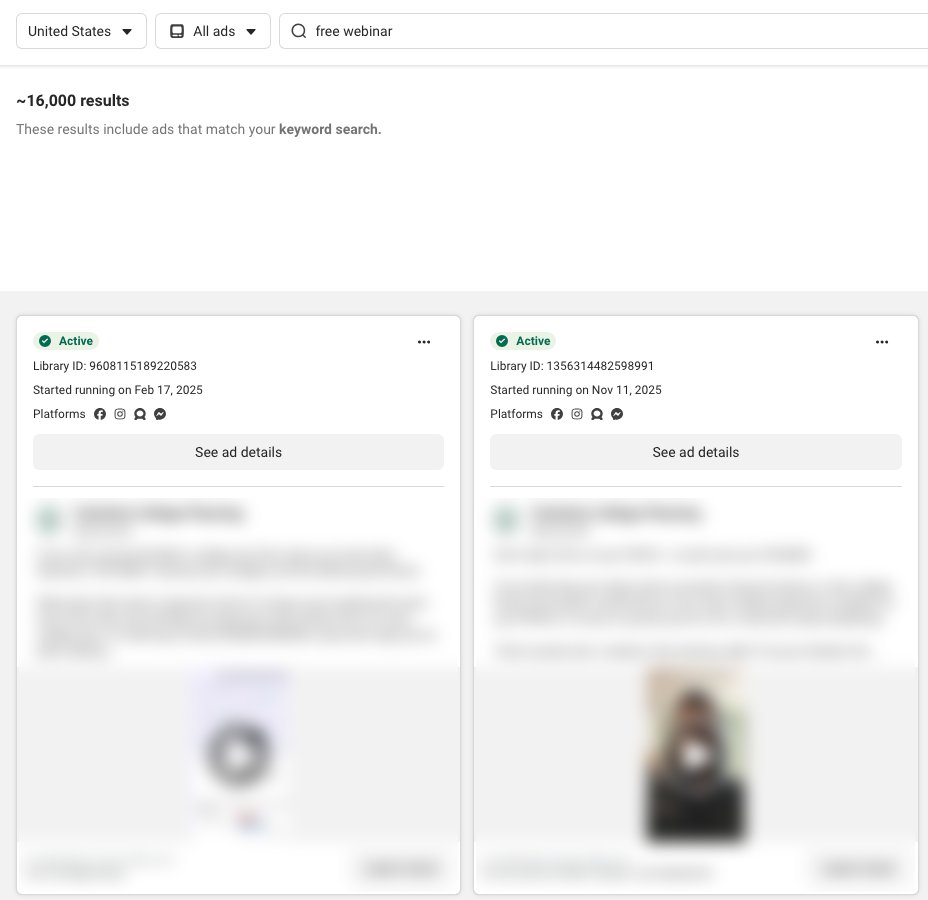
- Pick All ads, not the political category.
- Type your market's main promise in five words or fewer.
- This counts ads, not sellers. One seller can run fifty ads.
- Count each advertiser name once. That number is your seller count.
- The oldest ads are the ones that work. Follow those to count the steps.
Screenshot of Meta Ad Library, search for free webinar in the United States, taken 2026-10-17; advertiser names and ad content blurred
Five stages, and the two numbers to count at each one
| Stage | Season | Sellers with the same story | Steps in a working sale | Buyers feel |
|---|---|---|---|---|
| Romance | Spring | 1 to 2 | 1 | Hope |
| Infatuation | Summer | 2 to 5 | 2 | Peak hope |
| Realism | Fall | 5 to 10 | 3 | Doubt |
| Accountability | Winter | About 10, only 1 to 2 deliver | 5 | Distrust |
| Stability | After winter | About 2 survivors | Buyers come to them | Trust in a name |
Our market maturity model.
Every stage ends, and something new starts the next cycle
- Romance Few sellers, hopeful buyers.
- Infatuation Copies arrive. Selling feels easy.
- Realism Bad news spreads. Doubt sets in.
- Accountability Buyers demand results.
- Stability Two names survive.
Our market maturity model.
How do you know which stage your market is in? Count two things
Count the sellers. Then count the steps. Both counts are free.
Count 1: sellers telling the same story. Write your market's main promise in five words or fewer. Search it in the Meta Ad Library and the Google Ads Transparency Center, then count the different advertisers making it.
One or two sellers means romance. Two to five means infatuation. Five to ten means realism.
Ten or more, with only one or two showing real customer results, means accountability. Two big names and a few small ones means stability.
Count 2: steps in the sale that works. Open the ads that have run the longest. Follow each one to the buy button, and count every step a buyer must take.
One step is romance. Two is infatuation, three is realism. Five is accountability.
If the two counts point to different stages, use four tie-breakers.
How easy is it to sell? If selling feels too easy, you are likely in infatuation. If buyers roll their eyes at every new expert, you are in realism.
What do the ads sell? Template bundles everywhere point to realism. Ads that promise to do the whole job for you point to accountability.
Where do buyers complain? Complaints in private groups point to realism. Public posts saying the whole method does not work point to accountability.
Do results match the promises? Ask a few buyers whether they got what they were sold. A wide gap means a late stage.
Our rule when the signs split: pick the later stage. If you answer a doubt buyers do not have, you lose little. If you ignore a doubt they do have, you lose the sale.
The working sale grows from one step to five as a market ages
Steps a buyer takes in the sales process that works, by stage
- Romance 1
- Infatuation 2
- Realism 3
- Accountability 5
Our market maturity model. The step counts are the model's thresholds.
Six steps and about 30 minutes to place your market
- 1. Write the promise Your market's main promise in five words or fewer.
- 2. Count the sellers Different advertisers making it, in both ad libraries.
- 3. Follow the oldest ads Pick the three that have run longest.
- 4. Count the steps Every step from the ad to the buy button.
- 5. Break ties Ease of selling, what ads sell, where buyers complain, results vs promises.
- 6. Name the stage When the signs split, pick the later stage.
Our market maturity model.
Sell the format your stage wants
Your product format should change with the stage. As trust drops, buyers want more of the work done for them.
Romance and infatuation: do it yourself. Buyers think the payoff is huge, so they happily do the work. Courses and how-to programs sell.
Realism: done with you. Buyers stop wanting to learn. They want templates, kits and someone checking their work.
For example, an AI writing tool built on ready-made templates raised $125 million at a $1.5 billion valuation. Templates give tired buyers the result without the lesson.
Accountability: done for you. Buyers have been burned and want the job finished. Ads that promise to build the whole thing take over the feed.
Public warnings show up in this stage too. The FTC publishes a guide to spotting coaching scams, and buyers read it.
Stability: the name. Buyers pay for a brand they trust. They also pay for the time, experience and skill behind it.
What about price? In romance, few sellers offer a high-priced option, so there is room for yours. In accountability, profit per sale shrinks and many sellers leave for easier markets.
A rough pattern, not measured data: buyers try about three high-priced programs, or about nine low-priced purchases, before they quit a market. What matters more is how long they go without a result.
What the ads sell tells you the stage: courses early, templates and done-for-you late
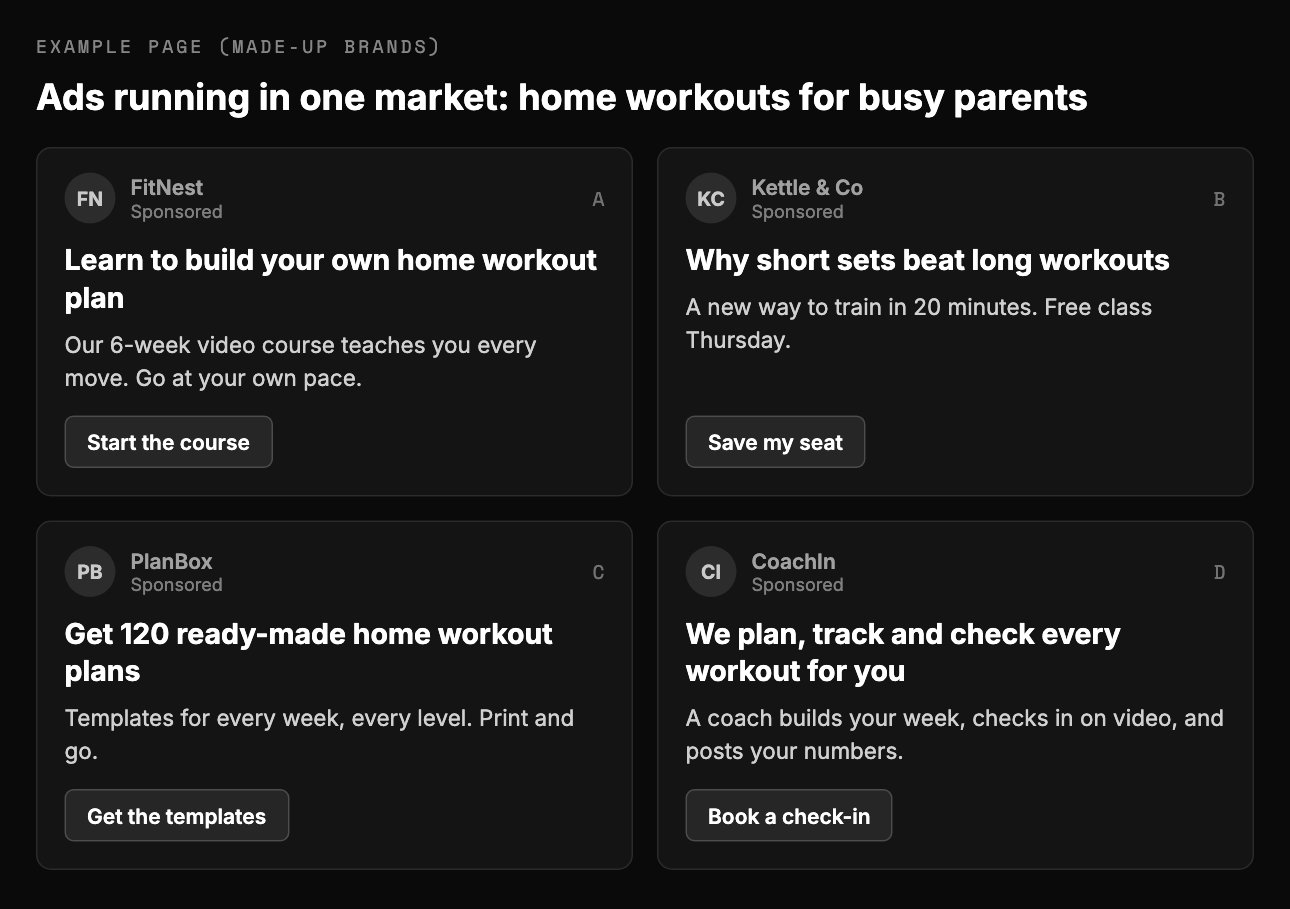
- Do it yourself: romance or infatuation.
- A new idea that leads to the same dream: infatuation.
- Templates everywhere: realism.
- Done for you: accountability.
- When most ads look like C and D, your market is late. Sell that way.
Example page built for this article with made-up brands
As trust drops, buyers want more of the work done for them
| Stage | Format that sells | Why |
|---|---|---|
| Romance | Do it yourself: courses, how-to | The payoff looks huge |
| Infatuation | Do it yourself, faster and easier | Buyers want speed |
| Realism | Done with you: templates, kits | Buyers stop wanting to learn |
| Accountability | Done for you | Buyers want the job finished |
| Stability | The name: brand, time, experience | Buyers trust the survivor |
Our market maturity model.
A template-based writing tool raised $125 million
- Raised in one round 125
- Valuation 1.5
Source: TechCrunch, AI content platform Jasper raises $125M at a $1.5B valuation (October 2022).
Lead with what buyers trade on at each stage
Each stage has a currency: the thing buyers pay attention to before they pay money. Lead with the wrong one and the ad sounds off, even when every word is true.
Romance: the dream. Show the life the result makes possible. Buyers have not heard it before.
Infatuation: the idea. Buyers have heard the dream from five sellers. Now they ask how your idea is different, so change the idea, not just the words.
Realism: the truth. Buyers trust their own experience more than your claims. Name the bad news they are finding, and say how you handle it.
Diet buyers are a clear example. After the low-carb boom, many learned that the keto diet can raise cholesterol. A realism ad leads with that worry instead of hiding it.
Accountability: trust. Show customer results with numbers. Our guide on stacking proof so buyers have nothing left to object to shows how.
Stability: the brand. The name does the selling. Your job is to keep earning it.
For doubtful buyers, read selling to buyers who have seen it all. To argue with a story your market believes, read argue against the story your market believes.
Each stage pays attention to something different
Example lead lines we wrote for a home workout program
| Stage | Currency | Example lead line |
|---|---|---|
| Romance | The dream | Get fit at home in 20 minutes a day. |
| Infatuation | The idea | Why short sets beat long workouts for busy parents. |
| Realism | The truth | Most home programs fail by week three. Here is how ours plans for it. |
| Accountability | Trust | Every member's week-12 numbers, posted where you can check them. |
| Stability | The brand | The program trainers recommend to their own families. |
Example lines are ours, not tested ads. Currencies from our market maturity model.
Use the stage to decide what to stop doing
The stages are most useful as a list of things not to do. A perfect offer for one stage flops in another.
How to burn a year in a tired market in four easy steps:
1. Copy the funnel that made someone rich three years ago.
2. When it stops working, rewrite the headline. Then blame the copywriter.
3. Push the webinar harder. Buyers who already distrust it now see it twice as often.
4. Post a photo of your private jet as proof. Late-stage buyers only want to know if it works for them.
Here is the stop list by stage.
Romance: stop underpricing. Few sellers offer a high-priced option yet, and a one-step sale is enough.
Infatuation: stop repeating the leader's idea. Change the idea, or you are one more voice saying the same thing.
Realism: stop teaching buyers to do it themselves, and stop making every ad about you. Sell templates and kits, and answer every comment.
Accountability: stop pushing harder on sales videos and webinars. Meet buyers on video calls, show your work, and stay in the business yourself.
Stability: stop chasing every buyer with ads. Protect the reputation that brings them to you.
Sometimes the right move is to leave. Years of pushing in a late stage wear out you and your buyers.

Knowing the stage tells you what to stop doing
| Stage | Stop | Start |
|---|---|---|
| Romance | Underpricing | A high-priced option and a one-step sale |
| Infatuation | Repeating the leader's idea | A new idea that leads to the same dream |
| Realism | Teaching buyers to do it alone | Templates, kits, answering every comment |
| Accountability | Pushing sales videos harder | Video calls, shown work, customer results |
| Stability | Chasing every buyer with ads | Protecting the reputation |
Our market maturity model.
A new product can restart the cycle
Markets do not only age. A new product, or a new way to deliver an old one, can start romance again.
Vitamins were an old, crowded market. Then AG1, formerly Athletic Greens sold a daily greens powder and pushed it through podcast hosts. Buyers got excited all over again.
Technology speeds the cycle up. Dating apps like Tinder pushed the dating market toward realism faster, because anyone with a phone could compare options.
Tools that let anyone copy a process speed it up too. Markets built on free content age faster than markets built on paid ads, because paying for ads slows copycats down.
Some markets barely move. A basic product like milk can take decades to cycle, while a market built on ad platforms can turn in a year or two.
Romance can also end hard. The Bored Ape NFTs hit a floor price near $354,000 in May 2022. Two years later it was around $40,000, a loss of about 90 percent.
Few sellers ever reach stability. The US has seen at least 1,900 car companies since 1895. Three of them became known as the Big Three.
Bored Ape NFTs lost about 90 percent of their floor price in two years
Floor price in US dollars at the time
- Peak, May 2022 354000
- May 2024 40000
Source: Wikipedia, Bored Ape, valuation history.
At least 1,900 US car companies, and three became the Big Three
- US car companies formed since 1895 1900
- Became known as the Big Three 3
Source: Wikipedia, Automotive industry in the United States; Big Three (automobile manufacturers).
Place your market with AI: the copy-paste prompt
Paste the prompt below into your preferred AI. It asks about your market, your two counts and your ads, one question at a time.
Then it names the stage, the format to sell, the lead and the stop list. It never invents a seller count, and it tells you where to count if you have not.
Check its answer against your own counts. You did the counting, so you have the final say.
Want a second opinion on the result? You can send it to us.
Paste into your preferred AI. It asks for your two counts, then names the stage, the format to sell, the lead and the stop list.
Act as a market analyst. Place my market in one of five maturity stages. Then tell me what format to sell, what to lead with and what to stop doing.

Ask me one at a time, with the example:
1. What do you sell, to whom, and where? (Example: a home workout program for busy parents, sold with Facebook ads)
2. What is the main promise in your market, in five words or fewer? (Example: "fit at home in 20 minutes")
3. How many different advertisers make that promise right now? (Example: 7)
4. Follow the three longest-running ads to the buy button. How many steps does a buyer take? (Example: 3: watch a video, book a call, talk to someone)
5. What do most ads in your market sell: a course, templates or kits, or done for you? (Example: templates)
6. Where do buyers complain: nowhere yet, in private groups, or in public? (Example: private groups)

Never invent a count. If I do not know one, tell me how to get it: search the main promise in the Meta Ad Library and the Google Ads Transparency Center, and count different advertisers, not ads. If you can browse, first check that both tools still work that way and tell me if anything changed.

Stages and their signs:
- Romance: 1 to 2 sellers, a 1-step sale, hopeful buyers. Sell do it yourself. Lead with the dream.
- Infatuation: 2 to 5 sellers, a 2-step sale, selling feels too easy. Sell do it yourself, faster and easier. Lead with how the idea is different.
- Realism: 5 to 10 sellers, a 3-step sale, template offers everywhere, complaints in private. Sell done with you: templates and kits. Lead with the truth, including the bad news buyers are finding.
- Accountability: about 10 sellers with only 1 or 2 getting results, a 5-step sale, done-for-you ads everywhere, complaints in public. Sell done for you. Lead with trust: customer results with numbers.
- Stability: about 2 survivors, buyers come to them. Sell the brand, time and experience. Protect the reputation.

If my answers point to different stages, pick the later stage and say why. Never suggest fake scarcity, fake reviews or claims I cannot prove.

Show your reasoning, then answer:
Stage: [name], and the two signs that decided it
Format to sell:
Lead with:
Stop doing: three things
Keep doing: one thing
Next three actions: 1. 2. 3.
Run it this week
1. Write your market's main promise in five words. Count the advertisers making it.
2. Follow the three longest-running ads to the buy button. Count the steps.
3. Run the prompt with both counts. Cut one thing on the stop list for your stage.
Think back to the webinar with the empty seats. The team did not need a new headline. They needed a format and a sales process built for the stage their market had reached.
Once you know your stage, the next question is budget. Read how much to spend on ads for a new offer.
Good copy is a seed. It still needs the right season.

Filip Kovacevic is the founder of Anar Agency in Phoenix. He spent five years running SEO, Meta ads, email, and content for medical practices across the United States, and now does the same work for healthcare, home-service, legal, and professional-service businesses, alongside AI implementation. More from Filip →
Talk it through in 15 minutes
Bring one question from this article. We will tell you what we would do, whether or not you hire us.
Book a 15-Min Chat →