How Much to Spend on Facebook Ads for a New Offer
Set a new offer's daily ad budget to everything one buyer can buy from you. The main offer, plus every extra. Then pick a total you could lose without pain, and spread it over at least four days.
Write down when you will stop. Do it before you spend a dollar.
How much should you spend on Facebook ads for a new offer?
New offer. Fresh ad account. One question: how much should I spend on Facebook ads?
Then the other questions pile in. Which audience, video or image? Three groups or six?
All real questions. None of them is the first one. The first one is uglier: will anybody buy this at all?
Picking audiences before you know that is like arguing about fishing rods at a lake that might be empty.
The usual advice online is $10 to $50 a day for most small businesses. Is $10 a day enough for a new offer? It will run your ads.
It rarely buys enough sales to read, as the chart below shows. At $50 a day and an $80 sale, that advice buys you fewer than one sale a day. It sets the budget from what you can spare; we set it from what one customer can spend.
Our take, and nobody prints it: a lot of budget advice comes from people who get paid when you spend more. Generic numbers never ask what one customer is worth.
The other classic is set-and-pray. Launch one ad, guess a budget, check back Friday.
That is not a launch. That is a lottery ticket.
There is a better way. It starts with what one customer can buy from you.
Example: $10 or $50 a day buys less than one sale a day to read
Expected sales per day at an $80 cost per sale = daily budget / $80
- $10 a day 0.13
- $50 a day 0.63
- $188 a day (example funnel) 2.35
Example math. $80 is the example cost per sale used in this article; $188 is the example funnel in the next section
What is a good daily budget for Facebook ads on a new offer?
A good daily budget for a new offer is the total one customer can buy from you in one visit. The main offer, plus any add-on offered at checkout, plus every upsell. An upsell is a second offer shown right after someone buys.
The Funnel-Value Budget is a daily ad budget equal to everything one buyer can buy in your funnel. Your funnel is the chain of offers one buyer moves through.
Most people pick a test budget like a tip: whatever feels fine. A budget picked by feel is a mood, not a plan.
Why that number? If one person buys everything, you hit your break-even point for the day. Every buyer after that is profit.
Does every buyer take every upsell? No. So a day with one small sale still loses money.
For example, one new offer launched at about $185 a day and later posted a break-even day. That is one example, not a promise.
Now the catch. The rule breaks when your funnel is small.
For example, a $27 product with no upsells gives a $27 day. At $80 a sale, that is about one sale every three days. Too few to read.
If your funnel value is less than one sale's cost, flip it. Set the daily budget from your test limit instead: divide it by four or five days.
Selling by phone or lead form? Start from the most you can pay for one customer, as our guides to setting a max allowable CPA and offer economics before launch show.
Example: a $188 funnel means a $188 day
Add up everything one buyer can buy. The total is your starting daily budget.
| Funnel step | Example price |
|---|---|
| Main offer | $27 |
| Add-on offered at checkout | $17 |
| Upsell 1 | $47 |
| Upsell 2 | $97 |
| Funnel value = starting daily budget | $188 |
Example prices
Add up everything one buyer can buy: the main offer, any add-on at checkout, every upsell. That total is your starting daily budget. One full-funnel buyer breaks the day even.
Funnel worth less than one sale? Divide your test limit by four or five days instead. Your test length comes from how much you can lose and get only data back.
Divide the daily budget by a padded cost per sale to get sales per day. Expect fewer than 6 sales a day: run one ad group. Split only when every ad group would still get at least 3 sales a day.
Fill each ad group with one body of copy and many openings paired with many creatives. Write your stop lines before launch. Once the offer sells, raise the daily budget to two times funnel value, then three times.
Is $500 enough for Facebook ads? Yes, spread over about five days
A $500 test is enough for a first read if you spread it over about five days. Not one day. Five.
Two numbers, two jobs. Your daily budget sets how fast you spend. Your test limit sets how long.
The test limit is the most you can spend and still be fine if all you get back is data. So ask it straight: if this $500 sells nothing, am I fine?
Ads are worth paying for only when one customer is worth more than the ads cost to get one. The test limit is the price of finding out.
Divide the limit by the daily budget to get days. Aim for at least four.
With the $188 example funnel, $500 lasts under three days. Too short. So drop to $100 a day for five days.
Why not burn it in one day? Spend a lot at once and the platform must reach past the easiest buyers. Each sale costs more.
Spending faster does not get you answers faster.
Spread a $500 test over about five days
Three ways to spend the same $500 when one sale costs $50 to $100
| Plan | What happens |
|---|---|
| $500 in one day | The platform must reach past the easy buyers, so each sale costs more |
| $100 a day for five days | One to two sales a day in one ad group, without overpaying for reach |
| $50 a day for ten days | Under one sale a day, too little for the platform to learn from |
Method example
Divide the budget by the cost of one sale to count your ad groups
To count your ad groups, divide your daily budget by what one sale will likely cost, your cost per sale. The answer is sales per day. An ad group is a set of ads that share one budget and one audience.
No history yet? Then estimate. Start from what similar offers cost per sale, in your own past ads or from someone who runs ads in your market.
Then add 25 to 50 percent. Everybody is optimistic about this number. That is the whole problem.
If similar offers averaged $80 a sale, your padded cost per sale is $100 to $120.
Expect fewer than 6 sales a day: run one ad group. Split only when every ad group would still get at least 3 sales a day.
Ten ad groups at $10 a day each, with $80 sales, get about one sale a day between all ten. That is not a test. That is a donation.
Audience? Start broad, with no interests, and let the platform find the buyers. Broad wins most new-offer tests.
Use interests only when your buyer is easy to name, like plumbers, and that audience still runs into the millions. Our guide on how Meta finds buyers explains why broad works so often.
Expect fewer than 6 sales a day: run one ad group
Ad groups = sales per day / 3, rounded down, so every ad group still gets at least 3 sales a day
| Daily budget | Expected cost per sale | Sales a day | Ad groups |
|---|---|---|---|
| $50 | $80 | about 0.6 | 1 |
| $100 | $80 | 1.25 | 1 |
| $188 | $80 | 2.35 | 1 |
| $500 | $50 | 10 | 3 |
Method example
Does the Facebook ads learning phase need 50 sales a week?
No. Ad platforms run a learning period while they work out who to show your ads to. Most new offers never reach the result count that ends it (see the settings box below), so expect a 'learning limited' warning.
If one ad group can reach that count, follow the platform's advice. If not, ignore the warning. Judge the group on cost per sale against break-even.
A warning label is not a verdict. Notice which fix the platform likes to suggest: spend more. Our take: that is rarely the fix for a new offer.
How many ads per ad set? About 15, from one piece of writing
Put about 15 ads in each ad group: 3 openings times 5 creatives, all with the same body. Write once. Multiply.
The opening is the first lines people see before the text is cut off. The creative is the image or video.
The opening does the heavy lifting. If the opening loses them, nobody reads the body. Pair each opening with every creative, as the grid below shows.
Platforms warn that many ads in one group means less learning per ad. Fair. But in an offer test you only need to learn about the offer, and more openings give it more fair chances.
Make every opening say who the ad is for. For example, one account ran an AI dancing video that drew heavy engagement and a bad cost per purchase.
Lots of likes. Wrong people. Likes do not pay the bills.
The platform's own ad auction rules also count engagement bait against an ad's quality.
Our piece on before-words and after-words covers which words to lead with. Add new ads in a new ad group, because the platform treats adding ads to a live group as a significant edit that restarts learning. Once the offer sells, test ads with fewer per test, as in our creative testing engine.
Example: 3 openings times 5 creatives is 15 ads from one body
The body stays the same. Only the opening and the creative change.
| Creative 1 | Creative 2 | Creative 3 | Creative 4 | Creative 5 | |
|---|---|---|---|---|---|
| Opening A | Ad 1 | Ad 2 | Ad 3 | Ad 4 | Ad 5 |
| Opening B | Ad 6 | Ad 7 | Ad 8 | Ad 9 | Ad 10 |
| Opening C | Ad 11 | Ad 12 | Ad 13 | Ad 14 | Ad 15 |
Method example
The opening is the text above 'See more.' Write three of them for one body

- This is the opening: the 2 to 3 lines of text people see before See more. Write 3 of these.
- Everything after this cut is the body. Write it once and keep it the same.
- This is the creative: the image or video. Pair each one with every opening.
- The first words name who the ad is for. No tease, no trick.
Example page built for this article with a made-up brand, screenshot taken 2026-10-16
Leave the cost goal blank and check your spending limit
Two settings can stop a new test from spending at all. Both are boring. Both can sink a launch.
First, leave the cost goal setting empty. A cost goal may spend less than your full budget to protect the target.
Second, check the account's daily spending limit, which the platform sets on many accounts and raises as you build history. On a brand-new account it can be tiny: $30 a day against a $300 plan.
If so, test at the limit. Spend up to it daily until it rises.
Our take: platform defaults are built to spend your budget, not to judge your offer. That part is your job.
The box below lists the current Meta settings this method touches. Every other setting is in hidden Meta ads settings.
A cost goal may spend less than your budget, so leave the box blank at launch
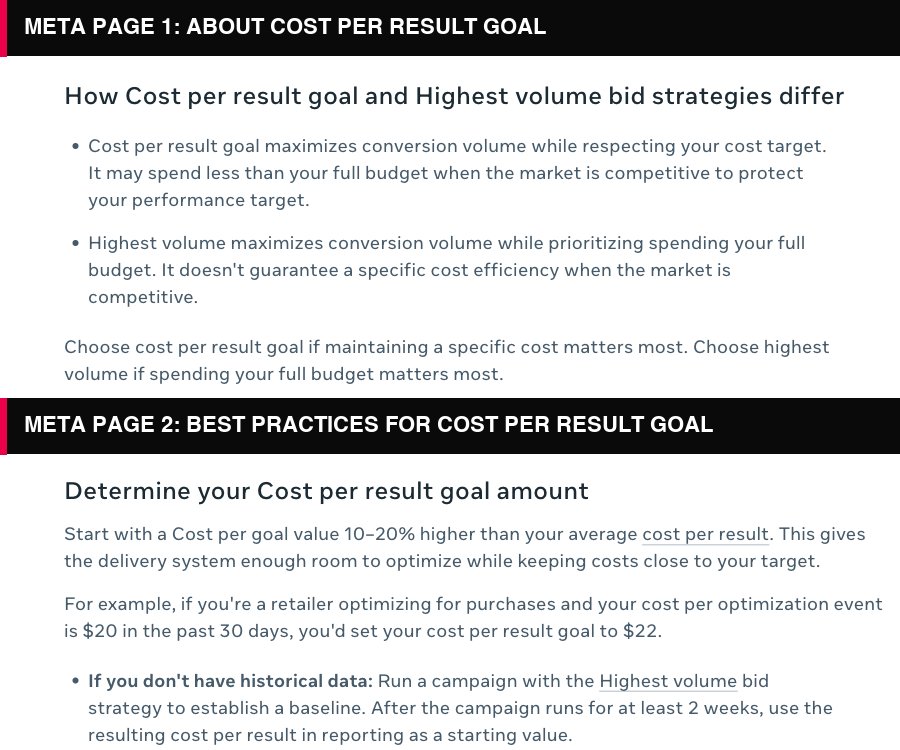
- A cost goal can hold back spend, which is why a campaign with a goal typed in may barely spend.
- Without a goal, Meta tries to spend your full budget.
- In a first test, getting the data matters most.
Screenshot of Meta Business Help Center, About cost per result goal, taken 2026-10-16
Write your stop lines before the first dollar goes out
A stop line is a number that, once crossed, means you turn the test off. Write yours before launch. While you are calm.
Start with the click line. The most you can pay per click is your padded cost per sale times your conversion rate, the share of visitors who buy. At $40 and a page where 5% buy, that is $2 a click.
If cost per click stays above this line after the first day's spend, rework the ad before judging sales.
Then the sale line. At $50 a day and a $100 sale, let it spend at least four days, $200, before you judge sales.
Stop at 10 times your padded cost per sale with no sale, or at your test limit, whichever comes first.
Watch the click and add-to-cart lines first. The click and add-to-cart lines can end a test in its first days; the four-day minimum only holds while those early numbers look normal.
How to burn your first $500 in four easy steps. Step one: launch one ad and call it a test. Step two: pick the budget by feel.
Step three: judge it on day one, by the likes. Step four: blame the price. Congratulations, you now own a damn expensive opinion.
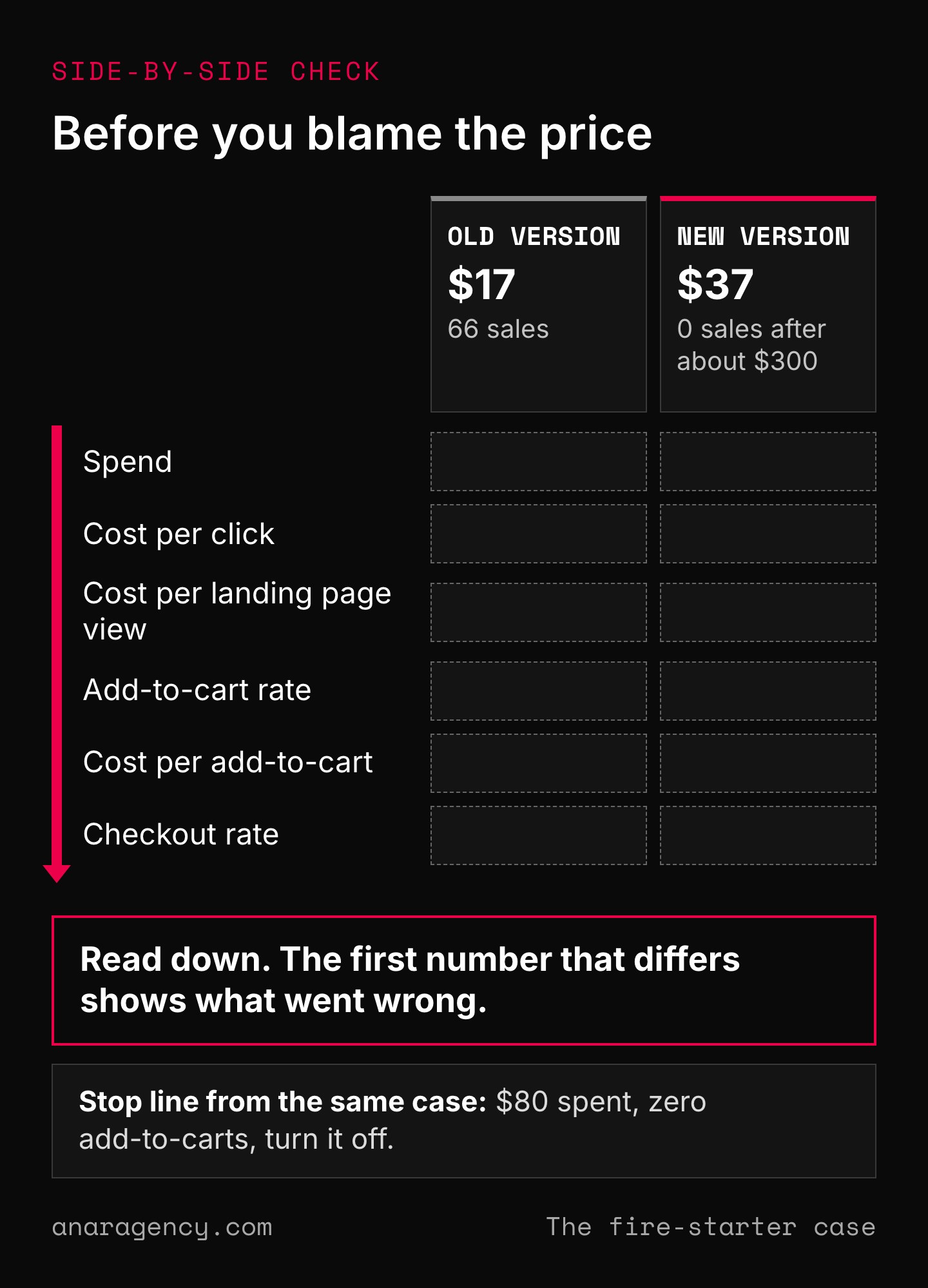
Here is what happens without stop lines. A small team sold a fire-starting kit for $17 and got 66 sales.
Then they rebuilt the pages and raised the price to $37. They spent about $300 over a week. Zero sales.
Their verdict came fast: the price. Maybe. But they could not tell, because nothing was set up to compare.
The fix is boring. Put the old and new versions side by side: spend, cost per click, cost per landing page view, add-to-carts. The first number that differs between the two versions shows what went wrong.
Their session recordings showed people scrolling fast and leaving. Curious clickers, not buyers. An early line would have ended it sooner: $80 spent with no add-to-cart is enough to turn it off.
More money just buys the same answer again. At a higher price.
To read every step from the feed to the last upsell, see reading ad data. If the page breaks the promise of the ad, start with ad-to-page alignment; if checkout falls short, start with checkout CRO.
Example: a $20 click only works if half your visitors buy
Most a click can cost at a $40 target cost per sale = $40 x page conversion rate
- Page converts 5% 2
- Page converts 10% 4
- Page converts 25% 10
- Page converts 50% 20
Method example: $20 click, $40 target, 50 percent needed
Early lines can stop a test on day one; the sale line waits
- One click for $50 Day 1 Early line. Stop: something is broken before the page.
- $50 a day, $100 sale Days 1 to 4 Let it reach at least $200 if clicks and add-to-carts look normal.
- 10 times the cost per sale, no sale Later Stop at $1,000 for a $100 sale, or at your test limit, whichever comes first.
Method example
Run it with AI
The prompt below runs this whole method for you. Paste it into your preferred AI and answer seven questions. It shows its math and returns a daily budget, test length, ad groups, ads and stop lines.
It never guesses a number. Missing one? It asks.
This week: first, run the prompt with your real prices and test limit. Second, build the ad group it gives you and leave the cost goal blank. Third, write the stop lines down before launch.
Want your numbers checked before launch? Send them to us; you are not signing up for anything.
Set-and-pray is a hell of a way to fund a hobby. This method is a real test.
Find out if the lake has fish first. You do not need more money. You need a better test.
Paste into your preferred AI. It asks for your prices and limits, then gives you a daily budget, test length, ad groups, ads and stop lines.
Act as a careful media buyer planning my Meta ad test for a new offer. Use only these rules and my answers. Never invent a number; if one is missing, ask me. If you can browse, first check Meta's current help pages for the learning period, cost goal and spending limit, and tell me if anything below has changed.

Ask one at a time, with the example, and wait:
1. Who the offer is for. (Example: home bakers who sell at markets)
2. Every price: main offer, checkout add-on, each upsell. (Example: $27, $17, $47, $97)
3. Similar offers' cost per sale (my past ads or a peer's). (Example: $80)
4. The most I can spend and be fine with only data back. (Example: $500)
5. Share of visitors I expect to buy. (Example: 5%)
6. Spend I allow with zero add-to-carts. (Example: $80)
7. My account's daily spending limit. (Example: $250 a day, or I don't know)

Rules:
- Daily budget = funnel value (all prices added).
- Padded cost per sale = answer 3 plus 25 to 50 percent. Use the higher.
- Days = test limit / daily budget, rounded down to whole days.
- If funnel value is under the padded cost, or days come out under 4, daily budget = test limit / 5 and days = 5.
- Sales per day = daily budget / padded cost. Fewer than 6: one ad group. Otherwise ad groups = sales per day / 3, rounded down.
- An ad group is an ad set (current Meta setting).
- Each ad group: 3 openings x 5 creatives (images or videos) = 15 ads. An opening is the lines before 'See more' (current Meta setting). Every opening names the buyer from answer 1. No teases, no fake scarcity.
- Leave the cost per result goal blank (current Meta setting).
- If answer 7 is under the daily budget, test at the limit (current Meta setting). If unknown, tell me to check it in Meta payment settings before launch.
- Click line: the most I can pay per click = padded cost per sale x the share of visitors who buy. If cost per click stays above it after the first day's spend, rework the ad before judging sales. Add-to-cart line = answer 6. Judge sales after 4 days and 2 x padded cost. Stop at 10 x padded cost with no sale, or at the test limit, whichever comes first.

Show your math, then use exactly this format:
DAILY BUDGET:
DAYS:
PADDED COST PER SALE:
SALES PER DAY:
AD GROUPS:
ADS PER AD GROUP:
SETTINGS:
STOP LINES:
ONCE IT SELLS: 2 x funnel value a day, then 3 x. Change ads only after 10 to 30 sales.
NEXT THREE ACTIONS:

Filip Kovacevic is the founder of Anar Agency in Phoenix. He spent five years running SEO, Meta ads, email, and content for medical practices across the United States, and now does the same work for healthcare, home-service, legal, and professional-service businesses, alongside AI implementation. More from Filip →
Talk it through in 15 minutes
Bring one question from this article. We will tell you what we would do, whether or not you hire us.
Book a 15-Min Chat →