Ad Copy Psychology: Should Your Ad Start With Why or How?
Start a feed ad with why or when, followed by a problem the reader already lives with. Those words point back at the problem. Start a search ad with how or what, the result and the steps, because that reader is already looking.
Readers who tried other fixes get one more opener: why will this time be different?
Should your ad start with why or how?
Picture two ads from the same roofer, with the same price, in the same town.
The first opens: "Why the stain on your ceiling comes back every spring." The second opens: "How to get a new roof in three days."
Most people pick the second. It is clear. It promises something.
It is also the wrong ad for most of the people who will see it.
The how ad only works on someone who already knows they need a roof. The why ad works on the person who has painted over a brown ring on the bedroom ceiling for three years. There are far more people like that.
This is ad copy psychology at its smallest: one word. The first word of an ad decides which reader stops.
So here is the short version. Open with why when the reader was not looking for you. Open with how when they were.
Same roofer, two first words, two different readers
| Opens with why | Opens with how |
|---|---|
| "Why the stain on your ceiling comes back every spring." | "How to get a new roof in three days." |
| Stops the person living with the stain | Stops the person already shopping for a roof |
| Most of the people in a feed | A small share of the people in a feed |
| Then needs the result and a short how | Then needs proof and a price |
Example ads written for this article
Why and when point back. How and what point forward.
Before-words point back at a problem the reader already has. After-words point forward at a result and the path to it. Why and when are before-words; how and what are after-words.
The word why sends the reader to the moment things went wrong. The word when does the same job. It points to when the problem started, or when it happens again.
The word what names the result they want. The word how names the path to get it. The two sit side by side.
Notice the mood each one creates. Looking back at a problem is a low mood. Looking forward at a fix is a high one.
Researchers see a similar split. In construal level theory, asking why puts people in big-picture thinking, and asking how puts them into concrete steps.
A related idea, regulatory focus theory, says a message lands better when its frame fits the state the person is already in, such as avoiding a loss or chasing a gain.
A different word reaches a different reader.
Why and when look back at the problem; how and what look ahead
| Word | Points at | Reader's mood | Who it pulls in |
|---|---|---|---|
| Why | The problem and its cause | Low, looking back | People living with the problem |
| When | The moment it happens | Low, looking back | People living with the problem |
| What | The result they want | High, looking ahead | People who want the result |
| How | The steps to get there | High, looking ahead | People who want instructions |
Method as taught in this article
Before-words (why, when) point back at a problem the reader already has. After-words (how, what) point forward at the result and the path. Ask what the reader was doing a second before the ad.
Not looking, as in a feed: open with why plus their real experience, then the result, then a short how. Already looking, as on search or in retargeting: open with what and how, and put one short why-this-works line at the end. Already tried other fixes: ask why this time will be different.
Name the situation, never the person.
A why opener works because it assumes the problem is real
A why question takes the problem as given. Ask a calm friend "why are you so upset?" and watch them start explaining anyway.
Linguists call that a presupposition: a belief the sentence takes for granted. The reader does not debate whether the problem exists. They start looking for the reason.
That is the power. It is also the trap.
People do not buy while they sit in a problem. They buy once they can see the way out. So a why opener is never the whole ad.
The why opens the ad. The what shows the result. A short how points to the page.
The evening news does the first half every night. It shows problem after problem, with no way out. An ad that stops at why is the news with a logo.
As a rule of thumb, spend about 60% of a cold ad on the why, 30% on the what and 10% on the how. The page carries the rest of the how. Our article on the three-layer ad builds that full structure.
Does the order matter that much? For example, one dating coach rebuilt his ads in this order: why, then the result, then a short how. His cost per sale fell by half and his conversion rate doubled, and those are his numbers, not ours.
A cold ad spends most of its words on the why
Rough share of a cold feed ad. The landing page carries the rest of the how.
- Why: the problem 60
- What: the result 30
- How: a short teaser 10
Method rule of thumb, not a measured result
Why opens the ad; what and how get the reader out
- Why Name the problem they already live with.
- What Show the result they want.
- How One or two lines that point to the page.
- The page Delivers the rest of the steps, starting where the ad stopped.
Method as taught in this article
Write the why from the reader's own experience
A why line works only when it names something the reader has actually lived. That means why, plus their real experience, not your features.
Generic: "Why roof problems cost homeowners money." Real: "Why the same stain shows up on your ceiling every spring."
The first is a fact. The second is about their own bedroom.
Where do you find the experience? Fifteen minutes of research.
Search for the biggest complaints people have about your category. Then search for the biggest downside of the usual fix. Read a few forum threads where buyers vent in their own words.
You can also ask your preferred AI what people struggle with when they try to solve this problem. Treat its answer as a lead, then check it against real posts.
Copy their exact words. Their words beat yours, every time.
The experience you pick also picks your audience. "Why old houses cost so much to keep up" reaches a lot of people. "Why the ceiling over your bay window stains every spring" reaches fewer people, but they match better.
Wide or narrow? Go wide when you need volume. Go narrow when the wide version brings the wrong people.
Our guide to moving an unaware market covers why the wide crowd is usually the cheaper one.
Find the why line in what buyers already complain about
- Search the complaints Type: biggest complaints about [your category].
- Search the downside Type: biggest downside of [the usual fix].
- Read the vents Forum threads where buyers describe it in their own words.
- Ask your preferred AI What do people struggle with here? Then check it against real posts.
- Write three why lines Why or when, plus their exact words.
Method as taught in this article
Turn a real complaint into a why line, not a feature
| Business | What buyers complain about | Why line |
|---|---|---|
| Roofer | The stain comes back every spring | Why the same stain shows up on your ceiling every spring |
| Bookkeeper | Tax season is a shoebox of receipts | Why tax season still starts with a shoebox of receipts |
| Dog trainer | The dog behaves at class, not at home | Why your dog listens at class and ignores you at home |
Example lines written for this article
In a feed, open with why. On search, open with how.
One question decides the first word: what was this person doing one second before they saw your ad?
In a feed, they were not looking. They were bored, curious, scrolling.
Meta's ad auction shows your ad to people its system predicts will act, not to people who asked. So the ad has to name the problem first. Lead with why.
On search, they were already looking. They typed the problem into a box, which is the whole idea of search engine marketing. Lead with what and how: the result, the time, the steps.
On search, move the why to the bottom. Give it one short line, about 10% of the ad: why this works, or why it is different.
In retargeting, they have seen the problem once. Do not make them sit through it again. Give them the result.
Can a why headline work on search? Sometimes. It tends to pull people who want to understand, not people ready to buy.
Test it before you trust it.
Display ads sit in between. On display networks people are reading something else, so they behave like feed readers. Longer, explanatory why copy fits there.
This is why your best Google headline often dies on Meta. It was written for someone who was already looking. Our piece on ad-to-page alignment shows how the page should continue whichever word you led with.
What was the reader doing a second ago? That picks the first word
| Where the ad runs | Were they looking? | Open with | Where the why goes |
|---|---|---|---|
| Social feed, cold | No, scrolling | Why plus their experience | At the top, about 60% |
| Display network | No, reading something else | Why, longer explanatory copy | At the top |
| Search | Yes, they typed it | What and how | One line at the bottom |
| Retargeting | They saw it once | What and how | One line at the bottom |
Method as taught in this article
Same roofer, two places: why first in the feed, how first on search
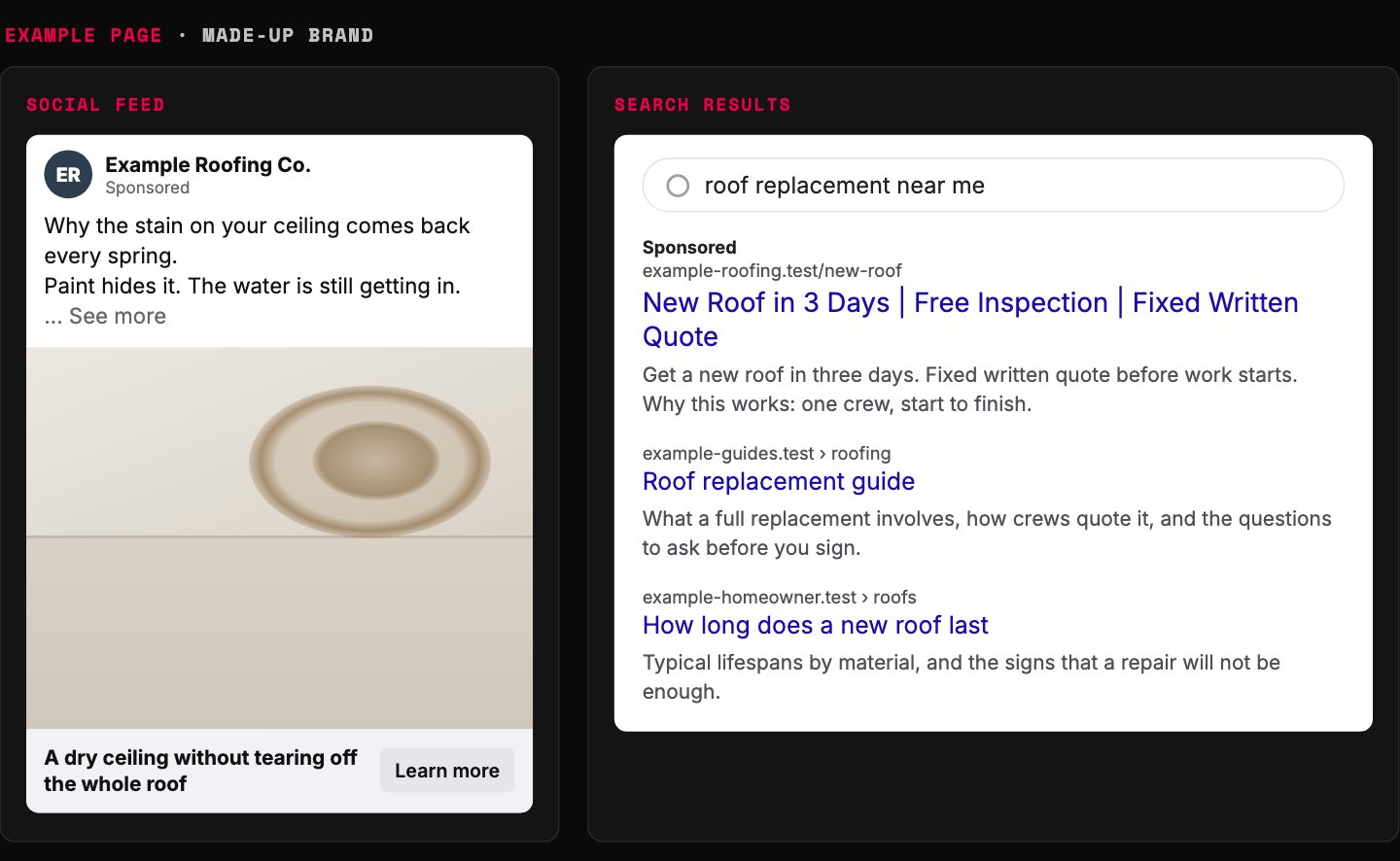
- Feed: nobody was looking, so the ad opens with why and the reader's own experience.
- Then the result, with the word without to rule out the fix they dread.
- Search: they typed the problem. They are already looking.
- So the search ad opens with what and how: the result and the time.
- The why moves to the bottom, as one short line.
Example page built for this article with a made-up brand. The 30-character headline limit is from Google Ads Help.
Already shopping? Pull them back with "why this time"
Opening with how on search is the default, not the law. A reader who already knows the fix can still be pulled back to the problem with the right why.
Use the fix they already tried. Ask why it will work this time, when it did not last time.
For the roofer: "Third patch on the same stain. Why would a fourth one hold?"
That reader is shopping. The question stops them anyway.
For example, one advertiser running ads before tutorial videos opened with a version of this. You have watched thousands of tutorials, so why would one more be the one that finally teaches you?
Then the result line rules out the fixes they hate. Add "without" or "even if": a dry ceiling without tearing off the whole roof, even if you have patched it twice.
So here is the decision rule. If they tried other fixes and got let down, open with why this time. If they are shopping for the first time and comparing options, open with how.
Buyers who have seen every pitch need this most. Our guide on selling to buyers who have seen it all goes deeper on that crowd.
Burned buyers get a why-this-time opener, even on search
- Why plus the failed fix Name the fix that let them down.
- Why this time Ask why this time would be different, then show how.
- Why plus their experience The default feed opener.
- What and how first Result, time, steps. One why line at the bottom.
Method as taught in this article
A shopper who got burned reads a different opener
| First-time shopper | Burned shopper |
|---|---|
| "How to get a dry ceiling in three days" | "Third patch on the same stain. Why would a fourth one hold?" |
| Compares prices and timelines | Doubts any fix will work |
| Wants the steps | Wants a reason to believe again |
| Result line: new roof in three days | Result line: dry ceiling, without tearing off the whole roof |
Example ads written for this article
How pulls in the people who want instructions
The word how has a side effect. It attracts people who want steps.
"How to fix a sagging gutter" pulls in people who want a list of instructions. "Why your gutters overflow in every storm" pulls in people living with the mess. Those are different crowds.
If your buyers are step-by-step people, such as accountants, engineers and people who build things, give them steps. Put the steps in the solution part of the ad, not in the opener.
Watch for a fake why. "Why our system is the best way to do your books" starts with why, but it answers a shopper's question. It points at you, not at their problem.
That is an after-word wearing a why costume. The reader can tell.
A why that points at your product is a sales pitch, not a problem
| Opener | Points at | Verdict |
|---|---|---|
| Why your gutters overflow in every storm | Their problem | Real why |
| Why our gutter guards are the best on the market | Your product | Fake why: a shopper's question |
| How to fix a sagging gutter | Instructions | Pulls in step-by-step readers |
Example lines written for this article
Where people get stuck with why and how
Most broken openers break in the same four places. Here is the wrong way first.
How to waste a good offer in four easy steps. Step one: open every ad with how, because it sounds confident. Step two: run it to people who have never noticed the problem.
Step three: when it flops, switch to why and stay there, so the ad never reaches the fix. Step four: call it a creative problem and make forty more ads.
Congratulations. You now own a damn big folder of ads that all make the same mistake.
Clicks but no sales? The ad is stuck in the why. Add the result and a short how, and make the page pick up where the ad stopped.
Cheap clicks from the wrong people? The why is too wide, or it teases instead of naming the problem. Meta's auction also scores ads down for withholding information and engagement bait.
Narrow the experience and say plainly who the ad is for.
Want a why in the picture and a how in the headline? Test it. The headline is bigger, so it can pull the eye away and argue with the picture.
Need more angles? Break the problem into its symptoms. Each symptom is its own why line, and our list of six openings gives you more places to start.

Four ways openers break, and the fix for each
| Symptom | Cause | Fix |
|---|---|---|
| Clicks, no sales | The ad never leaves the why | Add the result and a short how |
| Great on Google, dead on Meta | A search headline in a feed | Lead the feed ad with why |
| Cheap clicks, wrong people | The why is too wide or a tease | Narrow the experience; say who it is for |
| Ad rejected | The why pointed at the person | Name the situation instead |
Method as taught in this article
Name the situation, never the person
Leading with the problem does not mean scaring people. The reader should feel recognized, not accused.
Meta draws a hard line here. Its personal attributes policy bans ads that assert or imply personal traits of the viewer, such as health, age or money trouble. The policy also bans asking questions about those traits.
Its own examples of rejected ads include "Are you bankrupt?" and "Have you been diagnosed with cancer?" Meta also publishes the policy in its Transparency Center.
That rule catches a lot of lazy before-word copy. "Why are you so far behind on bills?" points at the reader. "Why minimum payments barely move a balance" points at the situation.
The second one is allowed. It is also better writing. Describe what happens, not who it happens to: the ceiling stain, not the homeowner.
The most famous problem-first ad in America never even says why. In 1993 California milk sales were sliding, and the milk board's research found 90% of people already said milk had calcium.
So years of benefit ads had told people what they already believed. The agency flipped it and showed the moment you run out: a mouth full of cookie and an empty carton. It was called the deprivation strategy.
In 1994 California milk sales rose for the first time in over a decade, from 740 to 755 million gallons.
The ad used two words, got milk, and no accusation. It just showed a moment everybody had lived.
Got Milk named the problem moment, and sales rose for the first time in a decade
California milk sales, millions of gallons
- 1993 740
- 1994, after got milk? 755
ANA Educational Foundation, got milk? case history, read 2026-10-17
Meta's own page: name the situation, never the person
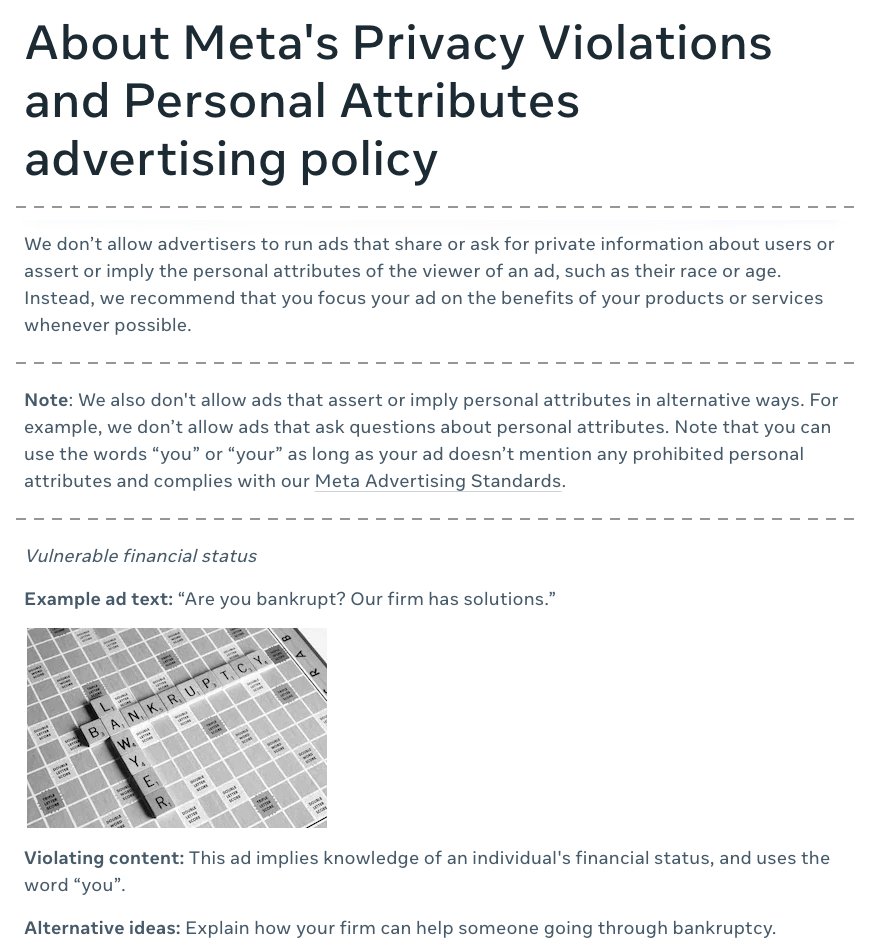
- The rule: never assert or imply who the reader is.
- You and your are fine. The trait is the problem.
- A why or a question that points at the person gets rejected.
- Meta's own fix: describe the situation, not the person.
Screenshot of the Meta Business Help Center page About Meta's Privacy Violations and Personal Attributes advertising policy, taken 2026-10-17. Sections joined at the dashed lines.
Run it with AI
The prompt below runs this method for you. Paste it into your preferred AI and answer five questions. It writes feed openers, search headlines and a why-this-time line, then checks each one against the policy.
It never invents a complaint or a result. Missing one? It asks.
This week: first, run the prompt with your real buyer complaints. Second, put the best why line on your feed ads and the best how line on your search ads. Third, check that every line names the situation, not the person.
Want a second pair of eyes on your openers? Send them to us; you are not signing up for anything. If your opener works and the hook still feels flat, read hooks that work next.
Remember the roofer? The stain was the ad all along.
Ask why first. Sell how second.
Paste into your preferred AI. It asks five questions, then writes feed openers, search headlines and a why-this-time line, and checks each against the policy.
Act as a careful direct-response copywriter. Use only these rules and my answers. Never invent a fact, number, result or testimonial; if you need one, ask me. If you can browse, first check Google's current responsive search ad limits and Meta's personal attributes ad policy, and tell me if anything below has changed.

Ask one at a time, with the example, and wait:
1. What I sell and who buys it. (Example: roof repair for owners of older houses)
2. Where the ads run: social feed, search, retargeting, or all three. (Example: Facebook feed and Google search)
3. Three complaints buyers have, in their own words. If I do not know, tell me to search 'biggest complaints about [my category]' and 'biggest downside of [the usual fix]', and to read a few forum threads. (Example: 'the stain comes back every spring')
4. Fixes they already tried that let them down. (Example: patching it twice)
5. The result they want and how long it takes. (Example: a dry ceiling, new roof in three days)

Rules:
- Feed and cold audiences: open with why or when plus the reader's real experience. Then the result (what). Then one short line that points to the page (how). About 60% why, 30% what, 10% how.
- Search and retargeting: open with what and how: the result, the time, the steps. Close with one short 'why this works' line.
- Readers who tried other fixes: write one opener that asks why this time will be different.
- Add 'without' or 'even if' to the result to rule out fixes they dislike.
- A why line points at their problem, never at my product. 'Why our system is the best' is not allowed.
- Name the situation, never the person. Never assert or imply health, money trouble, age, race, religion or other personal traits.
- No fake urgency, no teases that hide what the ad is for, no results I did not give you.
- Search headlines: 30 characters or fewer (current Google limit).

Use exactly this format:
FEED OPENERS (3):
SEARCH HEADLINES (3):
WHY-THIS-TIME OPENER (1):
RESULT LINE WITH WITHOUT OR EVEN IF:
POLICY CHECK (each line: situation or person?):
NEXT THREE ACTIONS:

Filip Kovacevic is the founder of Anar Agency in Phoenix. He spent five years running SEO, Meta ads, email, and content for medical practices across the United States, and now does the same work for healthcare, home-service, legal, and professional-service businesses, alongside AI implementation. More from Filip →
Talk it through in 15 minutes
Bring one question from this article. We will tell you what we would do, whether or not you hire us.
Book a 15-Min Chat →