How to Structure a Social Media Post: Open With What, End With How
To structure a social media post, open with the what: the thing the post is about. Close with the how: one step the reader can take today. In between, answer at least three of six questions: what, why, when, how, who and where.
If you skip a question, the reader answers it for you, usually with no.
How to structure a social media post: open with what, end with how
You wrote a post last night. It was true and useful, and it took an hour.
This morning it has eleven likes. Zero messages. Nobody booked.
The post was not wrong. It was unfinished. It answered one question and left the reader to guess the rest.
This guide shows how to structure a social media post so it feels finished. It works on LinkedIn, Facebook, in email and in short ads.
Here is the whole method in plain words. Readers bring six questions to every post: what, why, when, how, who and where.
Open with the what. Close with the how. Answer at least three of the six, and leave no gaps.
That is it. The rest of this page shows what each question does, the order we use, and how to fix a draft in five minutes.
A one-question post leaves the reader guessing; a finished post leaves them a step
| One-question post | Six Doors post |
|---|---|
| Opens with "Hey coaches" | Opens with the thing on their mind |
| Answers why, then stops | Answers what, why, when and how |
| Ends on a teaser | Ends on a step they can take today |
| Reader leaves with questions | Reader leaves with an answer they can use |
Our comparison, built on the method in this guide.
Six questions open six doors in the reader's mind
Reporters have checked their stories against the same six questions for more than a century. Journalism teachers call them the Five Ws, with how added as the sixth.
Kipling put them in a short verse in his Just So Stories. He called them his six honest serving-men.
We think of each question as a door. Ask it, and the reader's mind opens onto a different room. We call this the Six Doors.
What opens things. Something the reader can picture: a booking page, a price, a result. This question inspires the reader.
Why opens the past. The cause. It makes the reader feel safe, and it settles arguments before they start.
When opens time. Every payoff lives in the future. So the when question is the one that motivates.
How opens the process. The steps. It is the question that teaches.
Who opens connection. Who did it, who did not, who can. It only works with a person or a type the reader already knows.
Where opens direction. Where your business stands now, and where the market is going. Without a where, you cannot point anyone anywhere.
Why does this matter? Anyone reading your post is carrying one of these questions. The post that answers it gets read.
Each question opens a different door in the reader's mind
| Question | Opens | What it does | Example line |
|---|---|---|---|
| What | Things | Inspires | "Most new patients who skip visit two never come back." |
| Why | The past | Makes them feel safe | "It works because the first visit fixes nothing yet." |
| When | Time | Motivates | "When the plan is finished, the pain is gone." |
| How | The process | Teaches | "Book visit two before the patient stands up." |
| Who | Connection | Builds connection | "The front desk, not the therapist, makes this work." |
| Where | Direction | Points the way | "Here is where patient drop-off really starts." |
The Six Doors, as set out in this guide. Example lines: our physical therapy example.
A finished post walks the reader through at least three doors
- What The thing to picture
- Why The cause
- When The moment it pays off
- Who A person they know
- Where Where things are heading
- How The step for today
The Six Doors, as set out in this guide.
Readers bring six questions to every post, and each opens a door: what opens things, why opens the past, when opens time, how opens the process, who opens connection, where opens direction. Open with the what, close with a how the reader can do today, answer at least three in between, and close every loop. Skip one and the reader fills it in with no.
Open with how only for readers who already know the topic, with who when people are the offer, with where when a place is.
Open with what, close with how, and answer at least three
Every post we write has the same shape. It starts with a what. It ends with a how.
Two orders cover most posts. What, why, when, how. Or what, why, who, how.
Use the when order if the payoff is the point. Use the who order if a person is the proof.
The first line is the what. One prompt gets you there: what are we talking about today?
For example, picture a physical therapy clinic. Its what: "Most new patients who skip visit two never come back." A reader can see that.
Then answer at least three of the six. Three is where a post starts to feel finished. Two feels cut off.
Online, the main point goes first. Usability research on the inverted pyramid found web readers often leave after the opening. So the conclusion belongs at the top.
Readers also scan in an F shape: the first lines get read, the rest gets skimmed. Our verdict: if you fix one thing, fix the first line.
Start with what, end with how, and fill the middle from the reader's side
- 1. What The thing the post is about, in the first line.
- 2. Why The cause, written as "it works because."
- 3. When or who When the payoff comes, or who proves it.
- 4. How One step they can take today. Always last.
The Six Doors default order.
Use when if the payoff is the point; use who if a person is the proof
| What, why, when, how | What, why, who, how |
|---|---|
| Best when the result is in the future | Best when someone the reader knows did it |
| Motivates with the payoff | Persuades with the person |
| Example: "When the plan is finished, the pain is gone." | Example: "The front desk makes this work." |
The Six Doors, as set out in this guide.
End on the how, because the last thing read is the thing they keep
Why does the how go last? People remember the end of a list best. Psychologists call it the recency part of the serial-position effect.
So the last thing a reader sees should be something they can use. A step. Not a slogan.
There is a second reason. Each question pulls a different crowd.
Posts built on why tend to draw the most comments and the least buying. Posts built on how draw fewer readers, but those readers are closer to buying.
Picture a step-by-step video tutorial. Few people watch it to the end. The ones who do are often the ones ready to buy.
Treat that as a working rule, not a measured fact. Use both on purpose. Why earns attention, and how earns trust.
How many steps should you give away? Give more when you are building trust. Give a little less when you are selling, and let your paid service cover the rest.
Either way, the post must be useful by itself. More on this in where to put the offer and how to label it.
Posts built on why get comments; posts built on how get buyers
- Posts built on how Fewer read to the end. Those who do are ready to act.
- The goal What and why up top, how at the end, in one post.
- Teasers Few readers, no step. Skip them.
- Posts built on why Lots of comments and debate, little buying.
Working rule, not a measured result. Labels are ours.
Two rules rest on research; one is a working rule
| Claim | What backs it | How sure |
|---|---|---|
| The end of a post is remembered best | Serial-position effect (recency) | Well studied |
| Web readers decide in the first lines | Nielsen Norman Group reading studies | Well studied |
| Why-led posts get comments; how-led posts get buyers | A common pattern in posting, not a study | Working rule |
Sources: Wikipedia, Serial-position effect; Nielsen Norman Group. The working rule is not measured.
Skip a question, and the reader fills it in to play it safe
What happens to the questions you skip? The reader answers them.
Not with your answer. With the one that keeps them safe.
Leave out the who, and they decide nobody like them has done it. Leave out the why, and they decide it was luck.
Leave out the how, and they decide it is too hard. Every gap closes with "not for me." Then they scroll.
Psychologists call the pull toward doing nothing status quo bias. Every gap in your post gives that pull an easy win.
So we run one test on every draft. When the reader leaves, do they leave with answers they can use, or with questions?
A reader who leaves with questions starts to doubt you. It looks like you cannot explain your own work.
Google's guide to helpful content asks nearly the same thing. Will someone leave feeling they learned enough to reach their goal?
Open loops fail the same test. The Zeigarnik effect says unfinished tasks stick in memory. In a post they stick as annoyance, so close every loop inside the post.
How to write a post nobody acts on, in four easy steps:
1. Open with "Hey coaches."
2. Explain why for six paragraphs, then stop.
3. Promise the steps "next week."
4. Blame the damn algorithm.
Every question you skip gets answered with no
| You leave out | The reader decides |
|---|---|
| Who | "Nobody like me has done this." |
| Why | "It was luck." |
| How | "Too hard for me." |
| When | "Not now. Maybe later." |
| Where | "That is not where I am." |
Our examples of the gap rule. The pull toward doing nothing is called status quo bias.
Do not open with "Hey dentists." Open with what is on their mind
The most common bad first line is a call-out. You have seen them.
"Hey coaches." "Attention, dentists." "Calling all realtors."
It feels aimed at the right people. But readers do not even see it.
People do not notice their own labels. A dentist scrolling at night is not thinking "I am a dentist." They are thinking about the empty chair at 2 p.m.
Newspapers learned this long ago. A headline does not say "For farmers in Minnesota." It names what is on the farmer's mind, and the farmer stops.
So name the thing, not the person. "A freelancer's guide to pricing" reaches every freelancer without calling anyone out.
The same rule holds in paid ads. Open with the what. The button text is a broad how: what to do next, not every technical detail.
Three cases bend the rule. If readers already know the topic, open with the how and skip the setup.
If people are the main thing, like a dating service, open with who. If a place is the main thing, like a trip, open with where.
Even then, end on the how. For the first line itself, see how to write a hook.
A call-out first line gets scrolled past; a what-first line gets read
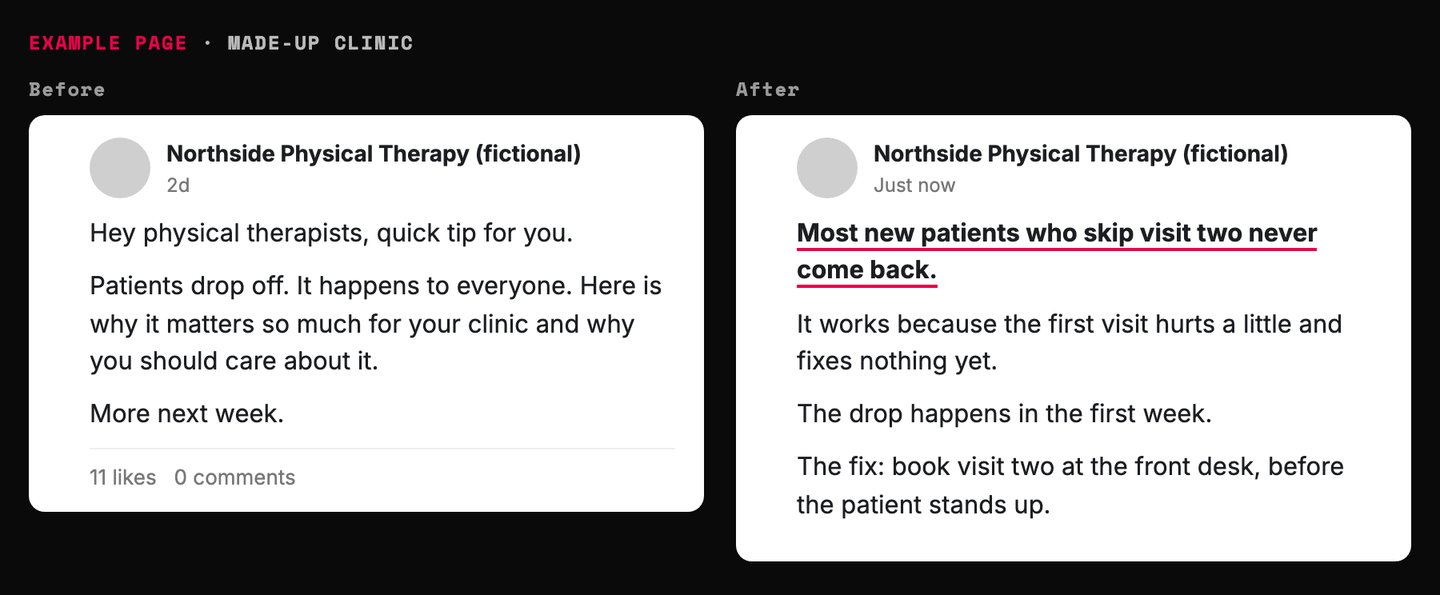
- A call-out. People do not notice their own label.
- A teaser. The reader leaves with a question.
- A what: the thing on their mind, in the first line.
- The why, written as settled fact.
- The post ends on a how they can do today.
Example page built for this article with a made-up brand
Name the thing on their mind, not the label they wear
| Call-out opener | What opener |
|---|---|
| "Hey coaches, quick tip." | "Most coaching clients quit in week three." |
| "Attention, dentists." | "The empty chair at 2 p.m. costs more than the ad." |
| "Calling all freelancers." | "A freelancer's guide to pricing." |
Example lines written for this guide.
Open with what, unless the reader already knows it or the offer is a person or a place
| The situation | Open with | Still end with |
|---|---|---|
| Most posts | What | How |
| Readers already know the topic | How | How |
| People are the main thing, like a dating service | Who | How |
| A place is the main thing, like a trip | Where | How |
The Six Doors, as set out in this guide.
Use the word "when" to move the reader, and "once" to make it feel certain
The when question is the one that moves people. It points at the payoff.
"When the clinic is booked out." "When the loan is paid off."
A when line can also push the other way. "When a cheaper clinic opens nearby, your best patients get a reason to leave." That is bad news about the future.
Bad news grabs attention faster than good news. Psychologists call it negativity bias. So a strong post often starts with the bad news about the future, then moves to the good news.
A useful form is a question. "What happens when three new clinics open down the road at half your price?"
Use it only for a change that is real and that you can show. A made-up threat is fear for sale. Readers spot it, and they stop trusting you.
Two small words matter here. The word "when" hints at work still to do. The word "once" makes the result sound settled.
"Once visit two is booked, most of the plan gets done." More on these in timeline words.
Write the why in the same settled way. Not "here is why it works." Just "it works because."
The first sounds like a pitch. The second sounds like a fact.
Settled wording sounds like a fact; pitch wording sounds like a pitch
| Weaker | Stronger |
|---|---|
| "Here is why it works." | "It works because..." |
| "When you finish the plan..." | "Once you finish the plan..." |
| "Next week I will share how." | "Here are the three steps." |
| "Big changes are coming." | "What happens when three clinics open nearby at half your price?" |
Example lines written for this guide.
Rebuild one post in five minutes
Take your last post. Mark each sentence with the question it answers.
Is the first line a what? If not, write one.
Count the questions. Fewer than three? Add the one the reader most needs.
Make the last line a how they can do today. Cut every teaser and every call-out. Then ask the walk-away question one more time.
Here is our physical therapy example, rebuilt. What: most new patients who skip visit two never come back.
Why: it works because the first visit hurts a little and fixes nothing yet. When: the drop happens in the first week.
How: book visit two at the front desk, before the patient stands up. Four doors, one post, done.
The same shape fits big news. For example, a post about AI offers losing steam was built in four steps.
What: the hype wave is over. Why: costs per sale are up and order sizes are down.
When: these offers will be harder to sell from here on. How: go back to the basics.
Stuck on what to write about at all? Start with something that changed. Then pick the belief to answer with worthless, helpless, hopeless.
Label every sentence by the question it answers, and end on the how
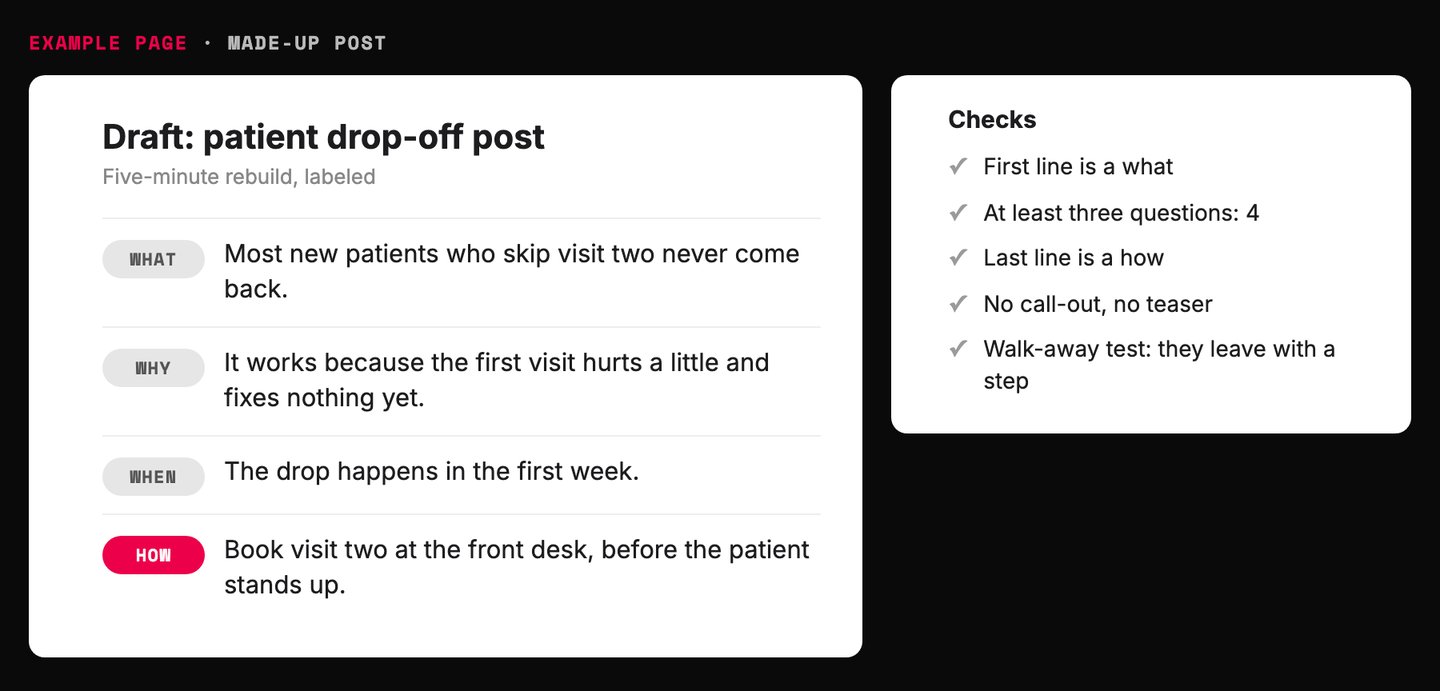
- Starts with a thing the reader can picture.
- The cause, stated as fact: it works because.
- Tells them when the problem hits.
- Always last: the step they can take today.
- Three is the minimum. This post answers four.
Example page built for this article with a made-up brand
Five checks turn any draft into a finished post
- 1. Label Mark each sentence with the question it answers.
- 2. First line Make it a what. Cut any call-out.
- 3. Count Fewer than three questions? Add the one the reader most needs.
- 4. Last line Make it a how they can do today. Cut teasers.
- 5. Walk-away test Will they leave with an answer they can use?
The Six Doors rebuild.
Example: a clinic post with four doors, what first and how last
| Door | The line |
|---|---|
| What | Most new patients who skip visit two never come back. |
| Why | It works because the first visit hurts a little and fixes nothing yet. |
| When | The drop happens in the first week. |
| How | Book visit two at the front desk, before the patient stands up. |
Example built for this guide. Not a client and not a measured result.
Rebuild your post with AI: the copy-paste prompt
Paste the prompt below into your preferred AI. It asks for your post, your reader and the one thing they should do.
Then it labels every sentence with its question, names the gaps, and rebuilds the post. It never invents a threat, a name or a number.
Check its labels against your own. If you disagree, you are probably right, because you know your reader.
Posting often and running dry? Read why posting volume should rise and fall.
Want a second look at a post? Send it to us.
Paste into your preferred AI. It labels each sentence, names the missing questions and rebuilds the post.
Act as a post editor. Rebuild one social media post with the Six Doors check.

Ask me, one at a time:
1. Paste the post exactly as written.
2. Who is it for? (Example: owners of small physical therapy clinics)
3. What should the reader do or believe after reading it? (Example: book visit two before the patient leaves)
4. Does the reader already know this topic well? (yes or no)

The six questions: what (a thing to picture), why (the cause), when (a moment in time), how (the steps), who (a person or type the reader already knows), where (where things stand or are heading).

Rules:
- Label every sentence of my post with the question it answers. Show the labels.
- The first line must be a what: the thing the post is about. If my reader already knows the topic, the first line may be a how.
- Lead with who only if people are the main thing in the offer. Lead with where only if a place is.
- Never open with an audience call-out like "Hey coaches". Name the thing on their mind instead.
- Answer at least three of the six. Tell me which are missing and which one the reader most needs.
- Write the why as "it works because", never "here is why".
- The last line must be a how the reader can do today.
- No teasers and no open loops. Every question the post raises gets answered inside it.
- A "what happens when" line is allowed only for a change I can show is real. Ask me for proof. Never invent a threat, a number, a name or a result.
- Keep my facts and my voice. Short sentences. No em dashes. No exclamation points.

Then answer:
Labels: [each sentence and its question]
Missing questions: [list]
Rebuilt post: [full text]
Walk-away check: what can the reader use after reading, in one line.
What to do this week
1. Run your last three posts through the five-minute rebuild. Note which question each one skipped.
2. Write one new post: what first, how last, three doors at least.
3. Cut every call-out from your drafts, and answer the question the reader would ask in the comments.
Remember the post with eleven likes? It did not need more words. It needed the other questions.
Start with what they can see. End with what they can do.

Filip Kovacevic is the founder of Anar Agency in Phoenix. He spent five years running SEO, Meta ads, email, and content for medical practices across the United States, and now does the same work for healthcare, home-service, legal, and professional-service businesses, alongside AI implementation. More from Filip →
Talk it through in 15 minutes
Bring one question from this article. We will tell you what we would do, whether or not you hire us.
Book a 15-Min Chat →