What Motivates Buyers: Moving From Unsafe to Safe
What motivates buyers is a move from a situation that feels unsafe to one that feels safe. Unsafe means they lack what it takes to handle a problem. So the best ads name the buyer's real situation in a line or two.
Then they show the product as the steps to a safer place, and never invent the threat.
What motivates buyers: the move from unsafe to safe
Picture a webinar. It has a decent opening, two minutes on how the product works, and a close that never seems to end.
Sales? Flat.
The owner wants a stronger close. Wrong fix. If you have to push that hard, the viewer never wanted the thing in the first place.
So what motivates buyers? Something simpler than any close. People act to get from a place that feels unsafe to a place that feels safe.
Unsafe here does not mean danger to life. It means a problem the buyer cannot handle yet, like messy books, an empty calendar or a plan that stopped working.
The Safe-Place Check is our five-part test for any ad or page. Find the unsafe place the buyer already lives in. Name it at the right level, aim it at the situation, show the way out, and decide if the buyer wants to escape a problem or reach a gain.
One rule sits on top of all five. We never invent the threat.
A product-first ad makes the buyer do the work; a safe-place ad does it for them
| Product-first ad | Safe-place ad |
|---|---|
| Opens with what the product does | Opens with the buyer's situation |
| Leaves the buyer to work out why it matters | Shows where they stand and where they want to be |
| Needs a long, hard close | Needs a short, plain offer |
| Talks about the seller | Talks about the buyer |
Our method, the Safe-Place Check, as set out in this guide.
Unsafe means the buyer lacks what it takes
A person feels unsafe when they face something and lack what it takes to deal with it. That might be money, skill, time, help or plain information.
Feeling bad is the sign of being unsafe. Feeling good is the sign of being safe. Most of what people chase is a route to the second feeling.
Money buys room for bad luck. Status means fewer people can push you around. A group means you are not alone.
So people do not buy the thing. They buy the safer life they expect after it.
That has a hard side. A happy, comfortable person has little reason to buy anything. Good luck selling them.
The unknown sits on the unsafe side too. People tend to prefer a risk they understand over one they cannot measure, which researchers call ambiguity aversion.
Familiar things also win by default. People warm to things simply because they have seen them before. Researchers call it the mere-exposure effect.
So make your offer new, but not strange. A better way to do a familiar job feels safe. A job nobody has heard of feels like a trap.
Every purchase is a trip from unsafe to safe
- Unsafe They face a problem and lack what it takes to handle it.
- Feels bad Unease is the signal that something is wrong.
- Looks for a way out They search, ask, compare and react.
- Buys the way out The product is the route to a safer place.
- Feels safe Until the next problem shows up.
Our method, the Safe-Place Check, as set out in this guide.
The Safe-Place Check treats every purchase as a move from a situation that feels unsafe to one that feels safe. Find the unsafe place from what buyers already react to, name it one level below what they think they are buying, aim the why at the situation instead of the person, show the product as the steps out, and match away-from or toward words to the buyer. Give the problem one or two true lines and the way out most of the words.
Never invent the threat.
Talk about the buyer's situation before the product
Three things sit in every sale: the product, the buyer, and the buyer's situation. Of the three, the product moves people least.
Our take: most ads spend most of their words on the product. That is the part buyers care about least.
For example, crypto offers once sold with almost any pitch. A couple of years later, strong offers in the same market struggled to sell.
Did the products get worse? No. The market stopped feeling safe.
One offer on its own can show the same pattern. For example, one dating offer saw sales rise and fall for no clear reason. Its ads told a good story, then showed the product.
Nothing in the middle told the reader where they stood. So readers had to make the case for themselves. Some days, people who already felt the need showed up and bought, and other days nobody did.
The fix is a middle step. Story first, then the buyer's situation and what it costs to stay there, then the product as the way out.
Copy that skips the middle is not a sales page. It is a brochure with a buy button.
The product moves buyers least; their situation moves them most
- The product Features and specs. The part most ads spend most words on.
- The buyer Who they are, what they believe, what they already tried.
- The buyer's situation What is happening to them now, and what it costs to stay there.
Our method, the Safe-Place Check, as set out in this guide.
Put the buyer's situation between the story and the product
| Story, then product | Story, situation, product |
|---|---|
| A good story | A good story |
| Straight to the product | Where the buyer stands now, and what it costs to stay |
| Buyers must make the case themselves | The page makes the case for them |
| Sales rise and fall with whoever shows up | Sales depend less on luck |
Pattern from one dating offer, given as an example; the fix is our method.
How do you find what makes your buyer feel unsafe?
Look at what your buyers react to, then ask what that reaction says they lack. Where people respond, there is a need.
Ignore the post or the product itself. Ask what the reaction is about.
Some reactions are stronger than others. People making their own videos about a topic is the strongest signal. Below that come groups built around it, then conversations, then comments, then likes.
A second clue is what your buyer thinks about all day. People mostly dwell on what threatens them. The worry they keep coming back to is their unsafe place.
Big research project? Not needed. Three facts will do: age, circumstances, and one thing happening to them right now.
For example, picture a shop owner, 45, with two employees and sales down this quarter. Ask your preferred AI what would make that person feel unsafe. Then ask what happens to them if the most likely item on the list comes true.
Pick the most likely answer, not the worst one. Ask once more, then stop.
Our rule: two steps deep is enough. Past that, you are writing a horror story about a stranger, not an ad.
People making their own content is the strongest sign of a need
| Reaction, strongest first | What it looks like | What it tells you |
|---|---|---|
| Making their own content | Videos, posts or reviews about the topic | The need is deep and lasting |
| Building groups | Forums, clubs, chats around it | They want company in the problem |
| Talking about it | Threads, questions, word of mouth | It is on their mind |
| Commenting | Replies under posts and ads | It touched a nerve |
| Liking | One tap and move on | Mild interest at best |
Our method, the Safe-Place Check, as set out in this guide.
Three facts and two questions find the unsafe place
- 1. Describe one buyer Age, circumstances, one thing happening now. Example: 45, two employees, sales down.
- 2. Ask what makes them feel unsafe Read the list against the reactions you collected.
- 3. Ask what happens if the likeliest one comes true Pick the most likely result, never the worst.
- 4. Ask once more, then stop Two steps deep is enough.
- 5. Ask what life looks like once it is fixed That answer becomes your what-if line.
Our method, the Safe-Place Check, as set out in this guide.
Your buyer is one level below what they think they are buying
Your buyer usually stands one level below the thing they think they want. Name that lower level, and the product becomes the step up.
The psychologist Abraham Maslow ranked human needs in five levels: the body, safety, love and belonging, esteem, and self-fulfillment.
Use it as a map. Losing something moves a person down a level. Gaining it moves them up.
For example, a dating offer looks like it sells love. But a lonely buyer is not shopping for love yet. They feel socially unsafe.
So the page speaks to safety first: not being alone, being wanted, keeping up with friends. Love is the next level up, and the product is the stairs.
Some categories touch several levels at once. Weight loss touches health, belonging and esteem. That is one reason it is such a big market.
Health is the lowest level, and the most fragile. People in poor health can feel there is no floor under them. Write for them gently, or not at all.
A dating offer sells love, but its buyer is standing on the safety rung
- The body Health, sleep, food. The most fragile buyers live here.
- Safety A stable life, not being alone, being wanted. The lonely dating buyer is here.
- Love and belonging What the dating offer appears to sell. The next level up.
- Esteem Respect from others and from yourself.
- Self-fulfillment Becoming who you want to be.
Levels: Maslow's hierarchy of needs, as summarized in Wikipedia. The dating example and the one-level-below reading are ours.
Should you scare people into buying? Name the real problem, then show the way out
No. Name the unsafe place the buyer is already in, in one or two true lines. Then spend the rest of the page on the way out.
Plenty of copy advice teaches the opposite: make the reader feel as unsafe as possible, pile on rules and worst cases, then sell the exit.
We do not write that way, and the research is on our side. Studies of the appeal to fear keep finding the same catch.
In the extended parallel process model, a scary message works only when people believe they can act on it. When the threat feels big and the way out feels weak, people deny it, push back or look away.
That push back has a name, psychological reactance. People resist when they feel cornered.
In plain words: more fear without a clear way out loses the sale. An invented threat is worse. The FTC says ads must be truthful and backed by evidence.
How to scare a buyer straight off your page in four easy steps:
1) Open with the worst thing that could ever happen to them.
2) Make it personal. Ask why they are such a mess.
3) Add a countdown timer that resets every time they reload.
4) Hide the price and the way out until the order form.
That is not urgency. That is a hostage note.
Here is a simple test. Read your page as a nervous stranger. Do you feel calmer at the end, or more anxious?
More anxious means the page is working against you.
One more rule of ours. Once a buyer is with you, never push them back into the unsafe place to sell the next thing. You built the safe place, so do not burn it down for an upsell.
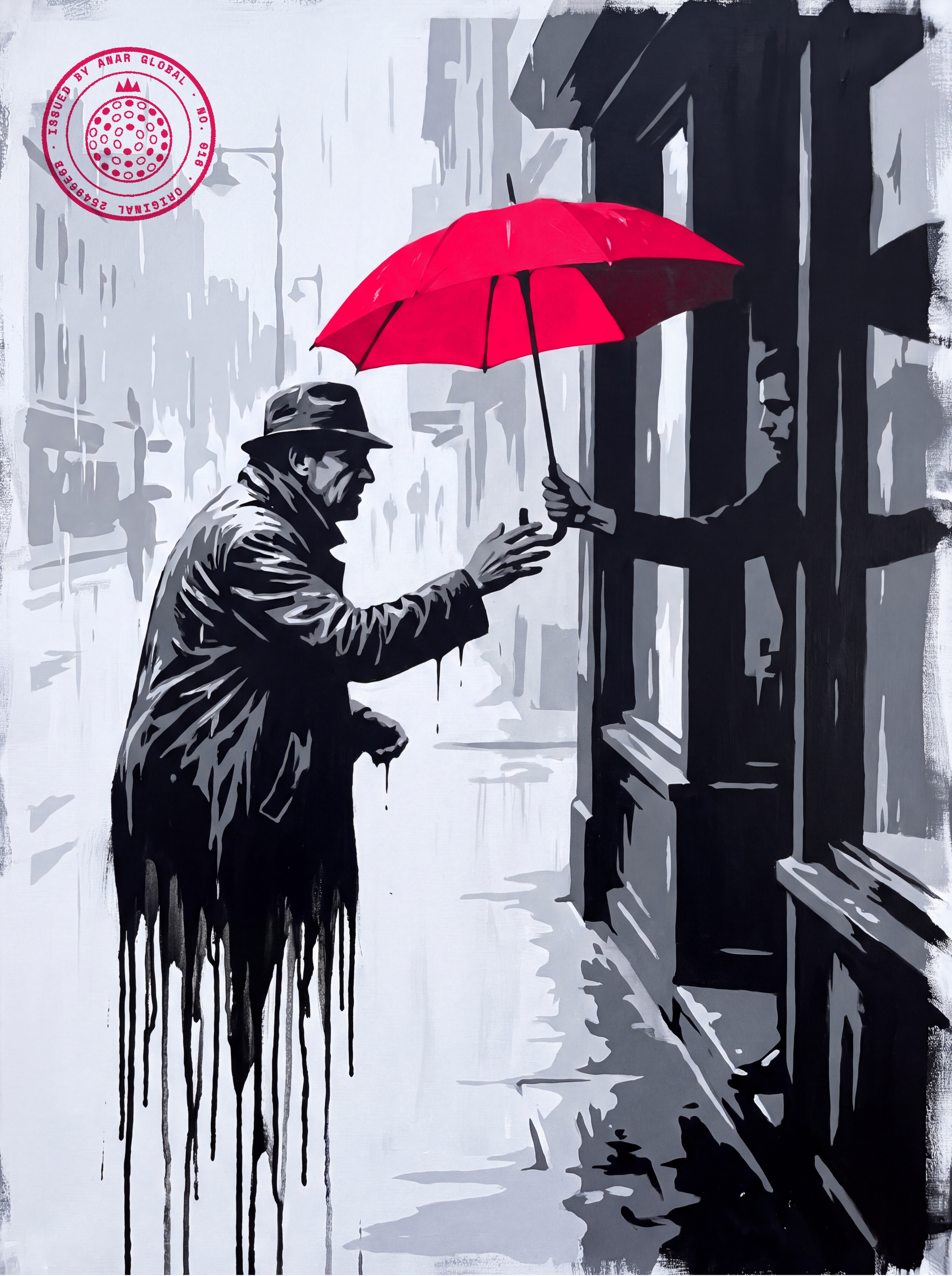
A big threat with a weak way out makes people look away
- They look away Denial, push back, avoidance. Fear-heavy pages land here.
- They act A real problem plus steps they believe they can take.
- Nothing happens No threat felt, so the message is ignored.
- Little reason to act The way out is clear, but nothing feels at stake yet.
Based on Kim Witte's extended parallel process model, as summarized in Wikipedia.
Fear-first copy spends its words on the danger; we spend ours on the way out
| Fear-first copy | Safe-Place copy |
|---|---|
| Paints the worst case | Names the likely problem in one or two true lines |
| Aims at the person | Aims at the situation |
| Most words on the danger | Most words on the way out |
| Leaves the reader anxious | Leaves the reader calmer |
| Pushes customers back down to sell more | Keeps customers in the safe place |
Our method, the Safe-Place Check, as set out in this guide.
Match the direction: away from a problem, or toward a gain
Use away-from words for buyers who spend most days under pressure. Use toward words for buyers who are doing well and have room to grow.
Stressed buyers already live in the unsafe place. They want out. Use words like stop, fix, end, no more, finally.
Comfortable buyers have resources. They want more. Use words like grow, add, next, faster, first.
Psychologists describe the same split as prevention focus and promotion focus. Some people mainly guard against losses, and others mainly chase gains. The older name for the pull in both directions is approach and avoidance.
Here is one bookkeeping service with two openings. For the stressed owner: "Stop guessing whether you made money this month." For the growing owner: "Know which location to open next."
Which one is your buyer? Look at the reactions you collected.
Complaints and questions call for away-from words. Plans and wins call for toward words.
Some advice says to rattle comfortable buyers by threatening what they already have. We skip it. Show them the next level instead.
Stressed buyers want out; doing-well buyers want more
| Your buyer | Most days feel | Words that fit | Example opening |
|---|---|---|---|
| Under pressure | Unsafe, short on time or money | Stop, fix, end, no more, finally | "Stop guessing whether you made money this month." |
| Doing well | Safe, with room to grow | Grow, add, next, faster, first | "Know which location to open next." |
Our rule. Related research: prevention and promotion focus (Wikipedia, Regulatory focus theory). Example lines are ours.
Write the ad in three lines: why, what if, how
A safe-place ad needs three lines: a why, a what-if and a how.
The why line names the problem as a question about the situation. The what-if line shows the outcome. The how line shows the product as the steps.
The why line works like a mirror. If the problem is real for the reader, they stop. If it is not, the line slides past them, and that is fine.
They were never your buyer.
Aim the why at the situation, never at the person. "Why the scale stops moving after week three" blames the plan. "Why are you still overweight?" blames the reader.
This is also a platform rule. Meta's personal attributes policy bans ads that assert or imply a viewer's traits, such as their health, money trouble or age. Pairing the word "you" with a trait is what gets flagged.
The what-if line paints the outcome. "What if your books were done every month, without you touching them?"
The how line is your product. "Here is how: connect your bank once, then get a one-page report each month."
Why does the how feel safe? Because steps mean a process. A process means someone has walked this road before.
Problem, picture, path. That is the whole ad.
To draft each line with AI, ask what problems this buyer has. Then ask what outcome they want if that problem went away. Your product goes in as the how.
Why, what if, how: problem, picture, path
- Why The problem as a question about the situation. "Why small shops find out they lost money at tax time."
- What if The outcome. "What if your books were done every month, without you touching them?"
- How The product as steps. "Connect your bank once, then get a one-page report each month."
Our method. Example lines for a fictional bookkeeping service.
Blame the situation, never the reader
| Aimed at the person | Aimed at the situation |
|---|---|
| "Why are you still overweight?" | "Why the scale stops moving after week three" |
| "Are you bad with money?" | "Why small shops find out they lost money at tax time" |
| "Why can't you get clients?" | "Why referrals dry up after year two" |
Our examples. The left column also risks Meta's personal attributes policy.
When a buyer got burned before, explain what is different
A buyer who got burned before is not stuck in the past. They use the past to predict the future. So answer the future: say why it went wrong, and what is different now.
Nobody fears the past. They fear a repeat.
Say why the last attempt failed, without trashing anyone. Name the one thing you do differently. Then make the first step small enough to test that difference.
The goal stays the same. The method changes.
Two tools help here. A small paid first step lets them test you cheaply. A clear guarantee that covers what they fear losing makes the step feel safer still.
For buyers who need every gap closed before they move, read risk-first buyers. If the doubt is whether it can work for them at all, see the three beliefs that stop a buyer.
Answer a burned buyer's fear of a repeat in four moves
- What they tried Before Name it plainly. Do not trash the last provider.
- Why it failed Why The real cause, in one or two lines.
- What is different Now The one thing you do differently.
- A small test First step Small enough to prove the difference cheaply.
Our method, the Safe-Place Check, as set out in this guide.
Meta's own examples: a trait plus the word you gets an ad rejected
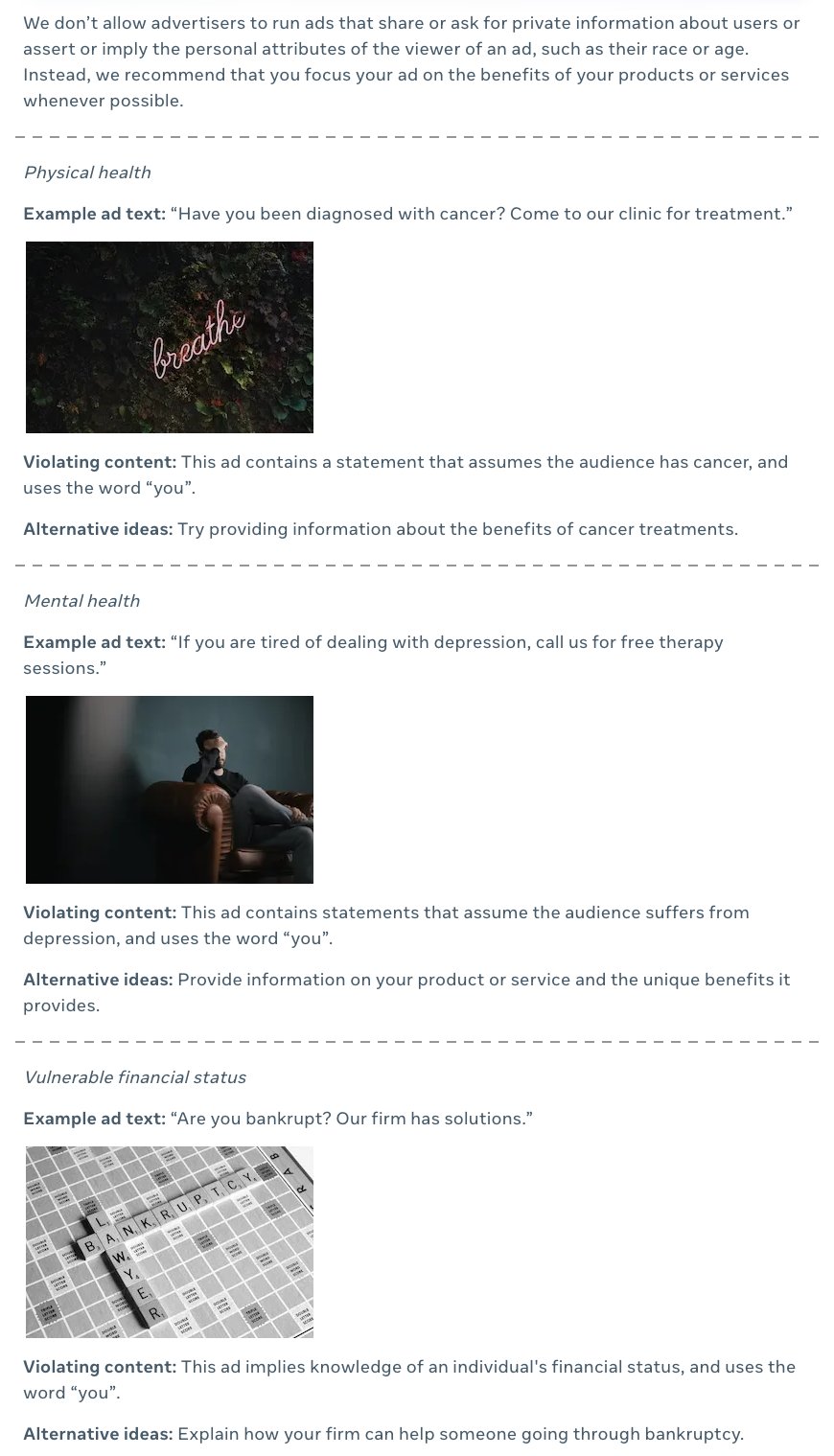
- The rule: an ad may not say or hint that it knows a viewer's personal traits.
- Money trouble aimed at you breaks the rule.
- Health traits break the same rule.
- The word you plus a trait is what gets flagged. Put the problem on the situation instead.
Screenshot of the Meta Business Help Center page About Meta's Privacy Violations and Personal Attributes advertising policy, taken 2026-10-17. Sections joined at the dashed lines.
Run the Safe-Place Check with AI
Paste the prompt below into your preferred AI. It asks about your buyer and your offer, finds the real unsafe place, and writes a why, a what-if and a how.
It checks the draft against our rules before it hands it back. It never invents a threat, a number or a deadline.
1. Run it for your main offer, with real buyer comments pasted in.
2. Read your current ad or page as a nervous stranger. Calmer or more anxious?
3. Swap your opening for the best why line and test it against the old one.
Most of your market may not know the problem yet. If so, start with how to move an unaware market. Once the opening works, the next job is the objections, covered in action is desire minus objections.
Remember the webinar with the endless close? It never needed a longer close. It needed a middle that showed buyers where they stood and how to get out.
Fear pushes people away. A clear path pulls them in.
Paste into your preferred AI. It asks about your buyer and your offer, then writes a why, a what-if and a how, and runs a calm check.
Act as a direct-response copywriter who never uses invented fear. Run the Safe-Place Check on one offer.

Ask me one at a time, with the example:
1. What do you sell, and to whom? (Example: monthly bookkeeping for small shop owners)
2. Describe one buyer in three facts: age, circumstances, one live condition. (Example: 45, two employees, sales down this quarter)
3. What do these buyers complain about, ask about or post about? Paste real comments, reviews or questions if you have them. (Example: "I never know if I made money until tax time")
4. Do they spend most days stressed, or doing well with room to grow? (Example: stressed)
5. What does your product do, step by step? (Example: connect the bank once, a one-page report each month, a call each quarter)
6. Did they try something like this before and get burned? What went wrong? (Example: a cheap app nobody kept up)

Rules:
- Use only problems my answers support. Never invent a threat, a statistic or a deadline.
- The unsafe place is what they lack to handle the problem. Name it one level below what they think they are buying.
- Ask "what happens if" two steps deep at most. Pick the most likely result, never the worst.
- Aim the why at the situation or the method, never the person. No line may assert or imply their health, money trouble, age or other personal traits.
- Stressed buyers get away-from words (stop, fix, no more). Doing-well buyers get toward words (grow, next, add). Never threaten what a comfortable buyer has.
- The problem gets one or two lines. The way out gets most of the words.
- If they were burned before, say why it failed and what is different now.

Show your reasoning, then answer:
Unsafe place: [one line]
Level: [the need it sits on, and the level the product lifts them to]
Direction: away or toward, and why
Why line: 3 options
What-if line: 3 options
How line: 3 options, product as steps
Calm check: would a nervous stranger feel calmer or more anxious? Rewrite any line that makes them more anxious.
Next three actions: 1. 2. 3.
Why, what if, how, and the way out in plain view
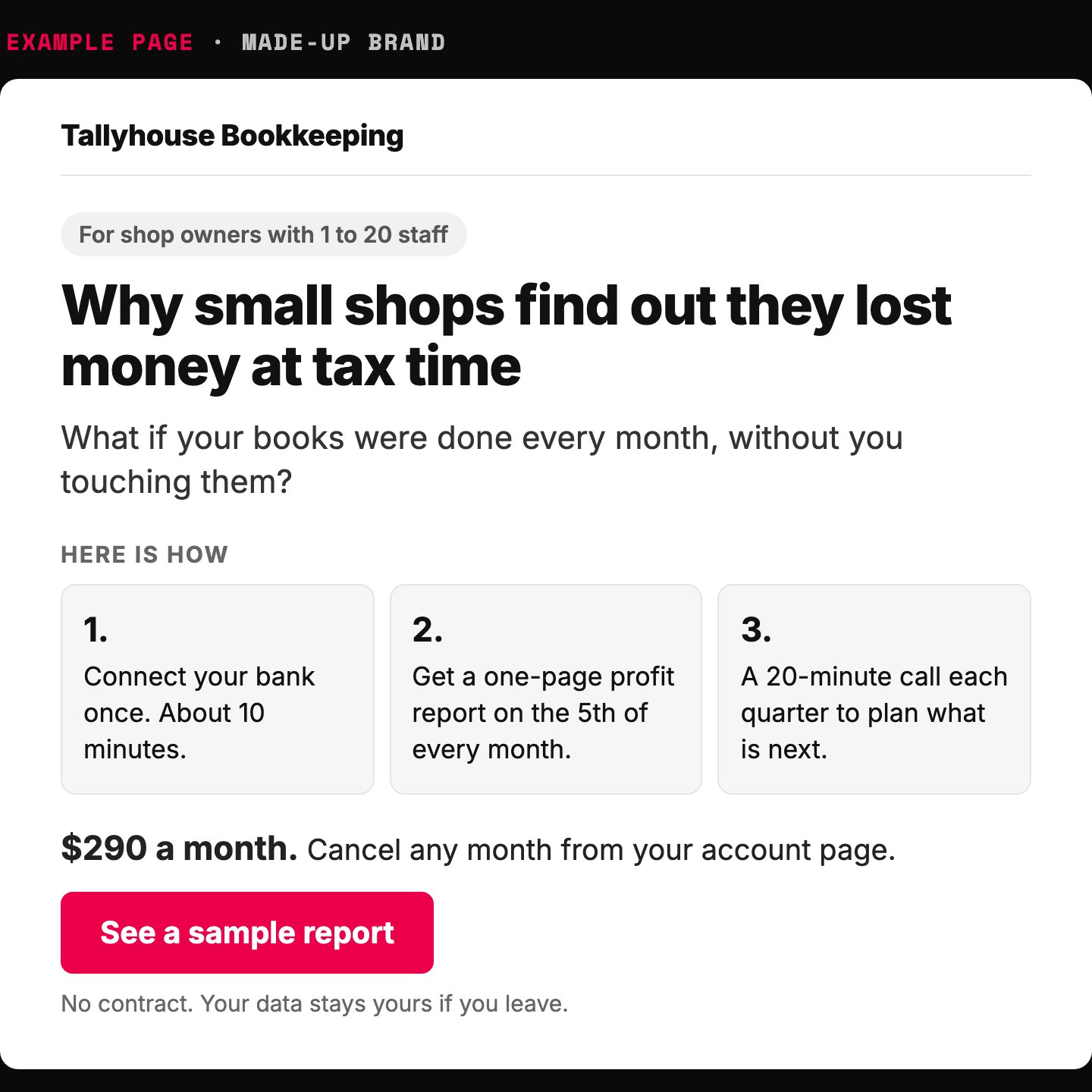
- The why: aimed at the situation, not the owner.
- The what-if: the outcome, in the buyer's words.
- The how: the product as steps. Steps feel safe.
- The way out, in plain view.
- A small first step, not a big commitment.
Example page built for this article with a made-up brand.

Filip Kovacevic is the founder of Anar Agency in Phoenix. He spent five years running SEO, Meta ads, email, and content for medical practices across the United States, and now does the same work for healthcare, home-service, legal, and professional-service businesses, alongside AI implementation. More from Filip →
Talk it through in 15 minutes
Bring one question from this article. We will tell you what we would do, whether or not you hire us.
Book a 15-Min Chat →