Most of Your Market Is Unaware: How to Move Them

Most of your market is not shopping and has not noticed the problem you solve. Describing your solution will not reach them. People notice change and tune out what stays the same.
So show them something that moved in their world, show where it leaves them, tie it to what they care about, then show how they can move too.
Your buyer stopped seeing the problem years ago
Look at the clock on your wall. You stopped seeing it years ago.
If its hands froze, you would not notice for days. If it fell off the wall, you would turn your head before you knew why.
Your buyer's problem is that clock. It has been there so long they stopped seeing it.
Most guides on awareness levels in marketing teach a ladder, from unaware to most aware. Then they spend one line on the bottom rung. This guide is only about that rung: people who have the problem and are not looking.
The short version? You cannot sell a fix to someone who has not noticed the break. First you show them something that changed in their world.
Buyers who are already shopping and have heard every claim need a different guide: selling to buyers who have seen it all.
What is an unaware audience?
An unaware audience is the people who have your buyer's problem, or soon will, and are not looking for a fix. Many have not noticed the problem at all.
Every market has two sides. The aware side is shopping. They search, compare, click on offers and ask friends.
The unaware side is everyone else with the same problem. They are busy with their own week.
How big is each side? A common rule of thumb puts it near 80 percent unaware and 20 percent aware. That is an estimate from experience, not a study.
We check each part of this method against public research below.
Your split will differ. Either way, the people shopping this month are only some of the people who will ever buy.
Here is the part most marketers miss. The aware side does not refill itself. It is fed by the unaware side, one person at a time.
So whoever wakes the unaware side first gets to shape what the whole market wants.
The shoppers are the smaller side of every market
| Aware side | Unaware side |
|---|---|
| Has noticed the problem | Has the problem, or will, and has not noticed |
| Searches, compares, clicks on offers | Busy with their own week |
| Easy to find by recent activity | Hard to find, and nobody else is talking to them |
| About 20 percent, by a common estimate | About 80 percent, by the same estimate |
Source: a rule-of-thumb estimate. Not a study.
Thousands of live ads talk only to people already comparing
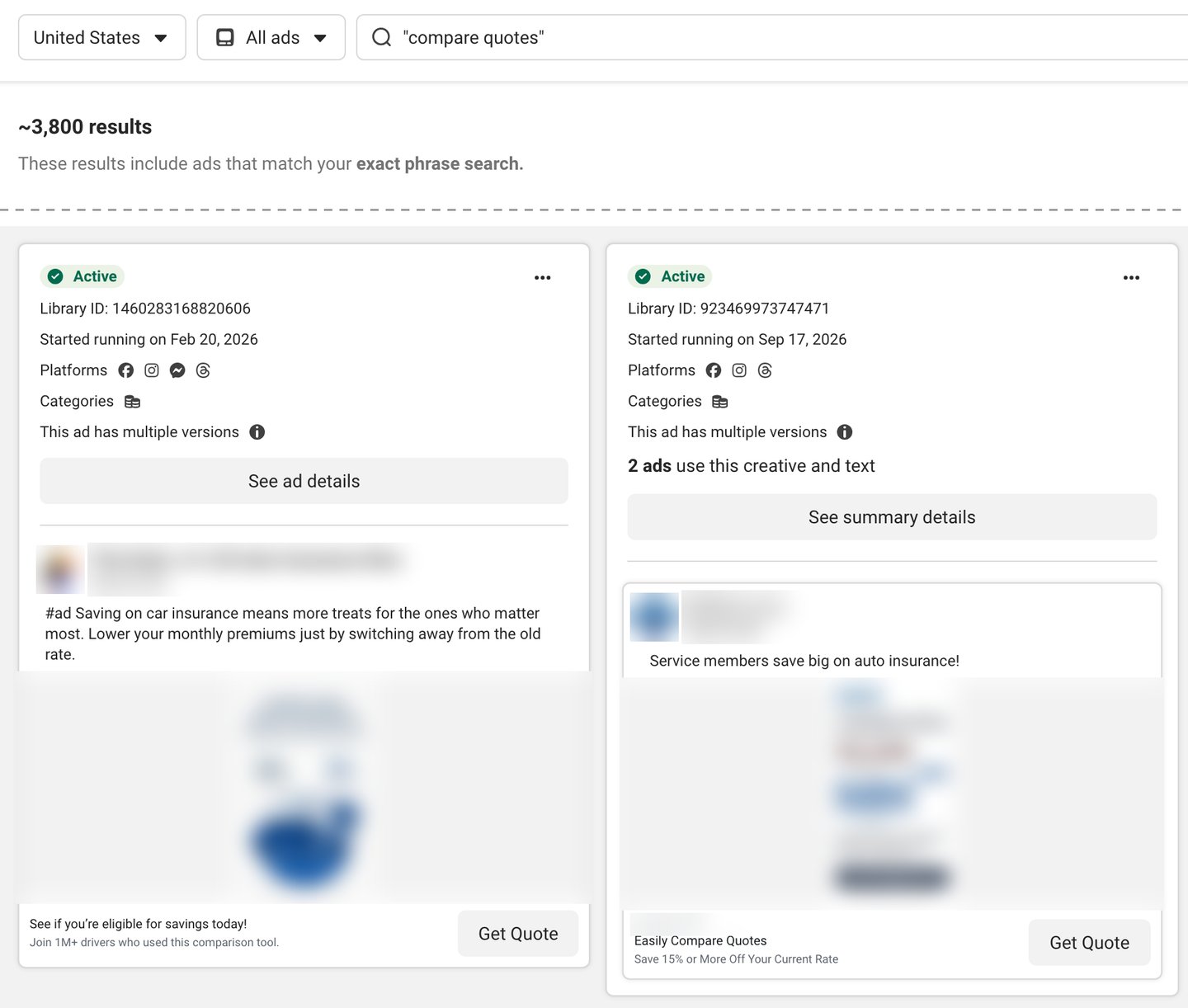
- Search your category the way a shopper would. Here, the exact phrase 'compare quotes'.
- About 3,800 live ads on this one phrase, all fishing in the same small pond.
- Written for someone already shopping: switch, save, get a quote.
- Compare quotes, save off your current rate. Only a person already comparing cares.
- Count how many ads in your own category end like this. That is the crowded side.
Screenshot of the public Meta Ad Library (US, active ads, exact phrase "compare quotes"), taken 2026-10-17. Advertiser names, logos, domains and images blurred; the empty space under the result count is cut out at the dashed line
Most of a market is not shopping and has not noticed the problem. People notice change and tune out what stays still, so the Motion Map reaches them in three levels: show something moving where they already look, show what changed and where it leaves them, then show how they can move too, which is where the offer appears. Tie every change to health, money and safety, standing or family, keep showing new real changes, and never invent one.
Why do ads aimed only at shoppers hit a ceiling?
Ads aimed only at shoppers hit a ceiling because every competitor chases the same small group. When everyone fishes in one pond, the fish get expensive.
Shoppers are easy to find. They leave a trail of searches, purchases and clicks. Direct mail houses picked lists the same way: by recent activity.
Easy for you means easy for every rival. So prices climb until nobody makes much.
Earnings per click is the money an offer makes for each visitor. For example, some sales video offers that once earned $30 to $50 per click now earn $1 to $3. That is a rough example, not audited data.
Then the offer peaks and dies. You rebuild it. It peaks again, and dies again.
How to keep a good offer small forever, in four easy steps:
1) Interview only people who already bought.
2) Write ads that compare you to the other forty sellers.
3) Bid on the same keywords and audiences as everyone else.
4) When results drop, blame the ad and start over.
That is not a growth plan. It is a hamster wheel with an ad budget.
Our take: shopper ads are not wrong. They pay the bills. They just cannot grow the pond.
The trade-off: shoppers are cheap at first and get more expensive over time. Waking the unaware costs more at first and less over time.
Check your own market today. Open the Meta Ad Library, search your category, and count how many ads speak only to people already comparing options.
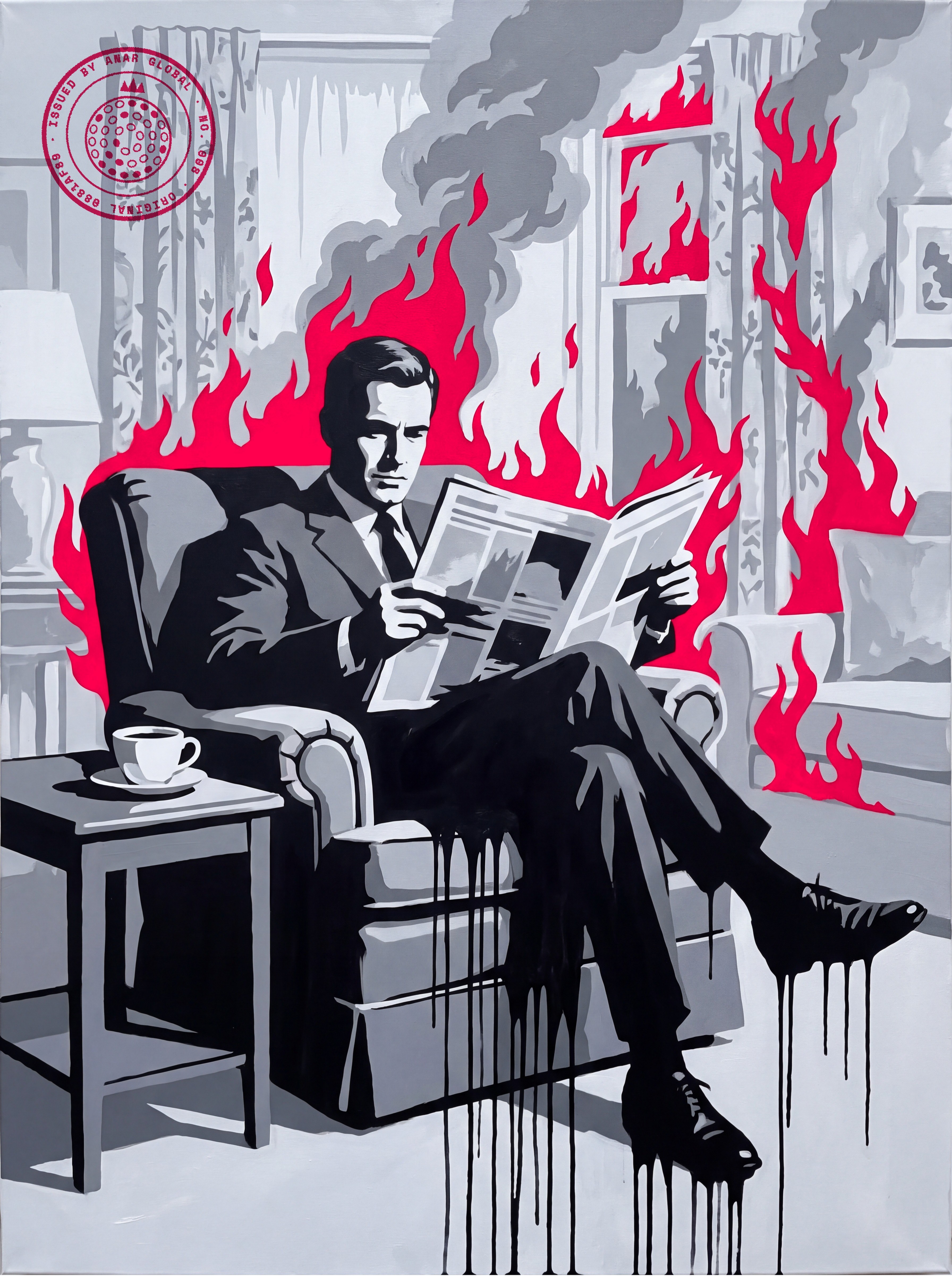
Shopper ads start cheap and get more expensive over time
| Sell to the aware side | Wake the unaware side | |
|---|---|---|
| Cost to start | Low | Higher |
| Cost over time | Rises as rivals pile in | Falls as one message keeps working |
| Leads | Shared with every competitor | Fresh, nobody else reached them |
| When results fall | Rebuild the offer | Show the next change |
Source: Anar.
The big numbers here are rough estimates, not measured data
| Claim | Type | How sure |
|---|---|---|
| About 80 percent of a market is unaware, 20 percent aware | Rule of thumb | Estimate |
| Sales video offers fell from $30 to $50 per click to $1 to $3 | Example | Not audited |
| Waking the unaware side could make a market five times bigger | Estimate | Not verified |
Anar has not verified these numbers.
People only notice what moves
People notice change and stop noticing what stays the same. That one fact is the key to the unaware side.
Try it now. Stare at one word on this screen and keep your eyes still. Unchanging things at the edge of your vision start to fade, an effect called Troxler's fading.
The same thing happens with sound and touch. When a thing repeats and does not matter, our response to it drops away. Scientists call that habituation.
The reverse is built in too. Any change around you pulls your attention before you decide to look. Pavlov called it the "What is it?" reflex, now known as the orienting response.
Think of a deer on a trail. Standing still, it blends into the trees. One step, and every eye in the woods finds it.
Walk an hour on a treadmill and you count the minutes. Walk an hour outside and you lose track. Same legs, but the world outside keeps changing.
Our read: your buyer's ongoing problem works the same way. The slow month, the old ache and the calls nobody returns have not changed in years, so they went invisible.
Describing your fix to that person does nothing. In their eyes, there is no problem to fix.
Three findings, one lesson: things that never change disappear
| Effect | What happens | What it means for your ad |
|---|---|---|
| Troxler's fading | An unchanging shape at the edge of your vision fades away | A message that never changes stops being seen |
| Habituation | The response to a repeated thing that does not matter drops | A claim they see every day stops landing |
| Orienting response | A change around you pulls your attention to it | Show a change and they look |
Sources: Wikipedia entries on Troxler's fading, habituation and the orienting response.
An hour on a treadmill drags; an hour outside disappears
| Treadmill | Walk outside |
|---|---|
| Same steps | Same steps |
| Nothing around you changes | Something new every few seconds |
| You watch the clock | You lose track of time |
| Your ad, saying what it always said | Your ad, showing what just changed |
Example.
The Motion Map: show a change, what it means for them, and what they can do
The Motion Map is a three-level way to move people from unaware to aware. Show them a change, show what it means for them, then show what they can do about it.
Level 1: be the thing that moves in front of them. Show up where they already look with something new, like a post, a clip or a short ad. Not a pitch.
Level 2: show what changed and where it is heading. Movement here simply means change. News is nothing but change, which is why people read it.
Level 3: show what they can do about it. This is where your offer comes in. It belongs on the page or the sales call, not in the first line of the ad.
Motion alone is not enough. A change that touches nothing they care about gets ignored in seconds.
The test is four needs. In plain words: health, money and safety, standing among other people, and family. Tie the change to one of them, or cut it.
A real example: for men in their 40s with families, one change is the retirement age. In the US, full Social Security benefits used to start at 65, and a 1983 law moved that to 67 for anyone born in 1960 or later.
Level 1 shows that change. Level 2 shows what it means for them: two more years of work before the full check. Level 3 shows how they can retire on their own terms anyway, and that is your offer.
The order: they are unaware, they see a change, they notice, they see why it matters, then you show a new change. Skip one and the chain breaks. Our guide to hooks built on change plus hope covers the first line.
Three levels move a buyer from not looking to buying
- Level 1: Something moves Show up where they already look, with something new. No pitch.
- Level 2: What it means for them Show what changed and where it is heading for them.
- Level 3: What they can do about it Your offer, on the page or the call. Not in the first line of the ad.
Source: the Motion Map, Anar.
A change that touches none of these four needs gets tuned out
| Need | In plain words | Ask of your change |
|---|---|---|
| Survival | Health | Does it touch their body or their energy? |
| Security | Money and safety | Does it touch their income, savings or risk? |
| Status | Standing | Does it change how others see them? |
| Reproduction | Family | Does it touch their partner, kids or future family? |
Source: Anar.
One real change, run through all three levels
| Level | What it shows | Example line |
|---|---|---|
| 1 | The move | "Full retirement age used to be 65. For anyone born in 1960 or later, it is 67." |
| 2 | What it means for them | "That is two more years of work before the full check." |
| 3 | What they can do about it | Your offer: a plan to retire on their own terms anyway. |
Source: US Social Security full retirement age, 1983 amendments (Wikipedia, Social Security (United States)). Lines are examples.
Keep moving, or they will tune you out again
Awareness wears off when the motion stops. Once people know a thing and it poses no threat to what they care about, they stop seeing it.
Think of someone who was in every feed five years ago and is nowhere now. They did not get worse. They stopped showing you anything new.
So waking a market is not one ad. It is a steady stream of real changes.
The cheap way to make that stream is content. Take one real change, explain it once, and cut it into many pieces, the way we lay out in one article, twenty pieces.
Ads count too, since an ad is content you pay to place. Why does it all work? Because all content is about change.
Each time they see something new from you, they trust you a little more. The day they start shopping, your name is already in their head.
No motion, no notice. No notice, no trust. No trust, no sale.
Awareness lasts only as long as you keep showing change
- Find a real change A rule, price, habit or number, with a source.
- Show it where they look A post, a clip, a short ad.
- Tie it to one need Health, money, standing or family.
- Show what they can do The offer, on the page or the call.
- Find the next change Messages that never change go unseen.
Source: Anar.
Find the movement by asking what happened before
To find the change an unaware buyer will notice, keep asking one question about your customers: what happened before this? Most research never asks it.
Why not? Research reaches people who already became aware. Interview a customer and you get the shopping story: the options, the prices, the reviews.
The unaware person cannot tell you anything. They have not noticed yet. So copy built only from customer interviews talks to people who are already shopping.
Before they compared options, they watched what people they trust chose. Before that, they tried things alone. Before that, something felt missing.
Keep going until you hit the first feeling that something was wrong. Storytellers call that moment the call to adventure. Your message to unaware buyers has to land right there.
For a health offer, ask when people first feel the symptom, long before any diagnosis. For an anti-aging offer, ask when people first start to feel old.
Google Trends shows which searches are rising, a free view of what is moving in your buyer's world. Our customer truth system shows how to keep what you learn.
One more rule. If your market is already shopping, clever words barely matter. You win on value, ease, time and cost.
Walk your buyer back from shopping to the first feeling
- Shopping Today Comparing options. Where most research starts and stops.
- Asking others Before Watching what people they trust chose.
- Trying alone Before that Searching and testing fixes on their own.
- Something is missing Earlier A sense that something is off or incomplete.
- The first feeling First Where your unaware message has to land.
Source: Anar.
Shopping questions find the aware side; before questions find the rest
| Questions that stay in the shopping stage | Questions that go before it |
|---|---|
| Why did you pick us? | What happened right before you started looking? |
| What else did you compare? | When did you first feel something was off? |
| What almost stopped you? | What did you try on your own first? |
Example questions by Anar.
Rising searches show what is moving in your buyer's world
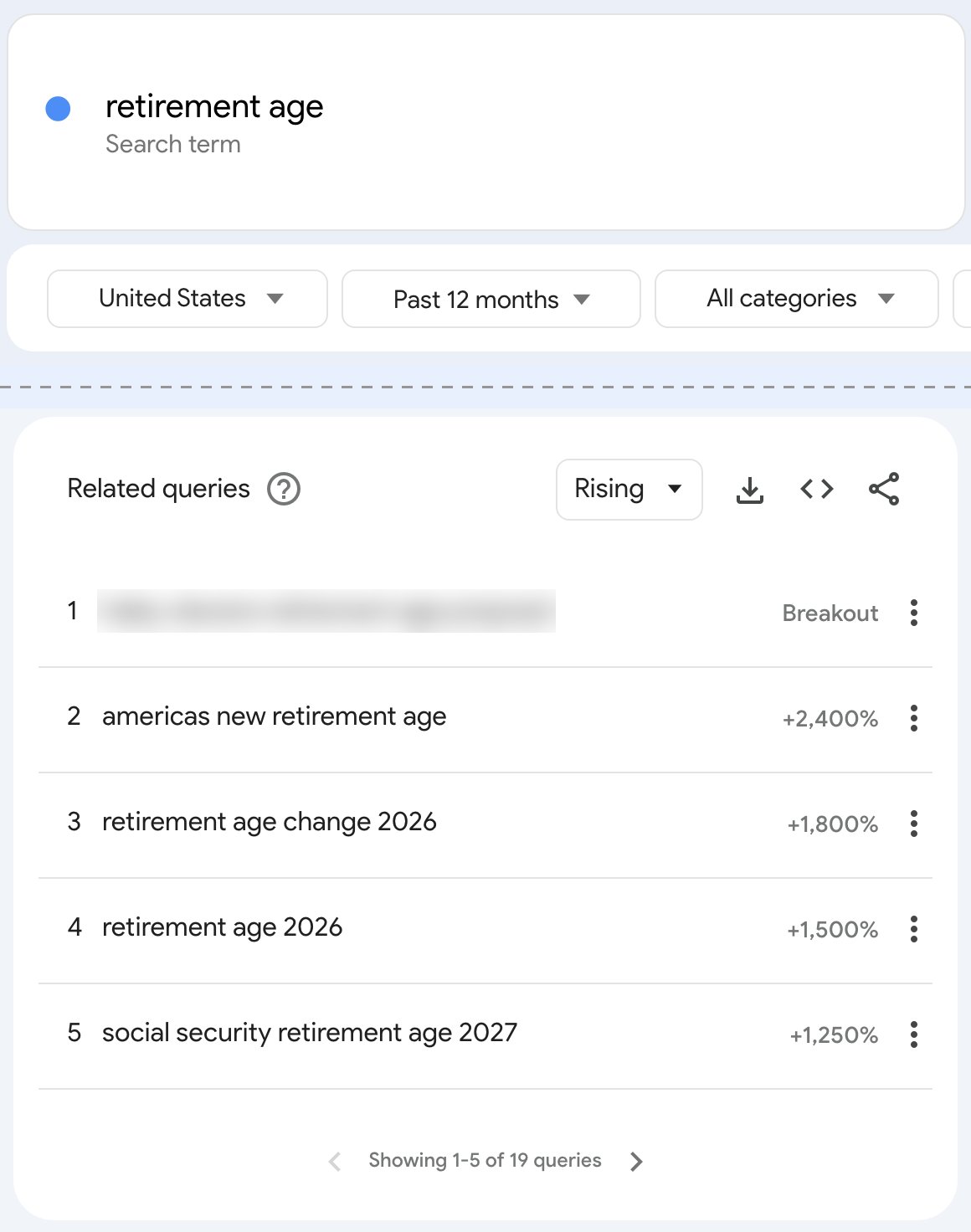
- Type the change in your buyer's words. Here: retirement age, the Motion Map example above.
- Set Related queries to Rising: the searches growing fastest right now.
- Searches for a new retirement age grew 2,400 percent. That is motion your buyer already feels.
- Check the fact behind a search before you write. Every change you show must be real and sourced.
Screenshot of Google Trends (retirement age, United States, past 12 months, related queries set to Rising), taken 2026-10-17. Two parts of the page, joined at the dashed line; one query naming a person blurred
Five ways to put motion into your words
You can put motion into copy one line at a time, with five moves we use.
1. Open with something you were just doing. "I was just on the phone with a client" shows something happening, and "We value our clients" shows nothing.
2. Write headlines that go somewhere. "How to go from a shoebox of receipts to a clean report" is a trip in one line: a start, an end and the path between.
3. Make the goal move away. Under the 4 percent rule, a common retirement rule of thumb, someone who wants $60,000 a year needs about 25 times that, or $1.5 million.
Now show that number moving. Inflation means the same $60,000 buys less each year, so the target keeps sliding away. Use the real figure from your country's official price index, never a guess.
4. Say what has not changed. People relax about things that stay the same, so if a fear is wrong, say plainly that the price and the terms are the same.
5. Show the market changing. Point to what they can check with their own eyes, like more delivery trucks on their street.
Gain or loss? Both count as change. Upbeat ads often beat negative ones, though that is an observation, not a test we ran.
Our rule on top: every change you show must be real and sourced. The FTC expects ad claims to be truthful and backed by evidence. A made-up threat buys one click and costs you the trust you came for.
Fear you invented is not urgency. It is bullshit with a deadline.
The same message, written still and written moving
| Still | Moving |
|---|---|
| "We value our clients." | "I was just on the phone with a client who..." |
| "Professional bookkeeping services." | "How to go from a shoebox of receipts to a clean report" |
| "You are not on track to retire." | "The number you need keeps moving away from you." |
| "Worried about hidden fees?" | "The price is the same as last year. So are the terms." |
Example lines by Anar.
Example: under the 4 percent rule, $60,000 a year means a $1.5 million target
- Yearly income wanted 60000
- Multiple under the 4 percent rule 25
- Target, before inflation moves it 1.5
Source: the 4 percent rule (Wikipedia, Trinity study). Arithmetic example, not financial advice.
How do you market to business owners who are not looking?
To market to a business owner who is not looking, show them a limit they do not know they have.
A problem needs two parts. They want to move forward. Something they cannot see holds them back.
Step 1: list the businesses you could help, by traits you can check. Step 2: name one limit most of them have not noticed. Step 3: show them that limit, with proof they can check on their own.
For example, picture a store that sells only through Facebook ads and has never tried TikTok. The owner is not shopping for TikTok help. He has never thought about it.
That message is not a pitch. It is news about their own business.
For when to send it, see the outbound signal engine. For which kind of problem you are pointing at, see four kinds of problems.
Wake a business owner by showing a limit they cannot see
- List who you could help Pick traits you can check, like size, sales channel or location.
- Name one hidden limit Something most of them have not noticed holding them back.
- Show it with proof Proof they can check on their own, before any pitch.
Source: Anar.
Where people get stuck
People stop, then scroll on. The motion caught them, but it touched nothing they care about. Tie the change to health, money, standing or family, or pick another change.
Your ads sound like every rival's. Your research only reached people already shopping. Ask what happened before until you reach the first feeling.
It worked for a month, then faded. You stopped moving. Show a new real change every week, in the places your buyers already look.
If a market forgets you, it is not being disloyal. You stopped showing anything new.
Three stuck points, and the fix for each
| Symptom | Cause | Fix |
|---|---|---|
| They stop, then scroll on | The change touches no need | Tie it to health, money, standing or family |
| Ads sound like every rival's | Research only reached shoppers | Ask what happened before, five times |
| It worked, then faded | You stopped moving | Show a new real change every week |
Source: Anar.
Run the Motion Map with AI this week
The prompt below runs the Motion Map in your preferred AI. It asks about your buyer and your offer, then drafts all three levels.
It never invents a change. Where it needs a fact, it writes [CONFIRM].
This week, do three things. Count how many of your ads talk only to shoppers. Then ask what happened before, five times, about your best customer.
Then run the prompt and publish one real change where your buyers already look. For the news angle, read why news is the oldest content engine, or talk to us about building the stream.
Your buyer's problem is still that silent clock on the wall. Make it tick loud enough to hear.
Paste into your preferred AI. It asks three questions, then drafts all three levels and flags every fact only you can confirm.
Act as a direct response strategist who writes for people who are not shopping yet.

Ask me these one at a time, with the example. If I give you everything at once, skip the questions and start.
1. What do I sell, and to whom? (Example: "Bookkeeping for restaurants with 1 to 3 locations.")
2. What problem does my buyer have before they ever search for help? (Example: "Costs creep up and nobody notices until tax time.")
3. What has really changed in my buyer's world? A rule, a price, a habit, a tool or a number, with the source for each. (Example: "Delivery app fees went up; source: my clients' statements.")

Then build a Motion Map:
1. Pick the one change most tied to one of four needs: health, money and safety, standing, family. Say which need.
2. Level 1: three opening lines that show the change. No pitch, no product name.
3. Level 2: where the change leaves this buyer if nothing changes, in two sentences.
4. Level 3: how they can move with it. This is the only place my offer appears.
5. A "what happened before this?" chain: five steps back from shopping to the first feeling.
6. Five more real changes I could show over the next five weeks.

Rules:
- Never invent a change, a number or a source. If you need one, write [CONFIRM: what you need from me]. If you can browse, look it up from an official source and name it.
- No fake threats, no fake deadlines, no fear the facts do not support.
- Plain words. Short sentences.

Output:
A. The chosen change and its need.
B. Levels 1, 2 and 3.
C. The before-chain.
D. Five follow-up changes.
E. Every [CONFIRM] item, numbered.

Filip Kovacevic is the founder of Anar Agency in Phoenix. He spent five years running SEO, Meta ads, email, and content for medical practices across the United States, and now does the same work for healthcare, home-service, legal, and professional-service businesses, alongside AI implementation. More from Filip →
Talk it through in 15 minutes
Bring one question from this article. We will tell you what we would do, whether or not you hire us.
Book a 15-Min Chat →