Four Kinds of Problems and Two Kinds of Buyers

Customer problems come in four kinds. Counting problems are shortages of time, money or resources. Wanting problems are a felt lack, like a missing skill.
Belonging problems are about feeling safe with other people. Body problems are physical. Sort your buyer's main problem first.
Then check if they are moving or must stop to learn.
Why does more marketing stop working?
Your ads worked last year. Now the same ads cost more and sell less.
So you do the obvious thing.
More ads. More emails. More posts.
It gets worse.
For example, product launches in one online market used to bring in $250,000 to $500,000 each. Then sellers copied each other until about three launched every day. Many now bring in $20,000 to $50,000.
Why does doubling down fail? The buyer was never short on offers. The buyer was short on time.
This guide is a market research framework for that moment. You sort the buyer's problem into one of four kinds. Then you check if the buyer is already moving or needs to stop and learn.
Get the sort wrong and every message hits the wrong problem. Get it right and you need less copy, not more.
Example: launches that made up to $500,000 now make up to $50,000
Money per launch in one online launch market, before and after sellers copied each other
- Before, low end 250000
- Before, high end 500000
- After, low end 20000
- After, high end 50000
Example figures from one online launch market, not our data
One public launch calendar listed 13 new launches in a single day
- new launches dated one day 13
MunchEye launch calendar, Just Launched list, launches dated October 16, checked 2026-10-17
A problem is anything in the way of what the buyer wants
A problem is anything that blocks an outcome the buyer wants. Smoking is a problem because it stands between a person and good health.
No block, no problem. If you have $100,000 and want a $100,000 car, price is not your problem.
Every block comes from a limit.
Short on money. Short on time. Short on skill.
Limits create criteria. Criteria are the things that must be true before a buyer says yes.
A buyer with a trillion dollars does not care what it costs. A buyer on a budget checks the price first.
So the limit decides what the buyer checks first. That is why the kind of problem matters more than the product.
Every objection is a criterion you did not meet. We unpack that in what they say no to is what they want.
A limit creates the problem, and the problem sets what the buyer checks
- Limit Short on money, time, skill or energy.
- Problem The limit blocks an outcome they want.
- Criteria What must be true before they say yes.
- Decision Meet the criteria and the yes comes easy.
Our method
Answer two questions before you write. First: which of four problems is in the way? Counting (short on time, money, resources or energy), wanting (a felt lack, like a missing skill), belonging (feeling safe with other people) or body (what the body can do).
Second: is the buyer moving or ready to stop? Sell a moving buyer a tool or a one-step repair; sell guidance to a buyer ready to stop. Then check direction, toward a gain or away from a pain, and open the same way.
Never answer a counting problem with more volume. Find all of it in the buyer's exact words.
Sort every problem into one of four kinds
Every problem a buyer pays to fix falls into one of four kinds. Some limits sit outside the person, like money. Others sit inside, like a feeling that something is missing.
Counting problems. A shortage you can measure, like time, money, resources or energy.
Wanting problems. A felt lack inside the person. They feel they are missing a skill or the know-how, and desire grows from that gap, as we show in desire is a gap.
Belonging problems. The need to feel safe, which people find around other people. It is part of why towns exist, and why buyers copy what others chose, a pattern called herd behavior.
Body problems. What the body can and cannot do, like health, weight, sleep or pain.
Do the kinds overlap? Sometimes. You still lead with one, because a headline can only lead with one thing.
Four kinds. One headline. Pick.
The safety side of belonging gets its own guide: safe place, unsafe place.
Four kinds of problems, four different first lines
Quotes are examples of how each kind sounds
| Kind | What is short | How it sounds | What fits |
|---|---|---|---|
| Counting | Time, money, resources, energy | "I don't have the hours." | Faster, cheaper, less work |
| Wanting | A skill or know-how, a felt lack | "I feel like I don't know enough." | A path to the missing piece |
| Belonging | Feeling safe with other people | "What is everyone else using?" | Proof that people like them chose it |
| Body | What the body can do | "I want to sleep through the night." | Relief that is simple to use |
Our method; quotes are examples
Unaware buyers tend to feel body and belonging problems
Buyers pay for one of two reasons. They do not know what the problem is. Or they know and cannot fix it.
Buyers who can name their problem tend to describe counting and wanting problems. Not enough leads. Not enough skill.
Buyers who cannot name it tend to feel body and belonging problems. Something feels off, so they ask strangers on forums what it is.
Treat this as a tendency, not a law. Use it for your first guess, then check the guess against real words.
Most of a market sits in that second group. We cover how to reach them in most of your market is unaware.
Buyers who can name the problem talk in numbers; the rest talk in feelings
| Can name the problem | Cannot name it yet |
|---|---|
| Tends to describe counting and wanting problems | Tends to feel body and belonging problems |
| "I need more leads." | "Something is off." |
| Searches for a fix | Asks forums what is wrong |
| Lead with the fix and the numbers | Lead by naming the problem |
Our method
Never fix a counting problem with more counting
A counting problem never gets fixed by more counting. More volume spends the one thing the buyer is short on: time.
It starts with copying. One seller finds something that works and runs the same ads for months. Others notice and copy, because copying feels safe.
One copy becomes two, then four, then eight. Making offers is cheap now. Reading them still costs the buyer real minutes.
AI can write seventy emails in an afternoon. Nobody gets a longer afternoon to read them.
For example, one ad writer charged about $500 an ad. A rival offered five ads for $500. The next offered ten.
Each rival answered price with volume. Each one made every ad worth less, their own included.
Video sales pages, the video version of a sales letter, show the same thing. Around 2010, a good one could earn $30 to $50 for every click. Today about $2 a click counts as good.
Earnings per click is the money a page makes for each visitor sent to it, a number every affiliate marketing program tracks. The videos got far better. The pay per click still fell.
Sales teams make the same move. Calls dry up, so they message everyone, then phone everyone, then email twice as often. Soon people leave groups just to escape the messages.
The copying never stops on its own. When we checked one public launch calendar, it listed 13 new launches on a single day. Each product launch fights for the same buyers.
How to kill a working channel in four easy steps. Step one: find something that works. Step two: do twice as much of it.
Step three: watch everyone copy you, then double it again. Step four: blame the algorithm.
Congratulations. You now pay more to annoy the same damn people.

One public calendar, one day, thirteen launches chasing the same buyers
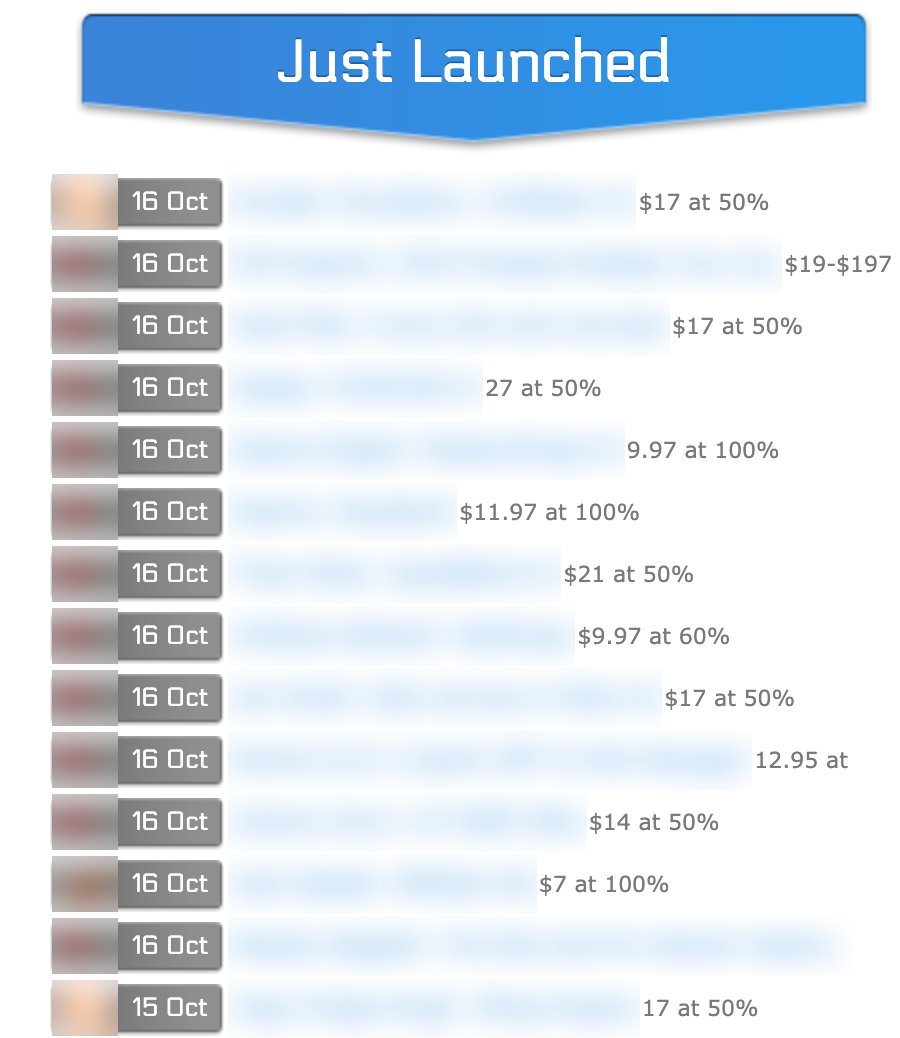
- A public calendar of new launches. No login needed.
- Count the launches with the same date. When we checked, one day had 13.
- Low prices, and half of each sale paid to whoever sends the buyer.
Screenshot of MunchEye's public launch calendar, Just Launched list, taken 2026-10-17. Product names, seller names and network icons blurred.
Example: copying doubles the sellers each round, while the buyer's day stays the same
Sellers using the same method after each round of copying
- Start 1
- Round 1 2
- Round 2 4
- Round 3 8
Method example
Example: video sales pages got better, and each click earns far less
Earnings per click, around 2010 against today
- Around 2010, low end 30
- Around 2010, high end 50
- Today, a good result 2
Example figures from one long-running seller of video sales pages, not our data
Make the buyer's time feel worth more
Fix a counting problem by speaking to what the buyer wants or where they belong, not by sending more. You cannot make the buyer's day longer. You can make your message worth the minutes.
When a message fits what the buyer checks first, a long page feels short. When it does not, ten seconds feel long and they leave.
Your offer is not fighting for market share. It is fighting for a share of the buyer's day. People spend money where they already spend time.
Every minute on your page is a minute not spent on something else. Economists call that the opportunity cost.
So cut the time it takes to get through your funnel. Every extra step costs the buyer minutes they do not have.
Upsells show it best. An upsell is a second offer shown right after someone buys.
For example, on a low-price offer, about 15 to 25 percent of buyers typically take the first upsell. The second gets 8 to 15 percent. The third gets 2 to 3 percent.
A seventh upsell is not a strategy. It is a tax on your best buyers.
Doing things in a group is one of the strongest pulls there is. People give their time to things other people are already doing.
Plan the next offer around the next problem, not the next pitch. Our guide to the next problem shows how.
Example: each extra upsell sells to far fewer buyers
Midpoint of typical take-rate ranges for a low-price offer: 15-25%, 8-15%, 2-3%
- Upsell 1 20
- Upsell 2 11.5
- Upsell 3 2.5
Example take-rate ranges, not our data
Volume spends the buyer's time; fit makes the time worth spending
| More volume | Better fit |
|---|---|
| Send more emails | Send the email that names their problem |
| Add a fourth upsell | Keep the upsells people actually take |
| Post every day | Post where people already gather |
| Uses up the buyer's minutes | Makes the minutes feel short |
Our method
Is your buyer moving, or does the buyer need to stop and learn?
Some buyers are in motion. They are already doing the work and want to go faster, with fewer mistakes.
Others must stop, learn something new, then start again. That pause is the one thing a moving buyer will not give you.
Sell a moving buyer a tool, like templates, software or done-for-you parts. Sell guidance to a buyer who is ready to stop.
Why not pitch the full rebuild? Because you are asking them to replace everything, not repair one part.
Replacing a webinar means new pages, new emails, a new pitch, new ads, new tracking and a retrained sales team. Repairing one step means none of that. That rebuild cost is a switching barrier, and it beats your pitch every time.
So how do you move a tool buyer to your method? Sell the tool first. Then learn the process they run with it.
Next, show them with real numbers where that process stops paying. Or wait until it costs them money.
Either way, the buyer has to see it for themselves. Push a rebuild on a happy buyer and you get a polite no.
Easy has a price, though. The quick fix often costs more later.
Teaching that moves people is its own skill, covered in teach them and they move.
Sell the moving buyer a tool; sell guidance to a buyer ready to stop
| Buyer in motion | Buyer who must stop |
|---|---|
| Already doing the work | Has to pause, learn, then restart |
| Wants speed and fewer mistakes | Wants to understand a new way |
| Buys tools, templates, done-for-you parts | Buys guidance, a plan, coaching |
| Hears "rebuild everything" as a cost | Is ready for a new process |
Our method
Move a tool buyer to your method in four steps
- Sell the tool Give them what they came for.
- Learn their process Find out what they run the tool inside.
- Show the ceiling Use real numbers to show where it stops paying.
- Let them choose The buyer decides to switch, or waits until it costs them.
Our method
Toward or away: open where the buyer already is
The second buyer check is direction. Some buyers move toward a gain. Others move away from a pain.
Away buyers talk about what they want to stop. They say things like "I don't want this" and "never again."
Toward buyers talk about what they want to get. They say things like "more clients" or "a stronger body."
Open where the market already is. Open a toward market on pain and it ignores you. The reverse fails too.
A flip line speaks to both. "So you can stop the late nights and start taking weekends off." Or name a gain, then add "without" and the pain.
Away buyers buy fast and need lots of proof that the pain is real. Once the pain is gone, many leave. Toward buyers tend to stay and buy again.
For example, one offer sold to lawyers had almost no upsell sales. Its copy only talked about pain going away. Rewritten to talk about gains, with numbered steps, it grew to about $1,000 a day in sales.
Notice what fixed it: not a split test, but a change of direction.
Which words to lead with is the whole topic of before-words and after-words.
Listen for the direction, then open the same way
| Away language | Toward language |
|---|---|
| "I don't want..." | "I want to get..." |
| "I want to stop..." | "I want more..." |
| "Never again." | "I'd love to..." |
| Open on: the pain going away | Open on: the gain arriving |
Our method
Pain pushes buyers away; pleasure pulls them toward, now or later
- Toward A gain they can feel today.
- Toward A gain they will get later.
- Away A pain they want gone today.
- Away A pain they want to avoid later.
Our method
Find the problem in the buyer's exact words
The sort only works on the buyer's own words. A summary in your words loses what they really meant.
Collect what buyers say when they are not choosing words carefully. Sales calls first, then email replies, then the ads they click. Together these are the voice of the customer.
Ask an open-ended question and let people hit reply. Read how they answer, not only what they say.
Two questions do most of the work. "How do you spend your free time?" shows what matters most. "What's stopping you?" shows the limit.
What a market keeps talking about is what stands in its way. Nobody thinks hard about the parts of life that run fine.
For example, a sleep coaching offer for people with sleep apnea kept hearing "let me think about it." When asked in their own words, buyers said they just wanted a good night's sleep again.
The word that mattered was "just." It meant: give me something simple. Their rival was a CPAP machine: put it on, go to sleep.
The offer asked for a long list of daily tasks. The problem was a body problem, but the buyer's test was simplicity. So the fix was to simplify the offer and sell it as one thing to do.
Want a system for collecting these words every week? See how to build a customer truth system.
Six exact quotes, sorted by kind and direction, give you the verdict
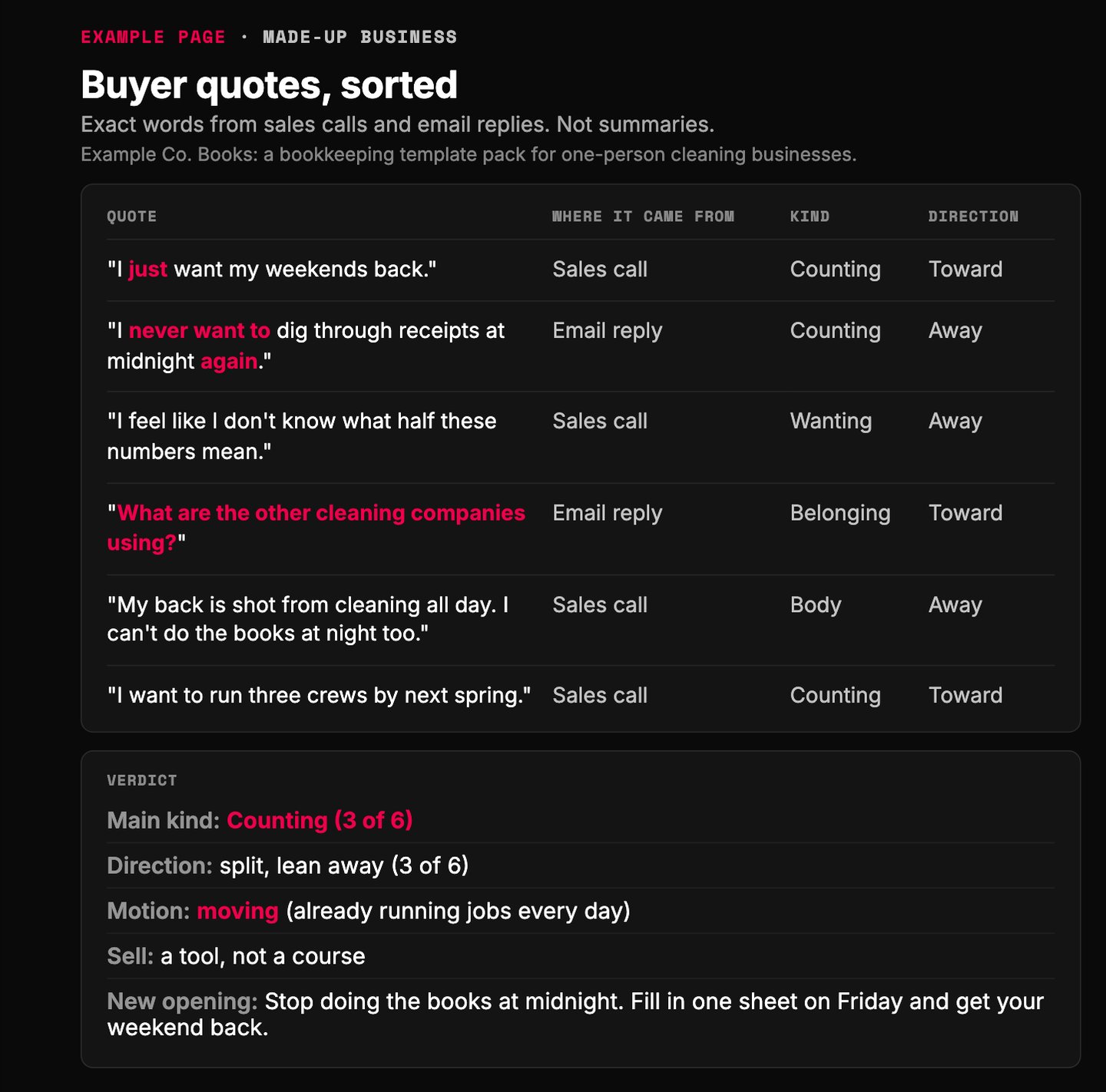
- The word "just" asks for a simple fix.
- Away language. Open on the pain going away.
- A belonging sign: they want what people like them chose.
- Lead with the kind that shows up most.
- A moving buyer gets a tool, not a rebuild.
Example page built for this article with a made-up business. Every quote and the verdict are invented.
Collect the buyer's exact words in this order
- Sales calls The best source: people talk without polishing.
- Email replies Ask one open question and let them hit reply.
- Ads they click The winning ad's words tell you what they check first.
- Two questions What do you do in your free time? What's stopping you?
Our method
Run the Problem Sort with AI
The Problem Sort is two questions you answer before you write a word. Which of the four problems is in the way? And is the buyer moving or ready to stop?
The prompt below runs the whole sort, direction included. Paste it into your preferred AI with ten real customer quotes. It tags each one and tells you what to sell and how to open.
This week: first, pull ten exact quotes from calls, replies or reviews. Second, run the prompt. Third, rewrite one ad opening so it leads with the problem the sort found.
Want a second pair of eyes on your quotes? Send them to us; you are not signing up for anything.
Remember those launches that fell to a tenth? More launches did not save them. More never does.
More messages buy less attention. Better-fit messages buy more of it.
Paste into your preferred AI. It asks for your offer and ten customer quotes, then tells you the problem kind, direction, what to sell and how to open.
Act as a careful market researcher. Sort my buyer's problem using only the rules below and my answers. Never invent a quote or a number; if something is missing, ask me.

Ask one at a time, with the example, and wait:
1. What I sell and the price. (Example: a $49 bookkeeping template pack)
2. Who buys it. (Example: owners of one-person cleaning businesses)
3. Ten exact quotes from buyers: call notes, email replies or reviews. Their words, not my summary. (Example: "I just want my weekends back.")
4. My current ad opening or headline. (Example: "The complete bookkeeping system")

Rules:
- A problem is anything in the way of an outcome the buyer wants.
- Tag each quote with one kind: COUNTING (short on time, money, resources or energy), WANTING (a felt lack inside, like a missing skill or knowledge), BELONGING (feeling safe with other people, wanting what others chose), BODY (health, sleep, weight, pain, physical limits).
- Tag direction: AWAY (don't want, stop, never again) or TOWARD (get, gain, more).
- Tag motion: MOVING (already doing the work, wants speed) or STOPPING (must pause and learn first).
- Flag small words like "just", "only" and "simply": they ask for a simple solution.
- If the main kind is COUNTING, never recommend more volume. Recommend a better fit.
- MOVING buyers get a tool or a repair to one step, never a full rebuild.
- Open where the buyer already is: AWAY opens on the pain, TOWARD opens on the gain.
- No fake urgency, no invented fear, no claims I cannot prove.

Show the tags for every quote, then use exactly this format:
MAIN PROBLEM KIND:
DIRECTION:
MOTION:
WHAT TO SELL (tool or guidance):
THREE NEW AD OPENINGS:
WHAT TO CUT:
NEXT THREE ACTIONS:

Filip Kovacevic is the founder of Anar Agency in Phoenix. He spent five years running SEO, Meta ads, email, and content for medical practices across the United States, and now does the same work for healthcare, home-service, legal, and professional-service businesses, alongside AI implementation. More from Filip →
Talk it through in 15 minutes
Bring one question from this article. We will tell you what we would do, whether or not you hire us.
Book a 15-Min Chat →