The Take-Away Close: High-Ticket Closing Without Pressure

A take-away close means stepping back and saying, honestly, that your offer may not be right for this buyer yet. People want what they might lose, so a true take-away lets the buyer argue for the sale. Give permission to say no at the start, handle objections in three steps, and never invent scarcity.
High-ticket closing works better when you step back
In 1975, researchers gave people a jar of cookies to rate. Some jars held ten cookies. Some held only two.
The cookies from the jar of two got better ratings, even though they were the same cookies.
Then the researchers tried something else. Some people got a jar of ten, and eight were taken away before they tasted one.
Those cookies scored highest of all. Being scarce helped. Being taken away helped more.
That jar shows the take-away close at work. In high-ticket closing, it means you stop pushing and say, honestly, that your offer may not be right for this buyer.
It is one of the oldest closing techniques in sales. Done right, the buyer leans in and makes the case for themselves.
Done wrong, it is a pressure trick with better manners. Our rule is simple. We only take something away when it is true.
The cookies rated best were the ones being taken away
| The jar | What happened | How the cookies rated |
|---|---|---|
| Ten cookies | Nothing changed | Lowest |
| Two cookies | Nothing changed | Higher |
| Ten, then two | Eight were removed before tasting | Highest of all |
Worchel, Lee and Adewole (1975), as summarized in Wikipedia, Scarcity (social psychology).
Why does taking the offer away work?
People push back when they feel a choice is being taken from them. Psychologists call this reactance. The option they might lose starts to look better.
There is a second force. People tend to feel a loss about twice as much as an equal gain. A buyer who might lose the offer feels it more than a buyer who is being sold it.
Most sales calls do the opposite. The buyer pulls back, so the seller pushes harder. So the buyer pulls back further.
Ever been chased across a car lot by a salesman? You walk faster.
The take-away turns it around. You step back, and now the buyer has to explain why it fits. People believe their own reasons more than yours.
That only works if you mean it. A fake step back is just a push in a nicer coat.
A loss tends to feel about twice as big as an equal gain
How large an outcome tends to feel, with an equal gain set at 1
- Gaining something 1
- Losing the same thing 2
Kahneman and Tversky (1992), as summarized in Wikipedia, Loss aversion. Rounded.
Pushing makes the buyer argue against you; stepping back makes them argue for it
| Pushing harder | Stepping back |
|---|---|
| Buyer pulls back, seller pushes | Buyer pulls back, seller steps back |
| The seller makes the case | The buyer makes the case |
| The buyer feels a choice being taken | The buyer feels free to choose |
| Ends in a stall or a forced yes | Ends in a real yes or a clean no |
Our comparison, based on reactance research.
The Take-Away Close is an honest way to close by stepping back. Give the buyer permission to say no before the first question. Take the offer away only when it is true: name who it does not fit, offer a next step and let them leave.
Handle objections in three steps: a neutral word, one question to find the real objection, then solve that one thing tied to the buyer's own reason. Get a clear yes before payment talk. Never invent scarcity and never hold anyone on a call.
Give permission to say no before your first question
The honest take-away starts before the pitch. Before your first question, tell the buyer that no is a full answer.
People often mix up two steps here. The permission to say no comes first. The take-away line comes later, once you both know whether it fits.
Here are the four rules we set at the start of a call.
1. Honest answers are all we need. "I will ask you some questions, and all I need is honest answers."
2. No is fine. "If this is not a fit, or you just decide no, that is completely okay."
3. Partners join now. "If someone else shares money decisions with you, it helps to have them on this call."
4. A clear answer at the end. "At the end I will ask for a yes or a no, and if you need time, just tell me what part."
Why does rule four matter? "I need to think about it" usually hides a question the buyer never asked. Rule four gives the buyer a way to say that question out loud.
Say the rules, then ask, "Does that sound fair?" Want the rules in place before the call starts? Put them on the booking page and in the reminders, as our guide to pre-call sequences shows.
Four rules make the take-away fair before you ever use it
- 1. Honest answers All we need from the buyer is the truth about their situation.
- 2. No is fine Not a fit, or just no, is a complete answer.
- 3. Partners join now Anyone who shares the money decision belongs on this call.
- 4. A clear answer at the end Yes or no. Need time? Name the part, and we sort it out.
The Take-Away Close, opening rules.
Set the four rules on the booking page, before the call starts
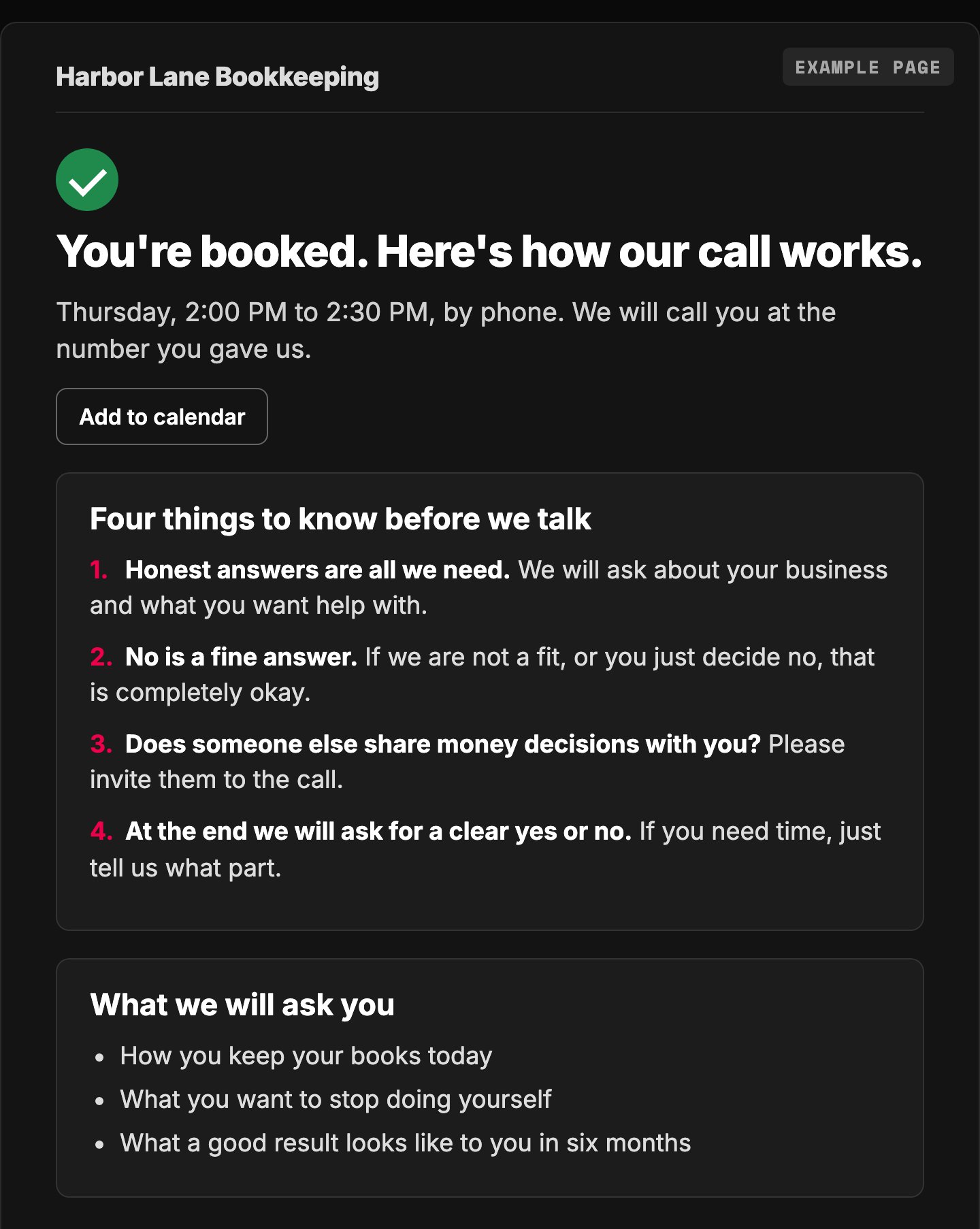
- Permission to say no, given before the first question.
- Partners join now, not after.
- A buyer who wants to think it over is asked to name the part that is still open.
- The buyer knows the questions before the call, so nothing feels like a trap.
Example page built for this article with a made-up brand.
Take the offer away only when it is true
A take-away is a true sentence about fit. It names who the offer does not work for, and it leaves the buyer free to agree.
Three moments on a call earn a take-away. The buyer doubts the whole category, or wants to dip a toe in, or goes quiet after hearing everything.
Each one gets a true line and then silence. The table below has the words. Mean them.
Some buyers will take the exit. Good. That is one refund nobody has to ask for.
Pair each take-away with an honest downside. "I will be straight with you, the first month is a lot of work." Buyers have heard "easy" a thousand times, and nobody believes it.
How to turn a take-away into a pressure tactic in four easy steps:
1. Invent a waitlist.
2. Say the price ends tonight. Say it again next week.
3. Call the buyer indecisive when they ask a fair question.
4. Refuse to hang up until they say yes. Hell, call it persistence.
Congratulations. You now have a sale, a refund request and a bad review. Usually in that order.

Three moments earn a take-away, and each line must be true
| The moment | What the buyer says | The true take-away |
|---|---|---|
| They doubt the whole category | "I am not sure this kind of thing is for me." | "If you do not want this at all, I am not going to talk you into it." |
| They want to dip a toe in | "I just want to test it out." | "This works for people who put in the hours every week. Testing it probably will not work." |
| They go quiet after hearing everything | "Hmm. I don't know." | "If you would rather leave this for now, that is fine too." |
The Take-Away Close. Example lines; adjust them to what is true for your offer.
An honest take-away describes fit; a fake one invents a limit
| Honest take-away | Fake take-away |
|---|---|
| "Based on what you told me, this may not fit yet." | "Only two spots left" when there are twenty |
| Names a real reason | Names a made-up deadline |
| Offers a next step | Offers a countdown |
| Buyer is free to leave | Buyer is kept on the call |
Our comparison.
How do you handle sales objections? Use three steps
Handle an objection in three steps. Say a neutral word, ask one question to find the real objection, then solve only that.
Step 1: say a neutral word, such as "okay", "all right" or "I see". These calm the moment and promise nothing.
Never say "I understand." The buyer hears the "but" coming before you say it.
Step 2: ask one question to find the root. Our favorite is "Is it the value, or is it the budget?" It separates doubt about results from doubt about money.
Why separate them? Because "too expensive" often means "I am not sure it works."
A discount does not fix that doubt. The buyer still wonders if it works, just at a lower price.
Step 3: solve that one thing, tied to their reason. Early in the call, the buyer told you why they want this. Bring it back now, in their words.
For example: "You said you want your weekends back. Is the money what stands between you and that, or is it whether this works?"
Repeating their situation back in new words is called active listening. Wait for "yes, exactly" before you move on.
Every objection you remove makes a yes easier, which is the idea behind action is desire minus objections.
Cannot solve it honestly? Say so. That is the true take-away.
Three steps turn an objection into one question you can answer
- 1. Say a neutral word "Okay." "All right." "I see." Never "I understand."
- 2. Find the root One question: "Is it the value, or is it the budget?"
- 3. Solve that one thing Answer the real objection, tied to the reason the buyer gave you earlier.
The Take-Away Close, objection steps.
The first objection is often a stand-in for a different one
| What they say | What it often means | One question to ask |
|---|---|---|
| "It is too expensive." | I am not sure it will work for me | "Is it the value, or is it the budget?" |
| "Bad timing." | Something else comes first | "What would need to change for the timing to work?" |
| "I need to ask my partner." | We decide money together | "Do they usually join decisions like this?" |
| "Can I pay monthly?" | The total or the first payment worries me | "Is it the total, or how the payments fall?" |
Our examples. The questions follow the three-step method.
What do you say when they say "let me think about it"?
Ask one question: "Sure. What part do you want to think about?" Then listen.
"Let me think about it" is rarely about thinking. It is usually one open question the buyer has not said out loud.
We use three honest replies, in order. Find the part, offer the information, or let them go with a plan.
Letting them go is a real option, not a bluff. Book a short follow-up, send what they asked for, and stop selling.
We do not use a fake deadline to cut the thinking short. If the price really changes on a date, say the date once. If it does not, do not invent one.
Some buyers need a night. Fine. A real yes tomorrow beats a forced yes today.
Three honest replies, and the third one lets them go
| Reply | What to say | What it finds |
|---|---|---|
| 1. Find the part | "Sure. What part do you want to think about?" | The open question |
| 2. Offer the information | "What would you need to know to decide? If I have it, I can tell you now." | The missing fact |
| 3. Let them go with a plan | "That's fine. Want to book ten minutes on Thursday?" | A real yes or no later |
The Take-Away Close. No fake deadlines at any step.
Get a clear yes before you talk about payment
"How do I pay?" is not a yes. It is a question about steps. Answer it too early, and you have explained payment to someone who has not decided.
So answer with a question: "Happy to walk you through it, but first, do you want to do this?" Wait for the words.
Not sure where they stand? Ask, "On a scale of 1 to 10, how sure do you feel?" Then ask what is missing from a 10.
The missing points are the real objection. Run the three steps on them.
Payment plan requests get the same root question. "Is it the total, or how the payments fall?" If it is the total, that is a value question, and a plan will not fix it.
The order matters more than the words. The timeline below shows where each piece sits. For why the promise comes before the price, read sale vs close and the stacked close.
Permission to say no comes first; the take-away comes after fit
- The four rules Start Honest answers, no is fine, partners join, a clear answer at the end.
- Their situation and reason Early Why they want this, in their words. Repeat it back.
- Fit check Middle If a true take-away applies, say it now, then stop talking.
- How you would help Middle Only after they ask to hear it.
- Objections Late Neutral word, one question, solve that one thing.
- Clear yes, then payment End "Do you want to do this?" before any card details.
The Take-Away Close, call order.
Where is the line between a take-away and pressure?
Two things mark the line: your words are true, and the buyer is free to leave. A take-away keeps both. Pressure breaks at least one.
"Only two spots left" when there are twenty is a false claim. Advertising claims must be truthful, and the FTC has a whole report on dark patterns, design tricks that steer people into choices they did not mean to make.
Some buyers can also change their minds by law. The FTC's Cooling-Off Rule gives three days to cancel certain sales made at home or at temporary places like hotel rooms.
It does not cover sales made fully by phone or online. So on a phone or video call, the buyer's only protection is your honesty.
Pressure costs money even when it works. For example, one high-ticket seller kept pushing a sick, elderly buyer who asked him to stop. He got the yes, and later the buyer asked for a refund and got it.
A pushed yes tends to end as a refund, a chargeback or a bad review. Never keep someone on a call who wants to leave.
Our take: if your close only works when the buyer cannot leave, you have an offer problem, not a skill problem. The claims side is in our guide to FTC risk.
Only one box is a take-away: true words and a buyer free to leave
- Fake scarcity A false limit. Still a lie, even if they can hang up.
- Honest take-away The only box we use.
- A scam False claims plus pressure.
- Hard close True words used as a trap. Expect refunds.
Our framework.
Some buyers get three days to cancel, but not on phone or online sales
- To cancel certain sales made at home or at temporary places 3
- Home sales under this amount are not covered 25
- Sales at temporary places under this amount are not covered 130
Source: FTC, Buyer's Remorse: The FTC's Cooling-Off Rule May Help (page dated September 2025), read 2026-10-17. Sales made entirely online, by mail or by phone are not covered.
What does a take-away sound like in your business?
The words change by industry. The rule does not. Say what is true about fit, and let the buyer decide.
The table below shows four examples. None of them invents a deadline or a shortage, and each one offers a next step.
These lines are examples, not scripts. Write yours from the real reasons your offer is wrong for some people.
Not sure who those people are? Start by qualifying before the call, so fewer of them book at all.
The same honest take-away works in any business
| Business | The true reason it may not fit | The take-away line |
|---|---|---|
| Dental practice | The full plan costs more than the patient is ready for | "Would it help to do only the urgent part now?" |
| Accounting firm | The owner only wants help at tax time | "The monthly service may be more than you need." |
| Contractor | The buyer wants the lowest price above all | "If price is the main thing, we are probably not your firm." |
| Coach or consultant | The buyer has no time for the next three months | "It may be better to wait until you can put in the hours." |
Our illustrative examples, not real conversations.
Plan your next call with AI
Paste the prompt below into your preferred AI. It asks about your offer, your best buyer and the objections you hear most.
Then it writes your opening rules, your true take-away lines and your three-step answers. It refuses to write fake limits.
1. Run the prompt for your main offer this week.
2. On your next call, say the four rules before your first question.
3. When the first objection comes, say "okay" and ask one question before you answer it.
Need to know how many calls you need in the first place? Book-a-call math works it backward from revenue.
Want a second opinion on your script? Send it to us.
Remember the cookies. They never tasted better than when they were about to be gone.
Paste into your preferred AI. It asks five questions about your offer, then writes your opening rules, take-away lines and objection answers.
Act as a sales coach who never uses pressure. Help me plan one sales call with the Take-Away Close.

Ask me one at a time, with the example:
1. What do you sell, and what does it cost? (Example: a bookkeeping retainer, $900 a month)
2. Who gets the best results from it? (Example: owners who want their numbers every month)
3. Who is it NOT right for, and why? Real reasons only. (Example: owners who only want help at tax time)
4. What are the three objections you hear most? (Example: "too expensive", "bad timing", "let me think about it")
5. Is any limit real right now, such as a spot count, a start date or a price change? (Example: no)

Then write, in call order:
- Opening rules, four lines: honest answers are all I need; no is a fine answer; anyone who shares money decisions should join this call; at the end I will ask for a clear yes or no, and if you need time, tell me what part.
- Up to three take-away lines, built only from my answer to question 3. Each names a true reason, offers a next step and leaves the buyer free to go.
- For each objection: a neutral first word (never "I understand"), one question that finds the real objection (value or budget, the total or how the payments fall), and a short answer tied to the buyer's own reason for buying.
- A reply to "let me think about it": ask what part, offer the information, or agree and book a follow-up.
- The clear-yes question to ask before any payment talk, and the 1 to 10 question with its follow-up.

Rules:
- Never invent scarcity, a deadline, a discount or a result. If question 5 is no, mention no limits at all.
- Never suggest keeping someone on a call who wants to leave.
- No income or results promises.
- Plain words, short sentences.

End with three things I should practice out loud before the call.

Filip Kovacevic is the founder of Anar Agency in Phoenix. He spent five years running SEO, Meta ads, email, and content for medical practices across the United States, and now does the same work for healthcare, home-service, legal, and professional-service businesses, alongside AI implementation. More from Filip →
Talk it through in 15 minutes
Bring one question from this article. We will tell you what we would do, whether or not you hire us.
Book a 15-Min Chat →