How to Close a VSL: Three Closes, Starting at the Product Name
To close a sales video (a VSL), start the close the moment you name the product, not at the price. Spend it on reasons to buy, not on objections. Then run three closes in a row: the offer with its price and guarantee, the cost of doing nothing, and the choice.
Never fake a deadline.
How to close a VSL: the close starts at the product name
Open the graph that shows how many viewers are still watching your sales video. Find the spot where it drops sharply.
You probably expect the drop at the price. Check yours. The drop often comes earlier, on the sentence where the product first gets its name.
That is the moment the viewer realizes they are being sold. It is also where the close starts. Most videos rush past that sentence.
This is how to close a VSL, a video sales letter. A VSL is a sales video that ends with an offer and a button. It grew out of the printed sales letter.
Here is the whole method in plain words. The close starts at the product name.
It spends most of its time on reasons to buy. And it runs three closes in a row, because one close only convinces one kind of buyer.
Selling on a live call instead? Read sale vs close.
Still fixing the opening? Start with the first 90 seconds of a VSL.
The close starts at the product name, not at the price
| Where most videos start closing | Where the close really starts |
|---|---|
| At the price | At the first sentence that names the product |
| The product name is a throwaway line | The product name gets as much care as the price |
| One offer, then a list of questions | Three closes in a row |
| Objections handled at the end | Objections handled in the story |
The Triple Close, as set out in this guide.
Everything after the product name is the close
- The viewer's life Opening No product, no promise.
- Remove objections Story About 80 percent of the work here.
- The close begins Product named The viewer knows they are being sold.
- The offer Close 1 Price, the reason for it, guarantee.
- One more thing Close 2 The cost of doing nothing.
- The choice Close 3 Firmer, then the button.
The Triple Close, as set out in this guide.
Spend the close on reasons to buy, not on objections
Two forces decide every click. Desire is what the buyer gains. Justification is what they give up to get it: money, time, effort, the old way of doing things.
Who controls each one? The market supplies desire.
People watching a video about getting out of debt already want out. You cannot argue anyone into wanting something.
You control justification. Your price, your guarantee, what they will not have to give up. That is where you win or lose.
Our rule of thumb splits the work 80/20. The opening and story spend about 80 percent on removing objections. The close flips it: about 80 percent reasons to buy.
Why so little room for objections at the end? Because an objection raised in the close turns the close into haggling. "I need to ask my wife" does not get answered by a bigger button.
So sort every line of your close into two piles. Objection, or reason to buy. Move most of the objection pile up into the story beats.
Not sure what the real objection is? Read handling objections in copy. Fight on the side you control.
The story removes objections; the close gives reasons to buy
| Part of the video | Removing objections | Reasons to buy |
|---|---|---|
| Opening and story | About 80% | About 20% |
| The close | About 20% | About 80% |
Our rule of thumb for splitting the work. A guide for sorting lines, not a measured result.
People click when they want it and can defend the cost
- Wants it, cannot defend it Objections pile up. Fix the close.
- Clicks Desire and justification balance.
- Wrong market No close fixes missing desire.
- Can defend it, does not want it Rarely buys. Find buyers who want it.
Our model of desire and justification.
The Triple Close treats the close as starting the moment the product is named. It spends about 80 percent of the close on reasons to buy and moves objections into the story. Then it runs three closes in a row: the offer with real prices, the true reason for the price and an honored guarantee; one more thing, the cost of doing nothing in the buyer's own numbers; and the choice, said firmly, with the risk on the seller and a button that names the outcome.
No fake timers, deadlines or scarcity.
Why one close only convinces one kind of buyer
People get convinced in different ways. Some need facts. Some need a feeling.
Some need to see people like them using it. Others need to picture how they would use it themselves.
They also differ on how long it takes. Some buy after one look. Others need to hear the case three times, from three sides.
A single close serves one of those buyers. Then the video turns into a list of questions and answers, and the other buyers leave.
For example, one company's recorded webinar restarted by mistake after it ended. Many viewers stayed for a second run. Some bought on the second or third pass.
People linger near an offer. Give them something new each time they do.
The Triple Close is three closes in a row, each with a different reason to buy.
Close one sells the offer. Close two shows the cost of doing nothing. Close three names the choice.
Each close reaches a buyer the last one missed
| What convinces this buyer | Where they get it |
|---|---|
| Facts and math | Close 1 prices and Close 2 numbers |
| A feeling | Close 3: the choice and the identity line |
| People like them using it | Proof in the story and in Close 1 |
| Picturing their own use | Close 1: how soon they start, what using it looks like |
| Hearing it more than once | All three closes, each from a new side |
Our mapping of buyer types to the three closes.
Close 1: walk from the product name to the guarantee
Close one runs from the product name to the guarantee. It has the most parts, so go in order.
Name the product inside the story. It should arrive as the answer to the story's problem. For example: "Too many owners asked me for help, so I built a service that does it for them."
Say what it is in "you" words. Your books. Your plan.
Then say how soon they can start, and promise only the start time you can deliver.
Remove the trade-offs. Use a three-part line: without this, even if that, so you can get the result. For a bookkeeping service: without learning accounting software, even if your receipts live in a shoebox, so you can stop doing books on Sunday night.
Do not run that pattern ten times. Viewers notice the repeat and start to resist. Switch to "This is not about saving a dollar here and there" and say what it is about.
Show what they will not pay. Start with what the real alternatives cost, using prices you can show. Then the price.
People judge a number against the one they saw first, a pattern called the anchoring effect.
Give the true reason for the price. A low price raises a question: what is the catch? Answer it.
For example, one software offer priced at $47 a month said the number matched what its servers cost each month.
Then the guarantee, then a fairness line. Under the FTC's guides, a money back guarantee means you refund the full price when the buyer asks. Any conditions must be clear.
End close one with a short line like "That is more than fair."
Close 1 runs from the trade-offs to the price, its reason, the guarantee and the button
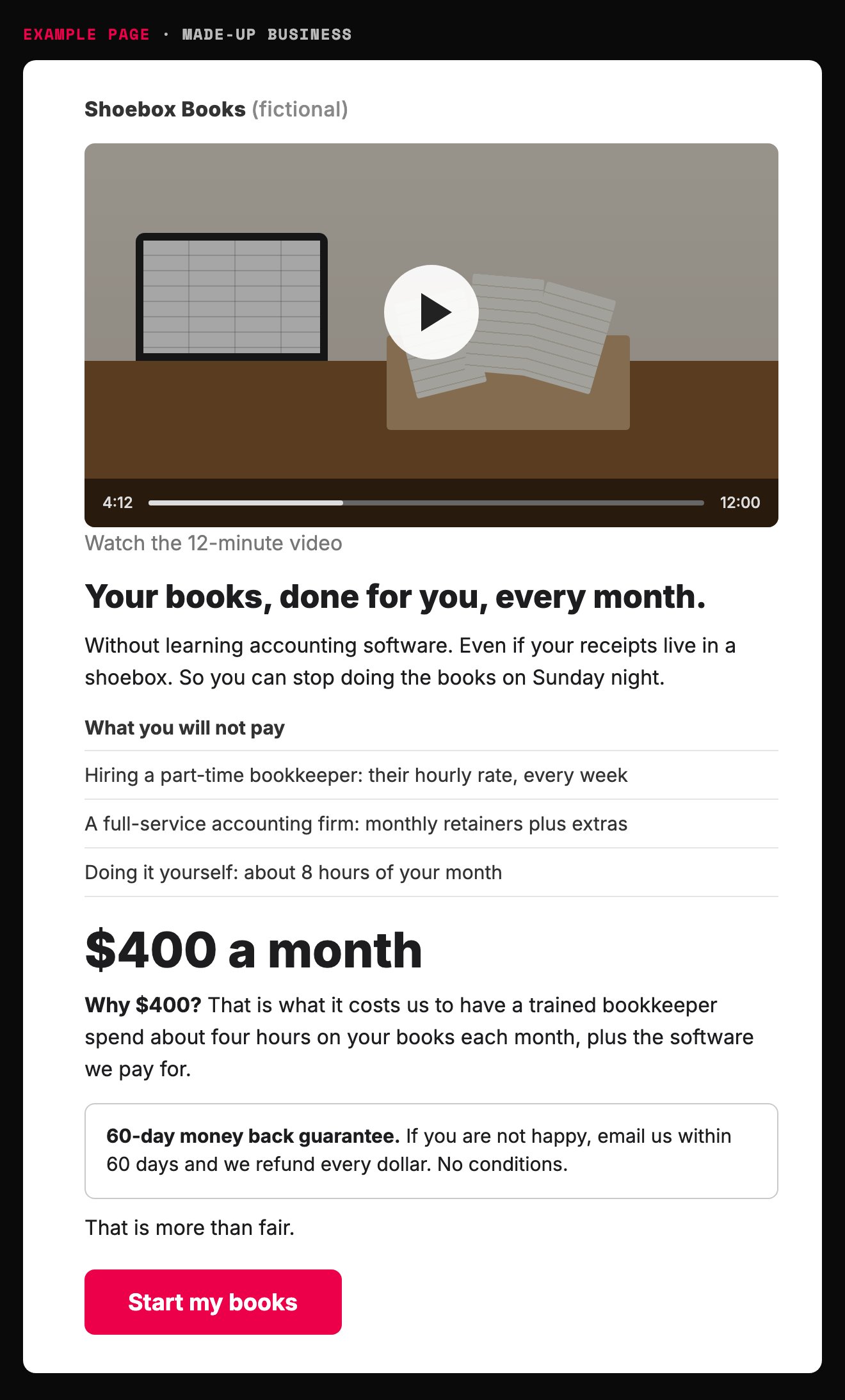
- Removes three trade-offs in one line.
- Real alternatives first, so the price is judged against them.
- The true reason for the price answers the question: what is the catch?
- Full refund when asked, and it says plainly there are no conditions.
- The button names the outcome, not Submit.
Example page built for this article with a made-up brand
Close one walks from the product name to the guarantee
- 1. Name it in the story The product answers the story's problem.
- 2. Say what it is In "you" words, with a start time you can deliver.
- 3. Remove trade-offs Without this, even if that, so you can get the result.
- 4. Show what they will not pay Real alternative prices first, then yours.
- 5. Explain the price The true reason it costs that.
- 6. Guarantee and fairness line A refund you honor, with clear conditions.
The Triple Close, Close 1.
Show the real alternatives before you show your price
- The real alternatives What a hire, a firm or doing it yourself costs. Only prices you can show.
- Everyday spend A comparison only if it is true for this buyer.
- Your price Said once, plainly.
- The reason for it Why it costs that. A true reason.
- The guarantee What happens if it does not work.
The Triple Close price sequence. Order effect: Wikipedia, Anchoring effect.
Close 2: one more thing, the cost of doing nothing
Close two opens with a turn: "And one more thing." That tells the viewer a new reason is coming, not the same one louder.
It answers the money question from a new side. Can they afford it? Wrong question.
Can they afford to keep things as they are?
People tend to stick with what they already do, even when it costs them. Psychologists call that status quo bias. Close two puts a price tag on it.
Use the buyer's numbers, not yours. For example, eight hours a month on the books, at $60 an hour of the owner's time, is $480 a month. The service costs $400.
The money gets spent either way. The only question is what it gets spent on. Economists call the thing you give up the opportunity cost.
No real numbers? Skip the math. A made-up loss is still a false claim.
End close two by turning the problem into a decision. They no longer have a problem. They have a fix, and a choice to make.
Example: doing it yourself costs $480 a month; the service costs $400
The cost of doing nothing, from the buyer's own hours and rate
- Owner's time on the books each month 8
- Value of one hour of the owner's time 60
- Monthly cost of doing it yourself 480
- Monthly price of the service 400
Example built for this guide. Prices and hours are illustrative inputs, not results. Math: 8 x $60 = $480.
Use the buyer's numbers, never a scary guess
| Pressure version | Our version |
|---|---|
| "You are losing thousands every month" | "Eight hours at $60 is $480. This is $400." |
| A loss nobody can check | Math the viewer can redo |
| The same reason, said louder | A new reason: the cost of standing still |
| Ends on fear | Ends on a choice |
Our comparison. Example numbers from this guide.
Close 3: the choice, said plainly and more directly
Close three names the choice. Keep things as they are, or click.
The tone moves from warm to firm. Not angry. Direct.
The soft version already played, and these viewers are still watching.
Say you cannot decide for them. Then put the risk on you: try it, and if it does not work, ask for the refund.
Lower the ask: "You are not saying yes. You are saying maybe, for 60 days."
Add a time contrast. A month from now, they will be a month older either way. In the bookkeeping example, the only difference is whether the books got done.
Then one identity line, late and short: who do you want to be a year from now? How people see themselves, their self-concept, drives a lot of choices.
Say the doubt out loud. Everyone has one before a purchase like this. Then send them to the button.
Make the button mean the outcome. The click is the moment they decide, so the call to action should name the result, like "Start my books", not "Submit". The same goes for a booking form.
Close 3 names the choice plainly and puts the risk on the seller
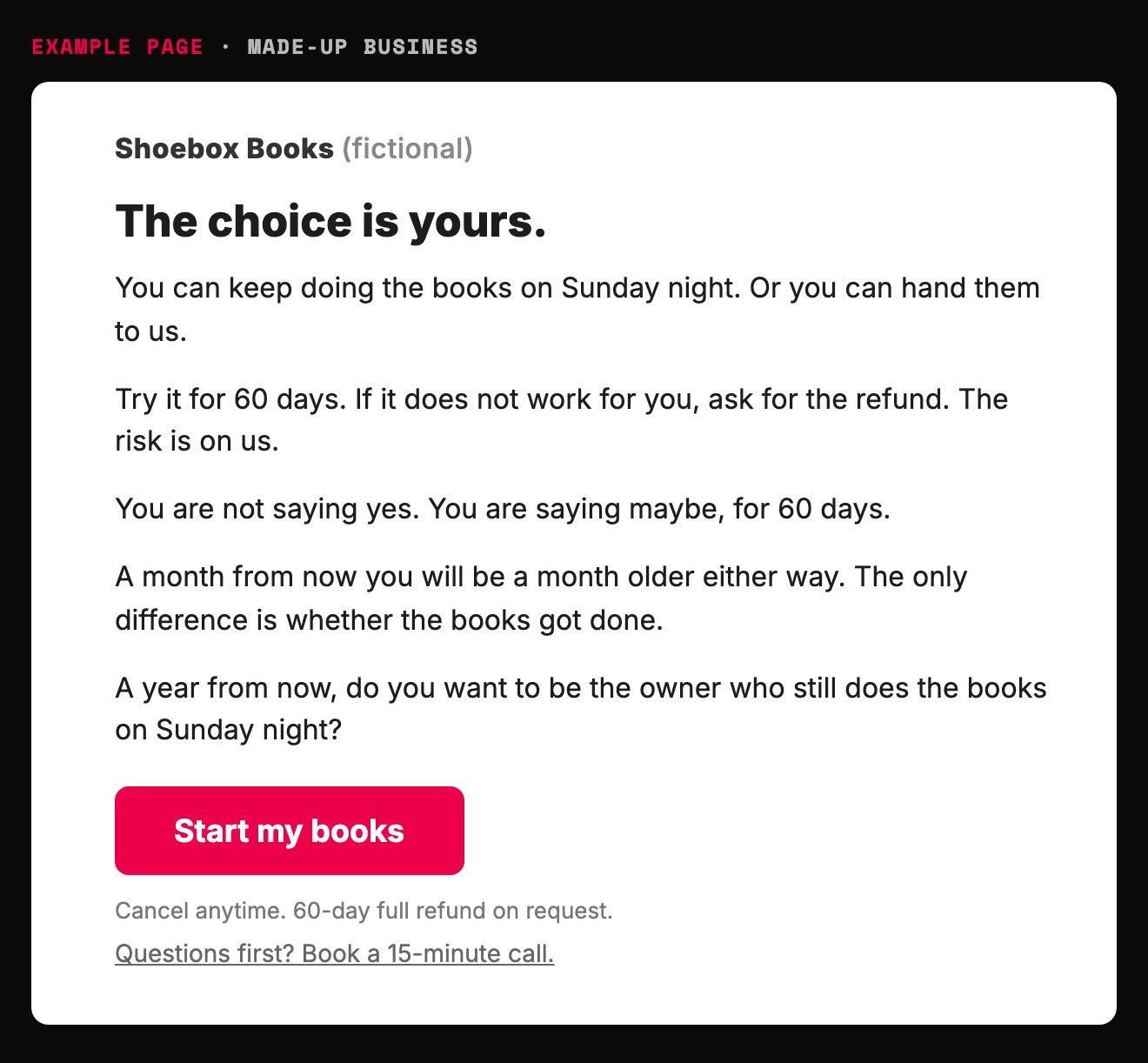
- Close 3 names the choice plainly.
- Risk moves to the seller, backed by a real refund.
- A smaller ask, tied to the length of the guarantee.
- One identity line, late and short.
- The button names the outcome. Terms sit right under it.
Example page built for this article with a made-up brand
Each close gets a little firmer, never ruder
- Close 1: warm Here is what it is and what it costs.
- Close 2: warmer Here is what waiting costs you.
- Close 3: direct Here is the choice. The risk is on us.
The Triple Close, tone guide.
Close three names the choice and ends on the button
- 1. The choice Keep things as they are, or click.
- 2. Risk on you Try it. Refund if it does not work.
- 3. A smaller ask Maybe, for the length of the guarantee.
- 4. Time contrast A month older either way.
- 5. One identity line Who do you want to be a year from now?
- 6. The button A label that names the outcome.
The Triple Close, Close 3.
How long should a VSL close be?
Match the close to the length of the video. A 10-minute video can use two closes. A 20-minute or longer video has room for three, with more parts in each.
Mass-market offers can carry long videos and long closes. Narrow, crowded markets reward the fastest clear message, because those buyers have heard the pitch before.
For example, one coaching company cut its sales video from 30 minutes to 8, and the short version did better. Another business's hour-long video for a mass-market book worked fine.
Selling to logical buyers, like finance or software buyers? Do the math on screen. If you show prices stepping down, every step must be a real price you charge or charged.
After the sale, an upsell video needs one short close. They already bought, so lead with the payoff, not the build-up. More on what to offer next.
Long close, short close? Your graph decides. See how retention at the offer sets your real cost per viewer.
Shorter videos need fewer closes, not weaker ones
| Video | Closes | Focus |
|---|---|---|
| About 10 minutes | 2 | Offer, then the choice |
| 20 minutes or longer | 3 | All three, more parts in each |
| Upsell after the sale | 1, short | The payoff, not the build-up |
| Logical buyers (finance, software) | 2 or 3 | Do the math on screen, real prices only |
Our guidance for the Triple Close.
What we leave out of every close
Some closes run on pressure. We leave those moves out, because pressure turns into refunds.
How to turn a strong close into a refund pile in four easy steps:
1. Add a countdown timer that resets when it hits zero.
2. Say "only three spots left" on a digital download.
3. Offer a money back guarantee, then hope like hell nobody reads the conditions.
4. Tell viewers it will be their own fault if they do not buy.
The FTC's report on dark patterns lists the baseless countdown timer: a fake clock that resets or vanishes when it runs out. Regulators abroad have acted on fake timers too.
Our rules are short. A real deadline, or no timer.
Real prices in every comparison. Every claim backed by evidence, and a guarantee you honor.
A firm tone is fine. Shame is not.
Pressure sells once. Then the refunds come. Read why refunds drive FTC trouble.
Every pressure move has an honest version that keeps the sale
| Pressure move | Our version |
|---|---|
| A countdown timer that resets | A real deadline, or no timer |
| "Only three spots left" on a download | No scarcity claim unless supply is truly limited |
| A guarantee with hidden conditions | Full refund on request, conditions stated |
| "It will be your fault" | "The choice is yours, and the risk is on us" |
Our rules. Timer example: FTC, Bringing Dark Patterns to Light.
Write your Triple Close with AI
Paste the prompt below into your preferred AI. It asks six questions, then rewrites your close from the product name to the button.
It sorts your lines into objections and reasons to buy. It never adds a timer, a fake deadline or a claim you cannot prove.
Check every price and number it writes. It only knows what you told it.
Paste into your preferred AI. It asks six questions, then rewrites your close from the product name to the button.
Act as a copy editor. Help me write the close of my sales video (VSL) with the Triple Close.

Ask me one question at a time, with the example:
1. What do you sell, at what price? (Example: done-for-you bookkeeping, $400 a month)
2. Who watches, and what do they want? (Example: shop owners who do their own books)
3. What do they give up today to get it themselves? (Example: about 8 hours a month)
4. What do the real alternatives cost, as prices you can show? (Example: a local bookkeeper's posted rate)
5. Your guarantee, exactly as you honor it. (Example: 60 days, full refund, no conditions)
6. Paste the script from the sentence where the product is first named to the end.

Rules:
- The close starts at the product name. Rewrite that sentence first, as the answer to the story's problem.
- Sort every line into "objection" or "reason to buy". Aim for about 80% reasons to buy. List objection lines to move into the story.
- Close 1: what it is in "you" words, how soon they can start (only what I can deliver), a "without... even if... so you can" line, real alternative prices, the price, the true reason for the price, the guarantee, one fairness line.
- Close 2: "one more thing": the cost of doing nothing, from my answer to question 3, math shown. No real numbers, skip it.
- Close 3: the choice, firmer and direct, never shaming. Risk on me, a time contrast, one "who do you want to be" line, a button label that names the outcome.
- Vary the wording; no phrase more than twice.
- Never add a countdown timer, a fake deadline, fake scarcity, a result claim I cannot prove, or a guarantee condition I did not give you.
- A 10-minute video gets two closes. Longer videos get three.

Output: the new product-name sentence, the objection lines to move, Close 1, 2 and 3 as script, then three changes to test first.
Run it this week
1. Find the sentence where your product first gets its name. Rewrite it as the answer to the story's problem.
2. Run the prompt on your script. Move the objection lines it flags into the story.
3. Add close two and close three. Then watch the viewer graph after the next 500 views.
Want a second pair of eyes on the script? Send it to us. For a live call, the same logic shows up in the take-away close.
Go back to that big drop on your graph. It was never really about the price.
Give the product's name the care you give the price. That is where the close begins.

Filip Kovacevic is the founder of Anar Agency in Phoenix. He spent five years running SEO, Meta ads, email, and content for medical practices across the United States, and now does the same work for healthcare, home-service, legal, and professional-service businesses, alongside AI implementation. More from Filip →
Talk it through in 15 minutes
Bring one question from this article. We will tell you what we would do, whether or not you hire us.
Book a 15-Min Chat →