How to Start a Sales Letter: Open by the Side Door
Start a sales letter, email or video with something the reader wants to hear more of, not with your offer. Use a short scene, a truth about their day, a puzzle from their work, or one useful tip. People tune out once they spot a pitch.
Bring in the offer after they are interested, and name it plainly.
The best-known sales letter never named the product in its first line
Starting in 1975, The Wall Street Journal mailed out a subscription letter by an ad writer named Martin Conroy. Here is its first line: "On a beautiful late spring afternoon, twenty-five years ago, two young men graduated from the same college."
No price. No newspaper. No offer.
Just two graduates and a spring afternoon.
It worked anyway. The letter ran for 28 years and is credited with an estimated $2 billion in subscription sales.
It never even says the successful man subscribed. Readers made that link on their own.
That is how to start a sales letter, an email, an ad or a video. You come in by a side door. The rest of this guide shows you the four doors, how to pick one, and how to turn to the offer without a bait and switch.
A letter that opened with a story ran for 28 years
- years in use, 1975 to 2003 28
- estimated subscription sales 2
- products or prices in its first sentence 0
Source: Wikipedia, Martin Conroy, citing the New York Times obituary. Sales figure is an estimate, as reported.
The most famous subscription letter opens with a scene and lets the reader connect the dots
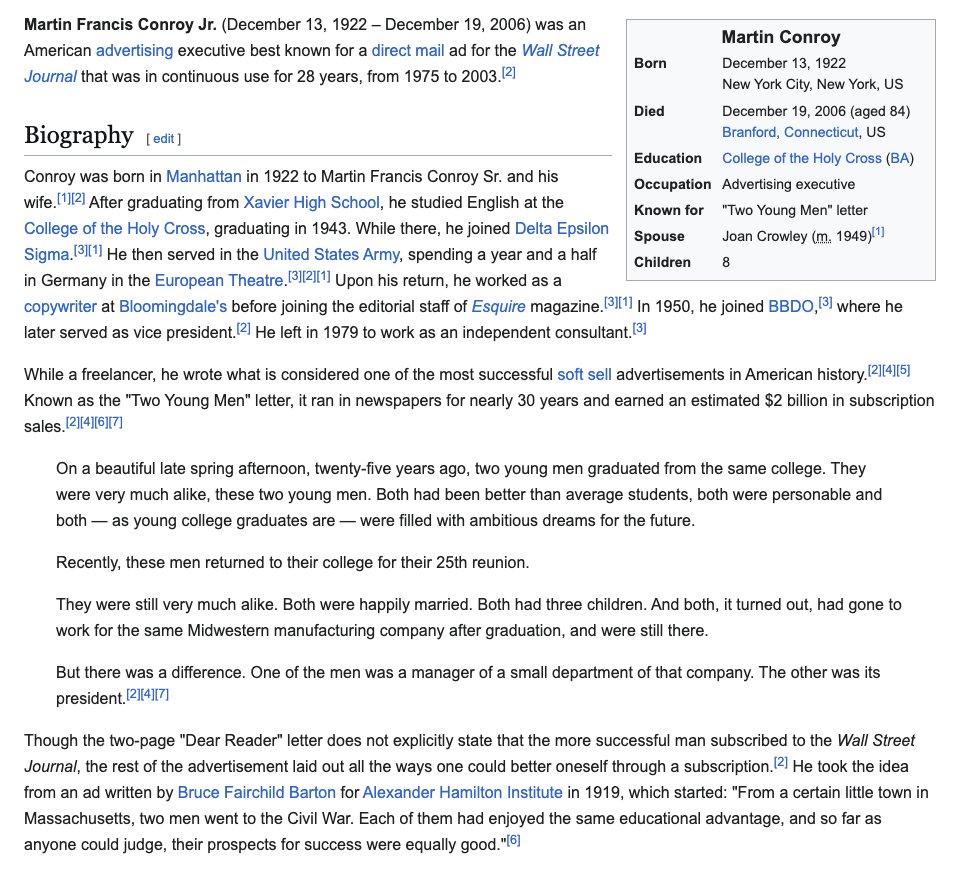
- The letter ran for 28 years.
- An estimate, as reported. Not our number.
- Line one is a scene. No paper, no price, no offer.
- The turn. The story raises the question the offer answers.
- The reader connects the dots alone.
Screenshot of Wikipedia, Martin Conroy (citing the New York Times obituary), taken 2026-10-18. Pin notes are Anar's commentary.
Why do people tune out the moment they spot a pitch?
People tune out a pitch because the moment they spot one, they start reading as a skeptic. From then on, they check every claim you make.
It happens fast. They work out what the message is. They compare the sender to themselves.
Then they decide. Keep reading, or leave.
Psychologists have a word for one part of this. When people feel pushed to choose, they push back. They call it reactance.
You can watch it happen in a meeting room. In Demand-Side Sales 101, Bob Moesta interviews a company leader named Chad about how he picked a new bank.
Chad tells him that if a bank walks in with a slide deck already prepared, he gets up and leaves. The finalists opened a different way. They said the meeting was about understanding his business, and the presentation could come later.
The bank he chose started from a blank sheet. Our reading: a page works the same way.
Talk about yourself first, and the reader walks out too. On a page, they do not even say goodbye.
How to get your sales email deleted in four easy steps:
1) Open with your company name.
2) Put the price in line two.
3) Ask for a call before they know why.
4) Describe a founder who looks nothing like the reader.
That is not an opening. That is an exit sign with your logo on it.
A pitch in line one makes the reader a skeptic
| Front door | Side door |
|---|---|
| "Ledgerline does monthly bookkeeping for roofers." | "It is 9 p.m. and a week of receipts is still in your truck." |
| The reader spots a pitch and starts checking claims. | The reader pictures the scene and wants the next line. |
| Every line after it is read by a skeptic. | The offer arrives once they care how it ends. |
Example. Ledgerline is a made-up business.
Buyers close up when the seller talks about itself first
| Where | What happened | Source | How sure |
|---|---|---|---|
| Choosing a business bank | The buyer leaves any pitch that opens with a ready-made deck. The finalists opened by asking about his business. | Demand-Side Sales 101 | One buyer's account |
| Buying a mattress | Store staff only asked bed size and budget. The buyer noticed. | Competing Against Luck | One buyer's account |
| A newspaper subscription letter | Opened with a story, no product. Ran for 28 years. | Wikipedia, Martin Conroy | Reported history |
Sources: Moesta, Demand-Side Sales 101; Christensen et al., Competing Against Luck; Wikipedia.
Start any sales message by a door the reader does not guard: a scene with no product in it, a truth about their day they already know, a puzzle from their work, or one useful gift. First cut every detail that makes the reader think "not like me," start with what they feel right now, and write three versions before you pick one. Turn to the offer as the next line of the story, agree before you add, and then name the offer, the price and the seller plainly.
Match the length to the medium: a paragraph for a letter, a line for an email, a sentence for a short video ad.
Four side doors that earn the next sentence
A side door is an opening that gives the reader something they want before it asks for anything. The Side-Door Opening is our method for starting any sales message with one of four doors, then turning to the offer once the reader is curious.
A scene: a moment the reader can picture, with no product in it. Two graduates on a spring afternoon, or a contractor's phone buzzing at nine at night.
A shared truth: something about their day they already know is true, such as "Nobody started a roofing company to do bookkeeping." Agreement in the first line is where rapport starts.
A puzzle from their work: a question about their trade, not about your product. "Why do some clinics fill their January calendar while others sit empty?"
A small gift: one useful tip, given before any ask. The authors of Hacking Growth build growth tests on this: people want to return a favor, so you give before you ask for a purchase.
Why do the first three work? People caught up in a story argue with it less, an effect researchers call transportation. The gift works on reciprocity instead.
None of this is new. Conroy borrowed his idea from a 1919 ad about two men who went off to the Civil War. Good openings get reused because they keep working.
Borrow the shape. Never the words.
Each door gives the reader something before it asks
| Door | What it is | Example line | Why it works |
|---|---|---|---|
| A scene | A moment with no product in it | "A contractor's phone buzzes at nine at night." | People caught up in a story argue with it less |
| A shared truth | Something about their day they know is true | "Nobody started a roofing company to do bookkeeping." | Agreement starts rapport |
| A puzzle from their work | A question about their trade, not your product | "Why do some clinics fill January and others sit empty?" | An open question pulls them forward |
| A small gift | One useful tip before any ask | "Here is the one receipt rule that saves the most time." | People want to return a favor |
Example lines are made up. Research: Wikipedia, Transportation theory, Rapport, Reciprocity.
How to write a side-door opening in five steps
Five steps take you from a pitch-first draft to an opening people finish. Use them on a letter, an email, a page or a script.
Step 1: write down who reads it. Age range, job, where they live, what their week looks like. One line each.
If it takes a paragraph, you do not know them yet.
Step 2: cut what makes them compare. Before you add anything, delete every detail that makes the reader think "not like me," such as a niche word that shuts out half your list or a city that is not theirs.
For example, one crypto course saw conversions rise after its 22-year-old seller was taken out of its video. His buyers were mostly men in their 40s and 50s. That is one business's example, not a test we ran.
Stay vaguely specific. "When I had my clinic" fits dentists and chiropractors. "When I had my dental clinic" loses every chiropractor, so say the wider version, and only if it is true.
Step 3: start with what they feel right now. Not where your offer starts. Not last year's problem.
How do you find that feeling? Ask three recent buyers about the day they started looking, then listen. No pitching.
A mattress buyer in Competing Against Luck shows why. Store staff, he tells his interviewer, usually just ask his bed size and his budget. No one in a mattress store had ever asked him that many questions.
Step 4: pick a door and write three versions. One scene, one shared truth, one puzzle. Read them to one person in your market and keep the one that makes them ask what happened next.
Step 5: write the turn. The turn is the line that moves from the opening to the offer. It should read like the next line of the story, not a change of subject.
Five steps from a pitch-first draft to a side-door opening
- Write down who reads it Age range, job, place, what their week looks like.
- Cut what makes them compare Delete every "not like me" detail before adding anything.
- Start with what they feel now Ask three recent buyers about the day they started looking.
- Write three versions A scene, a shared truth, a puzzle. Keep the one people want to finish.
- Write the turn The offer arrives as the next line of the story.
Anar's method.
The same email, opened by the front door and by the side door
| Front door | Side door |
|---|---|
| Subject: Monthly bookkeeping for roofers | Subject: The receipts in your truck |
| "Ledgerline does monthly bookkeeping for roofing companies. Plans start at $400 a month. Book a call this week." | "It is 9 p.m. The last quote just went out, and a week of receipts is still on the dashboard of your truck." |
| (no turn: the pitch is the opening) | Turn: "That pile is the job we take off your hands." |
| Offer in line one | Offer right after the turn: "Ledgerline closes your books every month for $400. You snap a photo of each receipt, and we do the rest." |
Example. Ledgerline and its price are made up.
Same email, same offer, and only the side door earns the next line
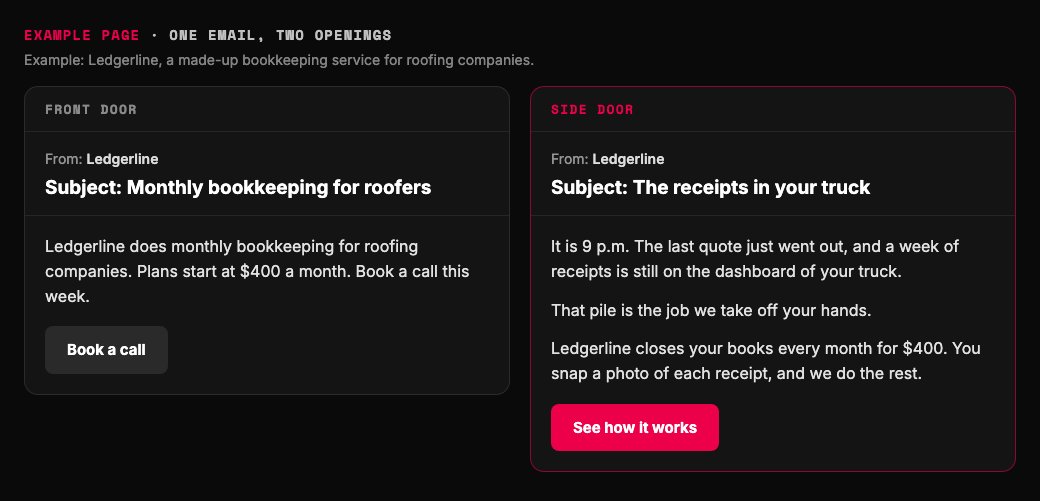
- Front door: the product in line one. The reader starts checking claims.
- The subject line is part of the door. No product in it.
- A scene the reader can picture, with no product in it.
- The turn: the offer arrives as the next line of the story.
- Then the offer, the price and the seller, said plainly.
Example page built for this article with a made-up brand.
How long should the opening of a sales message be?
The opening should be as long as the medium allows, and no longer. A letter can spend a full paragraph on a scene. A short video ad gets one sentence before the thumb moves.
Why so short online? Most people scan web pages instead of reading every word. So the first line carries the whole load.
Long ads and letters can afford the paragraph. See how to write the long ad.
Video is stricter. The side door has to open in the first three seconds, then hold through the first 90 seconds of a sales video.
Email sits in between. The subject line and the first sentence are the door. Everything else in a nurture sequence comes after it.
Good rule? Shorter than you think. Then cut one more line.
The shorter the medium, the shorter the side door
| Medium | How long the side door gets | What carries it |
|---|---|---|
| Sales letter or long page | A full paragraph | The headline and the first paragraph |
| Long social ad | Two or three short lines | The lines above the "see more" cut |
| One sentence | The subject line and the first sentence | |
| Sales video | One or two sentences | The first three seconds, then the first 90 |
| Short video ad | One sentence | The first three seconds |
Anar's rule of thumb.
Turn to the offer as the next line of the story
The turn is where most side doors fail. The writer tells a good story, then lurches into a pitch. It feels like a movie that cuts from the big chase to a car commercial.
Conroy's turn was five words: "But there was a difference." One graduate ran a small department. The other ran the company.
The rest of the letter explains the difference, and the paper is the answer. The story asks the question the offer answers.
Agree before you add. When the reader already believes something, say you see what they mean, then add your point with "and."
A "but" right after agreement cancels the agreement. Swap one word and the reader stays on your side.
Then build trust before you ask for respect. In Building a StoryBrand, Donald Miller cites Harvard researcher Amy Cuddy: people ask whether they can trust you, then whether they can respect you. Trust comes first, and a side door is how you earn it.
Proof earns the respect. That is a different job, covered in the four sources of trust.
Then name the offer plainly. What it is, what it costs, who sells it. No riddles.
The turn should read like the story's next line
| Change of subject | Next line of the story |
|---|---|
| "Anyway, that is why I started Ledgerline." | "That pile is the job we take off your hands." |
| "I see what you mean, but you are wrong." | "I see what you mean, and here is what changed my mind." |
| The reader feels the pitch arrive. | The reader feels the story answer its own question. |
Example lines.
Earn trust first, respect second, and only then ask
- Can I trust you? Answered by the side door: you understand their day.
- Can I respect you? Answered by proof: results, reviews, credentials.
- Do I want this? Answered by the offer, named plainly with its price.
Trust then respect: Amy Cuddy, as cited in Building a StoryBrand. The third rung is ours.
Is a soft opening just hiding the sale?
No, as long as the reader knows exactly what is for sale by the end. A side door delays the pitch. It does not disguise it.
Copywriters call this a soft sell. Hiding the sale is something else.
An ad dressed up as independent news or a friend's tip can mislead. That is why native advertising draws so much criticism. The FTC expects ads to be truthful and not misleading.
Our rule: the opening may not promise what the offer cannot deliver. A story that hints at a result is a claim. Claims need proof.
Made-up scenes get labeled. "Picture this" is honest. A fake customer story with a fake name is not.
A bait and switch is not a side door. It is a trapdoor, and readers remember who built it.
A side door delays the pitch and never hides it
| Fair side door | Keep out |
|---|---|
| "Picture this: it is 9 p.m. and the receipts are still in the truck." | A fake customer with a fake name and a fake result |
| The offer, price and seller are clear by the end. | The ad is dressed up as independent news. |
| The story points at a problem the offer really solves. | The story hints at a result the product cannot produce. |
Anar's rule. FTC: ads must be truthful and not misleading.
Where side-door openings go wrong, and the fix
Most side-door openings fail in one of three ways. Each one shows up in your own numbers or replies.
People read the story, then leave before the offer. The cause is a story with nothing to do with what you sell. Tie the scene to the problem your offer solves.
People reply "get to the point." The opening is too long for the medium. Cut the scene to one line, then check where readers stop in a scroll map or where viewers drop in your video stats.
The opening feels fake. The detail is invented, or it belongs to someone the reader is not. Use a true moment, and keep details general enough to fit most of your list.
The goal is not a clever opening. It is an opening people finish.
Openings that start from a cause the reader already accepts are covered in start with the cause.
Three ways a side door fails, and the fix for each
| Symptom | Cause | Fix |
|---|---|---|
| Readers leave before the offer | The story has nothing to do with what you sell | Tie the scene to the problem the offer solves |
| "Get to the point" | Too long for the medium | Cut the scene to one line, then check where people stop |
| The opening feels fake | Invented detail, or a detail the reader does not share | Use a true moment with details that fit most of your list |
Anar's fixes.
Rewrite your opening with AI this week
The prompt below runs the Side-Door Opening on any draft. Paste it into your preferred AI with your email, page or script.
It asks who reads it, what you sell and what is true. Then it writes three openings with their turns.
It will not invent a story or a number. Where it needs a fact, it writes [CONFIRM], and the truth stays your job.
This week, do three things. Pick the email or page you send most, and delete its first sentence if it names your product. Run the prompt, read the three openings to one customer, and ship the one they want to finish.
Then fix the next line down. How to write a hook picks up right where the side door leaves off.
Conroy's two young men never mentioned a price. They did not have to. Readers kept walking in by that side door for 28 years.
Paste into your preferred AI with your draft. It asks a few questions, then writes three side-door openings with their turns.
Act as a careful copy editor running the Side-Door Opening on my draft.

Ask me these one at a time, with the example. If I paste everything at once, skip the questions and start.
1. What do I sell, and what does it cost? (Example: "Monthly bookkeeping for roofing companies, $400 a month.")
2. Who reads this? Age range, job, what their week looks like. (Example: "Roofing owners, 35 to 60, quoting jobs at night.")
3. What do they feel right now about this problem, in their own words? (Example: "Behind on receipts and dreading tax time.")
4. One true story, moment or result I can use, or "none."
5. The draft: an email, page, ad or video script.

Then:
1. In the first lines, delete every detail that would make this reader think "not like me." List what you cut.
2. Write three openings, one per door: a scene with no product in it, a truth about their day they already know, and a puzzle from their work. If I said "none" for a story, start any scene with "Picture this:" so it is clearly made up.
3. For each opening, write the turn: one or two lines that move to the offer as the next step of the story. Agree before you add, and use "and," not "but."
4. Right after the turn, name the offer, the price and the seller plainly.
5. Fit the length to the medium: a paragraph for a letter or page, one line for an email, one sentence for a short video ad.

Rules:
- Never invent a fact, number, customer or result. Where one is needed, write [CONFIRM: what you need from me].
- No fake scarcity, no fake news formats, no opening that promises what the offer cannot deliver.

Output:
A. The three openings, each with its turn.
B. The one you recommend, and why, in one line.
C. Every [CONFIRM] item, numbered.
D. What you cut from my first lines, and why.

Filip Kovacevic is the founder of Anar Agency in Phoenix. He spent five years running SEO, Meta ads, email, and content for medical practices across the United States, and now does the same work for healthcare, home-service, legal, and professional-service businesses, alongside AI implementation. More from Filip →
Talk it through in 15 minutes
Bring one question from this article. We will tell you what we would do, whether or not you hire us.
Book a 15-Min Chat →