The First Three Seconds of a Video Ad: Build Frame One for the Eye
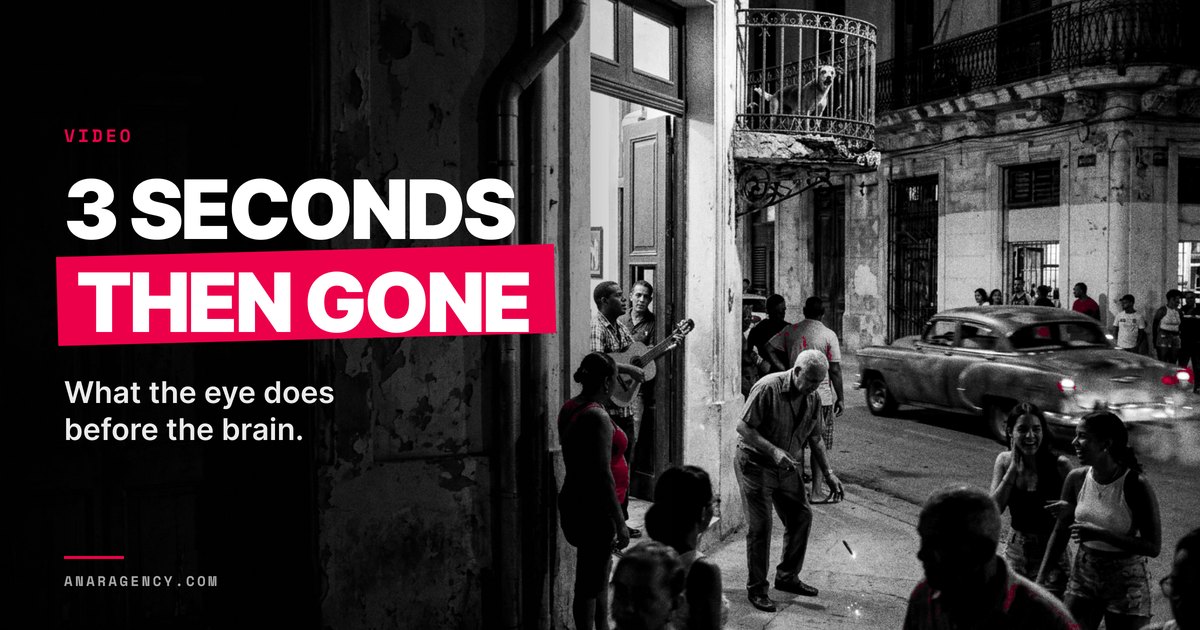
In the first three seconds of a video ad, the eye decides before the mind does. It jumps to motion, a face looking at it, strong contrast and anything odd. So build frame one from those: something already moving, a person facing the lens, four words on screen, one subject, an open question and a quick feeling.
Pause your ad on frame one, because that is where it loses
Pause your last video ad on its very first frame. Look at it for one second. That is all a stranger's thumb gives it.
A logo fades in on a white wall. Nobody is in the shot. Nothing moves yet.
That frame is where most video ads lose the room. Not at the offer. At frame one.
This guide is about the video ad hook you see, not the one you hear. The words get their own guide on how to write a hook. Here we fix the picture that has to win the glance first.
The short version? The eye picks before the brain thinks. Motion, a face, contrast and something odd win the pick, so we built six checks around them and a test you can run this week.
Most ads open on the left column; the eye wants the right one
| Common frame one | What the eye grabs |
|---|---|
| A logo fading in | A hand already moving toward the lens |
| A product on a table | A person looking into the camera |
| No words for two seconds | Four words in a high-contrast box |
| Three things at once | One thing to look at |
| Everything explained | Something that needs explaining |
| Calm and pleasant | A flash of surprise |
Anar's rules, built from the attention studies cited in this article.
What happens in the first 3 seconds of a video ad?
The first three seconds of a video ad are a reflex test, not a choice. The viewer has not heard your offer yet. Their eyes have already voted.
In the 1950s and 1960s, the Soviet psychologist Alfred Yarbus recorded where people's eyes went as they studied pictures. The gaze did not sweep the picture evenly. It jumped, and kept coming back to the eyes and mouth of a face.
He found a second thing that matters for ads. Attention went to parts of a picture that looked unusual, unfamiliar or hard to explain. Odd gets looked at.
Attention researchers call this pull salience: some things stand out from their surroundings and grab the eye on their own. A sudden change also sets off the orienting response, the reflex that turns your head toward anything new.
The book Writing for Busy Readers, by Todd Rogers and Jessica Lasky-Fink, names two shortcuts the eye takes. We notice strong contrast first. And we find what we are already hunting for, fast.
There is a catch. When the brain locks onto one thing, it tunes out the rest. In the invisible gorilla study, nearly half the people counting basketball passes missed a person in a gorilla suit.
So frame one has one job. Be the thing the eye picks. The persuading starts after that.
The eye votes before the mind reads
- 1. Reflex The eye lands on motion, a face, contrast or something odd. Or it moves on. No thinking yet.
- 2. Recognize What is this? Who is it for? Frame one has to answer fast.
- 3. Decide Is this worth my time? Only now do the offer and the words start to matter.
Anar's model, built on the attention research cited in this section.
The eye jumps to faces and odd details, and misses what it is not hunting for
| What the eye does | Where it comes from |
|---|---|
| Goes to faces, and returns to the eyes and mouth | Yarbus's eye-movement recordings |
| Stops on parts that look unusual or hard to explain | Yarbus, quoted on Wikipedia's eye tracking page |
| Notices strong contrast first | Rogers and Lasky-Fink, Writing for Busy Readers |
| Misses what it is not looking for | Invisible gorilla study: nearly half missed the gorilla |
Sources: Wikipedia (Alfred L. Yarbus; Eye tracking); Writing for Busy Readers; Simons and Chabris (1999).
The eye jumps to faces, and its path changes with the question
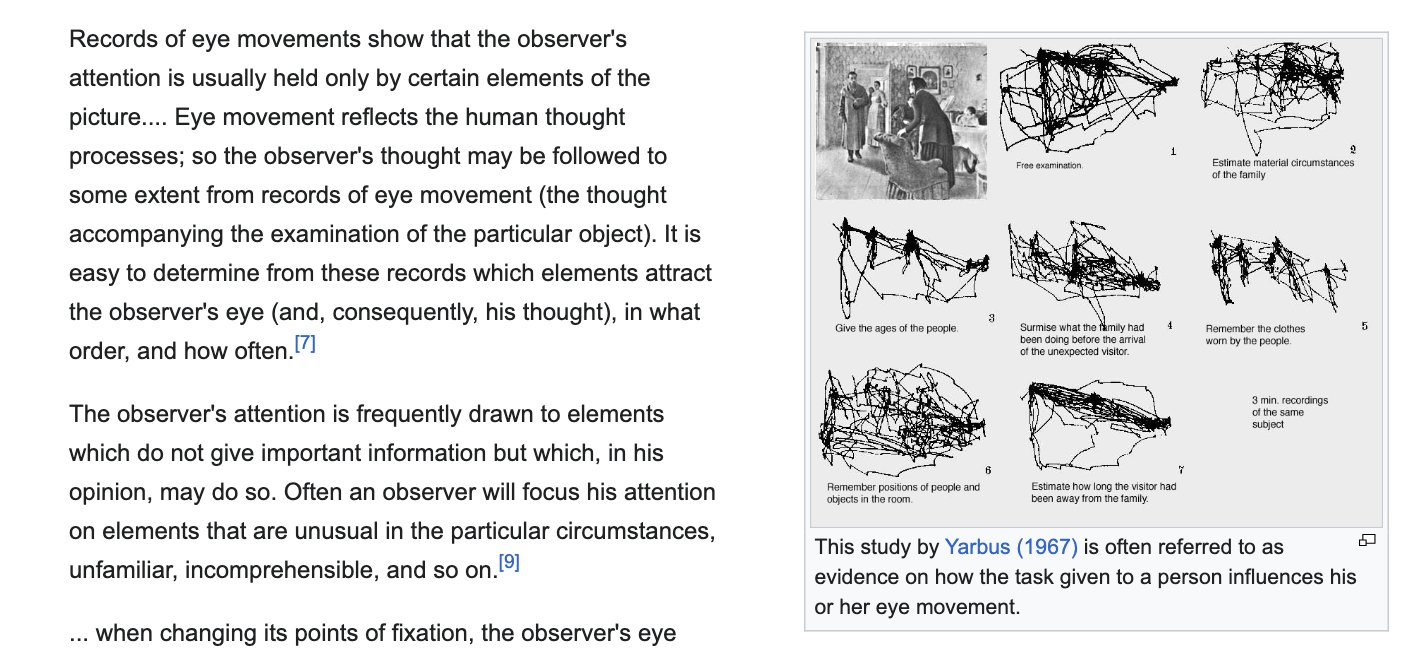
- The traces pile up on faces. The eye goes there first and keeps coming back.
- Same picture, different question, different path. The eye hunts for what it is asked to find.
- Your viewer's task is scrolling. Frame one has to win that hunt.
- Only a few parts of any frame get looked at. Decide which ones before you shoot.
Screenshot of the Wikipedia page Eye tracking, taken 2026-10-18.
Six checks for the first frame of a video ad: something is already moving, toward the lens if possible; a face looks into the lens; the first four words of the hook sit on screen in a high-contrast box; there is one hero element; the frame raises a question it does not answer; and it lands a fast feeling such as surprise. Four or more yeses can run; three or fewer means reshoot. Check that a stranger can say who is in it, what is happening and where.
The opener must belong to the ad, and every version is tested on 3-second plays divided by impressions.
Is the three-second rule real, or folklore?
The three-second number is part science, part counting rule and part folklore. Mix them up and you end up building ads for a myth.
Start with the folklore. You have heard that people now have an eight-second attention span, shorter than a goldfish. The BBC traced that claim and found no evidence that attention spans are shrinking.
That goldfish line still shows up in growth books and keynote decks. It is bullshit, and it costs you. It tells you people are broken, when they are just picky.
The counting rule is real. Ad platforms report how many plays reached three seconds, so that is where your first number shows up. The current definitions sit in the dated box near the end.
The science is real too, and it is faster than three seconds. The lab studies below measure what grabs the eye before the viewer has time to think it over. Three seconds is simply the first window you can measure.
Three seconds is a counting rule, not a law of the brain
| Claim | What is behind it | How sure |
|---|---|---|
| People have an 8-second attention span, less than a goldfish | No evidence found when the BBC traced it | Myth |
| The sale is made in the first three seconds | Repeated in business books, no study cited | Folklore |
| Platforms count a play after about three seconds | Ad platform metric definitions (dated box below) | Fact, can change |
| Motion, faces and contrast pull the eye before thought | Lab studies of attention capture | Strong in the lab |
Sources: BBC News, Busting the attention span myth; Meta and Google ad help pages; studies cited in the next section.
Build frame one from six things that pull the eye
The Three-Second Rules are six checks for the first frame of a video ad. Each one points at something the eye grabs on reflex. Use at least four in every opener.
Rule 1: something is already moving, toward the lens if you can. Not about to move. Already moving at frame one.
In a lab study, moving shapes and looming shapes grabbed attention. Looming means getting bigger, as if it is coming at you. Shapes that shrank away did not grab it.
Rule 2: a face looks into the lens. Faces with direct gaze held attention longer than faces looking away. And eye contact and sudden motion add together, so a face that turns to meet the lens is rules 1 and 2 in one shot.
Rule 3: four words sit in a high-contrast box. Contrast is the eye's first shortcut, so put the first four words of the hook on screen at frame one. That way the ad still works with the sound off.
Four is our rule of thumb, not a lab number. It is about what one glance can read.
Rule 4: there is one hero element, not a collage. In one online test, 84% of readers followed an instruction when it was the only highlighted sentence, and 65% when five sentences were highlighted.
That test was about text. We read the same effect into a busy frame. Five loud things cancel each other out.
Rule 5: the frame asks a question it does not answer. Picture a roofer on a roof, holding a garden hose.
Why the hose? Curiosity is the itch of a gap in what you know, and the gap keeps the thumb still.
Rule 6: it lands a fast feeling. Surprise, unease, awe or a laugh. Calm and pleasant is wallpaper.
The proof for rule 6 is indirect. A study of news articles found that high-arousal stories, like awe or anger, got shared more, and sad ones got shared less. Sharing is not stopping, so treat this rule as our bet.
Six checks for frame one, and how sure we are of each
| Rule | What backs it | How sure |
|---|---|---|
| 1. Already moving, toward the lens | Moving and looming shapes grab attention; shrinking ones do not (Franconeri and Simons, 2003) | Lab, strong |
| 2. A face looks into the lens | Direct gaze holds attention; gaze plus sudden motion add up | Lab, strong |
| 3. Four words in a contrast box | Contrast is noticed first; the number four is our rule of thumb | Mixed |
| 4. One hero element | One highlight beat five: 84% vs 65% followed the instruction | Online test, text |
| 5. An unanswered question | Curiosity comes from a gap in what you know (Loewenstein, 1994) | Theory, widely used |
| 6. A fast feeling | High-arousal articles were shared more (Berger and Milkman, 2012) | Indirect |
Sources: the studies linked in this section. 'How sure' is Anar's rating.
One highlight got followed most; five highlights diluted it
Share of readers who followed an instruction buried in a five-paragraph passage
- One sentence highlighted 84
- Five sentences highlighted 65
- No highlighting 55
Source: Rogers and Lasky-Fink, Writing for Busy Readers, online experiment. A text study; applying it to video frames is our reading.
Frame one is an envelope, and viewers judge it in a glance
Viewers judge two things from frame one: what they will get, and what it will cost them. The busy-readers research calls the outside of a message its envelope. People guess the value from the envelope, then guess the effort.
Effort shows up fast. In the authors' survey, 165 of 166 professionals said they would deal with the visibly shorter email first. A 49-word survey request got 4.8% to reply, against 2.7% for a 127-word version of the same ask.
Our reading for video: frame one is your envelope. A slow logo and a long intro look like work. One clear person doing one clear thing looks cheap to watch.
Looks like work? It gets skipped.
One more envelope test comes from websites. The StoryBrand book gives a home page five seconds to say what you offer, how it helps and how to get it. Our video version is shorter: by second three, a stranger should know who this ad is for.
The shorter request got nearly twice the replies
Response rate to the same five-minute survey request sent to 7,002 school board members
- 49-word email 4.8
- 127-word email 2.7
Source: Rogers and Lasky-Fink, Writing for Busy Readers, field experiment.
Who, what, where: give the eye a scene, not a slide
A frame holds the eye when it shows a person, doing something, somewhere. It loses the eye when it looks like a slide.
Orlando Wood's study Lemon argues that much advertising has turned flat, abstract, dislocated and devitalised. Dislocated means no place. Devitalised means no life.
So we ask three questions of every frame one.
Who is in it? What is happening? Where is it?
If you cannot answer all three from one paused frame, the eye has nothing to hold. The test is ours. The idea behind it comes from that study.
How to make a video ad nobody sees in four easy steps:
1) Open on your logo. It is your favorite part.
2) Wait two seconds for the music to build.
3) Show the product alone on a white table. Not moving.
4) Put the hook at second eight, after everyone has left.
That is not an opener. That is a screensaver.
Most frame-one logos are there because someone in the approval chain likes seeing them. The viewer never asked.
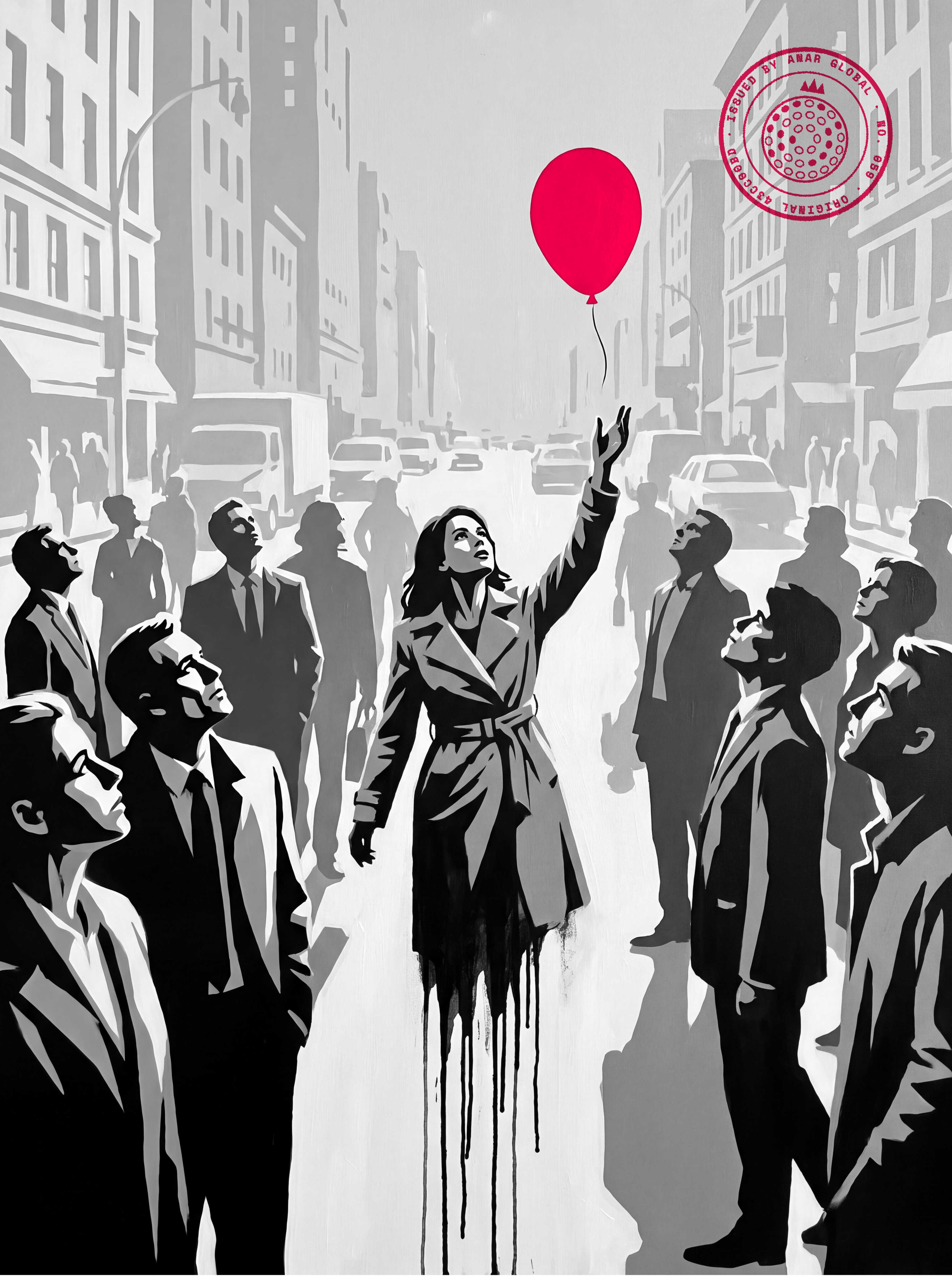
A person doing something somewhere holds the eye; a slide loses it
| Loses the eye | Holds the eye |
|---|---|
| Flat graphics and abstract shapes | A real person, front-on |
| A screen full of words | Something visibly happening |
| No place at all | A place you can name in one word |
| Nobody in the shot | A face, a hand, a body in motion |
Source: Anar's who-what-where test, in the spirit of Orlando Wood, Lemon (IPA).
Grade frame one in ten seconds
Grading frame one takes ten seconds and a pause button. Pause each ad on its first frame and answer six yes-or-no checks.
Moving? Looking at me? Four words?
One thing? A question? A feeling?
Count the yeses. Four or more, it can run. Three or fewer, reshoot the opener before you spend a dollar on it.
Then run the envelope check. Mute it, show the frame to someone who has never seen the ad, and ask who it is for.
If they cannot say, the frame may be pretty. Pretty is not the job.
Grade every format you run, from talking heads to product demos. The common ones are laid out in the UGC format library.
Pause on frame one and count the yeses
| Check | Weak frame one | Strong frame one |
|---|---|---|
| Is anything moving? | A logo fading in | A hand reaching toward the lens |
| Is someone looking at me? | A product on a table | A person, eyes to camera |
| Are there words? | None for two seconds | Four, in a contrast box |
| Is there one thing to look at? | A split screen | One subject, plain background |
| Is there a question? | Everything is explained | Something that needs explaining |
| Is there a feeling? | Calm stock footage | A flash of surprise |
Anar's grade. Four or more yeses can run; three or fewer means reshoot.
Is a scroll-stopping opener just clickbait?
A scroll-stopping opener becomes clickbait the moment it has nothing to do with the rest of the ad. Viewers stay for second three, leave at second four, and you paid for both.
The test is simple. The hose on the roof has to be explained, and the explanation has to be the point of the ad.
The busy-readers research carries a warning here too. In one email test, a "free events" subject line got nearly four times the volunteer sign-ups of a plain one. The authors also noted that some people likely opened for free concerts and felt misled.
We draw the line in the same place. No fake shocks, no results the product does not deliver, no actors posing as customers.
Those tricks grab the eye once. Then they cost you the trust the rest of the ad needs.
The numbers usually show where an opener gets stuck. The table below matches each symptom to its cause, and reading ad data covers the rest of the funnel.
Grab the eye and belong to the ad, or do not run it
- Honest but invisible Fix frame one with the six rules.
- Run it The eye stops and the ad pays off the question.
- Kill it Nobody stops, and nothing connects.
- Clickbait Viewers stop, then leave at second four, a little annoyed.
Anar's rule.
Read the symptom, then fix the cause
| Symptom | Cause | Fix |
|---|---|---|
| Few 3-second plays | Frame one fails the rules | Regrade it and fix the lowest checks first |
| Many 3-second plays, big drop right after | The opener does not belong to the ad | Make the frame's question the ad's main point |
| Good watch time, no clicks | The ad never says who it is for | Fix the hook words and the page match |
Anar's diagnosis rules.
Test three first frames and change nothing else
The only way to know which opener wins is to run them against each other. Your taste is a bad judge. So is ours.
In the busy-readers experiments, most people predicted the wordier message would win, and it lost.
Shoot one ad, then cut three versions that differ only in the first three seconds. Same words after second three, same audience, same budget, same days.
For each version, divide 3-second video plays by impressions. Many ad teams call this the hook rate.
Our floor for calling a winner is 2,000 impressions per version and a gap of at least 4 percentage points. Below that, keep running. Calling it early is guessing with a chart.
Keep the winner, then test a new opener against it. One change at a time, as in one-variable ad testing, and at volume with a creative testing engine.
On YouTube, a skippable ad gets a skip button after five seconds. So there the frame has to hold for five seconds, not three, as covered in our YouTube ad script guide.
Change only the first three seconds, and let the numbers pick
- 1. Cut three openers One ad, three versions. Only the first three seconds differ.
- 2. Run them side by side Same audience, same budget, same days.
- 3. Compute hook rate 3-second video plays divided by impressions, per version.
- 4. Call it, or keep running Winner only at 2,000+ impressions each and a 4+ point gap.
- 5. Test the next one Keep the winner and try a new opener against it.
Anar's test method.
Example: how hook rate is calculated and called
Example numbers chosen to show the arithmetic, not results
| Version | Impressions | 3-second plays | Hook rate |
|---|---|---|---|
| A | 2,000 | 300 | 15% |
| B | 2,000 | 420 | 21% |
| Gap | 6 points, so B wins |
Example. Hook rate = 3-second video plays divided by impressions.
Run the Three-Second Rules with AI
The prompt below grades your openers in your preferred AI. Describe frame one or upload a still, and it scores the six rules, then writes three new openers to test.
It never invents numbers. When you have results, paste them in and it does the hook-rate math with you.
This week, do three things. Pause every live video ad on frame one and grade it. Reshoot your worst opener three ways and run them against each other.
Then make sure the page matches the promise, with ad-to-page alignment. A great first frame that lands on a mismatched page is a well-lit dead end.
Now go back to that logo on the white wall. Swap it for a face turning to the lens, mid-step, with four words under it. Win the eye, and the brain follows.
Paste into your preferred AI. It asks about your ad, scores frame one, writes three new openers and calls your test.
Act as a video ad editor who grades opening frames.

Ask me these one at a time, each with its example:
1. What does the ad sell, and to whom? (Example: "Roof repair for homeowners in a rainy city.")
2. Describe frame one, or upload a still of it. (Example: "Logo fades in on a white wall, music starts.")
3. The first words of the hook. (Example: "Your roof is lying to you.")
4. Optional: results per opener, as impressions and 3-second video plays.

Grade frame one on the Three-Second Rules, yes or no, one line of reason each:
1. Something is already moving at frame one, ideally toward the lens.
2. A face looks into the lens.
3. The first four words of the hook are on screen in a high-contrast box.
4. There is one hero element, not a collage.
5. The frame raises a question it does not answer.
6. It lands a fast feeling: surprise, unease, awe or a laugh.
Then answer: who is in it, what is happening, where is it?

Rules:
- Four or more yeses can run. Three or fewer: rewrite the opener.
- The opener must belong to the ad. The ad's main point must answer the frame's question.
- No fake shocks, no results the product does not deliver, no actors posing as customers.
- Never invent a number. Hook rate = 3-second video plays divided by impressions. Call a winner only with 2,000+ impressions per version and a gap of 4+ percentage points; otherwise say "keep running".
- If you can browse, check the ad platform's current help page for how it counts a 3-second play, and tell me if it changed.

Output:
A. The six-rule score with reasons.
B. Three new frame-one ideas, one sentence each, each scoring 5 or 6.
C. The test plan: what changes between versions and what stays the same.
D. If I gave results: hook rate per version and the call.

Filip Kovacevic is the founder of Anar Agency in Phoenix. He spent five years running SEO, Meta ads, email, and content for medical practices across the United States, and now does the same work for healthcare, home-service, legal, and professional-service businesses, alongside AI implementation. More from Filip →
Talk it through in 15 minutes
Bring one question from this article. We will tell you what we would do, whether or not you hire us.
Book a 15-Min Chat →