One Variable at a Time: A Facebook Ad Testing Framework
Test Facebook ads by changing one thing at a time. Test the offer first, then the main ad text, then the opening lines and images, then the audience. Keep every other part the same.
Give each version the same number of views, write your stop rules before launch, and judge each test on the number that fits it.
How do you test Facebook ads without fooling yourself?
In 1747, a ship's surgeon had twelve sailors sick with scurvy. He split them into six pairs, fed them all the same food, and gave each pair a different extra treatment.
Only the pair given citrus got better. One change. One answer.
Now look at a normal Facebook ad test. New picture, new headline, new offer and new audience, all at once.
It wins. What did you learn? Nothing you can use twice.
Statisticians call this confounding: two things change together, so you cannot tell which one did the work. Change four things and it gets worse. You get a winner and no reason.
This Facebook ad testing framework fixes that. One change per test, in the right order, judged on the right number, with stop rules written down first.
Where a number comes from another business, we label it an example.
Change four things and you get a winner with no reason
| The usual test | A one-variable test |
|---|---|
| New image, headline, offer and audience at once | One change, everything else identical |
| Winner picked by feel, at any random time | Winner picked by a rule written before launch |
| Optimized for cheap clicks | Optimized for the result you pay for |
| Lesson: none you can reuse | Lesson: one line in your test log |
Our summary of the method in this article
Test in this order: offer, body copy, openings, audience
Test the offer first. Then the body copy, the main text of the ad.
Then the openings and images. Audiences come last.
Why that order? Each step sits on top of the one before it. A brilliant opening cannot sell an offer nobody wants.
Most people start with the opening, because it is what people see first. It feels logical. So they polish openings for an offer that was never going to sell.
Test openings only after you have body copy that works. Some changes to the order are fine. One rule stays fixed: the offer goes first.
How do you test an offer? Give the platform a few versions of the ad, then judge the result on cost per sale. You are not hunting for the best ad yet.
You are checking if the offer can work at all. If you need $40 a sale and the test lands at $50 to $60, it can. That is close enough, so now fix the page and the copy.
Audiences come last, and they only need to pass. You are not looking for the best audience. Any audience that hits your target stays.
Brand-new offer with no sales yet? Start with launching ads for a new offer, then come back here.
Test the offer first; audiences come last
- 1. Offer Does anyone buy near your target cost per sale? If not, nothing above this rung matters.
- 2. Body copy The main text of the ad. Judged on cost per sale against your target.
- 3. Openings and images Tested only once the body works. Judged against each other on cost per click.
- 4. Audiences Any audience that hits your target stays. You are not hunting for the best one.
Our method
Test in this order: the offer, then body copy, then openings and scroll-stopping images, then audiences. Change one thing and keep every other part of the ad identical. For openings and images, use one ad group, a cold audience, feed placements only, and an automated rule that switches each ad off at 1,500 impressions, in two rounds of 750.
Budget the opening test as versions x 1,500 x CPM / 1,000 over three to four days, and judge openings against each other on cost per click. Judge offers, body copy and audiences against your target cost per sale, with a kill ladder written before launch. Optimize every test for the result you scale on, run it at least four days, and log one line per test.
Then repeat with the next variable.
Make the versions identical except for one thing
A fair test changes one thing. In an opening test, ten ads share the same headline, image and body. Only the opening differs.
The opening is the first lines of text, the part people see before "See more". Our guide to hooks that work covers how to write one.
Then clean up the crowd. Leave out anyone who already knows you: site visitors, people who liked or commented on your page or Instagram, and your email list.
Why bother? An opening that happens to reach more fans looks better.
It is not better. It just met friendlier people.
Run the test on the Facebook and Instagram feeds only. Meta recommends automatic placements for most ads, and for scaling we agree.
In a test, it is a different story. One opening shown in a side column and another shown in the feed is not a fair fight.
Start them together. Turn the ad group on only after every ad is approved, so nobody gets a head start.
Never add test ads to a group that already works. Meta treats a new ad as a significant edit, which can restart its trial period and shake up a group that works. Give the test its own ad group.
That is the surgeon's rule for ads. Same ship, same food, one change.
In an opening test, only the opening changes
| Part of the test | Setting |
|---|---|
| Headline, image, body | Identical in every ad |
| Opening (text before See more) | The only difference, one ad per opening |
| Audience | Cold only: exclude site visitors, engagers and your email list |
| Placements | Facebook and Instagram feeds only |
| Start | All ads switch on together, after every ad is approved |
| Ad group | Its own, never a group that already works |
Our method
Two ads from one opening test: only the first lines differ
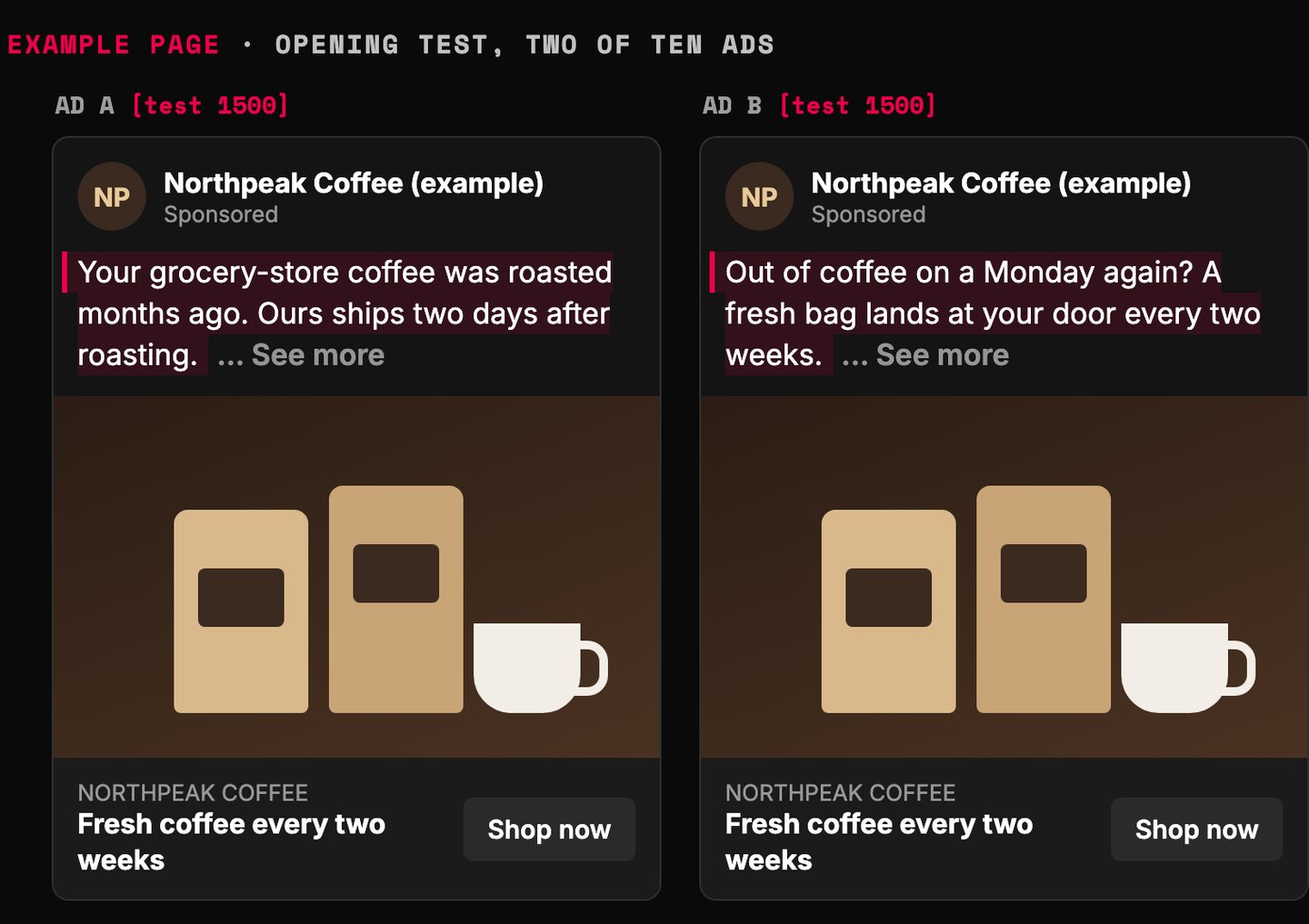
- Only this changes: the opening, the lines people see before See more.
- The second opening makes a different pitch. One ad per opening.
- Everything after See more stays word for word the same.
- Same image, headline and button in every ad.
- Same tag in every ad name, so one rule can cap each ad at 1,500 impressions.
Example page built for this article with a made-up brand
Give every opening the same 1,500 impressions
Left alone, the platform spends unevenly. One ad gets 30,000 views and another gets 100. You cannot compare those two.
So cap them. An impression is one time your ad shows on a screen. Give each opening 1,500, then switch it off.
The budget is simple math: openings x 1,500 x your expected CPM / 1,000. CPM is what you pay for 1,000 impressions.
Ten openings at a $30 CPM come to 10 x 1,500 x $30 / 1,000 = $450. Spread that over three to four days. About $150 a day.
The cap runs itself with automated rules. Put a tag like [test 1500] in every ad name. Then build one rule that switches off any tagged ad once it passes 1,500 impressions.
As each ad hits the cap, the money flows to the ads still running. One by one, they all switch off.
The better version runs two rounds. First, cap each ad at 750. When all are off, rename the tag to [test 1500] and switch them back on.
Why two rounds? The spend lands on more days, so one lucky afternoon cannot crown a winner.
Two openings still too close to call? Run just those two to 3,000 impressions.
Two automated rules give every opening the same exposure
- Tag the ads Put [test 750] in every ad name. Use a tag you would never type by accident.
- Rule one Switch off any active ad with [test 750] in its name once it passes 750 impressions.
- Rename and restart When all are off, change the tag to [test 1500] and switch them back on.
- Rule two Switch off any active ad with [test 1500] in its name once it passes 1,500 impressions.
- Close call Two still neck and neck? Run just those two to 3,000 impressions.
Our method
Example: ten openings at a $30 CPM cost about $450 to test
Budget = openings x 1,500 impressions x CPM / 1,000, spread over three to four days
- openings 10
- impressions in total 15000
- total test budget 450
- a day, over about three days 150
Method example: 10 x 1,500 x $30 / 1,000
Judge openings on cost per click, offers on cost per sale
Which number picks the winner? It depends on what you tested.
Openings and scroll-stopping images get judged against each other, on cost per click. You are picking the best of ten, not checking a target. At 1,500 impressions, each ad has too few sales to read.
Offers, body copy and audiences get judged against your target cost per sale. Those tests run long enough to count real sales.
One catch. Cost per click only means something when you tell the campaign to chase the result you will scale on. That usually means purchases or leads, never traffic.
For example, one business ran the same opening test twice, once optimized for traffic and once for purchases. The traffic version bought 475 clicks for $148 and zero sign-ups. The purchase version got 130 clicks for $241 and 36 webinar sign-ups, about $6.70 each.
Cheap clicks. Wrong people.
In its purchase-optimized image test, $1,025 bought 24 sales at $42 each. Its main campaigns were paying $45 a sale at the time, so the test paid its own way.
Then move the top two or three to your main campaign. A test picks a horse to bet on. It does not promise a win.
Not sure which column in your report is the real result? Read Results, not Leads.
What you test decides which number picks the winner
| What you test | Compared against | Main number |
|---|---|---|
| Offer | Your target | Cost per sale |
| Body copy | Your target | Cost per sale |
| Openings | Each other | Cost per click |
| Scroll-stopping images | Each other | Cost per click |
| Audiences | Your target | Cost per sale, keep every one that passes |
Our method
Optimized for traffic: 475 clicks, zero sign-ups
The same opening test run twice; only the optimization goal changed
| Optimized for traffic | Optimized for purchases |
|---|---|
| $10.50 per 1,000 impressions | $16.58 per 1,000 impressions |
| $148 spent | $241 spent |
| 475 clicks | 130 clicks |
| 0 webinar sign-ups | 36 webinar sign-ups, about $6.70 each |
Example from one business, not verified by us
The impressions condition is what lets a rule cap every opening at 1,500
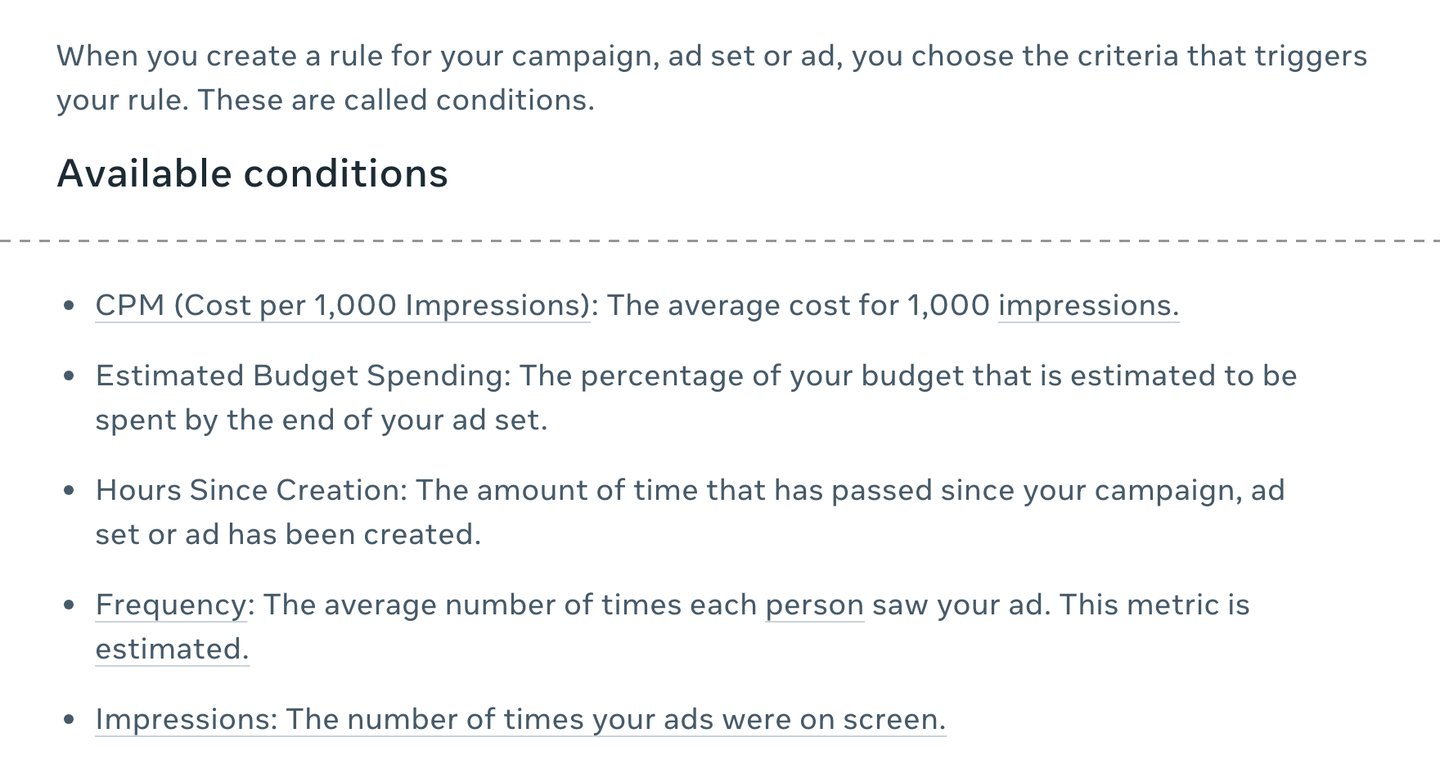
- A rule checks a condition you choose, then acts for you. That is how the cap runs itself.
- CPM sets the test budget: openings x 1,500 x your expected CPM / 1,000.
- The cap: switch off any ad tagged [test 1500] once its impressions pass 1,500.
Screenshot of Meta Business Help Center, Available Conditions for Automated Rules, taken 2026-10-17. Two parts of the page, joined at the dashed line
Write your kill ladder before you launch
A kill ladder is a list of stop points that gets stricter as spend grows. Write it before launch, while you are calm.
Here is a loose version, for a $50 target cost per sale. With no sale by $150 spent, cut it. By $200 spent, a sale must cost $100 or less, and by $250 spent, $83 or less.
The strict version cuts at $125 with no sale. After that, a sale must cost $75 or less by $150 spent, $68 by $200 and $50 by $250. Pick one ladder per test and stick to it.
Why write it first? Check a test every morning, stop the moment one ad leads, and luck will hand you false winners. Statisticians call it the multiple comparisons problem.
How much should each test get? Rough ranges: about 10 times your target cost per sale for an offer test, 3 to 5 times for body copy, and 2 to 3 times for each audience.
Spread each one over several days, at $50 to $200 a day. Not $2,000 in four hours.
Budget is a business choice. Pick what you can lose and still sleep, then shape the test to fit. Our guide to your max allowable CPA helps you set the target.
Example: the stop line gets stricter as the test spends more
The most one sale may cost at each spend level, $50 target. Above the line, cut the ad.
- Loose: 150 150, 200 100, 250 83
- Strict: 125 125, 150 75, 200 68, 250 50
Example ladders at a $50 target cost per sale
Each kind of test gets its own budget
| Test | Rough total budget | Pace |
|---|---|---|
| Offer | About 10 x target cost per sale | $50 to $200 a day, several days |
| Body copy | 3 to 5 x target cost per sale | $50 to $200 a day, several days |
| Each audience | 2 to 3 x target cost per sale | A few days |
| Openings | Openings x 1,500 x CPM / 1,000 | Three to four days |
Our method
How long should a Facebook ad test run? Four days, ideally a week
Run every test at least four days. A week is better.
People buy differently on a Tuesday than on a Saturday. A test that covers the whole week evens that out.
For example, one new agency owner's tests kept failing. He had been running each one for two hours.
Two hours is not a test. It is a coin flip with a receipt.
Five images sharing $10 a day for two days is not a test either. Too little money, too many versions, too few days.
Time of year matters too. A Valentine's gift will not sell in September the way it sold in February. December shoppers are not March shoppers, as anyone who studies seasonality will tell you.
So when an old loser wins two months later, do not panic. Check the spend, the campaign goal, the length, who you left out and how many things changed. Then check the calendar.
Four days is the floor; a week is better
- Not a test 2 hours A coin flip with a receipt.
- Still not a test 1 to 2 days Weekday swings decide the winner, not the ad.
- The short end 3 days Only with high spend.
- The minimum 4 days Enough to start smoothing out the week.
- Ideal 7 days Every day of the week gets a vote.
Our method
Small budget? Skip the test campaign
If you spend about $100 a day or less, you do not need a separate test campaign. Launch new ads in their own ad group, beside the one that works.
Never touch the working group. Then split your daily budget between the two.
Say you want $150 a day in total. Run the test at $50 and trim the working group to $100.
To shrink an opening test, test fewer openings: eight, five or three. Or cap each one at 1,000 impressions. Do not go lower, or you are reading luck, not results.
Make the versions very different. A small test can catch a big difference but will miss a small one. That is the core of sample size math.
So test two openings that make opposite pitches. Not two that swap one word.
And run the free test before you spend a cent. Picture your headline alone in a newspaper classified column, with a phone number under it. Would anyone call?
Example: fewer openings cut the test cost, not the fairness
Opening test budget at 1,500 impressions each and a $30 CPM
- 10 openings 450
- 8 openings 360
- 5 openings 225
- 3 openings 135
Method example: openings x 1,500 x $30 / 1,000
Example: on $150 a day, give the test $50 and keep the working ad group at $100
Under about $100 a day, skip the separate test campaign
- Working ad group 100
- New test ad group 50
Method example: a $150 a day split
Where Facebook ad tests go wrong, and the fix for each
Most broken tests fail in one of three ways. Each has a clear sign, a cause and a fix.
First, one ad got all the money. In one account, one ad let the platform choose between images, and it showed one image 10,000 times and another just 11 times. Nobody can judge an image on 11 views, so cap impressions and run one ad per version.
Second, good copy looked bad. The cause is often a tired control image: the usual image you run, which people have seen too many times. Mix it with recent winners and fresh images, and test body copy with images, not video, because a video carries its own message.
Third, the ad that won on clicks lost once you spent more. The test was set up to get cheap traffic. Set it up to get the result you will scale on.
How to run a test that proves nothing, in four easy steps. Step one: change the image, headline, offer and audience at once. Step two: optimize for traffic, because clicks are cheap.
Step three: check it every hour and crown the early leader. Step four: declare the loser dead forever.
That is a hell of a way to spend $450. You bought an opinion, not an answer.
When one test result looks odd, walk the numbers from the ad to the sale, as shown in reading ad data.
Three ways a test lies, and the fix for each
| Sign | Cause | Fix |
|---|---|---|
| One ad got almost all the views | The platform picked a favorite early | Cap impressions, one ad per version |
| Good copy looked bad | A tired control image | Mix control, recent winners and fresh images; no video |
| Click winner lost at scale | The test optimized for traffic | Optimize for the result you scale on |
Our method
With no cap, one image got 10,000 impressions and another got 11
- Image A 10000
- Image B 11
Example from one business's ad where the platform mixed the images, not verified by us
Plan your next test with AI
The prompt below plans one fair test for you. Paste it into your preferred AI and answer seven questions. It returns the setup, the budget, the stop rules and the number to judge on.
It never guesses a number. Missing one? It asks.
This week: first, pick the one thing you will test, using the order above. Second, run the prompt and build what it gives you. Third, write your kill ladder down before launch.
Then keep a log, one line per test: what changed, what happened, what you now believe. Twenty lines in, you will know things about your market that no ad library shows.
Want to turn those lines into rules? Read copy the rules, not the ad and the creative testing engine.
Want your test plan checked before launch? Send it to us.
The surgeon did not need twelve cures at once. He needed one change and the patience to watch it.
One change, one answer. Five changes, no answer.
Paste into your preferred AI. It asks seven questions, then gives you the setup, budget, stop rules and the number to judge on.
Act as a careful media buyer planning ONE fair Facebook ad test for me. Use only the rules below and my answers. Never invent a number; if one is missing, ask me. If you can browse, first check Meta's current help pages on automated rules, ad placements and A/B testing, and tell me if anything below has changed.

Ask one at a time, with the example, and wait:
1. What I sell and the result I pay for: sale, lead or booked call. (Example: a $27 guide, sales)
2. My target cost per result. (Example: $50)
3. Has the offer already sold at or near that target? (Example: yes, at about $55)
4. Do I have body copy that already works? (Example: yes, one control ad)
5. What I want to test and how many versions. (Example: 10 openings)
6. My usual CPM, the cost of 1,000 impressions. (Example: $30)
7. The most I am comfortable spending a day on testing. (Example: $150)

Rules:
- Test order: offer, then body copy, then openings and scroll-stopping images, then audiences. If answer 3 is no, the test is the offer, whatever I asked for. If answer 4 is no, test body copy before openings.
- Change one thing. Every other part of the ads stays identical.
- Optimize the campaign for the result in answer 1, never for traffic.
- Opening or image test: one ad group, one ad per version, same headline, image and body. Cold audience only: exclude site visitors, page and Instagram engagers and my email list. Facebook and Instagram feeds only. Start all ads together after every ad is approved. Budget = versions x 1,500 x CPM / 1,000, spread over 3 to 4 days. Tag each ad name [test 750], add a rule that turns tagged ads off at 750 impressions, then rename to [test 1500], turn them back on, and add a rule that turns them off at 1,500. Run two close finishers on to 3,000. Judge versions against each other on cost per click. Keep the top 2 or 3. If the budget is too big, cut to 8, 5 or 3 versions, or cap at 1,000 impressions, never lower.
- Offer, body copy or audience test: judge against the target cost per result. Budget: offer about 10 x target, body copy 3 to 5 x target, each audience 2 to 3 x target, at $50 to $200 a day.
- Kill ladder (the loose version), scaled to my target: no result by 3 x target spent, cut. At 4 x target spent, need 2 x target or better. At 5 x target spent, need 1.67 x target or better.
- Run at least 4 days, ideally 7. No verdict before the kill ladder or the impression cap says so.
- If answer 7 is about $100 or less: no separate test campaign. Launch the test in a new ad group beside the working one and never edit the working one.

Show your math, then use exactly this format:
WHAT WE ARE TESTING:
WHAT STAYS THE SAME:
SETUP:
BUDGET AND DAYS:
JUDGE ON:
KILL LADDER:
LINE FOR MY TEST LOG:
NEXT THREE ACTIONS:
Filip Kovacevic is the founder of Anar Agency in Phoenix. He spent five years running SEO, Meta ads, email, and content for medical practices across the United States, and now does the same work for healthcare, home-service, legal, and professional-service businesses, alongside AI implementation. More from Filip →
Talk it through in 15 minutes
Bring one question from this article. We will tell you what we would do, whether or not you hire us.
Book a 15-Min Chat →