Funnel Optimization: Find the One Element That Wins, Then Spread It

Start funnel optimization with the part that already wins. Put every piece on the same measure: each checkout extra, each email, each ad. Look for one piece that beats the rest on every number.
Check that it holds over a second stretch of time. Then move it into your main offer, your emails and your ads.
Funnel optimization starts with the part that already wins
July 1799. French soldiers are rebuilding a fort near the Egyptian town of Rosetta. One of them finds a broken stone slab in an old wall.
It carries one decree written three ways: in hieroglyphs, in a later Egyptian script and in Greek. Scholars could already read Greek. So the Rosetta Stone became the key to reading the other two.
Your funnel has a stone like that. One part that buyers say yes to far more than anything else. It shows what they actually came for.
Most funnel optimization advice says test everything.
The button. The form. The footer.
We do the opposite. Find the one part that already wins. Check that it is real, then spread it through everything else.
A funnel is every step a buyer passes through: the ad, the page, the checkout, the extras, the emails. Here is how to read yours for the winner.
Testing everything spreads effort thin; the One-Element Rule follows the winner
| Test every part | One-Element Rule |
|---|---|
| Starts with the button, the form, the footer | Starts with the part buyers already pick most |
| Every part gets the same hours | The winner gets most of the hours |
| Reads the funnel in total | Reads every part on its own number |
| Small lifts in many places | One proven win, carried everywhere |
Our comparison. Testing every part as commonly taught; the One-Element Rule as set out in this guide.
The One-Element Rule: one part that wins on every number
The One-Element Rule is our name for this. When one part of your funnel beats the others on every number, it shows you what buyers want. So you build more of the funnel around it.
Every number. Not just one.
Why does that matter? Because one number can lie. A $1 extra will get taken a lot, and that alone proves nothing.
So we check three numbers. Take rate is the share of people who say yes when they see an offer. We also check money per person who saw it, and refunds.
For example, one music business sold a guitar offer with a few extras. One extra used AI to help buyers write songs. Between 70 and 80 percent of buyers took it.
The rest of the offer did fine. Nothing special.
So they put the songwriting help into the main offer, the upsell, the emails and the ads. Sales took off. We have not seen their numbers, so treat it as an example, not proof.
Seventy percent is more than a nice bonus. It tells you what buyers came for.

Example: one extra was taken by 70 to 80 percent of buyers, then became the pitch
| What | Detail | How sure |
|---|---|---|
| The business | A music offer: guitar lessons with a few extras | Example |
| The winner | An extra that used AI to help buyers write songs | Example |
| Take rate | 70 to 80 percent of buyers took it | Example; we have not seen the data |
| What they did | Moved it into the main offer, upsell, emails and ads | Example |
| What happened | Sales took off. No figures were given. | Not verified |
Example from another business. Not our result, and not verified by us.
The One-Element Rule says that when one part of a funnel beats the others of its type on every number, it shows what buyers came for. Put every part on one scorecard with one main measure per type, require at least 100 people per part and a lead of double or more, confirm it over a second stretch of the same length, name why it wins, then spread it into the main offer, upsell, emails and ads.
Where does the winner hide? Six places to look
The winner usually hides in a spot nobody reads closely. Start with these six.
The checkout extra. A small add-on with a tick box at checkout, often called an order bump. Read its take rate.
The offer right after purchase. This is the upsell. Read its take rate and the money it brings per buyer.
The cheaper offer for people who said no. Some buyers pass on the upsell and take the smaller one. Sometimes the smaller one is the real hit.
One email that gets replies. Seven emails get opened, and one gets answered. Its topic is what readers care about.
One ad that carries the account. You only see it when you read results ad by ad, not in total. We explain how in read results, not leads.
One question on every sales call. Prospects keep asking about the same thing first? That is your headline, handed to you.
Six places a winner hides, and the one number to read for each
| Place | Read this number | A winner looks like |
|---|---|---|
| Checkout extra (order bump) | Take rate | Taken far more often than any other extra |
| Offer after purchase (upsell) | Take rate and money per buyer | Out-earns the main offer per person |
| Cheaper offer after a no | Take rate | Picked by people who said no to everything else |
| Emails | Replies per send | One email gets answers; the rest get opens |
| Ads | Cost per result, ad by ad | One ad brings most of the results |
| Sales calls | The first question asked | The same question on almost every call |
Our checklist. Measures as defined in this guide.
How do you find it? Put every part on one scorecard
You find the winner by putting every part on one scorecard. Same time window, same measure for each type.
Step 1: list every part a buyer sees, in order. Ads, main offer, checkout extra, upsell, cheaper offer, emails.
Step 2: give each type one main measure. Extras get take rate, and emails get replies per send. Ads get cost per result.
Compare like with like. An email and an ad do different jobs, so their numbers never compete.
Step 3: write down how many people saw each part. A percent with no count behind it means nothing.
Step 4: run the every-number test. Check the main measure, money per person who saw it, and refunds. Money per person who saw it is the same idea as earnings per visitor, applied to one part.
Step 5: mark any part that beats the next best of its type by double or more. That is our line. Smaller gaps are usually noise.
On one scorecard, the winner leads on every number and the count says it is not luck
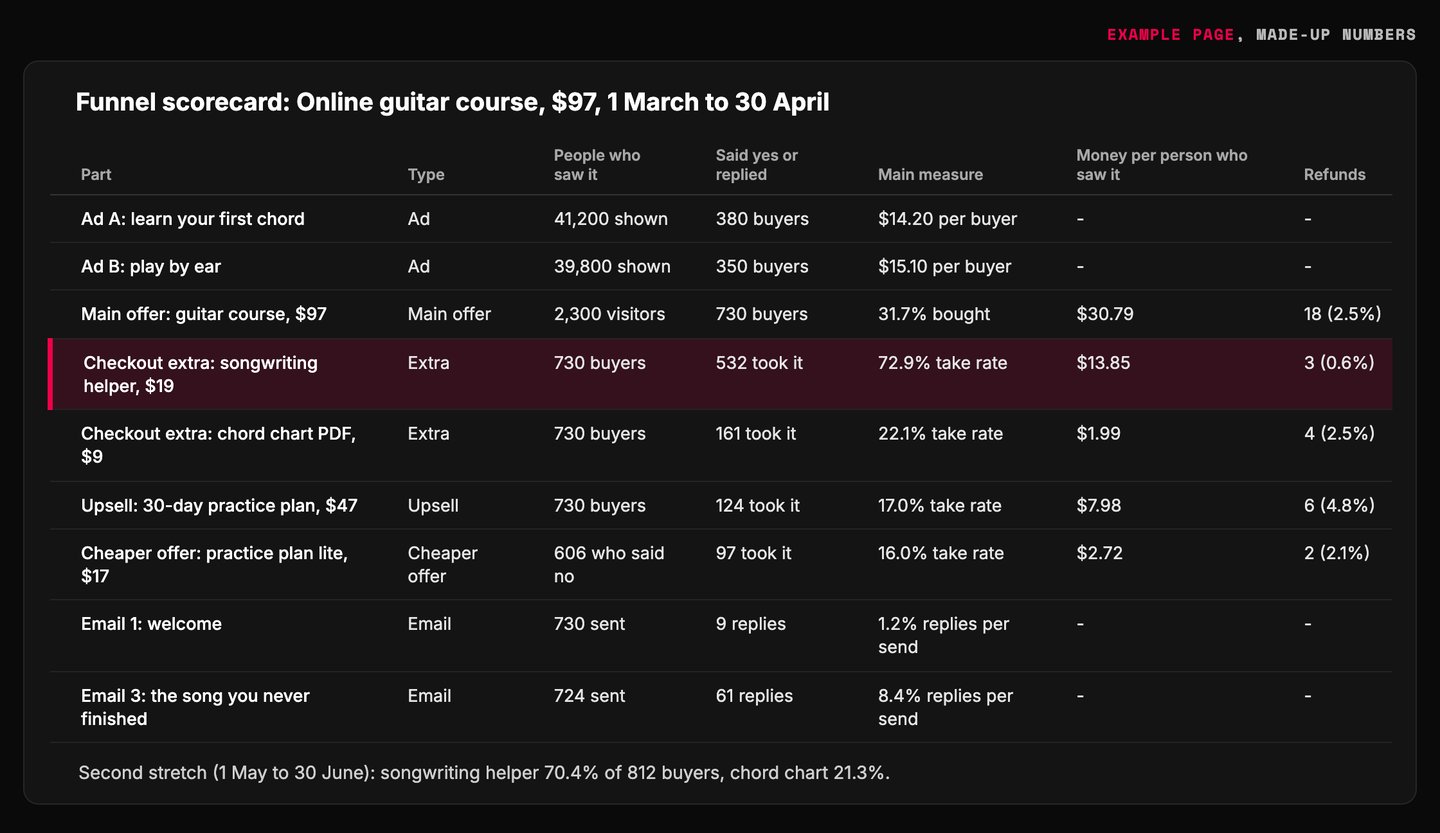
- The winner: 72.9 percent take rate, more than triple the other extra.
- Every percent has a count beside it. Under 100 people, wait.
- Compare extras with extras. This is the next best one.
- A second clue: the songwriting email gets seven times the replies.
- The second check: it still leads by double two months later.
Example page built for this article with a made-up brand and made-up numbers
Five steps from a pile of numbers to one winner
- 1. List every part Every ad, offer, extra and email, in the order buyers see them.
- 2. One measure per type Extras: take rate. Emails: replies per send. Ads: cost per result.
- 3. Write the count How many people saw each part. No count, no verdict.
- 4. Every-number test Main measure, money per person who saw it, refunds.
- 5. Mark the double Any part at double or more the next best of its type.
The One-Element Rule scorecard, in five steps.
Compare parts that do the same job, or the scorecard lies
| Wrong comparison | Right comparison |
|---|---|
| An email's open rate against an ad's click rate | Email against email, on replies per send |
| This month's extra against last year's upsell | Every extra in the same time window |
| Percent only | Percent plus how many people saw it |
| The total funnel number | Each part on its own number |
Our rules for the scorecard.
Is it real or a fluke? Check the count, then check it twice
A big percent from a small number of people can be pure luck. So before you rebuild anything, check two things: how many people saw it, and whether it wins twice.
Example: 7 of 10 buyers take an extra. That is 70 percent. But the true rate could be anywhere from about 40 to 89 percent, using standard confidence interval math.
At 70 of 100 buyers, the range narrows to about 60 to 78 percent. At 280 of 400, it is about 65 to 74.
So our rule is a floor of 100. Each part must be offered to at least 100 people before you call a winner.
Then check it twice. One great week is not a finding. It is a great week.
Results far above normal tend to slide back toward average, which statisticians call regression toward the mean.
So run a second stretch of the same length. Does it still beat the next best by double? Then it is real.
One more trap. Slice the results enough ways and something will look best by pure luck. That is the multiple comparisons problem, so pick your measure before you look.
Example: a 70 percent take rate is only trustworthy once the count is big
The 95 percent range around a 70 percent take rate, by how many people saw the offer
- High end of range: 10 89.2, 25 84.3, 50 80.9, 100 78.1, 200 75.9, 400 74.3
- Low end of range: 10 39.7, 25 50.4, 50 56.2, 100 60.4, 200 63.3, 400 65.3
Wilson 95 percent intervals for a 70 percent rate, computed by us. Method: Wikipedia, Binomial proportion confidence interval.
At 10 buyers, a 70 percent extra and a 20 percent extra can overlap; at 100 they cannot
| People who saw it | Range for a 70% extra | Range for a 20% extra | Clear winner? |
|---|---|---|---|
| 10 | 40 to 89% | 6 to 51% | No, the ranges overlap |
| 100 | 60 to 78% | 13 to 29% | Yes, a wide gap |
Wilson 95 percent intervals, computed by us.
A finding survives a big count and a second stretch; a fluke does not
| Fluke | Finding |
|---|---|
| Fewer than 100 people saw it | At least 100 people saw it |
| Led for one good week | Still leads by double in a second stretch |
| Found after slicing the data many ways | Measure picked before looking |
| Nobody can say why it wins | Buyers can tell you why they took it |
Our rules, built on regression toward the mean and the multiple comparisons problem.
Ask why it wins before you copy it
A winner is a clue, not a finished answer. Before you spread it, name the reason buyers want it.
Ask five questions.
Is it the topic? The promise? The price?
How little work does it ask of the buyer? What about the format?
In the music example, our read is that the extra took work off the buyer. Writing a song is hard. Getting help writing one is easy to want.
The reason is the part you can reuse. We go deeper on that in copy the rules, not the ad.
Can't name the reason? Ask the people who took it. A two-line email is enough: what made you add this, and what did you hope it would do?
Guessing the reason is how a winner gets copied wrong.
Five questions that turn a winner into a reason you can reuse
| Ask | Look for | Reuse it by |
|---|---|---|
| Is it the topic? | One subject buyers keep picking | Making that subject the headline |
| Is it the promise? | One result they want most | Leading every page with that result |
| Is it the price? | A price that feels easy | Testing that price point elsewhere |
| Is it the effort? | It does work for the buyer | Taking work off them in the main offer |
| Is it the format? | A tool, a template, a call | Offering more in that format |
Our decoding checklist.
Spread the winner into your main offer, upsell, emails and ads
Once the winner holds up, put more of it everywhere a buyer looks. Four places, in this order.
The main offer. Lead the page headline with it. Name it on the first screen, not in a list of bonuses.
The upsell. After purchase, offer a deeper version of it, or help with the next problem it creates, as in sell the next problem.
The emails. Open the sequence with it. Our lead-first email sequence shows where the first email goes.
The ads. Work it into the hook. Change one thing at a time, as in one variable at a time, so you know what moved.
Sometimes the winner should become the product. Instagram began as Burbn, a check-in app built by Kevin Systrom and Mike Krieger. Photo sharing had become its most popular feature.
So they cut the rest and relaunched as a photo app in October 2010. Facebook bought it in April 2012 for about $1 billion.
Same founders. One feature.
Spread the winner: headline, first screen, upsell and first email all lead with it
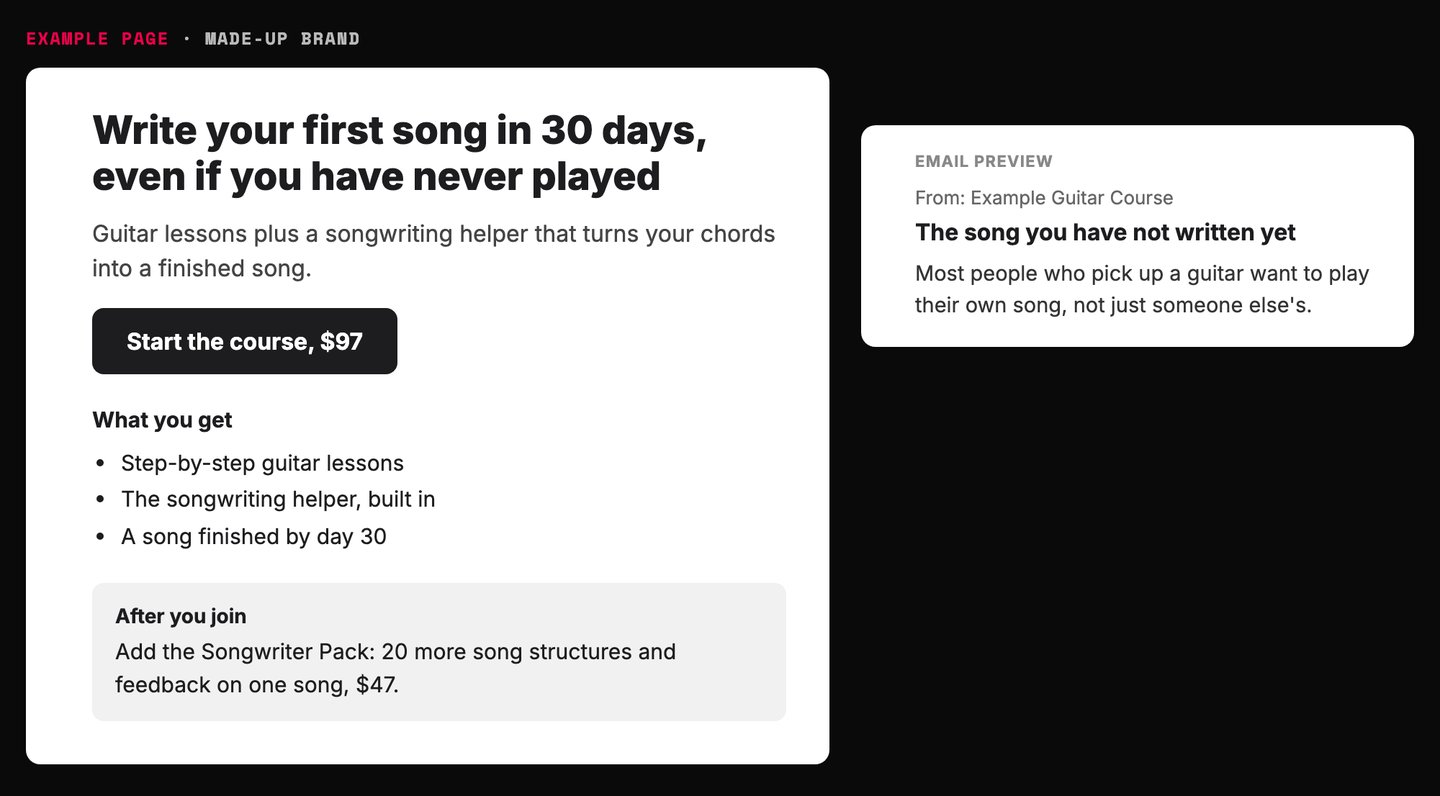
- Main offer: the headline now leads with the winner.
- The old checkout extra moved onto the first screen.
- Upsell: more of the same thing buyers already chose.
- Email one opens with the winner, not a welcome.
Example page built for this article with a made-up brand
One winner, carried into four places
| Place | What changes | In the music example |
|---|---|---|
| Main offer | The headline leads with the winner | Lead with help writing your own songs |
| Upsell | More of the same, or the next step | A deeper songwriting add-on |
| Emails | The first email is about it | Email one: the song you have not written yet |
| Ads | The hook names it | Ads about writing a first song |
Places from the example. The example rows are our illustration of how it could look, not the business's real copy.
Instagram began as one popular feature inside a check-in app
- Burbn 2010 A check-in app. Photo sharing becomes its most popular feature.
- Instagram October 2010 The founders cut the rest and relaunch as a photo app.
- Sold April 2012 Facebook buys the company for about $1 billion in cash and stock.
Source: Wikipedia, Instagram, read 2026-10-17.
Stop polishing the parts that are not winning
Every hour spent on the eighth email is an hour not spent on the one that works. A few parts usually bring most of the results. This idea is known as the Pareto principle.
Our take: many funnel audits grade every part the same because that fills more pages. Equal attention sounds fair. It is just slow.
How to optimize a funnel into the ground in four easy steps:
1. Test the button color first. It feels like science.
2. Give all eight emails the same hour of polish.
3. Read the totals, never the parts.
4. Find a 70 percent winner, then leave it buried in the bonus list where it belongs.
Polish feels like progress. Mostly it is just polish.
Keep normal split testing (showing two versions to see which wins) for the parts you spread the winner into. Just stop running it on parts that do not matter.
Polishing every part feels busy; feeding the winner moves results
| Polish everything | Feed the winner |
|---|---|
| An hour on each of eight emails | Most hours on the one email that gets replies |
| Button color first | Headline rebuilt around the winner first |
| Winner left in the bonus list | Winner named on the first screen |
| Report shows totals | Report shows each part |
Our comparison.
What if nothing in my funnel stands out?
Sometimes every part looks about the same. That usually has one of three causes.
Too few people. Twelve ads with three results each cannot show you a winner. Run fewer things with more people behind each, until each one reaches 100.
Parts too alike. Eight emails making the same point in slightly different words will score alike. Make them truly different.
The funnel is not selling yet. With no sales there is no winner to find. Then the job is getting one thing to work, which we cover in launching ads for a new offer.
And remember, you only see what you tried. Your best part is only the best of what you built. This trap is related to survivorship bias.
So keep testing one new idea at a time, even while you spread the winner. The next stone may still be in the wall.
Count and gap together tell you what to do next
- Promising Keep it running until 100 people have seen it. Then check again.
- Winner Confirm over a second stretch, then spread it.
- Too early Keep collecting. Run fewer parts with more people each.
- No winner yet Make the parts more different, or fix the offer first.
Our decision rule. Thresholds as set in this guide.
Find your winner with AI: the copy-paste prompt
Paste the prompt below into your preferred AI. It asks for your parts and their numbers, one at a time. Then it runs the scorecard, the count floor and the second-stretch check.
It never invents a number. If one is missing, it asks you or marks it unknown.
Want a second pair of eyes on the result? You can send it to us.
Paste into your preferred AI. It asks for your parts and their numbers, then runs the scorecard, the count floor and the second-stretch check.
Act as a funnel analyst. Use the One-Element Rule: find the one part of my funnel that wins on every number, check that it is real, and tell me where to spread it.

Ask me one at a time, with the example:
1. What do you sell, and at what price? (Example: an online guitar course, $97)
2. List every part a buyer sees, in order: ads, main offer, checkout extras, offers after purchase, emails. (Example: 3 ads, 1 checkout extra, 1 upsell, 1 cheaper offer, 6 emails)
3. For each part, over one stretch of time: how many people saw it, how many said yes or replied, the money it brought in, and refunds. (Example: checkout extra, 210 buyers saw it, 150 took it, $2,850, 2 refunds)
4. The same numbers for a second stretch of the same length, if you have them.

Never invent a number. If one is missing, ask me for it or mark it unknown.

Rules:
- Compare like with like: extras with extras, emails with emails, ads with ads.
- Measures: take rate (said yes divided by saw it), money per person who saw it, refund rate. Emails: replies per send. Ads: cost per result.
- A winner beats the next best part of its type by double or more on its main measure, and is no worse on the others.
- Fewer than 100 people saw it: too early. Say so.
- Show the 95 percent range for each take rate and say whether the ranges overlap.
- A winner must still lead by double in the second stretch.
- Fix the measures before reading the data. Never slice the data many ways to find a winner.
- No winner? Name the cause: too few people, parts too alike, or the funnel is not selling yet.
- When spreading the winner, never suggest fake scarcity or hidden charges.

Show your math, then answer:
Winner: [part, or none]
Count check / gap check / second stretch: pass or fail each
Why buyers want it: your best guess, plus one question to ask buyers
Where to spread it: main offer / upsell / emails / ads, one line each
Next three actions: 1. 2. 3.
Run it this week
1. Pull the last two months. Write every part, its main measure and how many people saw it.
2. Run the prompt. Check its math against the 100 floor and the double gap.
3. If one part passes, move it into your headline first. Then the upsell, the emails and the ads.
No winner yet? Check the whole offer with six checks for an offer that is not selling.
The scholar Jean-Francois Champollion did not invent a new language. He used the Greek text, which he could read, to help decode the rest. Your buyers have already shown you what they want, so read their choices.

Filip Kovacevic is the founder of Anar Agency in Phoenix. He spent five years running SEO, Meta ads, email, and content for medical practices across the United States, and now does the same work for healthcare, home-service, legal, and professional-service businesses, alongside AI implementation. More from Filip →
Talk it through in 15 minutes
Bring one question from this article. We will tell you what we would do, whether or not you hire us.
Book a 15-Min Chat →