Copy the Rules, Not the Ad: What Makes a Winning Ad Win
To analyze a competitor's ad, pick one that has run for months. Read it line by line and write down what each line gives the buyer, such as proof, how fast it works, or something they can skip. Those notes are your market's rules.
Then write your own ad that follows them, in your words, with your proof.
How to analyze competitor ads: read what each line gives the buyer
You find a competitor's ad that has run for five months. You make your own version. Same kind of headline, same kind of photo.
It dies in a week.
So what happened? You copied how the ad looks. You never found out why it works.
This guide shows how to analyze competitor ads the useful way. You read one long-running winner, line by line. Next to each line, you write what it gives the buyer.
Those notes are the rules of your market. We call the page a Rules Sheet.
Then you write your own ad that follows the rules. Your words. Your proof.
Copiers keep the look; rule readers keep what the buyer needed
| Copying the ad | Reading the rules |
|---|---|
| Starts from the headline and the photo | Starts from what each line gives the buyer |
| Swaps in what you would want to read | Keeps what this market needs to see |
| Takes someone else's words | Uses your words and your proof |
| Dies when the look stops being new | Works again in a new look |
Our comparison.
Why does a copied winning ad fail?
Because the parts you can see are rarely the reason it won.
In the Second World War, analysts studied the bombers that came back from missions. A statistician named Abraham Wald spotted the catch. Planes that were hit in other places never made it back, so nobody counted them.
That mistake is called survivorship bias. A winning ad hides the same trap. The headline and the photo are what you see, but they are often not why it won.
What kept it running is what it gives the reader.
Maybe a kind of proof. Maybe how fast it works. Maybe something they get to skip.
Copiers grab the format, such as an "old way versus new way" layout. Then they fill it with what they would want to read.
But you are not the buyer. What grabs you is often not what grabs them.
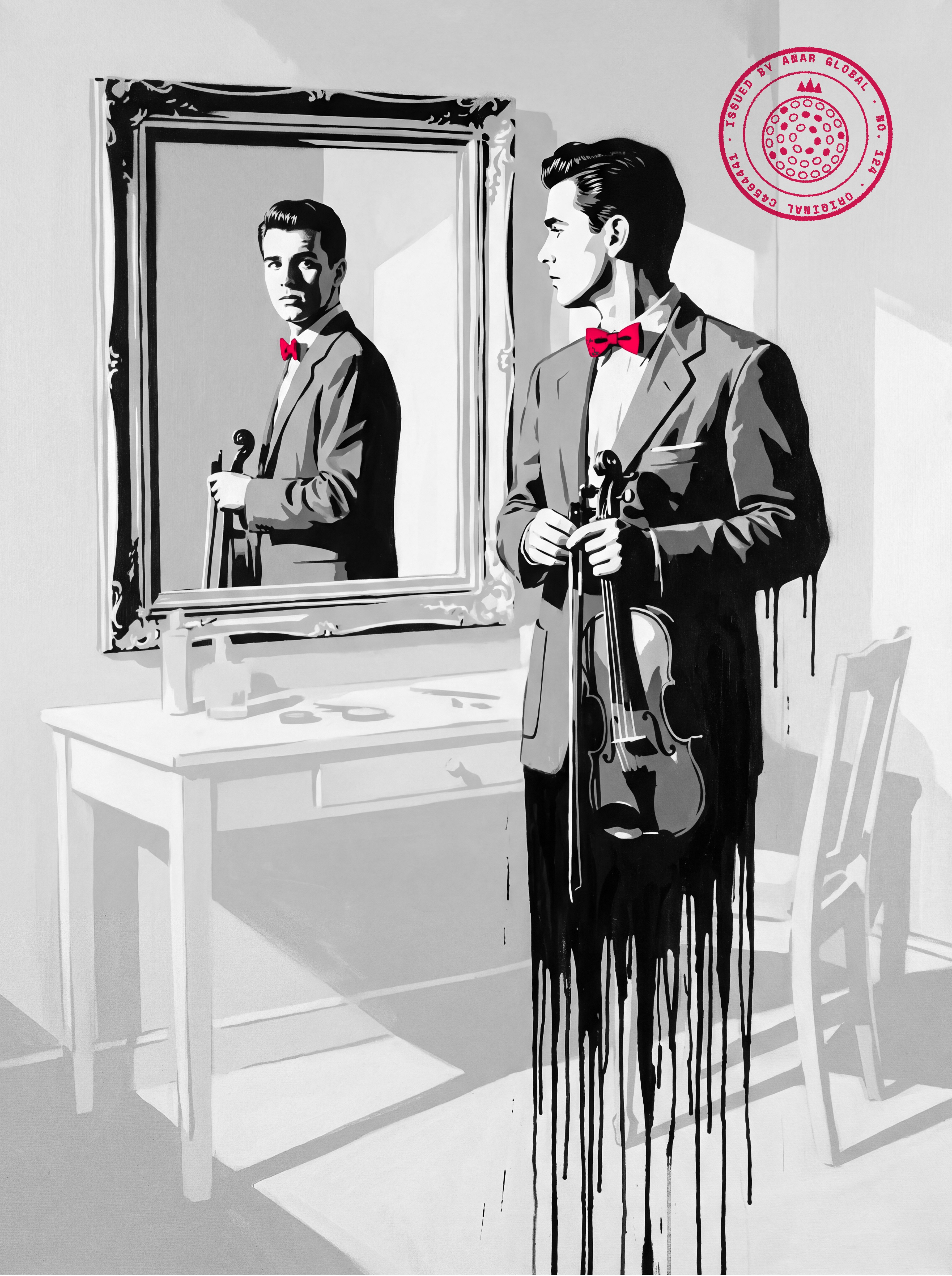
The goal is top left: a new look that carries the old rules
- Your goal Your words and proof, built on the market's rules.
- A clone Looks like everyone else and takes someone else's work.
- A guess A new angle with no rules behind it.
- The copied flop Same look, missing the reasons. Dies in a week.
Our model.
The Rules Sheet pulls the rules out of one ad that has run for months. Put each line of the ad on the left and what it gives the buyer on the right, then name it: proof, believability, time, steps, things to skip, order, risk, or whatever new label that market needs. Add the signals: length, price, button, story or facts.
Note how much change the ad asks for. Every ad you write carries all the rules, in your own words and proof, and asks for no more change than the winner.
Start with one ad that has run for months
Start with one winner, not ten random ads. Your own best ad works. So does a competitor's.
To find competitors' ads, use the Meta Ad Library. It is free, and anyone can search it.
Meta says the library shows every active ad and the date it started running. For most ads it shows no spend and no results.
Why does the start date matter? Advertisers rarely keep paying for an ad that loses money. So an ad that has run for months has usually matched what its market wants.
Treat the date as a strong hint, not proof. It is still the best clue you can get for free.
Pick the ad that has run longest. Months, not days. Save its full text and a screenshot.
The Ad Library shows how long each ad has run, and months is the clue
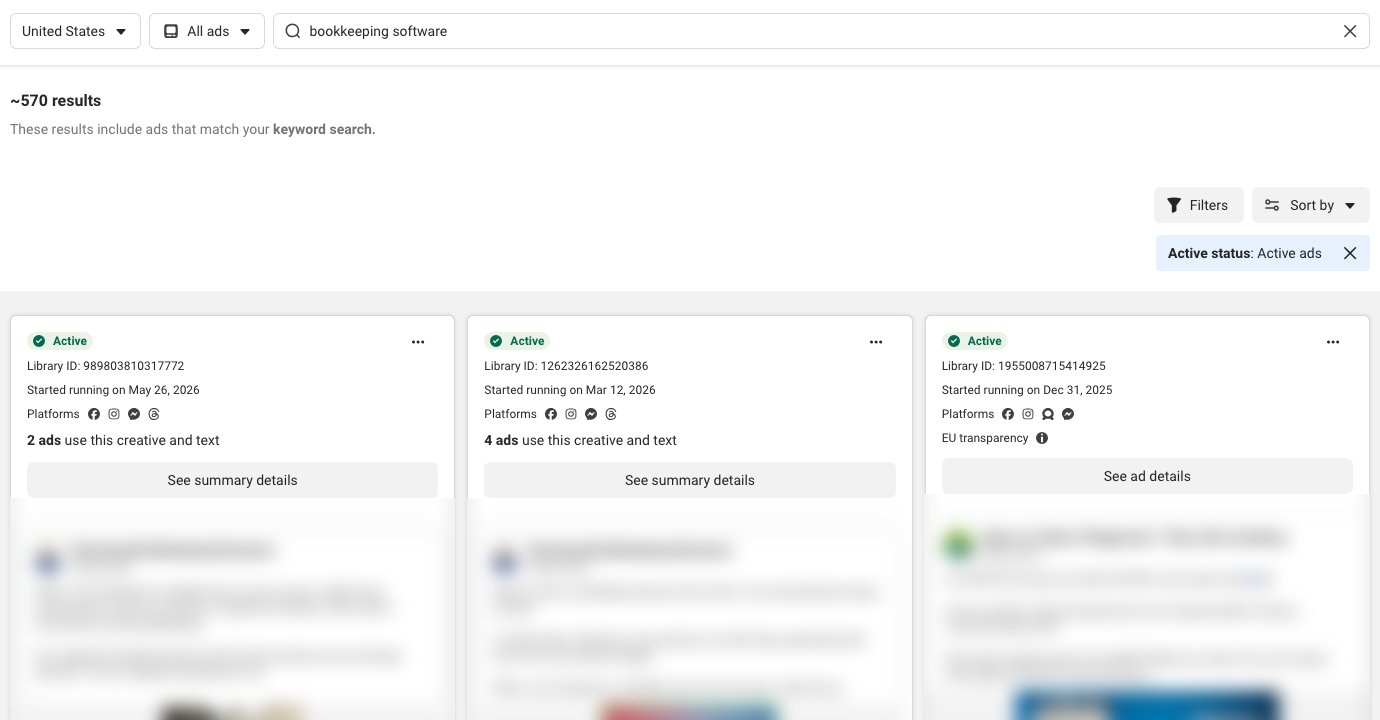
- Search your product type, or a competitor's Page name.
- Pick the country you sell in.
- Active ads only. Stopped ads mostly drop out of the library.
- This date is your best free clue. Months, not days.
- Open it and save the full text and a screenshot.
Screenshot of the public Meta Ad Library search for bookkeeping software, taken 2026-10-17. Advertiser names, photos and ad creative blurred
Five steps to one ad worth studying
- 1. Search Type your product type or a competitor's Page name into the Ad Library.
- 2. Filter Pick your country and active ads only.
- 3. Read the date Each ad shows the day it started running.
- 4. Pick the oldest Months, not days. Long runs usually mean the ad fits its market.
- 5. Save it Full text and a screenshot, before it stops running.
Our method, using the public Meta Ad Library.
Build the Rules Sheet, one line at a time
Open a doc and make a table with two columns. Paste the winning ad on the left, one line per row.
Now go top to bottom. For each line, ask one question: what does this give the reader? Write the answer on the right.
Give each answer a short name. Common ones are proof, believability, time, steps, things they can skip, order and risk.
For example, take an ad for a $5 guide for online store owners. It opens with thousands of tests and a sales total. That is proof.
It says the method came out of $80 million in ad spend. That is believability. Notice it says nothing about the founder.
In that market, buyers do not care who he is. They care whether it works.
Mark the lines that jump out at you. Those are the rules you cannot drop.
Skip the headline's exact words. Skip the photo. That is the surface, and it is exactly what you will replace.
A Rules Sheet keeps what each line gives the reader, not the words
- Start with one ad that has run for months.
- Write what each line gives the reader, not what it says.
- Name it in plain words. Add new labels when your market needs them.
- Mark the rules you cannot drop.
- Check how much change the ad asks for. Yours should ask no more.
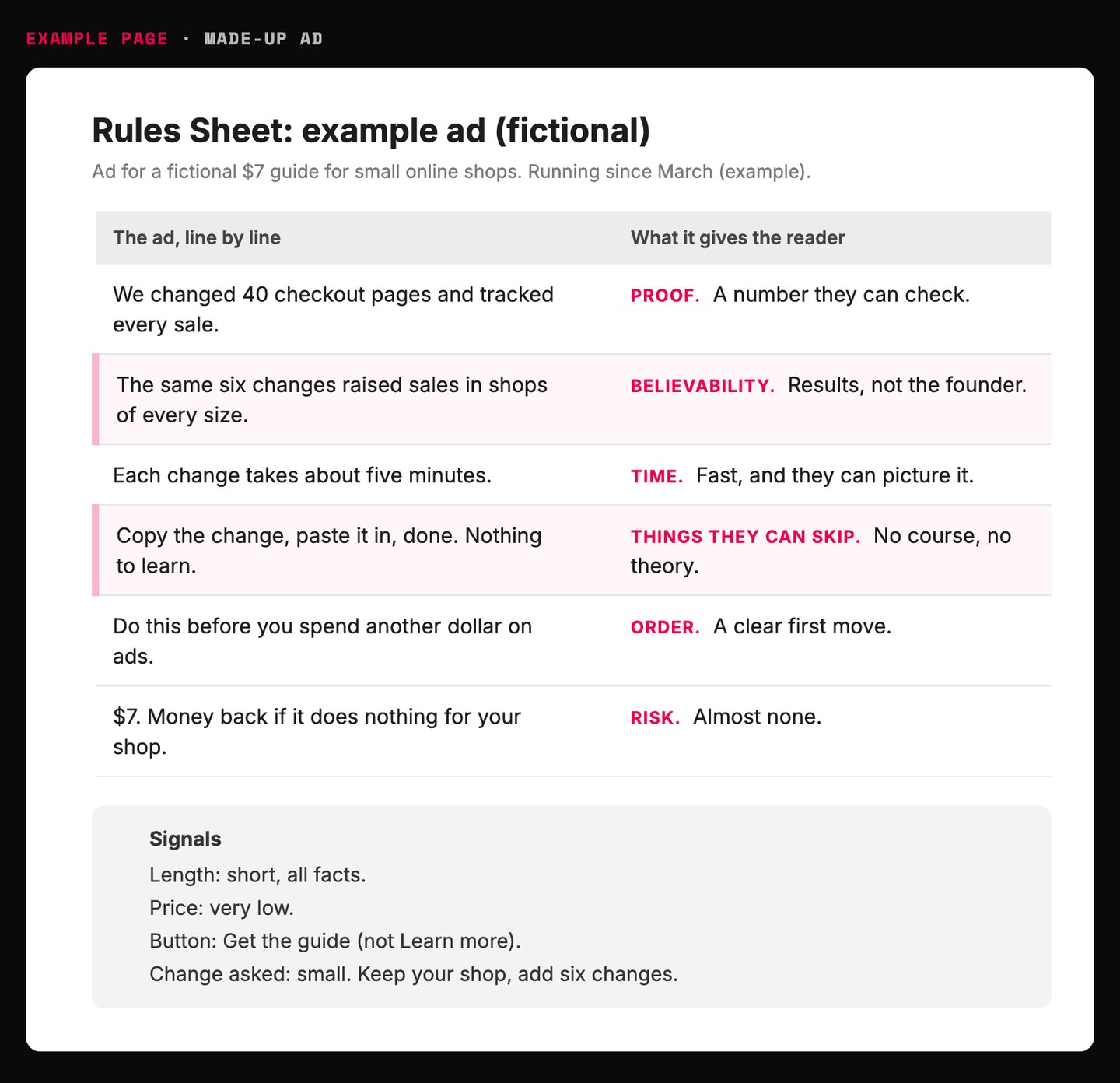
Example page built for this article with a made-up brand
Example: six lines from one store-owner ad, and what each gives the buyer
| What the line says | What it gives the reader | Rule |
|---|---|---|
| Thousands of tests and a sales total | A number they can check | Proof |
| Built on $80 million in ad spend | A reason to believe it works | Believability |
| Set the changes once, then leave them | Nothing to learn or watch | Things they can skip |
| Do this before you spend more on ads | An order to follow | Order |
| About $5 | Almost no risk | Risk |
| Short, all facts, no story | Respect for a reader in a hurry | Length |
Example ads from other businesses, paraphrased. Not our results. The labels are ours.
Common rule names and the question each one answers
| Rule | Ask the line |
|---|---|
| Proof | What can the reader check? |
| Believability | Why should they trust this works? |
| Time | How fast, and how long does it last? |
| Steps | Is the method shown as steps? |
| Things they can skip | What will they not have to do? |
| Order | Is there a first move? |
| Risk | What do they lose if it fails? |
Our labels. Your market's winner may need others.
The rules change from market to market
There is no fixed checklist. Every market has its own list, and you find it by reading its winners.
For example, a dating coach for older men ran a long ad. It opened by asking why women stop texting back.
Then it told readers the reason was not their age, their hair or their looks. It was not their fault.
Next came a simple step-by-step process. They would not have to change who they are. And the choice would be theirs.
Compare it with the $5 store guide. The rules are completely different.
One sells facts to people in a hurry. The other sells hope to people who feel stuck.
So never fill in someone else's checklist, including ours. What does your market's winner give, line by line?
Two winning ads, two different lists of rules
| Store guide, $5 | Dating coach for older men |
|---|---|
| Short, all facts | Long, for a reader who feels low |
| Proof from numbers | A reason why it keeps going wrong |
| Believability from results, not the founder | It is not the reader's fault |
| Nothing to learn | Age and looks are not the problem |
| Do this first | A simple process, no change to who they are |
| Low price, low risk | The reader gets to choose |
Example ads from other businesses, paraphrased. Not our results. The labels are ours.
Read the length, the price and the button too
Some rules are not in the words. Check four more things.
Length. Short, factual ads speak to people who feel fine and want to move fast. Long ads speak to people who feel low and will read to find hope.
More on that in when long Facebook ads win.
Price. A very low price says low risk. It can also look too cheap to be real, so watch for that.
The button. "Learn more" suits people who want to learn. The store owners in our example did not.
They wanted it done.
Story or facts. A long founder story, told to a buyer who wants facts, loses them fast.
Write each signal on the sheet. It is part of the rules.
Length, price, button and story tell you who the buyer is
| Signal | What you see | What it tells you |
|---|---|---|
| Length | Short and factual | Readers feel fine and want to move fast |
| Length | Long | Readers feel low and want hope |
| Price | Very low | Low risk, unless it looks too cheap to be real |
| Button | "Learn more" | Fits people who want to learn, not people who want it done |
| Story or facts | Founder story | Loses buyers who came for facts |
Our reading rules.
Make each rule stronger with a specific
Once you have the rules, every ad you write carries all of them. Then you make each one more specific.
Specifics beat claims. "We tested a lot" is a claim. "We tested our checkout page 500 times" is a picture.
Ask the follow-up a buyer would ask. How fast did it work?
How long did it last? For how many stores?
Then time each step. Watch one video, two minutes.
Copy the template, 30 seconds. Install it, two minutes.
A buyer can picture four and a half minutes. Nobody can picture "easy."
Only write numbers you can prove. The FTC says ad claims must be truthful and backed by evidence. The 500 tests above are an example, not a figure to borrow.
You can also open with one line about the market. For example: "Only [X] percent of stores like yours reach [result]. Here is what we found."
Fill in X only from a source you can cite.
Every vague line has a specific version a buyer can picture
| Vague | Specific (example) |
|---|---|
| We tested a lot | We tested our checkout page 500 times |
| It is quick | It takes five minutes |
| Easy to set up | Watch one video, copy one template, install it |
| We made a lot of money | How fast it worked, and how long it lasted |
| Low risk | If it does not do what we promise, get your money back |
Example lines. Use only numbers you can prove.
Example: three timed steps add up to four and a half minutes
Minutes per step in an example setup line
- Watch one video 2
- Copy the template 0.5
- Install it 2
Worked example of a timed-steps line. The times are the example's, not a benchmark.
Check how much change your ad asks for
Almost nobody checks this next part. How much change does your ad ask the reader to make?
People sort into three rough groups. Keep-it-the-same buyers want almost everything to stay as it is. Same-but-better buyers keep most things and want a little new.
Something-new buyers want mostly new. They are curious. They also tend to drift off when the next new thing shows up.
Most people lean toward what they already have. Researchers call it status quo bias. Losing something also feels worse than gaining the same amount, which is called loss aversion.
So assume your buyer is same-but-better. Let your market's long-running ads prove you wrong.
For example, an online store course had a hook about starting a profitable business in four weeks. To the reader, starting a business sounds like everything changes.
The fix kept the hook and added one promise. The business would let the reader keep their job, keep their hobbies and still have free time.
The course owner says the ad went from losing to winning. They reported cost per sale falling from a few hundred dollars to about $30 to $40. Their numbers varied, and we have not seen the data.
One word did the work: keep.
Three buyers, three amounts of change they will accept
| Buyer | Keeps the same | Wants new | Words that land |
|---|---|---|---|
| Keep it the same | Almost all | Almost none | Keep it working |
| Same but better | About 70 to 80% | About 20 to 30% | Keep, add, better |
| Something new | About 20 to 30% | About 70 to 80% | New, different, first |
Our model. The percentages are rough rules of thumb, not measured data.
Example: the same hook, rewritten to keep what the reader has
| Asks for a big change | Keeps what they have |
|---|---|
| Start a profitable business in four weeks | Start one in four weeks and keep your job, your hobbies and your free time |
| Replace your system | Add this system to your business |
| Quit your job and buy a business | Keep your job and check the numbers on weekends |
| A brand-new way to work out | Your same workout, a little better |
First row: one course's hook, paraphrased; the owner reports it went from losing to winning, not verified by us. Other rows: our examples.
When an ad is not working, check two things in order
First, check the rules. Does your ad carry everything the winner carried?
Second, check the change. Does your ad ask for more change than the winner did? Words like replace, start over and brand new are the warning signs.
Only then look at who you target. That is the easy layer, and it is rarely the problem.
How to waste a month of ad spend in four easy steps:
1. Find a winner and copy its look.
2. Fill it with what you would want to read.
3. Promise the reader a brand-new life.
4. When it dies, blame the damn algorithm and launch ten more.
Ten unrelated ads are ten guesses. Build one base ad that carries every rule. Then run A/B tests on one change at a time, as in testing one variable at a time.
Give each test a fair run. Meta describes a learning phase for new ads, when results swing more than usual.
Check the rules and the change before you blame the targeting
- 1. Who you reach Interests and audiences. The easy layer, rarely the problem.
- 2. The rules Does the ad carry everything the winner carried?
- 3. The change Does it ask for more change than the winner did?
Our model.
Three common stuck points, and the fix for each
| What you see | Why | The fix |
|---|---|---|
| The copy of a winner dies in a week | It kept the look and lost the rules | Rebuild it from a Rules Sheet |
| Clicks, but no sales | The page or the next offer breaks the ad's rules | Carry the rules past the ad |
| Works small, dies as you spend more | More spend reaches people who resist the change you ask for | Ask for less change: keep and add |
Our diagnosis rules.
Carry the rules past the ad
An ad that works can still lose money after the click. The page, the emails, the next offer and the sales call often break the rules the ad set.
If the ad is short and factual, so is the page. If the ad promised nothing to learn, the first email does not open with a lesson.
The amount of change matters here too. Sell a same-but-better buyer more of the same next. After that, offer the same thing a little better.
Our guide to matching the page to the ad walks through the page part.
The page, emails and next offer keep the ad's rules
- Landing page Same length and tone as the ad. Short ad, short page.
- Emails If the ad promised nothing to learn, no lessons up front.
- Next offer More of the same, then the same but a little better.
- Sales call Same proof, same promise, same amount of change.
Our method.
Is this just copying with extra steps?
No. You keep the rules and throw away the words.
The US Copyright Office says copyright does not protect ideas, systems or methods. It may protect the way they are expressed.
So never lift a competitor's sentences, images or brand. A swipe file of other people's ads is for study, never for pasting.
Learning that a market wants proof, a clear time frame and nothing to learn takes nothing from anyone. Lawyers call this the idea and expression split.
Stuck on the believability rule? Our guide to four sources of credibility covers where it can come from.
The rules are free to learn; the words are not yours to take
| Yours to learn | Not yours to take |
|---|---|
| The market wants proof from numbers | Their exact sentences |
| Buyers want to skip the learning | Their photos and videos |
| Short and factual beats long | Their brand name, logo and look |
| Keep and add beats replace | Their customer quotes and results |
Our rule, in line with the US Copyright Office: ideas and methods are not protected; the way they are expressed may be.
Pull the rules with AI: the copy-paste prompt
Paste the prompt below into your preferred AI. Give it one winning ad and your own ad.
It builds the Rules Sheet, reads the signals and checks how much change each ad asks for. It never invents a number. It marks each gap for you to fill.
Want a second pair of eyes on the result? You can send it to us.
Paste into your preferred AI. It asks for the winning ad and yours, then gives you the rules, the signals and what your ad is missing.
Act as an ad analyst. Pull the rules out of one winning ad with a Rules Sheet, then check my ad against them.

Ask me one at a time, with the example:
1. Paste the winning ad's full text and describe its image or video. (Example: a long-running ad for a $5 guide for online store owners)
2. When did it start running? Use the start date in the Meta Ad Library. (Example: five months ago)
3. What else do you see: the price, the button text, the length, story or facts? (Example: $5, "Learn more", short, all facts)
4. Paste my ad, or describe the offer I want to sell.

Rules:
- Work top to bottom. Make a two-column table: each line of the winning ad on the left, what it gives the reader on the right.
- Name what each line gives in plain words, such as proof, believability, time, steps, things they can skip, order or risk. Add a new label whenever a line gives something else. Never force a fixed list.
- Ignore the surface: the exact words, the photo, the layout. I will replace all of it.
- Read the signals. Short and factual means readers in a hurry. Long means readers looking for hope. Say whether the price and the button fit those readers.
- Change check: does the ad ask the reader to change a lot (replace, start over, brand new) or a little (keep, add, same but better)? Quote the words that tell you.
- For each rule, suggest one specific that would make it stronger. Use only facts I give you. Never invent a number, a result or a testimonial. Write [NEED: what is missing] instead.
- Check my ad: which rules it carries, which are missing, and whether it asks for more change than the winner.
- Never copy a sentence, an image idea or a brand element from the winning ad.

Answer in this order:
Rules Sheet: [table]
Signals: length / price / button / story or facts / change level
Rules my ad must carry: [list]
My ad: carries / missing / asks for more change or not
Three new opening lines in my own words: 1. 2. 3.
What I still need to find out: [list]
Run it this week
1. Find the longest-running ad in your market in the Ad Library.
2. Fill one Rules Sheet for it, with the prompt or by hand.
3. Check your best ad against it, rules first and change second. Fix what is missing.
Need a stronger first line next? Read how to write hooks with change and hope.
Their look belongs to them. The rules come from the buyer, so anyone can follow them.

Filip Kovacevic is the founder of Anar Agency in Phoenix. He spent five years running SEO, Meta ads, email, and content for medical practices across the United States, and now does the same work for healthcare, home-service, legal, and professional-service businesses, alongside AI implementation. More from Filip →
Talk it through in 15 minutes
Bring one question from this article. We will tell you what we would do, whether or not you hire us.
Book a 15-Min Chat →