Long-Form Facebook Ad Copy: How to Write the Long Ad

Long Facebook ad copy works when the buyer has a big decision and has tried other fixes. Most people scroll past, and that is fine. Build it in eight parts: an opening that names the reader, a short setup, the problem in scenes, the failed fixes, a brief turn and result, one argument, and a clear close.
Does long-form Facebook ad copy still work?
Picture your thumb scrolling fast past a dog video, a shoe sale and a cousin's wedding.
Then you see a plain photo with 800 words under it. Everyone you know says nobody reads that.
Most people don't. The few who stop are the ones with the problem. They are the only ones you wanted.
Long form Facebook ad copy works when the writing is good and the buyer has a real decision to make. When a long ad fails, the cause is usually the writing, not the length.
Why does a long ad work at all? Because a click is work. Reading one more line is almost free.
So do the selling inside the ad, where it costs the reader nothing. The page then gets a reader who already wants the thing, which is the whole idea behind ad-to-page alignment.
Our take: when someone says short copy beat their long copy, ask to see the long copy. It is usually a short ad with extra words.
A long ad is not a short ad that kept talking. It has eight parts, in a fixed order. The table below shows each one.
A long ad moves the selling from the page into the ad
| Short ad | Long ad |
|---|---|
| Names the problem in one line | Shows the problem in scenes |
| Sends a curious stranger to the page | Sends a reader who already wants it |
| The page does all the selling | The ad does most of the selling |
| Fits quick, cheap buys | Fits buys people think over |
Method
Eight parts: the problem gets the most room, the argument does the most work
| Part | Its job | Length |
|---|---|---|
| 1. Opening | Name the reader and the change | 2 to 3 lines |
| 2. Setup | Give a reason to read the story | Short |
| 3. Problem | True scenes, small to big | Long |
| 4. Failed fixes | The pain of what they already tried | Long |
| 5. Turn | The moment it changed | 2 to 3 lines |
| 6. Result | Life after, briefly | 1 to 2 lines |
| 7. Argument | Why nothing worked before, and why this will | Medium |
| 8. Close | Why you made it, the cost of waiting, one last line | Short |
Method
How long should Facebook ad copy be? As long as the decision
Facebook ad copy should be as long as the buyer's decision. A quick, cheap buy needs a few lines. A buy that takes weeks of thought needs several hundred words.
Selling a t-shirt? Keep it short. Nobody needs a story about cotton.
The more time and money a decision takes, the more the ad should teach. Time matters even more than price.
The second test is how many fixes the buyer has already tried. Someone who read the books and bought the apps has heard every promise. Only an argument shows them why yours is different, as we explain in selling to buyers who have seen it all.
Some offers do not fit at all. A greens drink rarely needs a story. A holiday villa may sell better with a slow video of the rooms than with any copy.
Not sure? Open the Meta Ad Library and look at what others in your market run. Then check the grid below.
Big decision, many failed fixes: write long. Small decision, first try: write short and move on.

Write long when the decision is big and the buyer has tried other fixes
- Short ad, sharp argument A few lines on why the usual fix fails.
- Full long ad All eight parts. This is where a long ad pays off.
- Short ad A few lines and a clear offer. The t-shirt zone.
- Long ad, simple argument Teach the decision; the argument can stay light.
Method
The Long Ad is a Facebook ad of several hundred words built in eight parts. One: an opening of two or three lines that names the reader and the change. Two: a setup that gives a reason to read the story.
Three: the problem in true scenes, small to big. Four: the fixes that failed. Five: the turn, brief.
Six: the result, brief. Seven: the argument, in the shape 'You think X is the problem, and so you do Y. But Z is the real problem, and Y makes Z worse.' Eight: the close, with why you made it, the cost of waiting and one last line.
Tell the story in first or third person. Use it for decisions people think over.
Name the reader in the first words of the opening
The opening is the two or three lines people see before the text is cut off. Its job is to get the right person to keep reading. Its first words should say who the ad is for.
For example, picture a bookkeeper who works with small contractors. Her opening could be: Here's how small contractors go from 'buried in receipts' to 'done by Friday', even when bookkeeping apps haven't helped.
That one line does three jobs. It names the reader. It shows the change in a few words, and the 'even when' part answers the doubt that stops them.
The wrong reader leaves. Good. Meta's ad auction weighs how likely each person is to act on your ad.
Our view: a clear opening helps Meta find more people like the ones who read on. Vague openings get clicks too, but often from the wrong people.
Meta's ad quality rules also count withholding information and engagement bait (posts that beg for likes or comments) against an ad. A tease can cost you both the right clicks and ad quality.
Write three openings for the same body and test them. Our guide to writing a hook covers what the first line should promise.
The opening is everything above 'See more', and its first line does three jobs
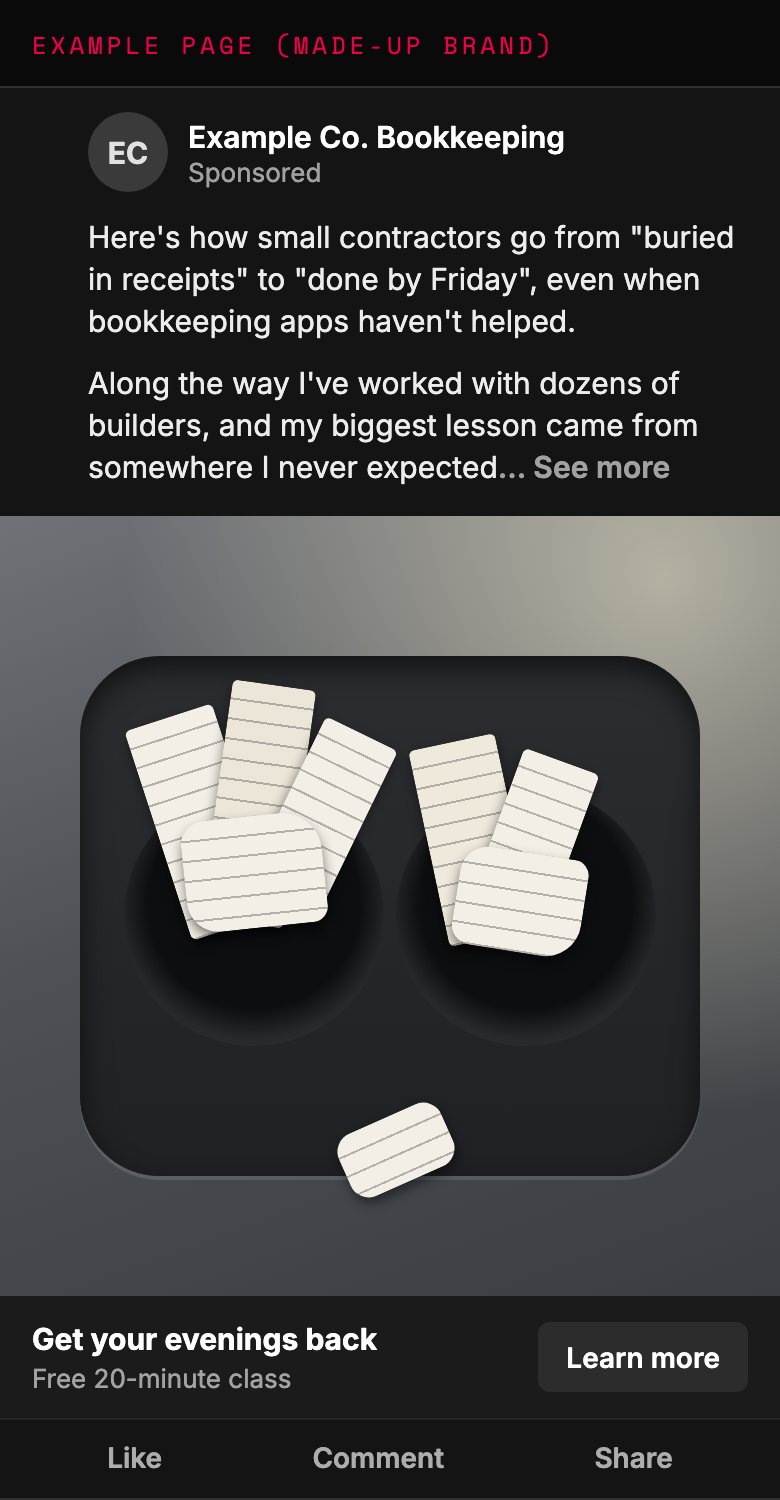
- The first words name who the ad is for. The wrong reader leaves, and that is fine.
- The change, from and to, in a few words.
- The even-when line answers the doubt that would stop them.
- This is where the opening ends. The setup and the story start here.
Example page built for this article with a made-up brand
Example: one opening line does three jobs
| Piece | Example words | Its job |
|---|---|---|
| Who | Here's how small contractors | The right reader stops and the wrong one leaves |
| From and to | go from 'buried in receipts' to 'done by Friday' | Shows the change in a few words |
| Even when | even when bookkeeping apps haven't helped | Answers the doubt that stops them |
Made-up example for this article
Example: a named opening trades some clicks for the right ones
| Vague opening | Named opening |
|---|---|
| 'You won't believe what happened next' | 'Here's how small contractors get their books done by Friday' |
| Anyone might click | The right reader clicks |
| Holds back information, which Meta counts against ad quality | Says who it is for and what changes |
Made-up example for this article; Meta Business Help Center, About ad auctions
Set up the story before you tell it
Never open a Facebook ad with the story itself. People in a feed did not come for a story. They came to scroll.
'It was the worst night of my life' works in a video someone chose to watch. In a feed, the reader thinks: who are you? Then they leave.
Picture a stranger who hears you ask a friend about a good place to eat. He leans over and says he knows the best one in town, and it is not what you would guess. You listen.
Now picture him starting with the first time he ever ate out. You walk away. Same man, same story, no reason to care yet.
The setup gives them that reason. It sits between the opening and the story and does six small jobs, shown below.
Mention your credentials in passing, in the middle of a sentence. In the bookkeeper example, 'along the way I've worked with dozens of builders' sounds natural. A bare 'I am a certified accountant' makes people wonder why you are telling them a story.
Answer only the doubts that would stop them reading. Not every doubt. Only the one or two that block the way.
The setup does six small jobs before the story starts
- Why listen Your credibility, in passing, inside a sentence that keeps moving.
- The doubt that stops them Only the doubt that would stop them reading.
- A hint of the result What they want, said lightly.
- An open question For example: my biggest lesson came from somewhere I never expected.
- A light hint at the argument For example: why the usual advice misses it. Do not give it away.
- Why a story is next So the story feels like the natural next step.
Method
Start with why to listen, not with the worst night of your life
| Story first | Setup first |
|---|---|
| 'It was the worst night of my life.' | 'Here's what I learned getting builders' books done every Friday.' |
| The reader asks: who are you? | The reader knows why to keep going |
| Works in a video someone chose to watch | Works in a feed full of strangers |
Made-up example for this article
Tell the problem in scenes, then the fixes that failed
The problem part of a long ad works only as scenes the reader can see. 'I felt bad, it was hard' gives them nothing to picture.
Move in time order: the start, the middle, the years after. Climb from small signs to big ones. Then come back to the feeling inside.
In the bookkeeper example: receipts stuffed in the truck's cup holder. A supplier bill found three months late. A letter from the tax office on the kitchen table.
Then go back to the feeling inside: the knot in her stomach every time the mail came. Three scenes, not four. The rule of three works because three feels complete.
Next comes the second problem: the fixes that failed.
I tried three apps. I tried a shoebox system. I tried paying my nephew.
Short lines stacked back to back hit harder than one long sentence. One line standing alone gets the most weight. Use that for the line you want remembered.
This part matters most when buyers have tried everything. If you say the usual advice never explains how to do it, the reader will expect you to explain how.
Add the trap they feel stuck in. I didn't want to lose my evenings to paperwork, but I couldn't hand my books to a stranger. Acting hurts, and so does doing nothing.
Where do true scenes come from? From research, not imagination. Talk to the owner, watch their webinars, read customer stories, and put it all in one document.
Our rule: every scene must be true, and a customer's story needs that customer's permission. Invented details lose the readers who lived the real thing.
Example: climb from small signs to big ones, then return to the feeling
- Small sign Receipts stuffed in the truck's cup holder
- Bigger sign A supplier bill found three months late
- Biggest sign A letter from the tax office on the kitchen table
- The feeling inside The knot in her stomach every time the mail came
Made-up example for this article
Scenes give the reader something to see; feeling words give them nothing
| Feeling words | Scenes |
|---|---|
| It was stressful | A letter from the tax office on the kitchen table |
| I was behind | A supplier bill found three months late |
| Nothing helped | I tried three apps. I tried a shoebox. I tried my nephew. |
Made-up example for this article
Keep the turn and the result short
The turn is the moment things changed, and it takes two or three lines. Maybe a wise person spoke up, a friend gave advice, or you took matters into your own hands.
Hint at what changed. Do not explain it yet. Keep it about feeling, not facts.
The result comes next, in a line or two. In the example: ten minutes a day, and the pile never came back. That is enough.
How many results should you list? As many as the buyer actually wants. A health offer might list sleep, energy and skin, while a bookkeeping offer needs one: evenings back.
One smart move: hold the biggest result back. Save it for after your strangest piece of advice. Then the result proves the advice worked.
Our take: the happy ending is the part readers trust least. Keep it short and let the argument do the convincing.
Four places long ads stall, and the fix for each
| Symptom | Cause | Fix |
|---|---|---|
| Readers drop off before the story | The ad opened with the story | Add a setup that says why to listen |
| The turn feels sudden | Nothing hints at what changed | One line of feeling about the change; the argument explains it |
| Readers doubt the happy ending | The result runs too long | Cut it to a line or two and hold the biggest result back |
| Lots of clicks, few buyers | A vague opening drew the wrong people | Name the reader in the first words |
Method
Write the argument: they were fixing the wrong problem
The argument is one line of logic that explains why everything the reader tried has failed. The whole ad depends on it. Spend more time here than on the story.
Use this shape. You think X is the problem, and so you do Y. But Z is the real problem, and Y makes Z worse.
A classic example. You think you need to burn more calories, so you jog for an hour every day. The jogging makes you hungrier, you eat more, and the weight comes back.
Story first, logic second. The story makes them want it. The argument lets them say yes with their head as well.
The best arguments push against conventional wisdom the reader knows by heart. Call it the usual advice, or what the experts say, and never name a competitor. Our piece on arguing against the story your market believes goes deeper.
Your argument will sound odd at first. Say so before they do: I know that sounds backwards. Then show the proof.
Done right, the reader sees why nothing worked, why this will, and that they are not stuck. That feeling is hope. Hope is what people buy.
The argument in one line: the usual fix feeds the real problem
| Slot | Weight-loss example | Bookkeeper example |
|---|---|---|
| You think X is the problem | Not burning enough calories | The wrong app |
| So you do Y to fix X | Jog for an hour every day | Switch to a new app |
| But the real problem is Z | Hunger | No daily habit |
| And Y makes Z worse | Jogging makes you hungrier, so you eat more | Each new app resets the habit to zero |
The weight-loss case is a classic illustration; the bookkeeper case is made up for this article
Five questions that find your argument
- What does everyone in this market believe? Write down the usual advice word for word.
- What is different about this offer? The one thing the usual fixes do not do.
- What goes wrong with every other fix? Find the problem they share that yours does not have.
- What does the buyer not realize? The hidden cause behind the failed fixes.
- What surprise explains why the old fixes failed? If the answer fits X, Y and Z, use the shape. If not, use the surprise as it is.
Method
Should a Facebook ad say 'you' or 'I'?
Tell the story as 'I' or 'she', and use 'you' only when it does not point at a personal trait. That keeps the ad soft and inside Meta's rules.
Meta does not allow ads that assert or imply personal attributes of the audience, such as physical or mental health or a weak financial position. 'Do you have diabetes?' breaks the rule. 'New diabetes treatment available' does not.
'You' by itself is fine, and Meta's page says so. The trouble starts when 'you' or 'other' points at a trait. 'Meet other seniors' fails for the same reason.
There is a second, gentler reason too. 'Don't you feel awful about your weight?' is a stranger telling you how you feel. 'I fought my weight for years and never felt like myself' lets the reader decide it sounds familiar.
So tell the story about yourself or a customer, in first or third person. The reader connects it to their own life. People trust a conclusion they reached on their own.
Health and money topics get the strictest review. Read Meta's policy summary before you write a single scene. For which words to lead with, see before-words and after-words.
'You' is fine; 'you' plus a personal trait is not, so tell the story as 'I' or 'she'
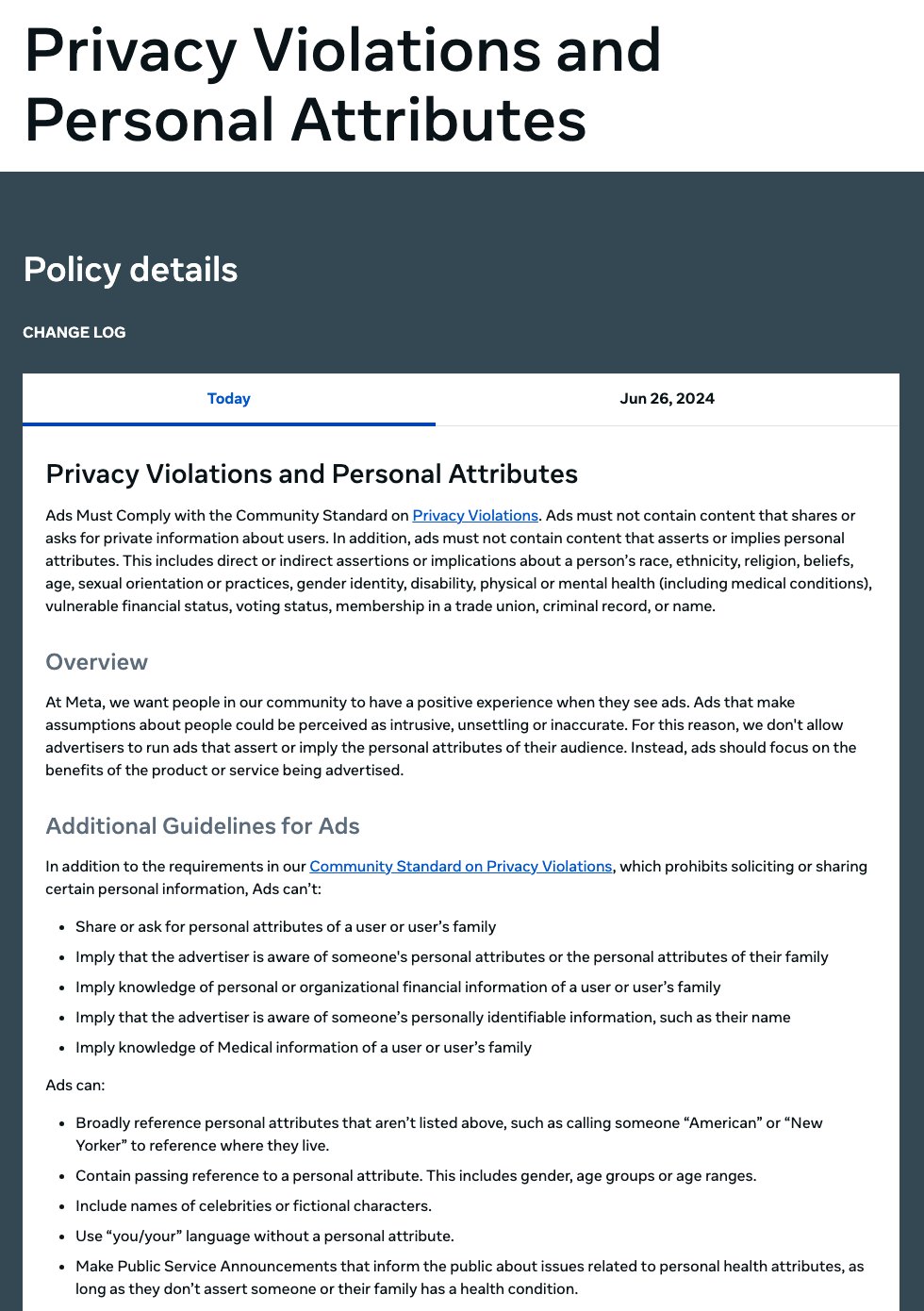
- The rule: an ad cannot say or hint that it knows the reader's personal traits.
- Health and money are on the list. A long story about "your" problem walks into this.
- Do not write as if you know the reader's situation. Tell your own story instead.
- "You" by itself is allowed. "You" plus a personal trait is not.
Screenshot of Meta Transparency Center, Privacy Violations and Personal Attributes, taken 2026-10-17
Tell it as 'I' or 'she', and keep 'you' away from personal traits
| Second person | First or third person |
|---|---|
| 'Don't you feel awful about your weight?' | 'I fought my weight for years and never felt like myself.' |
| 'Do you have diabetes?' (Meta lists this as not allowed) | 'New diabetes treatment available' (Meta lists this as allowed) |
| 'Meet other seniors' (not allowed) | 'Meet seniors' (allowed) |
| Tells the reader how they feel | Lets the reader decide it sounds familiar |
Meta Transparency Center, Privacy Violations and Personal Attributes, read 2026-10-17; first row made up for this article
Close with why you made it, the cost of waiting, and one last line
The close turns the story into an offer in five moves. Give the full result if you held it back. Then say why you made the offer.
Make the reason a good one. 'I want other contractors to get their evenings back' beats 'I started a business.' Then name the free class, the call or the product.
Answer leftover doubts in passing. 'To be clear, I'm not against apps' calms the people who love their app. 'Are you wondering if this will work for you?' plants the doubt you meant to remove.
Then name the cost of doing nothing, in words real customers actually used, like 'I wish I had started sooner.' Loss aversion is why it works: people feel a loss more than an equal gain.
End on one short line worth remembering. Then the link, your call to action. Our guide to the stacked close covers what to say about price.
How to waste 800 words in four easy steps. Step one: open with 'It was the worst night of my life.' Step two: list your degrees before anyone cares.
Step three: spend 300 words on the happy ending. Step four: end with 'Are you wondering if this is right for you?' Congratulations, you wrote a damn diary with a link.
Before you publish, read the ad like a stranger. Every 'he', 'she' and 'it' must point to one clear person or thing. If a reader has to stop and puzzle out a line, they scroll away.
Instagram cuts captions shorter. Write the long version for Facebook first, then trim a shorter one if it wins. Our one-variable testing guide shows how to test openings cleanly.
Close in five moves
- Give the full result If you held the biggest one back, now is the time.
- Say why you made it A reason that serves the reader, not your revenue.
- Answer doubts in passing 'To be clear, I'm not against apps.'
- Name the cost of waiting Only in words real customers used.
- One last line, then the link Short, warm, worth remembering.
Method
Write your long ad with AI
The prompt below runs the whole method. Paste it into your preferred AI and answer seven questions. It drafts all eight parts and lists every line that needs a fact checked.
It never invents a scene or a result. Missing one? It asks.
This week: first, gather your research into one document. Second, run the prompt and get three openings. Third, launch all three with the same body.
Want a second pair of eyes before launch? Send us your draft. You are not signing up for anything.
Back to that plain photo with 800 words under it. Most people will scroll past. Let them.
Write for the reader who stops, not for the crowd that scrolls.
Paste into your preferred AI. It asks seven questions, then drafts all eight parts, three openings and a fact-check list.
Act as a careful copywriter drafting a long Facebook ad. Use only my answers and these rules. Never invent a scene, result, number or quote; if one is missing, ask me. If you can browse, first check Meta's current ad standards on personal attributes and tell me if anything below has changed.

Ask one at a time, with the example, and wait:
1. Who the ad is for, in a few words. (Example: small contractors)
2. The change they want, from and to. (Example: buried in receipts, to done by Friday)
3. The fixes they already tried. (Example: three apps, a shoebox, a nephew)
4. Three true scenes of the problem, small to big. (Example: receipts in the truck's cup holder)
5. What changed for me or a customer, and the result. Say if the customer agreed to be shared.
6. The usual advice in my market. (Example: get a better app)
7. The offer and the link. (Example: a free 20-minute class)

Rules:
- Eight parts in order: opening, setup, problem, failed fixes, turn, result, argument, close.
- Opening: 2 to 3 lines. The first words name the reader. Show the change. Add an 'even when' line. No teases.
- Setup: why to listen (in passing), the one doubt that would stop them reading, a hint of the result, why a story is next.
- Problem: scenes in time order, small to big, then the feeling inside. Three items, not four.
- Failed fixes: short stacked lines, then the trap of acting versus not acting.
- Turn and result: two lines each.
- Argument: You think X is the problem, so you do Y. The real problem is Z, and Y makes Z worse. Name the objection it raises, then the proof.
- Close: a reason I made it that serves the reader, doubts answered in passing, the cost of waiting (only from real customer words), one last line, the link.
- Tell the story in 'I' or 'she'. Never pair 'you' or 'other' with health, money or any other personal trait.
- No fake scarcity. No invented testimonials.

Output: the full ad, then 3 other openings to test, then a list of every line that needs a fact checked.

Filip Kovacevic is the founder of Anar Agency in Phoenix. He spent five years running SEO, Meta ads, email, and content for medical practices across the United States, and now does the same work for healthcare, home-service, legal, and professional-service businesses, alongside AI implementation. More from Filip →
Talk it through in 15 minutes
Bring one question from this article. We will tell you what we would do, whether or not you hire us.
Book a 15-Min Chat →