Argue Against the Story Your Market Believes

Contrarian marketing works when you argue against the story your buyers already believe, not when you add one more claim for your product. Find the belief. Find what holds it up.
Show where that support went out of date, in time or in what it does. Blame the situation, never the buyer. Then give your explanation, with proof.
Contrarian marketing that works argues against a story
Two ads sit in the same feed. Ad one says: "We get contractors more leads." Ad two says: "Here's why paying for shared leads is costing you jobs."
Ad one sounds like every other ad. Ad two questions something the reader already does every week. Guess which one gets read.
Most ads argue for a product. The ones that work argue against a story.
Contrarian marketing usually means saying the opposite of everyone to get attention. That is not what we mean. We mean arguing against the one explanation your buyers already hold, with proof, so your explanation has room.
Why bother? When you argue for your product, you stand next to every competitor making the same case. You help them sell.
When you argue against the old story, you are the only one asking the question. We call the method the Counter-Story: five steps, and one AI prompt at the end.
Arguing for your product puts you in a crowd; arguing against the story puts you alone
| Arguing for your product | Arguing against their story |
|---|---|
| "We get you more leads." | "Here's why shared leads cost you jobs." |
| Joins every competitor's claim | Questions what every competitor assumes |
| The reader files it and scrolls | The reader has to check their own belief |
| Helps the whole category sell | Moves buyers away from the old way |
Our comparison. Ad lines are examples written by us.
Why do buyers ignore one more good claim?
Buyers ignore new claims because they already hold a story that explains their problem. That story keeps them feeling safe.
A market story is the explanation buyers repeat about why things are the way they are. "We have to run webinars." "We have to buy leads."
People repeat it on autopilot. It tells them the world makes sense. No story, no safety.
Researchers have a name for the pull to keep things as they are: status quo bias. The current state feels safe, and any change gets judged against it.
So a new claim bounces off. The old story was there first, and it is still standing.
Before people can join your side, they have to leave theirs. Your conversion rate is really the rate at which you change minds.
Big products did this at scale. When Yahoo moved its main results to search, its hand-built directory of sites faded.
The first iPhone argued against the keypad. Neither one said "we are a better version of the old thing."
Big products argued against an old way, not for a better version of it
| Old story | What argued against it | The crack it showed |
|---|---|---|
| To find a site, browse a directory | Search: type a word, get results | Directories could not keep up with the web |
| A phone needs a keypad | The first iPhone, 2007 | One screen could do the keypad's job and more |
| You need a job to be safe | Most business-opportunity offers | A job is one income you do not control |
| High-price offers sell on webinars | "Here's why your webinars cost too much" | Ad costs changed the math |
Yahoo Directory and iPhone from Wikipedia. Last two rows are examples, written by us.
The Counter-Story is an ad or offer opening that argues against the story a market already believes, instead of arguing for a product. Find the one belief the whole market shares, find what holds it up, and show where that support went out of date in time or in function. Blame the situation, never the buyer, and concede what is true.
Take the old story away first, then give your explanation as a gain, with proof the buyer can check.
Step 1: find the belief by listening for "we have to"
The belief you argue against is the one the whole market agrees on. Not a niche opinion, but the thing everybody does.
Listen for two words: "have to." A contractor who says "we have to buy leads from the big lead sites" is telling you the belief out loud.
Look at the biggest offers in your market too. What do they all assume? "Everybody needs a sales funnel" is a belief, sold in a dozen shapes.
Pick one belief. Only one.
Found three? Then you have not found the real one yet. One story per ad, or the reader tries to solve all of them and solves none.
Different sellers, one belief: you need a funnel
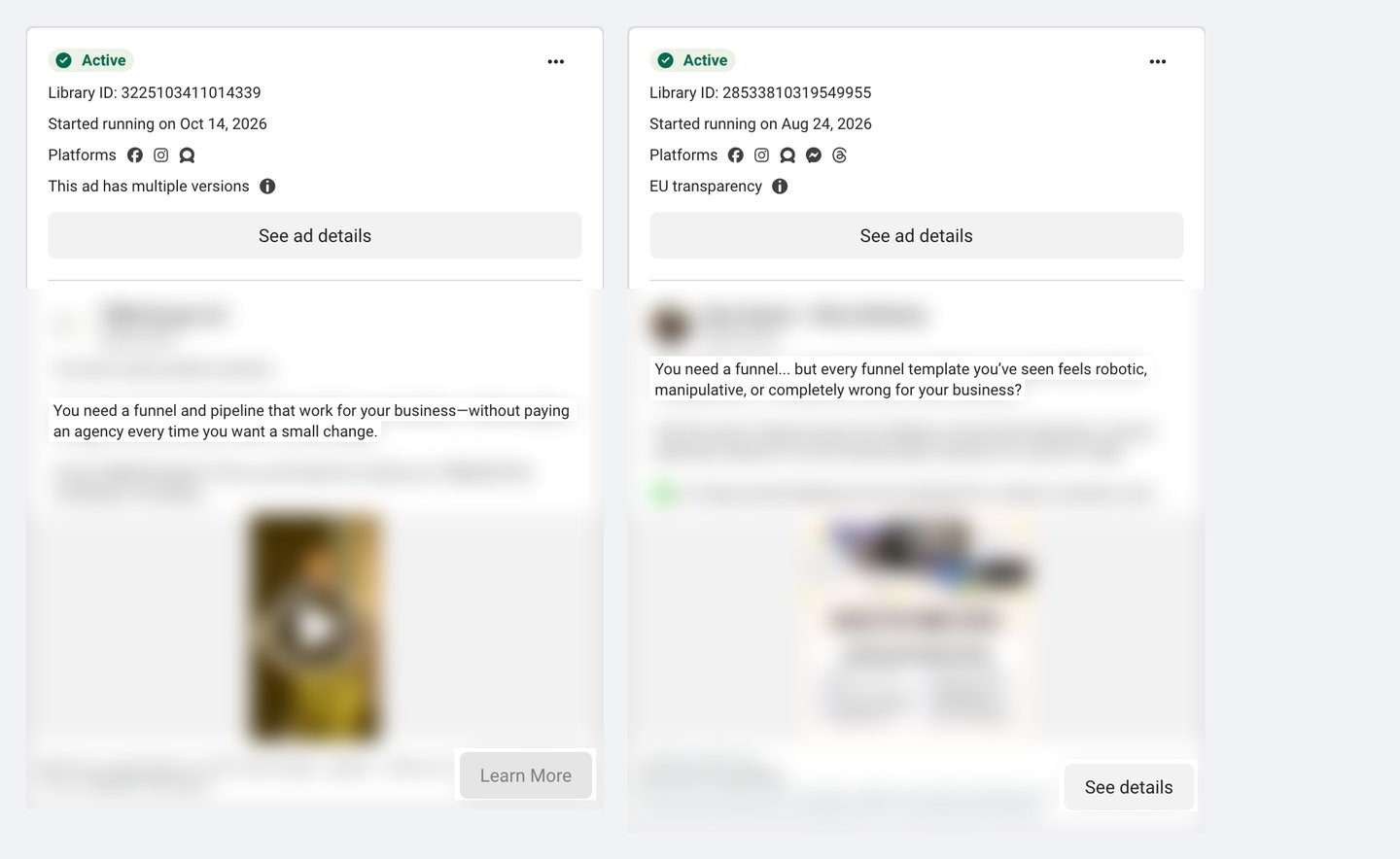
- The market's belief, said out loud.
- Different seller, same belief. Each ad argues for it.
- Every ad sells a better funnel. None asks if the buyer needs one.
- Your counter-story asks the question none of these ads ask.
Screenshot of the public Meta Ad Library (US, active ads, exact phrase "you need a funnel"), taken 2026-10-17. Two cards from the same results page placed side by side; names, pictures and the rest of each ad blurred.
A "have to" sentence is the market's belief, said out loud
| What buyers say | The belief under it | The question your counter-story asks |
|---|---|---|
| "We have to buy leads from the big lead sites." | Paid lead sites are the only steady source | What happens when the same lead goes to several companies? |
| "We have to run webinars." | Webinars are how big offers sell | What does one buyer cost from a webinar now? |
| "We have to be on Google." | Buyers find you when they search | Where are buyers before they search? |
| "We have to post every day." | More posts means more attention | What if the posts are not the reason anyone buys? |
Examples written by us to show the pattern.
Step 2: find what holds the belief up
Every belief stands on something, usually an experience, an assumption or a piece of evidence.
Ask one question. Why does the buyer think this is true?
Most of the time it is an experience. It worked for them once. Or it worked for everyone they knew, back then.
Write that support down in one line. That line is your target, not the person.
Guides on counterarguments make the same point. You can agree with part of a belief and still go after the evidence under it.
Easy to say. Most ads skip it and argue with the belief itself, which is like arguing with the weather.
Every belief stands on one piece of support; that is your target
From the bottom: what a market story is built on
- An experience "It worked for me once." Usually the real foundation.
- An assumption "So it still works." The part that may have gone out of date.
- The belief "We have to do it." What buyers say out loud.
- The story "Everyone does it." What the whole market repeats.
Our model of the Counter-Story method.
Step 3: show the support went out of date, in time or in function
Support goes out of date in two ways. In time: it was true back then, and something changed. In function: the old way still exists, but it stops doing the job the buyer wants.
Start with time. It is the easiest to show and the hardest to argue with.
For example, many real estate wholesaling courses were built in the years of cheap money. The average 30-year mortgage rate fell to 2.65 percent in January 2021, per Freddie Mac's weekly survey. By October 2023 it hit 7.79 percent.
Those courses were right for their time. Then the cost of every deal changed. A course that still teaches the cheap-money playbook is teaching rules for a market that has changed.
Here is the same pattern in another market. Google Ads has a reputation for being complicated and too expensive to test.
The counter-story: "That was true once. Here's what changed."
Today you choose your own average daily budget, so a first test can start at $5 or $10 a day. More on sizing it in how much to spend on Google Ads.
Next, the function test. Picture a course that teaches game design the way big studio teams work. Solo developers learn it, then take years to ship one game.
The skills are fine. The setup is wrong for one person. That is a counter-story in function.
You do not need to prove the old story 100 percent wrong. One real crack, shown clearly, opens the door. Our rule: the crack has to be true.
Courses built on 3 percent mortgages now teach a market with 7 percent ones
US 30-year fixed mortgage rate, yearly average, percent
- 30-year fixed rate: 2016 3.65, 2017 3.99, 2018 4.54, 2019 3.94, 2020 3.11, 2021 2.96, 2022 5.34, 2023 6.81, 2024 6.72, 2025 6.6
Source: Freddie Mac Primary Mortgage Market Survey, weekly history. Yearly averages computed by us, read 2026-10-17.
Old support fails in one of two ways: time or function
| Out of date in time | Out of date in function |
|---|---|
| It was true back then | It is still true somewhere |
| Something changed: rates, costs, tools | It no longer does the job this buyer wants |
| Line: "That was true once. Here's what changed." | Line: "That works for big teams. You are one person." |
| Example: cheap-money wholesaling courses | Example: studio-style game design for solo developers |
Our summary of the Counter-Story method. Examples written by us.
Step 4: blame the situation, never the buyer
The buyer believed the story for good reasons. Say so. The situation changed, not them.
Agree first. Concede what is true, then show the limit.
"Google is great if you want someone who is ready to buy today. Most of your buyers are not ready today." Nothing in that line attacks Google, or the reader.
A compliment can carry the counter-story too. "Group coaching is great if you want to show up and motivate people every day."
It sounds kind. A reader who does not want that job hears the problem.
Talk to beginners and experts differently. Tell a beginner to start. Tell an expert to do it differently.
Never tell an expert to start over. That says years of their work were wasted. It is the fastest way to lose one.
Want the reader to agree on the cause before you argue? Read agree on the cause first, then make the argument.
Concede first, then show the limit, and the reader never feels attacked
| Concede | Then the limit | Why it lands |
|---|---|---|
| "Google is great if you want buyers who are ready today." | "Most of your buyers are not ready today." | It praises the old way and shrinks it |
| "Group coaching is great if you want to motivate people every day." | "If you don't want that job, it is a lot of work." | It sounds like a compliment; they hear a problem |
| "Your current funnel worked when ads were cheaper." | "Ad costs changed, so the math changed." | The situation changed, not the buyer |
| "You already know how to do this." | "Here is how to do it differently." | Experts keep their past work |
Examples written by us to show the pattern.
Step 5: take the old story away, then give them yours
Order matters. Take the support out from under the old story first. Then put your explanation in.
Pull out the old story and you leave a gap. The buyer still wants the outcome. Now they have no way to get it.
People do not like a gap in their explanation. Whoever fills it with a clear reason becomes the expert in the room.
Do not announce their problem. "You have a lead problem" puts people on guard. Walk them to it, so they see it for themselves.
Two openings do the job.
"Here's why you're not [outcome]." Here's why your calls don't book. Here's why your webinars cost too much.
"The reason you're not getting [the result you want] is ___. The reason the usual advice fails is ___."
Example: the reason your business is not growing is that you don't know your numbers. Every system fails if you can't tell whether it works.
Then show the way through, and only then introduce yourself. Who you are matters after they care about what you said.
Agree first, concede, give the reason, introduce yourself last
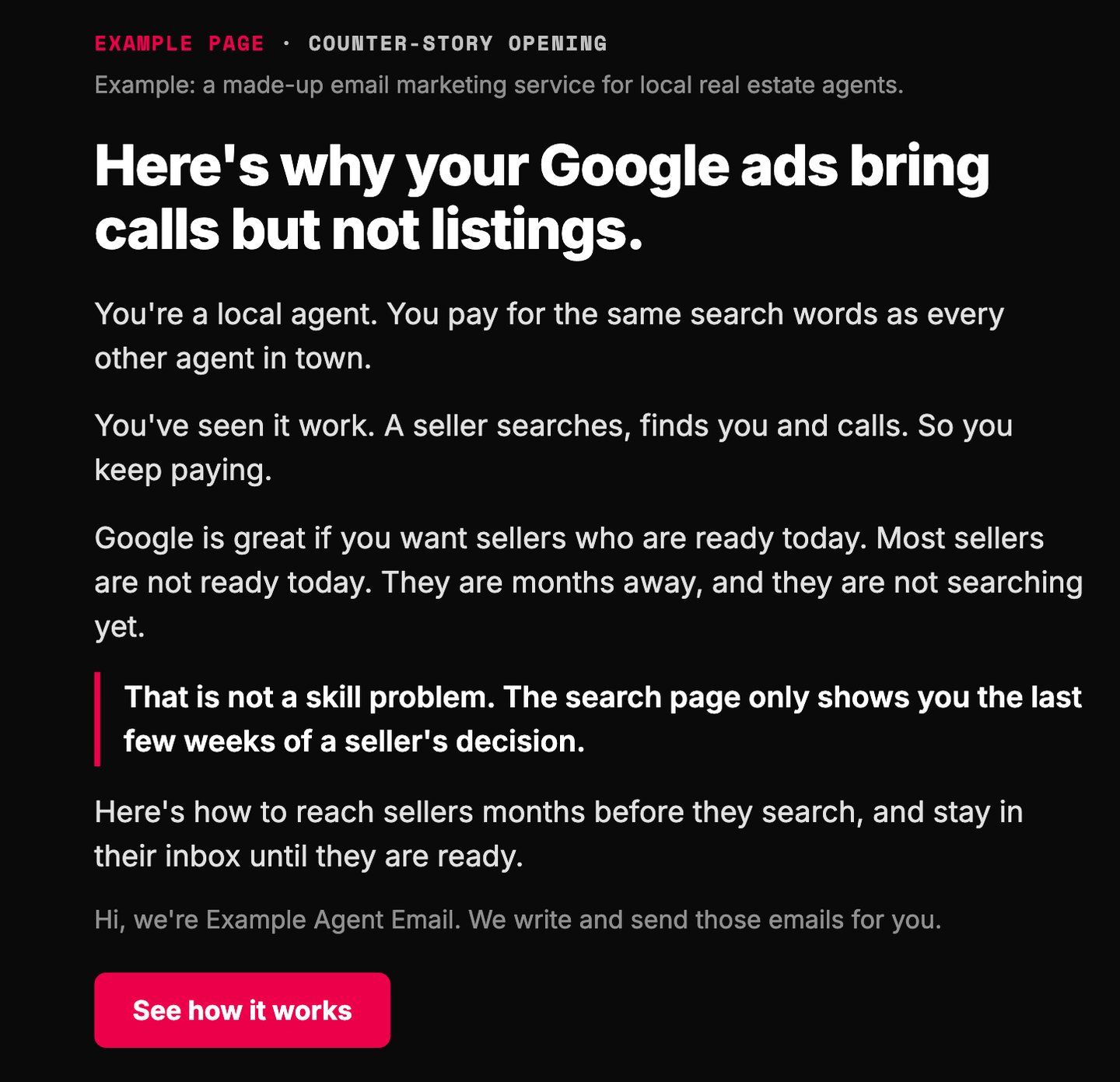
- Orient: where the reader is right now.
- Agree with what they have seen for themselves.
- Concede first, then show the limit.
- The counter-story: the situation changed, not the agent.
- Introduce yourself last, after they care about the reason.
Example page built for this article with a made-up business.
The order of a counter-story opening: agree first, introduce yourself last
- 1. Orient Where they are and what they are doing right now.
- 2. Agree with what they see What they can see and feel for themselves.
- 3. Agree with what they believe Say their story back to them, fairly.
- 4. Name the outcome The thing they want and are not getting.
- 5. The counter-story The reason they are not getting it: the situation changed.
- 6. Show the way through What works now, with proof they can check.
- 7. Introduce yourself Only now: who you are and what you sell.
Our order for the Counter-Story opening.
Where do counter-stories go wrong?
Counter-stories go wrong in three places. The ad sounds negative, it lands too early, or it starts doubts of its own.
Symptom: the leads are poor and few. Cause: every line talks about what they lose.
The ad attacks the reader's whole situation, not one old method. Fix: argue against the old way, then promise growth.
For example, one offer that helped lawyers grow their practices was written almost entirely in loss language. It barely got a response, and the few leads were poor.
Rewritten around growth, it brought in about $200,000 in roughly two months. Same audience. People choose differently when the same facts are framed as a gain or a loss, a pattern called the framing effect.
Symptom: people argue in the comments, or nobody reacts. Cause: you are too early.
A counter-story is only controversial when the market has not started to doubt yet. Fix: seed it softly, with a line like "Maybe you shouldn't run webinars, and here's why."
Symptom: the pitch backfires. Cause: your counter-story starts doubts of its own. "Don't be a coach, be a thought leader" sounds great until the reader thinks: who am I to lead?
Fix: list the doubts your own line creates before it goes live. If the list is long, pick another line.
How to start a fight with your whole market in four easy steps:
1. Tell buyers they were stupid to believe the old story.
2. Say the opposite of everyone. Skip the proof.
3. Write every line as a loss. Fear sells, right?
4. Launch two years before anyone doubts the old way. Call the silence brand awareness.

Three ways a counter-story fails, and the fix for each
| Symptom | Cause | Fix |
|---|---|---|
| Few leads, and poor ones | Every line is a loss | Argue against the old way, promise growth |
| Arguments in the comments, or silence | Too early: the market has no doubt yet | Seed it softly: "Maybe you shouldn't..." |
| The pitch backfires | The new idea starts doubts of its own | List those doubts before it goes live |
| One lawyer-growth offer, rewritten from loss to gain | Same audience | About $200,000 in roughly two months (example, not verified) |
Example from another business. Not our result, and not verified by us. Applies to the last row only.
Run a counter-story only with real proof and a market that has started to doubt
- Seed it softly Too early for a loud ad. Start with "Maybe you shouldn't..."
- Run it Lead with the counter-story.
- Do not run it That is a hot take, not a counter-story.
- Get proof first The market is ready. You are not yet.
Our decision rule.
Is contrarian marketing honest?
Contrarian marketing is honest when the crack you show is real. Our rule: argue only against what you can show, with proof the buyer can check.
That rule is ours, and the law points the same way. Under FTC rules, advertisers must have evidence to back up their claims.
"The old way stopped working" is a claim. See the FTC risk drivers in marketing claims.
So no health scares, no made-up studies, and no invented enemies. A hot take with no proof is just bullshit with a budget.
We hold our own ads to it. The common belief in paid social: go broad and let the platform find your buyers.
In our own lead ads, a lead from a med spa owner cost about $19. A contractor lead cost about $60 to $62. A broad "business owner" audience cost $181 per lead.
Broad is great if you want to pay more than nine times as much per lead. We don't. Those are our accounts, not a law, so test it on yours.
Buyers who have heard every claim need this most. More in selling to buyers who have seen it all.
In our ads, a broad audience cost more than nine times as much per lead as med spa owners
Cost per lead, Anar's own Meta lead ads, by audience
- Med spa owners 19
- Contractors 61
- Broad "business owner" 181
Source: Anar's Meta lead-gen ads, May to November 2025, about $9,190 across 16 campaigns. Meta API pull 2026-09-22. Contractors about $60 to $62.
Write your counter-story with AI this week
Paste the prompt below into your preferred AI. It asks what you sell, finds the one belief, tests its support for time and function, and writes two openings.
It never invents proof. If you have none, it tells you what to collect and stops.
1. Write down five "have to" sentences your buyers say. Pick the one most of them act on.
2. Run the prompt on it. Check every fact it uses against a source you can open.
3. Test the new opening against your current ad, one change at a time. Here is how to test one variable in your ads.
Selling a second product later? Its counter-story argues against your first product: the first step works, but here is why it is not enough alone. See how every solution sets up the next sale.
Back to the two ads in the feed. Ad one argued for itself. Ad two argued against something the reader already believed.
Arguing for your product makes you one more voice. Arguing against the old story makes you the only one.
Paste into your preferred AI. It asks four questions, then gives you the belief, the crack, a concede line and two openings.
Act as a direct-response copywriter. Help me write one counter-story: an ad opening that argues against the belief my market already holds, instead of arguing for my product.

Ask me one at a time, with the example:
1. What do you sell, and to whom? (Example: email marketing for local real estate agents)
2. What outcome do your buyers want? (Example: more listings)
3. What do they say they "have to" do to get it? (Example: "We have to be on Google")
4. What proof do you have that this belief stopped being fully true? (Example: our own lead costs by channel)

Method:
- Name ONE belief the whole market shares. If I give several, pick the one most buyers act on and say why.
- Name what holds it up: an experience, an assumption, or evidence.
- Test that support two ways. Time: it was true back then; what changed? Function: it no longer does the job the buyer wants.
- Use only my proof or public facts I can check. Never invent a number, study or result. If I have no proof, say so and tell me what to collect. Stop there.
- Blame the situation, never the buyer. Concede what is true first.
- Frame the outcome as a gain. No fear scares, no health claims, no fake scarcity.
- If the market shows no doubt about the belief yet, warn me it may be too early, and offer a softer version.
- Check if my counter-story starts doubts of its own in the buyer's head. If it does, list them.

Then answer in this format:
Belief: [one sentence, in the buyer's words]
What holds it up: [one line]
Where it went out of date: [time or function, and the proof]
Concede line: "[X] is great if you want ___. But ___."
Opening A: "Here's why you're not [outcome]..." (3 sentences)
Opening B: "The reason you're not getting [the result you want] is ___. The reason the usual advice fails is ___."
Proof I still need: [list]
Risks: [too early, built-in doubts, sounds negative]

Filip Kovacevic is the founder of Anar Agency in Phoenix. He spent five years running SEO, Meta ads, email, and content for medical practices across the United States, and now does the same work for healthcare, home-service, legal, and professional-service businesses, alongside AI implementation. More from Filip →
Talk it through in 15 minutes
Bring one question from this article. We will tell you what we would do, whether or not you hire us.
Book a 15-Min Chat →