How to Publish an Expert and Split the Money

A publishing business model pairs an expert with a marketer. The expert makes the product. The publisher pays for ads, runs sales and owns the marketing.
The publisher keeps the first sale, which pays for each new customer. The expert takes a share of profit on the bigger sales that follow: 10 percent if passive, 30 to 50 if active.
Publishing business model: they know it, you sell it
For example, one publisher's first deal was a dog trainer with an email list of about 30,000 people. The trainer knew dogs. The publisher knew ads.
A launch to that list brought in about $60,000. Paid ads later took the same offer past $1.5 million.
Same trainer. Same skill. Different seller.
That is the publishing business model. One side knows the subject. The other side sells it, pays for the ads and carries the risk.
A record label works this way with musicians. The For Dummies books did it with a different expert on every cover and one brand on all of them.
Most advice on this model stops at the handshake. The money fight starts right after it.

The expert makes the product; the publisher pays to sell it
| The expert brings | The publisher brings |
|---|---|
| The skill and a product that works | Ads, sales pages and sales copy |
| An audience, standing, or a proven program | The ad money, and the risk of losing it |
| Videos, emails and launch calls, if active | The payment account, brand and email list |
| A share of back-end profit | The front end, which pays for each customer |
Our summary of the Publisher Split as set out in this guide.
Pick the market first, then find the expert
Start with the market, not the expert. Pick the expert first and you end up asking them what to sell.
Our order: prove people buy here, plan what they buy next, then find someone who can deliver it.
Check one: is someone already making money here? Search your buyer's words in the Meta Ad Library. Lots of ads with recent start dates mean advertisers keep paying to sell, which usually means it pays.
No ads at all? Usually there is a reason. Being the first one in rarely means you are the smart one.
Check two: is there a big purchase? We call it magnitude: one large sale on the back end, like coaching or a full program. Magnitude is a must.
Why a must? Sell each customer once and you mostly break even. The ad platform becomes a partner that takes a cut of every sale.
Check three: what do they buy second, third, fourth and fifth? Map it before launch. Selling many times to one customer is what raises their lifetime value, so you pay the ad platform for that customer once.
Skip check three and you learn it the expensive way. Picture spending four or five months and $50,000 on ads, then asking: what else do we sell them?
How many people need it? A smaller audience in a market that spends can outsell a huge one in a market that does not.
Need topic ideas? The For Dummies catalog lists subjects a publisher researched before printing. A title's table of contents is a ready outline.
Get inspired. Do not copy.
Many active ads with recent start dates mean the market pays
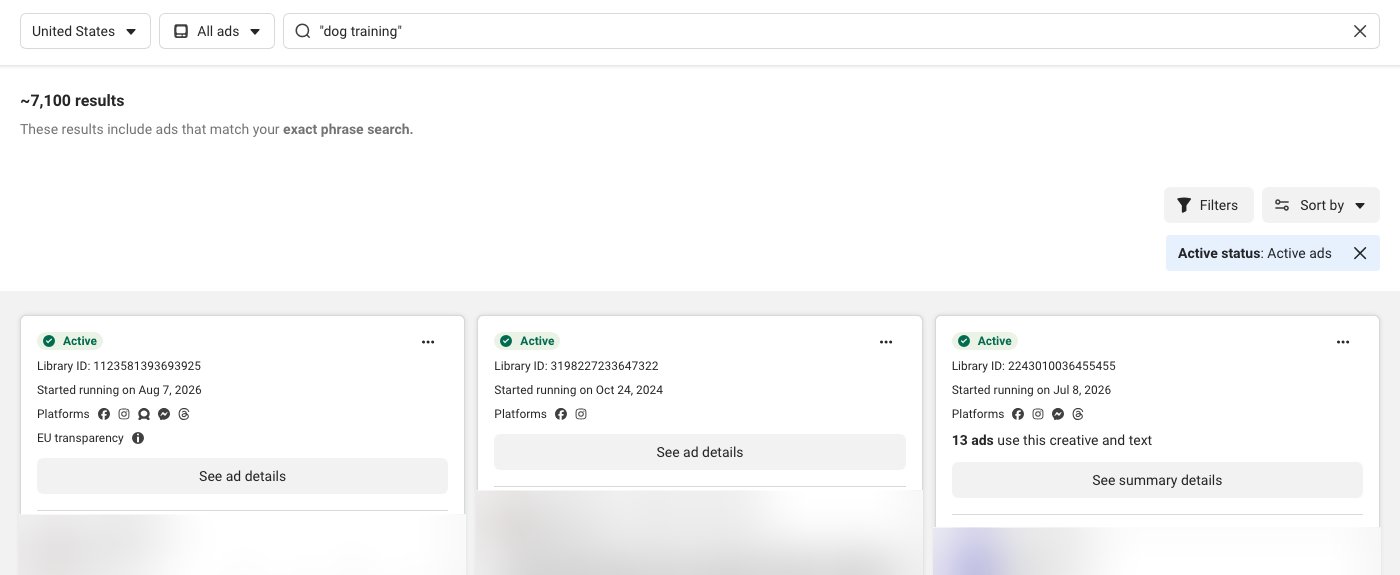
- Search the words your buyer uses, not a brand name.
- Lots of ads in one market means many advertisers keep paying to sell there.
- Active means the ad is running today.
- Recent start dates mean someone is still launching new ads. That is check one passing.
- Several versions of one ad: the advertiser is testing, which usually means it pays.
Screenshot of the public Meta Ad Library (US, active ads, exact phrase "dog training"), taken 2026-10-17. Advertiser names, pictures and ad creatives blurred.
Three checks decide if a market is worth publishing
| Check | Passes if | Fails if |
|---|---|---|
| Is someone making money here? | Many ads running, with recent start dates | No ads at all |
| Is there a big purchase? | Coaching or a program on the back end | Only a low-price product |
| What do they buy next? | Purchases two to five written down before launch | Nobody knows |
The Publisher Split. Magnitude (a big back-end purchase) is the one check with no exceptions.
Example: four purchases planned before the first ad ran
- $3 book The front end. It pays for the customer.
- $97 first upsell Offered right after the book.
- $67 second upsell One more step on the same path.
- High-price program Sold on a call. The magnitude.
Example structure from one publisher's book funnel. Example numbers from other businesses. Not our results, and not verified by us.
The Publisher Split divides a publishing deal by risk and by work. Pick the market first: it needs a big back-end purchase and a plan for purchases two to five. The publisher pays for ads, runs the payment account, owns the brand, list and channels, has final say on marketing, and keeps the front end to buy customers, stated in writing.
The expert takes a share of back-end profit, 10 percent or less if passive and 30 to 50 percent if active, never capped. Profit is revenue minus a named list of costs, paid from money in the bank, between two separate companies with a trial term, a divorce clause and a buyout price.
What makes an expert worth publishing?
An expert worth publishing has a product that works and brings at least one thing: an audience, standing in their field, or a proven high-price program. Bring none of those and you start from zero.
The product must work. This is the biggest risk. If the expert is not actually good, refunds pile up and the campaign dies.
You will sell their product hard. You can only do that with a straight face if it works.
Middle-sized beats famous. Look for a growing audience, say 50,000 to 100,000 followers. The biggest names tend to bring the biggest egos.
Earning little from it is a good sign. The best fits make between nothing and $10,000 a month from their audience. They have the following but not the selling.
Would they do it for free? Experts who love the work keep making new products. Experts who only want the money stop making things once it arrives.
Listen to how they talk about customers. Someone happy to stretch a claim for a sale will stretch your contract too. Claims and refunds go out in your name.
Then test the list. Have the expert ask their audience one question: what is your number one problem with this? Count the replies, then keep the answers for your copy.
A proven product matters more than a big audience
- Proven product, no audience Publishable. Your ads build the reach.
- Proven product and an audience The best start. Launch to their list first.
- Unproven, no audience Pass. There is nothing to sell yet.
- Audience, unproven product Test first and watch refunds closely.
Our screen, built on the rule that the expert must bring an audience, standing or a proven program.
Five questions to ask before the first call
| Question | Good sign | Walk away if |
|---|---|---|
| Does the product work? | Real results and testimonials | Vague results, many refunds |
| How big is the audience? | Growing, about 50,000 to 100,000 | Unproven product and no following |
| What do they earn from it? | $0 to $10,000 a month | They already run a big sales machine |
| Would they do it for free? | They talk about the work | They only talk about money |
| How do they talk about claims? | Careful, specific, honest | Happy to stretch the truth |
The Publisher Split expert screen.
How to pitch an expert who gets pitched every week
Pitch as the investor, not the vendor. Agencies ask experts for thousands up front. You ask for nothing.
The pitch in plain words: we build the sales page, pay for every ad and write the copy. You make the product. We split the money, and you never pay us.
Send it as a short personal video, one or two minutes, with their channel or website on screen. Then ask for a call.
No track record yet? Show products like the one you will build and ads like the ones you will run.
Make yes easy. Offer a test to a small part of their list. If they hate it, you switch it off.
Promise it only adds to what they have. Their current links and products stay as they are. You run your own page and your own payment account.
What reply rate is normal? For example, one publisher gets about 10 replies and 3 calls per 100 messages. Most experts on a call want to work with you, so the real question is whether you want them.
Pitch the expert in five beats, and ask for no money
- Make it personal A one or two minute video with their channel or site on screen.
- Say what you cover Sales page, copy and every ad dollar.
- Say what they do Make the product. Never pay you.
- Show proof Your past results, or products and ads like the ones you will build.
- Offer a small test Part of their list first. Switch it off if they hate it.
The Publisher Split outreach steps.
Example: about 3 calls from every 100 messages
- Personal messages sent 100
- Replies 10
- Calls booked 3
Example numbers from other businesses. Not our results, and not verified by us.
How should a publisher and an expert split the money?
The Publisher Split is our rule for dividing a publishing deal by risk and by work. The front end pays for customers. The back end pays the partners.
The front end is the first, low-price sale. The back end is everything bigger that follows: programs, coaching, memberships.
The publisher keeps the front end. That money buys the next customer, so it goes straight back into ads.
Why not split that too? Here is what happens if you do. You spend $100,000 on ads and the front end brings in $80,000.
You are $20,000 in the hole. Now split the back end 50/50, and the expert out-earns the person who took the loss.
So the expert's share comes from back-end profit, and its size follows the work they do.
Passive experts record once and wait for checks, much like a royalty. They get 10 percent or less.
Active experts write emails, shoot videos and show up for launches. They get 30 to 50 percent.
Aim for 30 percent with an active expert. The gap up to 50 percent pays for the copywriter and sales help you will need as it grows.
Passive experts rarely turn active. You can usually hear it in how they talk about the work.
Selling the back end on calls? Pay the sales team first. For example, one publisher sends 20 percent of each back-end sale to closers and splits the rest 50/50: on $10,000, that is $2,000 to closers and $4,000 each.
One more rule. Never cap the expert. Cap them at $50,000 a month and they stop working the day they hit it.
The expert's share follows the work they do
| Who | What they do | Their share |
|---|---|---|
| Passive expert | Records once, waits for checks | 10% or less of back-end profit |
| Active expert | Emails, videos, launch calls | 30% to 50%; start at 30% |
| Publisher | Ads, sales, payment account, brand, list | The front end, plus the rest of the back end |
The Publisher Split. The gap from 30 to 50 percent pays for later hires.
Example: lose $20,000 up front, split 50/50, and the expert earns three times more
$100,000 in ads, $80,000 back on the front end, then $60,000 of back-end profit split 50/50
- Expert 30000
- Publisher, after the loss 10000
Worked example. The $100,000 and $80,000 come from one business's example; the $60,000 back end and the math are ours.
Example: closers paid first, then a 50/50 split of a $10,000 sale
Where each dollar of one $10,000 back-end sale went
- Closers (20%) 2000
- Expert 4000
- Publisher 4000
Example numbers from other businesses. Not our results, and not verified by us.
Define profit in the contract, line by line
Profit means revenue minus a named list of costs. Write the list. Anything not on it is not a cost.
Why so strict? Film studios made this fight famous. With Hollywood accounting, a hit film can show a loss on paper, so anyone paid from net profit gets nothing.
It happens in small deals too. A surprise $10,000 water bill lands on the books, and the expert's share disappears.
Our list: ad spend, refunds, payment fees, the closers' cut, and a fixed software amount agreed up front. Refunds come out before anyone is paid.
For example, one publisher's 50/50 deal ran $100,000 in revenue against $40,000 in ads. That left $60,000, or $30,000 each before refunds and fees.
Pay from money in the bank. Pay monthly, from cash that actually landed, not from sales on a dashboard. Hold the payout past the refund window, so money from October sales gets paid out at the end of December.
Pay coaching shares as the coaching happens. Say a buyer pays $10,000 for an eight-week program. If the expert quits at week four, you owe the refund, so pay their share every two weeks as the weeks get delivered.
Can the expert see the books? Some publishers say never. Our rule: they see every number their check is calculated from, not your whole ad account.
And if you keep the front end, the contract says so in plain words. A deal that only works while your partner misreads it is not a deal. It is a fight waiting to happen.
Example: profit is revenue minus a list you wrote down first
| Line | Amount |
|---|---|
| Revenue | $100,000 |
| Ad spend | minus $40,000 |
| Left to split | $60,000 |
| Each partner, 50/50 | $30,000 |
| Still to come out | Refunds, payment fees, the fixed software amount |
Example from one publisher's 50/50 deal. Example numbers from other businesses. Not our results, and not verified by us.
Example: on an eight-week program, pay the expert as the weeks get delivered
- First quarter of their share Week 2 Two weeks of coaching delivered.
- Second quarter Week 4 If they quit here, you only owe the refund, not their pay.
- Third quarter Week 6 Paid as delivery continues.
- Final quarter Week 8 Program complete. Share fully paid.
Worked example for a $10,000 eight-week program. The schedule is ours.
Who owns what, and how the deal ends
Sign a joint venture contract between two separate companies. Do not form a joint company or open a joint bank account.
Why so careful? A shared company is easy to start and hard to leave. For example, one partnership built about $5 million in a shared account, and one partner wired it all to his own company and vanished.
The side that pays for ads runs the ad accounts and the merchant account that takes card payments. It is their money at risk.
Own the marketing real estate. That means the brand, the email list, the ad accounts, and any channel your ads send people to. Register the brand name as a trademark in your company's name.
For example, two publishers once sent every ad viewer to the expert's own video channel. His audience grew. Soon he did not need them.
Keep final say on marketing. The expert reviews copy so it sounds like them. The final call on ads, offers and price stays with you.
For example, one company gave an early expert approval over the marketing. As it grew he fought the copywriters, and the marketing ran at about 60 percent of what it could be.
Plan the exit on day one. Start with a trial term of one or two quarters, with 30 days' notice to end it.
Add a divorce clause: if you split up, you keep selling for 24 or 36 months and pay them 10 percent of profit. Add a buyout at a set price too.
How to lose a publishing deal in four easy steps:
1. Open a joint bank account. Trust the vibes.
2. Agree to 50/50 now. Define profit later.
3. Send every ad to the expert's personal channel.
4. Give them a veto on every headline, then wonder why the hell sales stalled.
Every clause of the split on one page, before a lawyer drafts it
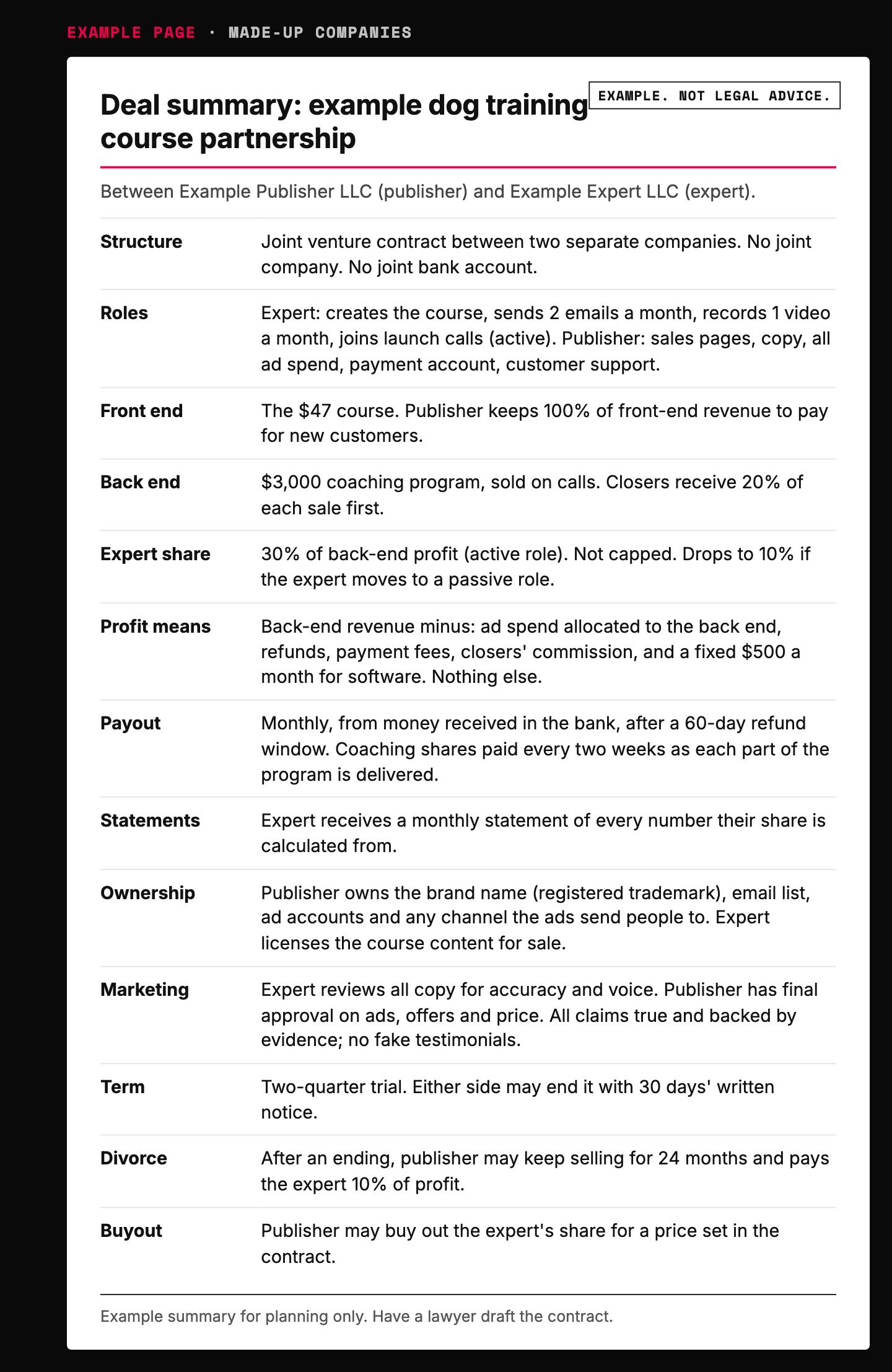
- Who keeps the front end is written in plain words.
- 30 percent for an active expert, never capped.
- Profit is a named list. Anything not on it is not a cost.
- Paid from money in the bank, after refunds, and coaching paid as it is delivered.
- The exit is written on day one.
Example page built for this article with made-up companies. Prices, the $500 software amount and the email and video counts are invented; the clauses follow this guide's rules.
Two separate companies under one contract beat one shared account
| Joint company or joint account | Joint venture contract, two companies |
|---|---|
| Easy to start, hard to leave | Each side keeps its own company |
| Either side can move the money | The ad payer runs the payment account |
| Exit means untangling a company | Exit follows the written clauses |
Our comparison. See Wikipedia, Joint venture. Not legal advice; have a lawyer draft the contract.
The clauses that prevent the usual fights
| Clause | What it says |
|---|---|
| Profit | Revenue minus a named list of costs. Refunds out first. |
| Front end | The publisher keeps it, stated in plain words. |
| Payout | Monthly, from money in the bank, after the refund window. |
| Ownership | Publisher owns the brand, list, ad accounts and channels. |
| Marketing | The expert reviews copy. The publisher has final say. |
| Term | One or two quarters to start, 30 days' notice. |
| Divorce | Keep selling 24 or 36 months, pay 10% of profit. |
| Buyout | A set price, agreed up front. |
The Publisher Split. Not legal advice; have a lawyer draft the contract.
Where publishing deals get stuck
Most stalled deals stall in one of three places. Each has a clear symptom and a cheap fix.
The expert will not say the script. They rewrite every line or freeze on camera, because the copy does not sound like them.
The fix: read it together on a video call, line by line. Where they trip, ask how they would say it. Use their words.
The expert goes quiet halfway. They stop showing up or change the script. Often someone close to them saw the money come in and called it a scam.
The fix: warn them before launch that family may say this, and show why the work still helps people. If the honest answer is that it does look like a scam, fix the marketing, not the expert.
The front end sells, then nothing. Nobody planned purchase two, and the expert says that is all they know.
The fix: map the back end before launch. Let the expert build inside limits you set, because experts rarely know which product will sell. See how to sell the next step up.
Three stuck points, and the cheap fix for each
| Symptom | Cause | Fix |
|---|---|---|
| The expert rewrites every line | The copy does not sound like them | Read it together; use their words |
| The expert goes quiet halfway | Someone close says it looks like a scam | Warn them before launch; keep the marketing honest |
| The front end sells, then nothing | No purchase two was planned | Map the back end before launch |
The Publisher Split.
Keep the marketing honest, because it carries your name
Every claim about the expert's results must be true and backed by evidence. That comes from the FTC's advertising guide for small businesses, not from our taste.
Paid or connected endorsers must disclose the connection. Fake reviews and made-up testimonials are banned under the FTC's reviews and testimonials rule.
So we do not hire actors to pose as customers or as the expert's team. We do not invent stories. Health offers need real evidence before any claim.
Trust is the whole asset you are publishing. Read the four sources of credibility and the claims that get sellers in trouble with the FTC.
Check your deal with AI before you sign
Paste the prompt below into your preferred AI. It asks about your market, your expert and your numbers. Then it scores the market, sets the split and lists the clauses.
It never guesses a number. It asks, shows its math, and flags any deal where the expert out-earns the side carrying the ad risk.
Check the front end first with offer economics before launch. Then set your ad ceiling with a max allowable CPA.
Paste into your preferred AI. It asks about your market, your expert and your numbers, then scores the market, sets the split and lists the clauses to write.
Act as a deal analyst for a publishing partnership: an expert makes the product; a publisher pays for ads, runs sales and owns the marketing. Check my deal with the Publisher Split.

Ask me one at a time, with the example:
1. What market, and what does the expert teach? (Example: dog training, online course)
2. What is the first, low-price product? (Example: $47 course)
3. What do buyers purchase second to fifth, and what is the biggest one? (Example: $97 add-on, then $3,000 coaching)
4. What does the expert bring: an audience (how big), standing in the field, or a proven high-price program?
5. Passive (records once) or active (emails, videos, launch calls)?
6. Expected ad spend and front-end revenue, if known. If I do not know, never guess; tell me what to test.

Rules:
- Market first. No big purchase on the back end means the market fails. Say so and stop.
- The publisher keeps front-end revenue to buy customers. The contract says this in plain words.
- The expert's share comes from back-end profit: passive 10% or less; active 30 to 50%, start at 30%. Never capped.
- If closers sell the back end, pay them first, then split the rest.
- Profit = revenue minus a named list: ad spend, refunds, payment fees, closer commission, a fixed software amount. Nothing else.
- Pay monthly from money that reached the bank, after the refund window. Pay coaching shares as the coaching is delivered.
- The expert sees every number their share is calculated from.
- Flag any deal where the expert out-earns the publisher while the publisher carries a front-end loss.
- Two separate companies, one written joint venture contract, no joint bank account. The ad payer runs the ad and payment accounts.
- The publisher owns the brand, list, ad accounts and any channel the ads send people to, and has final say on marketing. Trial term with 30 days notice, a divorce clause and a buyout price.
- Every claim true and backed up. No fake testimonials. Disclose paid endorsements.

Show your math, then answer:
Market: passes or fails, and why
Expert: fit or not, biggest risk
Split: front end / expert % of back end / closers %
Profit list:
Red flags:
Clauses to write:
Next three actions: 1. 2. 3.
What to do this week
1. Run the three market checks on one market. Write down purchases one to five.
2. List five experts who pass the screen. Send each one a short personal video.
3. Before any call, write your split and your profit list. Run both through the prompt.
Ready to spend? Read how to launch ads on a new offer.
Remember the dog trainer. The trainer's skill made the product. The contract decided who got paid for it.

Filip Kovacevic is the founder of Anar Agency in Phoenix. He spent five years running SEO, Meta ads, email, and content for medical practices across the United States, and now does the same work for healthcare, home-service, legal, and professional-service businesses, alongside AI implementation. More from Filip →
Talk it through in 15 minutes
Bring one question from this article. We will tell you what we would do, whether or not you hire us.
Book a 15-Min Chat →