What Business Are You Really In?
What business are you really in? Write what you deliver and how you support that delivery. Together, they name it.
Then ask two questions. Will your method still work in 10 years? Can customers get results by following steps?
Yes to both is the best spot. You build once and get paid for years.
What business are you really in? Probably not the one on your sign
McDonald's sells burgers. Everyone knows that.
It also owns the land under many of its restaurants. By 2015, rent from franchisees made up about one-fifth of its revenue.
So what business is it really in? Real estate. The location decides how many hungry people walk in.
Your business has a second answer too. Most owners never look for it. So they compete on the wrong thing.
Here is the short version. Write down what you deliver and how you support that delivery. Together, those two lines name the business you are really in.
Then run two tests. Will your method still work in 10 years? Does your customer have to be creative to get the result?
The answers put you in one of four boxes. We call the map the Market Quadrant. The best box is the one where the method lasts and customers just follow steps.
The question itself is old. In 1960, Theodore Levitt named the habit of defining a firm too narrowly marketing myopia. This guide turns his question into a test you can run this week.
A burger company's public record reads like a landlord's
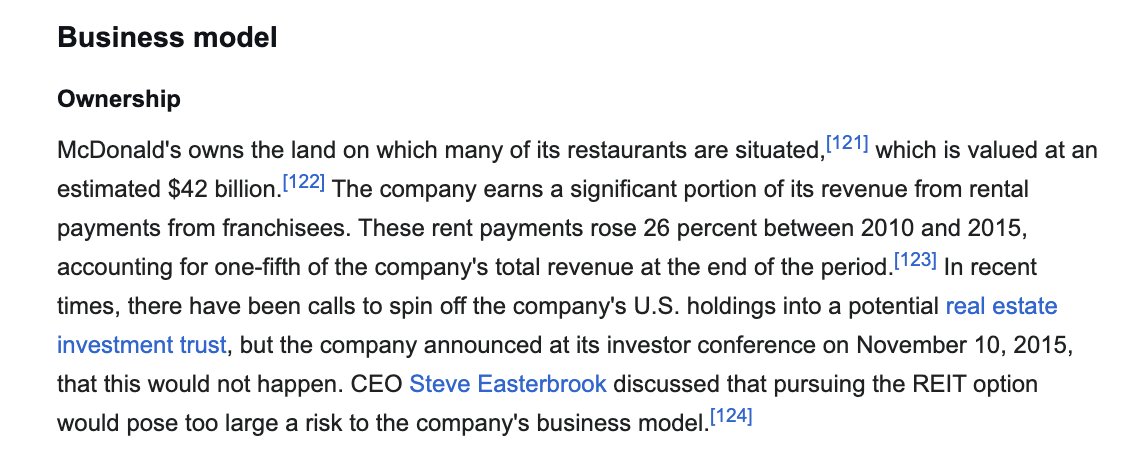
- Read the business model, not the menu.
- The company owns the ground under many of its restaurants.
- That land is valued at about $42 billion.
- By 2015, rent from franchisees was about a fifth of revenue. That is the real business.
Screenshot of Wikipedia, McDonald's, Business model and Ownership section, taken 2026-10-17.
McDonald's earns like a landlord
What the company's land and rent looked like, from its public record
- Estimated value of the land under its restaurants 42
- Share of revenue from franchisee rent, by 2015 20
- Rise in rent payments, 2010 to 2015 26
Source: Wikipedia, McDonald's, Business model section, read 2026-10-17. One-fifth shown as 20 percent.
Name your real business: what you deliver, plus how you support it
Your real business has two parts: what you deliver, and how you support that delivery. Write each one in a single line.
Take a copywriter. She delivers sales pages. But the client is paying for revenue.
So she is in the revenue business. That changes who she competes with. A client can buy revenue hundreds of other ways.
Run the same two lines on other businesses and the answers get surprising fast.
A coaching business delivers advice. It backs that advice up with calls, check-ins and answers. So it is really a customer service business.
An agency delivers campaigns that its staff run. So it is really in people management and recruiting.
An online community delivers lessons. It keeps members with a daily push to keep going. So it is really in the motivation business.
A live event delivers talks. People choose it by where it is. So it is really selling the destination.
How do you know you found it? Picture the business without that part. If it falls apart, that was the real one.
For example, picture a community that runs on daily motivation videos. Stop the videos and members drift off. The lessons were never what kept them.
People join for what the sales page promises. They stay for the part underneath. That part is your business.
Why bother? Because the answer tells you what to compete on, who to hire and where your limits are.
A coaching business that is really customer service needs people who answer fast. People eat into your profit. Better to know that before you scale.
Start from the result, in plain words. Our guide to selling outcomes, not deliverables shows how. So does why offers start with principles, not products.
The business you are really in is the part that keeps buyers
| The sign says | What keeps buyers | Really in the business of |
|---|---|---|
| Copywriter | More revenue for the client | Revenue |
| Coaching | Calls, check-ins and answers | Customer service |
| Agency | Staff who run the work | People management and recruiting |
| Online community | A daily push to keep going | Motivation |
| Live event | A trip worth taking | The destination |
| McDonald's | A busy location | Real estate |
Examples restated by us. McDonald's figures: Wikipedia, McDonald's.
Four lines find the business you are really in
- 1. What you deliver The result the buyer pays for, in plain words.
- 2. How you support it What you do after the sale to make the result happen.
- 3. Name the business Put both lines together in a few words: revenue, customer service, motivation.
- 4. Remove the core Take it away in your head. If the business falls apart, you found it.
The Market Quadrant, as set out in this guide.
The Market Quadrant is a four-box map of a business. First name the business you are really in: what you deliver plus how you support that delivery, tested by asking what falls apart without it. Then run two tests: will the method still work in 10 years (static or dynamic), and must the customer be creative to get the result (creative or mechanical).
Static and mechanical is the best box. Move a market toward it, by turning creative work into steps or a fast market into a slow one, and you become a utility: useful with no real alternative.
Test one: will your method still work in 10 years?
The first test sorts markets into static and dynamic. Ask one question. If a customer uses your method today, will it still work 10 years from now?
Yes means static. How you train a dog today is how you will train one in ten years. Teaching a language and giving dating advice work the same way.
No means dynamic. Business opportunity offers, coaching methods, crypto and creator businesses change every year or two.
In a dynamic market a method has a shelf life of about two years. Then it stops working. You rebuild.
Marketers call the rise and fall of a product its product life cycle. In a dynamic market it runs on fast forward.
What makes a market dynamic? Customers who turn into competitors. Teach people your method, and some of them start selling it.
Teaching your own skill is the classic dynamic offer. Every student who learns it can sell it. Economists would say the market has low barriers to entry.
Anyone can copy you for the price of one purchase.
For example, one business-book seller counted about one new competitor for every 200 to 500 books sold. Every sale trained a rival.
There is a name for why static methods last. The Lindy effect says an idea that has lasted a long time will likely last a long time more.
Dynamic markets work like the Red Queen in Through the Looking-Glass. You run as fast as you can just to stay in place.
For example, one dating-advice business ran the same search ads for about eight years. The owner spent that time on other projects. The money kept coming.
Static is better for owners. It is worse for freelancers: a static client hires you once and may not need you again for years.
A static market pays you for work you did once. A dynamic one makes you redo that work every two years.
Static methods last; dynamic methods expire in about two years
| Static market | Dynamic market |
|---|---|
| Method still works in 10 years | Method lasts about two years |
| Buyers rarely become competitors | Buyers learn it and sell it |
| Build once, get paid for years | Rebuild every cycle |
| Dog training, language teaching, dating advice | Business opportunity offers, crypto, creator businesses |
| Fewer repeat jobs for freelancers | Steady work for freelancers |
The Market Quadrant's 10-year test. Market examples restated by us.
In a dynamic market, every sale trains a rival
- Sell your method Buyers pay to learn how you do it.
- Buyers learn it Some get good at it fast.
- Some start selling it Now there are more sellers than before.
- The method stops working Usually within about two years.
- You rebuild New method, same loop.
The Market Quadrant. The two-year shelf life is the method's rule of thumb, not a measured average.
Example: one static offer ran for years; one dynamic seller kept making rivals
| The case | What happened | What it shows | How sure |
|---|---|---|---|
| A dating-advice business | Ran the same search ads for about eight years | A static market pays for work done once | Example; not verified by us |
| A business-book seller | About one new competitor for every 200 to 500 books sold | Buyers who learn the method can sell it | Example; not verified by us |
Example numbers from other businesses. Their claims, not our data.
Test two: does your customer have to be creative to get the result?
The second test sorts the work into creative and mechanical. Ask whether the customer has to invent something to get the result, or just follow steps.
Mechanical means steps. Think dog training: sit, stay, reward, repeat. Most people who follow the steps get the result.
Creative means the customer has to make something new each time. Teaching copywriting is the classic case.
The student has to write, sell and find clients. Only a small share make it.
That small share is your problem. Results depend on talent you cannot ship in a box. When results fall, the blame lands on you.
Creativity does not scale. Steps do.
Mechanical work is what a standard operating procedure is for: written steps any trained person can follow.
Stuck in a creative market? Use templates as training wheels. Give customers a process so they start, then teach them to work without it.
Do not sell the process as the product. A process sold into a creative market tends to break in about two years.
Then you are rebuilding it. Your static business just became dynamic.
Teach people how to think and the lesson outlives any template.
Mechanical results come from steps; creative results come from talent
| Mechanical | Creative |
|---|---|
| Customer follows steps | Customer must invent something new |
| Most who follow the steps get results | A small share get results |
| Easy to write down and hand on | Hard to box up |
| Example: dog training | Example: learning to write sales copy |
| Scales with more customers | Does not scale; the blame lands on you |
The Market Quadrant's creative test. Examples restated by us.
Use templates as training wheels, then take them off
- 1. Give a template A starting process so the customer begins today.
- 2. Get a first result Small and quick, so they keep going.
- 3. Show why it works Teach the thinking behind each step.
- 4. Take the template away Never sell the template as the promise. It breaks in about two years.
Our restatement of process-driven marketing for creative markets.
Which business model box is best? Static and mechanical
Put the two tests together and you get four boxes. The Market Quadrant is a map of how long your method lasts and how hard your customer's result is to get.
The best box is static and mechanical. The method lasts, and customers get results by following steps.
That is where you build once and get paid for years. Dog training sits here.
The hardest box is dynamic and creative. The method expires, and results depend on talent. Teaching copywriting sits here.
The other two boxes sit in between. Static and creative lasts, but few customers get results. Dynamic and mechanical gets fast results, but the steps expire.
Plenty of advice says no business model is better than another. We disagree. If you get to choose, choose static and mechanical.
Already in a hard box? You are not stuck. You can move the market.
Static and mechanical is the best box
- Fast results, short life Steps work until the market moves. Expect to rebuild.
- Best box Build once, get paid for years. Example: dog training.
- Hardest box The method expires and results need talent. Example: teaching copywriting.
- Lasts, but few succeed Durable, hard to get results. Example (our placement): learning music.
The Market Quadrant. The music placement is ours.
Each box asks you to build something different
| Box | Build this | Watch for this |
|---|---|---|
| Static + mechanical | One strong offer and a system to deliver it | Getting bored and tinkering with what works |
| Static + creative | Templates and support that raise the success rate | Blame when buyers do not get results |
| Dynamic + mechanical | A budget and a calendar for the next rebuild | Steps that quietly stop working |
| Dynamic + creative | A move toward steps, or toward a slower market | Students who become competitors |
Our guidance, built on the Market Quadrant.
Move the market, and you become a utility
The biggest wins come from moving a market into a better box. Turn creative work into steps, or a fast market into a slow one, and you own it.
Canva did it with design. It built a drag-and-drop tool for people with no design training.
Design used to need talent. Now it needs a template.
AI writing tools did the same to copy. For example, one copywriting course had about 200 members, while one AI copy tool had about 50,000 users.
The catch? Moving a market takes software, and the software can cost millions.
When you move a market, you become a utility. A utility is useful with no real alternative. You pay the power bill because there is no other company to buy power from.
Real public utilities often have no rival because nobody else can afford to build the power lines.
The opposite of a utility is a commodity. That is something buyers treat as the same no matter who sells it. Commodities compete on price.
So count your alternatives. Where else could your buyer get the same result tomorrow?
Many places means commodity. Few means utility.
Markets slide toward commodity over time. Economists call it commoditization: products start to look alike, and sellers lose pricing power.
Early on, few people wrote sales copy, so good writers charged big fees. Then courses and certifications made more of them. Now each one spends every sales call explaining why they are different.
Here is some good news: you do not have to be the only option. Buyers just have to see no real alternative.
Commodities fight over price. Utilities just send the bill, and people pay it.
Many alternatives make you a commodity; few make you a utility
| Commodity | Utility |
|---|---|
| Buyers see you as the same as others | Buyers see no real alternative |
| Competes on price | Sends the bill |
| Every call explains why you are different | Nobody asks why you are different |
| Example: one more freelancer in a crowded field | Example: the power company |
Commodity as defined in Wikipedia, Commodity; utility as useful with no real alternative.
Example: turning writing into steps reached far more buyers
Buyers of a creative copywriting course vs a mechanical AI copy tool, in one example
- Copywriting course, members 200
- AI copy tool, users 50000
Example numbers from other businesses. Their claims, not our data. Approximate counts.
You climb toward utility by cutting your buyer's alternatives
- Commodity Many alternatives. Price fights.
- Seen as the only option Buyers see no real alternative, even if one exists.
- Utility Useful with no real alternative. They must use you.
The Market Quadrant. Being seen as the only option counts.
Where people get stuck with the Market Quadrant
How to build a business you hate in four easy steps:
1. Launch whatever made money last month. Ask questions later.
2. Teach your skill to everyone. Act surprised when your students undercut you.
3. Sell a template into a creative market and promise results.
4. Change the playbook every week. Your team will love that, said nobody, ever.
Most of those come down to fit. The box can suit the market and still be wrong for you.
Stuck point 1: the box fits the market but not the owner. Someone who hates the camera will hate running a motivation business. Someone who dislikes people will hate a customer service one.
Most owners lean one of two ways. Creators love starting new things. Mechanics love running a system until it hums.
Creators start fast. Mechanics tend to go the distance.
The fix is the team. A creator needs a mechanic and a supporter. Two creators in one business mostly argue.
And keep the playbook steady. Weekly changes burn out the mechanics and supporters who keep the business running.
Stuck point 2: the product is mechanical, but the market is not. Software for coaches can be pure steps. It still sits in the coaching market, where the way coaches make money changes every year or two.
The fix: judge your box by your buyer's market, not just your product.
Stuck point 3: you sell a service into a static market. The client hires you once and is done for years.
The fix: price that one job for what it is worth, or add something they pay for every month. Here is why buyers stay on a recurring plan, or leave.
A business that fights its owner loses. It just takes a few years to show it.
Three stuck points and the fix for each
| Symptom | Cause | Fix |
|---|---|---|
| You dread the work that makes the money | The box suits the market, not you | Hire your opposite: a creator needs a mechanic and a supporter |
| A step-by-step product still churns | The buyer's market is dynamic | Judge the box by the buyer's market, not your product |
| Clients hire you once and vanish | You serve a static market | Price the one job well, or add a monthly plan |
Our guidance, built on the Market Quadrant.
Name your business and your box with AI
Paste the prompt below into your preferred AI. It asks what you sell, how you support it and where else your buyer could go.
Then it names your real business, places you in a box and gives you one move for this month.
It never invents a fact or a count. If it needs one, it asks you.
Want the money side checked before you build? Read offer economics before launch, or send us the result.
What the prompt gives back for one business, row by row
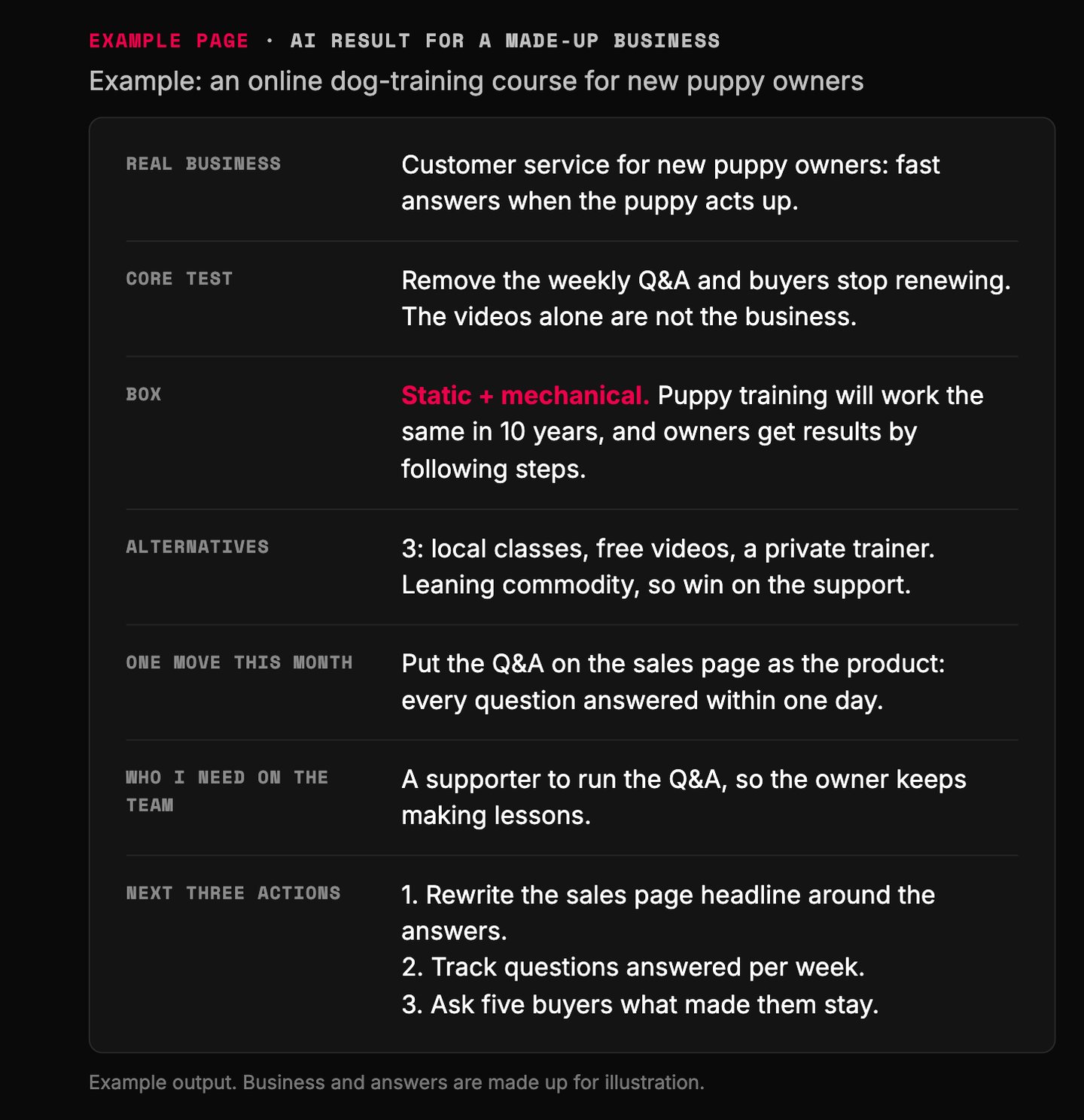
- Line one: what it delivers plus how it supports delivery.
- The remove test. If the business falls apart without it, that is the core.
- The best box: the method lasts and customers follow steps.
- Many alternatives means commodity. The fix is to compete on the core.
Example page built for this article with a made-up business. Every answer is made up for illustration.
Paste into your preferred AI. It asks five questions, then names your business, places it in a box and gives you one move.
Act as a business model analyst. Use the Market Quadrant to name the business I am really in and place it in one of four boxes.

Ask me one at a time, with the example:
1. What do you sell, and to whom? (Example: an online dog-training course for new puppy owners)
2. What result does the buyer pay for, in plain words? (Example: a puppy that listens at home)
3. How do you support that result after the sale? (Example: a weekly live Q&A and a private group)
4. Where else could your buyer get the same result tomorrow? List them. (Example: local classes, free videos, a private trainer)
5. What do you enjoy doing, and what do you avoid? (Example: I like making lessons, I avoid sales calls)

Never invent a fact or a count. If an answer is missing, ask again.

Rules:
- Real business = what I deliver + how I support that delivery. Name it in one line. Then test it: if that core were gone, would buyers leave? If not, find the real core.
- Test one, static or dynamic: will my method still work 10 years from now? Signs of dynamic: buyers who learn it can sell it, and methods that stop working in about two years.
- Test two, creative or mechanical: must the customer invent something to get the result, or just follow steps?
- Place the buyer's market, not only my product.
- Static + mechanical is the best box. Say so plainly if I am not in it, and name the move toward it.
- Alternatives: many means commodity (I compete on price). Few means utility.
- Creative market: suggest templates as a starting aid, never as a promise of results.
- Fit: does the box suit what I enjoy? Who would I need to hire?

Answer in this format:
Real business: [one line]
Core test: [what falls apart without it]
Box: [static or dynamic] + [creative or mechanical], and why
Alternatives: [count], commodity or utility
One move this month: [shift the box, or strengthen the core]
Who I need on the team: [role]
Next three actions: 1. 2. 3.
Run the Market Quadrant this week
1. Write your two lines: what you deliver, and how you support it.
2. Run the 10-year test and the creative test. Write down your box.
3. Count your buyer's alternatives. Then pick one move: shift the box, or make the core stronger.
Back to McDonald's. It looks like a burger company. It gets paid like a landlord.
Your business has a second answer too. Once you name it, you know what to sell next. See how every solution sets up the next sale.
Find the part that holds your business up. Then compete on that part, and only that part.

Filip Kovacevic is the founder of Anar Agency in Phoenix. He spent five years running SEO, Meta ads, email, and content for medical practices across the United States, and now does the same work for healthcare, home-service, legal, and professional-service businesses, alongside AI implementation. More from Filip →
Talk it through in 15 minutes
Bring one question from this article. We will tell you what we would do, whether or not you hire us.
Book a 15-Min Chat →