Membership Retention: How to Keep Members Paying Past Month Two

Membership retention comes down to one question: do members stay long enough to pay back what it cost to win them? Work out that payback in months. Bill programs that need the member's effort yearly, and low-effort ones monthly.
Get every new member a real win before their second card statement. Keep cancelling as easy as joining.
Membership retention: buying is one decision, staying is a monthly one
Picture month two of a new membership. A member opens her card statement and finds $97 for a program she joined and never opened.
She cancels the same day. Then she asks for both months back.
Winning her cost $100 in ads. Nobody noticed she never logged in. That is a membership retention problem, and it started on day one.
Membership retention is the share of members who keep paying from one month to the next. It is customer retention for a monthly plan. Its opposite is the churn rate, the share who leave.
Why does it matter more than the sale? A one-off sale asks for one decision: buy or not. The buyer weighs your offer against a new phone, a trip, and every other use of the money.
With one-off sales, you start over next month. Same fight, new buyer.
A membership asks for that decision once. After that, the member makes a different choice every month.
The question is no longer "should I buy?" It is "should I leave?"
Leaving has a cost. Their work, their history and their people are inside. Economists call these switching barriers, and they are why a good membership is easier to keep than to sell.
Easier does not mean automatic. The rest of this guide shows how.
A sale is won once; a membership is kept every month
| One-off sale | Membership |
|---|---|
| The buyer decides once: buy or not | The member decides every month: stay or go |
| Competes with every other use of the money | Competes with what the member would lose by leaving |
| Next month, you win a new buyer from zero | Next month, the member stays unless something pushes them out |
| Growth is paid from your profit | Growth is paid from your members' payments |
Our comparison.
Your members pay for your next members, if they stay
A membership changes who pays for growth. In a one-off business, every new customer is paid for out of profit. In a membership, today's members pay for tomorrow's.
For example, say a membership costs $50 a month, and winning one member costs $100 in ads. That $100 is your customer acquisition cost.
Two members' monthly payments buy one new member. So 1,000 members bring in $50,000 a month, enough to win 500 more.
Next month, 1,500 members can win 750. You pay for the first members yourself. After that, their payments do the work.
There is a catch: that math assumes nobody leaves.
Every member has a payback point: the month their payments cover what it cost to win them. Here it is $100 divided by $50, so two months. Finance calls this the payback period.
A member who leaves in month one lost you money. A member who stays six months paid $300, enough to cover her own $100 and win two more members.
Everything a member pays over their whole stay is their customer lifetime value. Stay length is the biggest part of it.
For example, a common rule of thumb says members of online business-training programs stay about 2.5 months. We have not seen the data behind it. If it is close, most of those members barely clear a two-month payback.
So the growth plan is really a retention plan. Run the full numbers in offer economics before launch before you buy a single member.
Example: payback is the cost to win a member divided by the monthly price
- Cost to win one member 100
- Monthly price 50
- Payback: $100 / $50 2
Worked example. The math is ours.
Example: if members only stay as long as payback, the stack stops growing
Members over four months, starting at 1,000, at $50 a month and $100 to win a member, with every payment spent on new members
- Nobody leaves: Start 1000, Month 1 1500, Month 2 2250, Month 3 3375, Month 4 5063
- Half leave each month (2-month average stay): Start 1000, Month 1 1000, Month 2 1000, Month 3 1000, Month 4 1000
Worked example: each month, members x $50 / $100 new members join; in the second line, half of the members leave. The math is ours.
The Membership Stack is a recurring business drawn as a tall building: the first floor of monthly revenue pays to win new members, the second pays the team, and everything above is profit. It only grows if members stay past payback, which is the cost to win a member divided by the monthly price. Bill active memberships yearly and passive ones monthly.
Count trial users only once they pay. Get every new member one win before the second card statement, and nudge anyone with no login for 7 days. Give the membership a one-line theme, a weekly format and a next level.
Keep cancelling as easy as joining.
Build the Membership Stack in three floors
The Membership Stack is our name for a recurring business drawn as a tall building. Each floor of monthly revenue has one job.
Floor one pays to win new members. The first slice of revenue goes to ads and sales. Today's members pay for the next ones.
Floor two pays the team. That means support, whoever runs the ads and whoever answers questions. Once this floor is full, the whole team is covered.
Everything above is profit. Once the first two floors are paid for, a new member costs you the ad and little else.
For example, picture a membership at $500,000 a month. The first $50,000 could fund new members and the next $50,000 the team. The rest is profit.
Now picture a business with no recurring revenue. Acquisition, team and profit all sit on one floor. Every launch, you knock it down and build the damn thing again.
Which would you rather own? One of these buildings gets taller every month.
There is one more edge. A business whose members fund new members can pay more to win a customer than a rival starting from zero. That raises the cost of entry for everyone else.
To set how much you can pay to win one member, see how to set a max allowable CPA.
Each floor of monthly revenue has one job
- Floor 1: win new members The first slice of monthly revenue pays for ads and sales.
- Floor 2: pay the team The next slice covers support, ads and delivery.
- Floors 3 and up: profit Each new member up here costs the ad and little else.
The Membership Stack, as set out in this guide.
Without recurring revenue, you rebuild the building every launch
| One-off business | Membership Stack |
|---|---|
| Acquisition, team and profit share one floor | Each has its own floor |
| Every launch starts from zero | Each month starts from last month's members |
| New customers are paid from profit | New members are paid for by current members |
| Can pay only what one sale earns to win a buyer | Can pay more to win a member than a rival starting from zero |
Our comparison.
Why is recurring harder to sell? Buyers count six months, not one
A monthly price looks small to the seller. To the buyer, it is several months agreed to at once.
Nobody buys a phone to keep it a week. People join a membership expecting to stay three to six months, sometimes a year.
So $97 a month is a $291 to $582 decision in the buyer's head. That is why a membership is harder to sell than a one-time product at the same price.
Money is only part of it. Buyers also ask how much time it takes, whether they have the skill, and whether it fits how they learn.
So make it feel lighter, in plain words. Tell them they can use it lightly in a busy week and go deep in a quiet one.
Selling a big monthly retainer? Sell a fixed package first. A $5,000 a month service is a $15,000 to $30,000 decision in the buyer's head.
A set package first, then a monthly plan, asks for a smaller first yes.

A $97 monthly price is a $291 to $582 decision in the buyer's head
What $97 a month adds up to over the stay buyers expect when they join
- 1 month 97
- 3 months 291
- 6 months 582
Worked example: $97 times the three to six months buyers expect to stay. The math is ours.
Bill active memberships yearly and passive ones monthly
Every membership is active or passive, and the type decides how you bill it.
Active means the value needs effort. The member shows up, does the work, or works with you. Think coaching, masterminds and group programs.
Passive means the value arrives with little effort. Think software, a content library or a done-for-you tool. Members keep paying while it runs in the background.
Active memberships remind members of their value every week. They also tire people out. Even a strong active program rarely holds a member past two or three years.
So sell active memberships by the year, up front. Keep a monthly option for people who want one.
For example, a guitar membership could offer $47 a month, or a full year for $197.
Where does a number like $197 come from? Your own records.
After three months of sales, look at the average stay. If members stay three months at $50, each one brings in $150. Price the year a little above that, around $200.
The buyer pays less than twelve months would cost. You collect more than an average member pays you now. Fair trade.
Passive memberships can stay monthly. Low effort means little reason to cancel, so a fair monthly price can run for years. Mixed models work too: members stay for the tool, and the coaching inside keeps them using it.
Bill by the work the member has to do
| Question | Active membership | Passive membership |
|---|---|---|
| Where the value comes from | The member's effort, with you | The tool or library, with little effort |
| Examples | Coaching, masterminds, group programs | Software, content libraries, done-for-you tools |
| How long members stay | Two or three years at best, often far less | Can run for years |
| How to bill | Yearly up front, with a monthly option | Monthly is fine |
The Membership Stack billing rule.
Example: a $197 year beats what a three-month member pays at $47 a month
What one member pays under each option
- 3 months at $47 141
- 1 year up front 197
- 12 months at $47 564
Worked example: $47 x 3 = $141; $47 x 12 = $564. Example prices; the math is ours.
Count trial members only when they pay, then win them before the second statement
A free trial gets people in the door. It does not make them members.
The number that matters is the share of trial users who become paying members. Count members from the first payment, never from the sign-up.
Your trial length is your window. A 14-day trial gives you 14 days to deliver one real result.
Most sellers spend that window doing nothing and let the card charge. That is how you get a member who already distrusts you.
The second danger point is the card statement. Cancels and refund requests tend to bunch up in month two or three. That is when members read the statement and ask what that charge is.
A member who got a win by then remembers the win. A member who never logged in remembers nothing, and leaves.
So we set one alarm. Any new member with no login for 7 days gets a personal nudge that same day.
Use the channels the member agreed to: email, text, a call. In the US, automated texts and calls need consent first under the Telephone Consumer Protection Act.
The nudge points to one task. Ten minutes, one clear result. A quick first win beats a long welcome tour every time.
A day-7 nudge names one ten-minute task and keeps the cancel link in sight
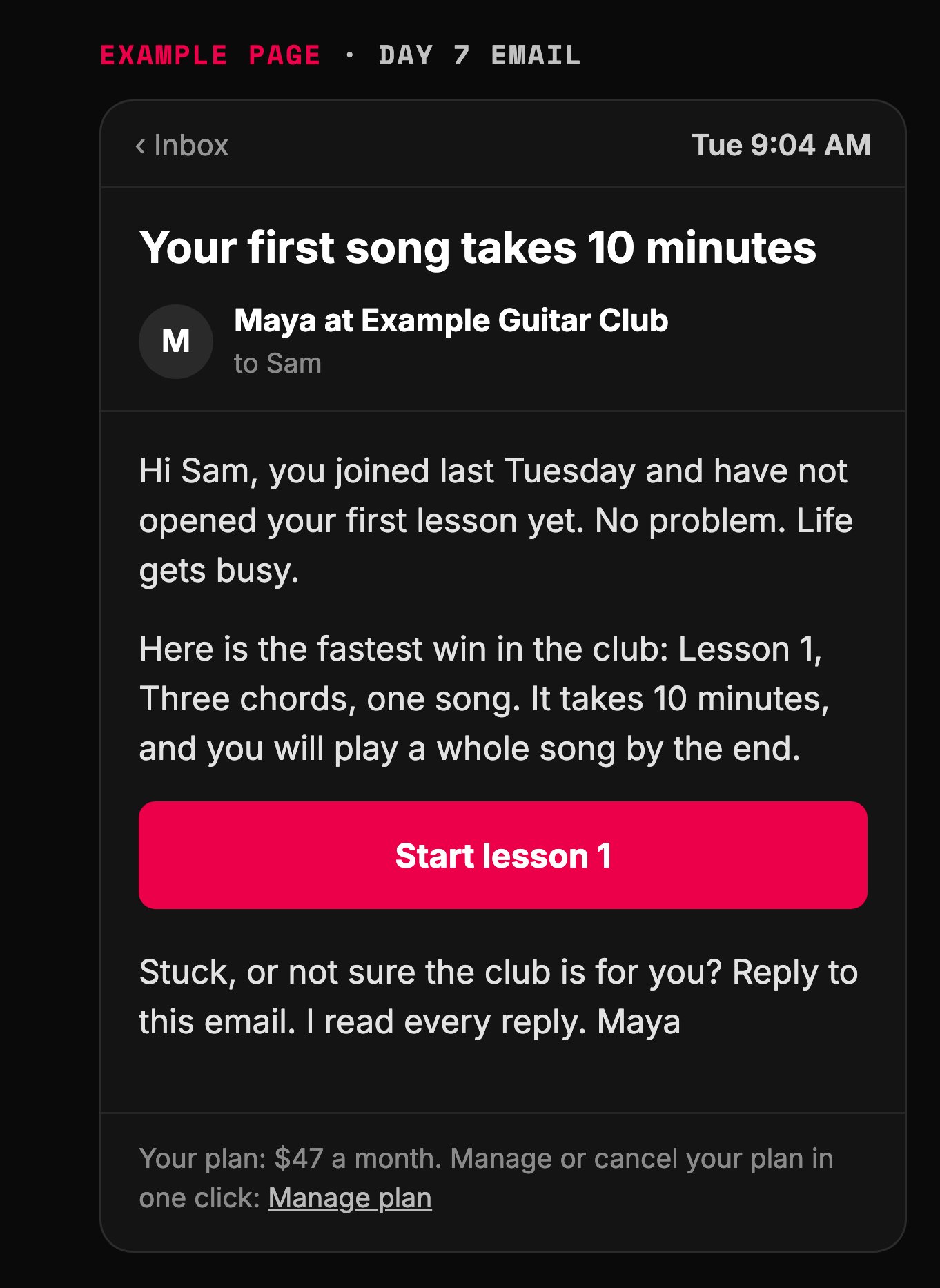
- One task and the time it takes. Not "We miss you."
- Sent on day 7 with no login. Says what happened, with no guilt.
- One link to one ten-minute win.
- A named person who answers.
- The price and the cancel link, in plain sight.
Example page built for this article with a made-up brand. The $47 price is the article's example membership.
Win the member before the second card statement
- Join Day 0 Send one task that takes ten minutes.
- First win Day 1 Check they did it. Help if they did not.
- Alarm Day 7 No login yet? A personal nudge today.
- Trial ends Day 14 Count them as a member only once they pay.
- The statement Month 2 to 3 Members check the charge. A member with a win keeps it.
The Membership Stack, first 60 days.
One alarm catches members before the statement does
- 1. Track logins Every member, every day.
- 2. Flag 7 days A week with no login puts them on today's list.
- 3. Reach out in person Email, text or a call, only on channels they agreed to.
- 4. Point to one task Ten minutes, one clear result.
- 5. Still quiet? A real person calls.
The Membership Stack alarm rule.
Give members something to remember: a theme, a format and a next level
Members stay for what they remember about you when they are not using it. Most owners never check what that is.
What does your member remember on a busy Tuesday? A win, a person, a promise. Or nothing.
The theme is what your membership stands for, in one line. For example: nobody here gets stuck alone with a problem.
The format is the weekly rhythm that delivers the theme. A Tuesday call, a Friday review, a monthly event.
The format decides how much members use the membership. Use decides how much it is worth to them.
The next level is where members go when they finish. A program that teaches one process is a movie. Once members have seen it, they leave.
A membership needs to work like a TV series, with a next episode. So add a level above the process. Members who finish it move into a group they could not join before.
Name the levels by stage: getting started, getting consistent, leading others. Everyone can see where they are and what comes next.
For example, one agency put clients on monthly plans and gave them a chat channel and not much else. It was an active service run like a passive one. It did not last.
Theme and format drive use, and use is what members remember
- Theme One line on what the membership stands for.
- Format The weekly rhythm that delivers it.
- Use Members show up and do the work.
- Wins A result they can name.
- Memory What they think of on a busy day.
The Membership Stack.
A process program ends; a membership needs a next episode
| Process program (a movie) | Membership (a TV series) |
|---|---|
| Teaches one process, start to finish | Keeps a next episode coming |
| Members leave once they have seen it | Members stay for what comes next |
| Value ends with the last lesson | A next level opens after the last lesson |
| No reason to come back | A group they can join only by finishing |
Our comparison.
Should you make it hard to cancel? No, and the law agrees
Some sellers count on members forgetting to cancel. We do not, and here is our reasoning.
Revenue from members who would leave if they noticed is not revenue you can plan on. The day they read their statement, it is gone, often with a refund request and a card dispute attached.
US law points the same way. The Restore Online Shoppers' Confidence Act covers negative option billing online: plans that keep charging until the buyer says stop.
Sellers must disclose the terms clearly, get express consent before charging, and give a simple way to stop the charges.
The FTC's policy statement on recurring charges adds that cancelling should be at least as easy as signing up. Our rule: cancel in the same place, in as few clicks, as you joined.
Long contracts are the polite version of the same habit. A 12-month lock-in keeps the money coming even after the delivery stops. Our take: no lock-in keeps you honest, because you have to earn every month.
How to lose a member in four easy steps. Step one: hide the price in small print. Step two: pre-tick the membership box at checkout.
Step three: say nothing for the first month. Step four: bury the cancel button and wait for the dispute.
Congratulations. You built a refund queue with a logo.
Ask one question instead. What would a member lose if they cancelled today?
If the honest answer is nothing much, fix that before you sell another month. For the buyer's side of that list, see what buyers fear losing.
US law already asks for clear terms, a clear yes and a simple way out
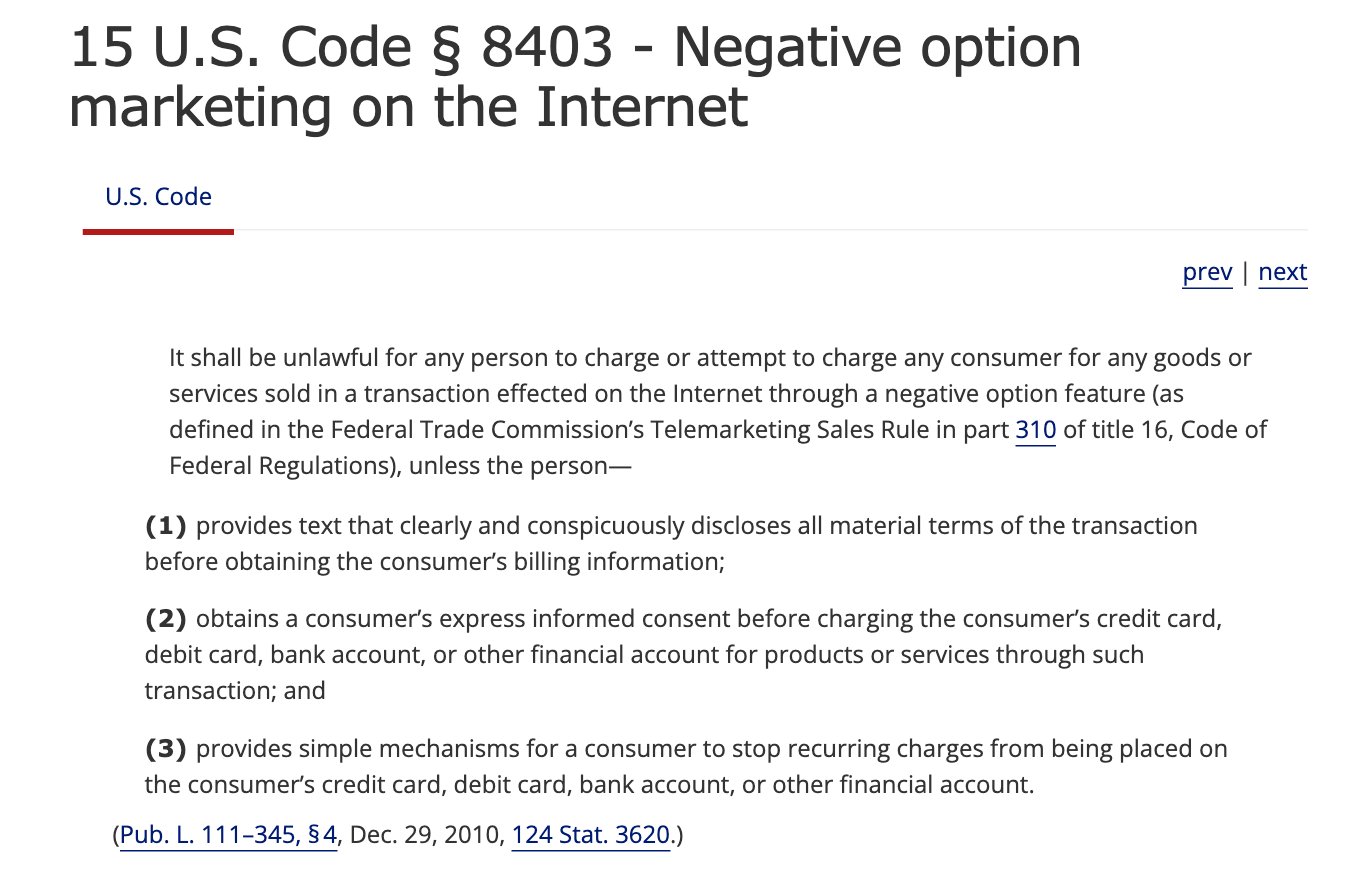
- The US law for online plans that keep charging until you say stop.
- Terms first, card number second.
- A clear, active yes before any charge.
- A simple way to stop the charges. Our rule: as easy as joining.
- The law since December 2010.
Screenshot of 15 U.S. Code 8403 on Cornell Law School's Legal Information Institute, taken 2026-10-17. Pin 4's 'our rule' is our stance, in line with the FTC's 2021 policy statement that cancelling should be as easy as signing up.
Our rule: keep members with value, never with the bill
| Kept by the bill | Kept by the value |
|---|---|
| Counts on members not reading the statement | Gets members a win before the statement |
| Pre-ticked boxes and small print | Clear terms before the card is charged |
| Lock-in contracts | Cancelling as easy as joining |
| Ends in refund requests and card disputes | Ends in members who chose to stay |
Our stance. Legal duties: 15 U.S. Code 8403; FTC negative option policy statement (2021).
Plan your membership with AI this week
The prompt below runs the whole Membership Stack. Paste it into your preferred AI and answer its questions with your real numbers.
It works out your payback months, picks monthly or yearly billing, and writes your first 60 days. It never invents a number. It asks.
This week: first, run the prompt for your main membership. Second, set the 7-day no-login alarm. Third, write your theme in one line and read it to three members.
Still setting the price? Start with pricing from your buyer's income.
Ready for what members buy next? Read offering the next step up.
Want a second pair of eyes on your numbers? Send them to us.
Back to that card statement in month two. A member who got a win in week one reads $97 and keeps going.
Buying happens once. Staying is earned every month.
Paste into your preferred AI. It asks six questions, then gives you your payback, a billing choice and a first-60-days plan.
Act as a membership analyst. Plan one recurring offer with the Membership Stack.

Ask me one at a time, with the example:
1. What is the membership, and its monthly price? (Example: group coaching, $97 a month)
2. Does the value need the member's effort (active) or arrive with little effort (passive)? (Example: active)
3. What does it cost to win one paying member? (Example: $100 in ads)
4. How long do members stay on average, from my records? (Example: 3 months)
5. Do I offer a free trial, and how long is it? (Example: 14 days)
6. In one line, what is the membership about? (Example: nobody gets stuck alone)

Never invent a number. If I do not know one, mark it unknown and tell me how to measure it.

Rules:
- Payback months = cost to win a member / monthly price. A member who leaves before payback loses money.
- If the average stay is not clearly longer than payback, fix retention before adding ad spend.
- Growth check: members x price / cost to win = new members those payments could fund in a month, before anyone leaves.
- Active: offer a yearly option priced a little above what an average member pays now (average stay x monthly price). Keep a monthly option.
- Passive: monthly billing is fine.
- Count members from the first payment, not the trial sign-up. Report the share of trial users who pay.
- Plan one first win inside the trial, or inside the first 14 days.
- No login for 7 days = a personal nudge that day, only on channels the member agreed to.
- One-line theme, a weekly format, and a next level for members who finish.
- Clear terms before payment. No pre-ticked boxes, no lock-in contracts. Cancelling as easy as joining.

Show your math, then answer:
Payback: _ months
Average stay vs payback: ahead or behind
Billing: monthly, or yearly at $_
First 60 days: day 0, day 1, day 7, trial end, month 2
Theme / format / next level:
Next three actions: 1. 2. 3.

Filip Kovacevic is the founder of Anar Agency in Phoenix. He spent five years running SEO, Meta ads, email, and content for medical practices across the United States, and now does the same work for healthcare, home-service, legal, and professional-service businesses, alongside AI implementation. More from Filip →
Talk it through in 15 minutes
Bring one question from this article. We will tell you what we would do, whether or not you hire us.
Book a 15-Min Chat →