Upsell Strategy: Sell the Next Problem Your Product Creates
A good upsell strategy sells the fix for a problem your first product creates. Every purchase brings a new need. A book that teaches a method means the buyer now has to do the work.
List those next problems in order. Offer the first fix right after the sale, with a clear price and an easy no.
Upsell strategy starts with the problem your product creates
You cook a great dinner. Everybody eats. Then you turn around and see the sink.
Dinner fixed hunger. It also made a pile of dishes. Every purchase works like this, and a good upsell strategy is built on it.
Most upsells are random add-ons the seller happened to have lying around. Buyers can tell. They click no and feel a little used.
Our rule is simpler: sell the fix for the problem your product just created. Can't name that problem? Then you have no upsell.
A random add-on asks for a new reason; a next-problem offer already has one
| Random add-on | Next-problem offer |
|---|---|
| Whatever the seller has in stock | The fix for what the purchase just created |
| Buyer asks: why is this here? | Buyer thinks: I was about to need that |
| Feels like a pitch | Feels like the next step |
| Fewer yeses, more regret | Easy yes, easy no |
Our comparison.
Every solution creates the next problem
Every solution creates a new problem for the person who owns it. Most sellers think the story ends once the problem is solved.
It is never done. Buy a dishwasher and you need detergent pods. Buy a car and you need fuel, insurance and tires.
Buy a house and you get repairs, taxes and a power bill. Economists call things that get used together complementary goods. A printer and its ink is the classic pair.
Services work the same way. A book that teaches a method fixes the problem of not knowing how. Now the reader has a new problem: doing the work.
Here is the useful part. You can see the next problem before your buyer can. You have watched other buyers hit it.
Most sellers stop at the solution; buyers keep living with it
| Problem, then solution | Solution, then problem |
|---|---|
| Hungry, so you cook | You cook, so you have dishes |
| The sale ends the story | The sale starts the next chapter |
| You wait for the next need | You can see it coming |
Our comparison.
Every purchase hands the owner a new problem
| You buy | Now you have to deal with |
|---|---|
| Dinner | Dirty dishes |
| A dishwasher | Detergent pods |
| A car | Fuel, insurance, tires |
| A house | Repairs, taxes, a power bill |
| A printer | Ink |
| A book that teaches a method | Doing the work |
Everyday examples. Printer and ink: Wikipedia, Complementary good.
The Next-Problem Chain plans upsells from the problems your product creates. Start from your main product and ask what the buyer now has to deal with, then what is better than that. Build the links close to your main job that you can deliver well, hand the rest to partners or skip them.
Design the whole offer first, make the first purchase work alone, price add-ons as small additions to the order, keep every box unticked and every price in plain sight, and judge the path by money per visitor.
How do you find upsell ideas? Map the Next-Problem Chain
The Next-Problem Chain is a list of the problems your product creates, in the order your buyer hits them. Each link is a possible offer. You need one page and a pen.
Step 1: start from your main product. It is the first thing you fix for the buyer. Write down what they have the day after they buy.
Step 2: ask what they now have to deal with. Not what else you could sell. What they will really run into.
Step 3: ask what is better than that. For example, someone who finds a partner next wants to keep them. Someone who keeps a partner then wants a commitment.
Step 4: check each link against the one before. Upsell 1 must relate to the main product. Upsell 2 must relate to both.
Step 5: mark which links are yours. Build it, hand it to a partner, or skip it.
For example, one business sells a $27 book that teaches how to build an offer. Now the reader has to build it, so upsell 1 is done-for-you templates at $197. Once it is built, they have to run ads, so upsell 2 is an ad package.
Notice what is missing. No random bonus. Each offer answers the question the last purchase raised.
Five steps from one product to a planned upsell path
- 1. Start from the main product What does the buyer have the day after they buy?
- 2. Name what they now deal with What they will really run into, not what you want to sell.
- 3. Ask what is better than that Each answer is the next link up.
- 4. Check each link Upsell 1 relates to the main product. Upsell 2 relates to both.
- 5. Mark which links are yours Build, partner or skip.
The Next-Problem Chain, as set out in this guide.
Example: each offer fixes the problem the one below it created
- Book, $27 Teaches the whole method.
- New problem Now the reader has to build it.
- Upsell 1: templates, $197 Done-for-you build.
- New problem Now it is built, and it needs ads.
- Upsell 2: ad package Ready ads and how to run them.
Example numbers from other businesses. Not our results, and not verified by us.
One question finds the next link in any market
| Market | First want | Better than that | Better still |
|---|---|---|---|
| Dating | Attract a partner | Keep them | Commitment |
| Business income | Monthly profit | Daily profit | None listed |
| Clinic owners | More patients | Higher-value patients | Recurring patients |
Example ladders from other businesses' offers, restated by us.
Decide which next problems you solve and which you hand off
You do not have to solve every next problem. Some you build. Some you hand to a partner, and some you skip.
Owning everything has a cost. Ford wanted control of the whole chain behind the car, down to the rubber. It started its own rubber plantation in Brazil.
The project failed. The town Ford built there was abandoned by 1934. Owning every step of your supply chain is called vertical integration.
Apple went the other way. Before the iPhone launched, Steve Jobs did not plan to let outside developers build native apps. Developers pushed back, and the App Store let other companies solve the problems the phone created.
Our decision rule: build the links close to your main job that you can deliver well. If a link is close to your job but you cannot deliver it well yet, hand it to a partner you trust. Skip anything far from your job, however tempting.
Can't deliver it well? Then it is not an upsell. It is a refund waiting to happen.
Build what is close to your job and what you deliver well
- Partner A trusted partner delivers it. You choose who.
- Build it This is your next upsell.
- Skip it Not yours, not now.
- Think twice You can do it, but it pulls focus. Ford's rubber plantation sits here.
Our decision rule.
Build the whole offer first, then cut it into steps
Design the complete offer first, then split it into a first purchase and upsells. Most sellers do the reverse. They build a small product and keep bolting bits on.
Car buyers know this as trim levels, from the base model to fully loaded. We plan offers the same way, from the top down. Start with everything a buyer needs for the full result.
Then cut along the chain. In the book example, the book is the base model. The templates and the ad package are the higher trims.
Our rule: the first purchase must work on its own. The book must teach the whole method, even if the buyer never buys again. If it only works once they buy part two, that is a trick, not an offer.
Offers built bottom up, one small piece at a time, end up with random add-ons. The buyer looks at upsell 2 and thinks, why is this here? That thought costs you the sale.
Packaging items together on purpose is called product bundling. When you plan from the top down, every package has a reason to exist.
Build it whole and cut it down, not small and bolted on
| Bottom up | Top down |
|---|---|
| Start with a small product | Start with everything for the full result |
| Add whatever is handy | Cut along the next problems |
| Upsells feel random | Each upsell answers the last purchase |
| The first product may need part two | The first product works on its own |
Our comparison. Trim-level terms: Wikipedia, Trim level (automobile).
How should you price an upsell? As a small addition to a yes
Price each checkout add-on as a small addition to the decision the buyer already made. A separate full price asks for a whole new decision. "Just $10 more" lets the buyer add to the choice they already made.
For example, one checkout starts with a $27 book. An audiobook adds about $10, and a small add-on about $17. A buyer who takes both is now worth about $53.
How well the add-on fits the order matters more than its price. For example, one seller's checkout add-on was an early pitch for his course. He swapped it for extra material on what the buyer was already buying, and the take rate, the share of buyers who say yes, went from 8.3 to 21 percent within a few hours.
The upsells after checkout cost more than the main product. That is why it is called an upsell. Prices step up as the buyer moves along the chain.
That is also how a buyer climbs toward your bigger offers. People who take upsell 1 have already said yes twice. Checkout details are in our guide to checkout pages that convert, and the price itself in how to price your product.
An honest add-on fits the order, costs a little more, and the box starts empty
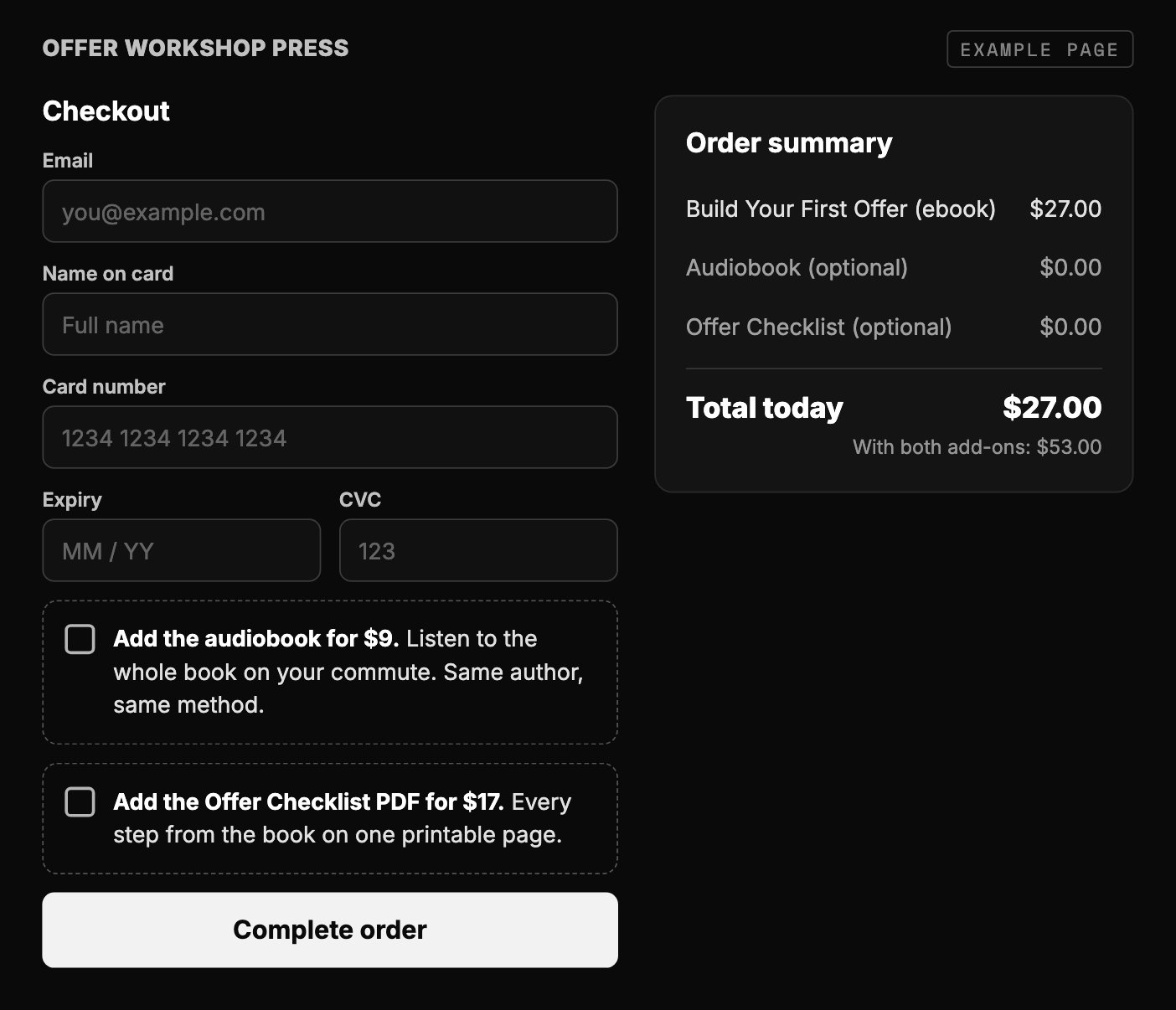
- The box starts empty. The buyer ticks it, or nothing is added.
- The add-on is tied to what they are already buying.
- Priced as a small addition to the order, not a new purchase.
- The total updates in plain sight. No surprise on the receipt.
Example page built for this article with a made-up brand
Example: two small add-ons took a $27 order to about $53
Order value per buyer who takes each add-on at checkout
- Book only 27
- + audiobook, about $10 37
- + add-on, about $17 53
Example numbers from other businesses. Not our results, and not verified by us. Add-on prices approximate.
Example: a relevant add-on was taken 2.5 times as often
Share of buyers who took the checkout add-on
- Add-on unrelated to the order 8.3
- Add-on tied to the order 21
Example numbers from other businesses. Not our results, and not verified by us. Measured over a few hours.
What should an upsell page say? Seven parts, in order
An upsell page confirms the order, names the next problem and offers the fix with a clear price. It is an upsell when it sells a bigger version, and a cross-sell when it sells something that goes with it. The page works the same for both.
Part 1: confirm the order. Say the payment went through and where the product is. Many older buyers expect a receipt, and a surprise sales page can make them leave.
Part 2: recap the win. One line on what they just got, in outcome words.
Part 3: name the next problem. Knowing the steps is half the job, and now they have to build it.
Part 4: offer the fix with a time word. Example: templates that cut a build from a few months to a few weeks. Buyers want the result sooner.
Part 5: say what the click does. State the price, the charge and what arrives. A button like "Yes, add the templates for $197" leaves no room for surprise.
Part 6: support the button. Put the guarantee, the timeline and what happens next right beside it. Buyers tend to hover over a bare button, then leave.
Part 7: give a plain way out. "No thanks, I will build it myself" is honest and easy to find. Then show the receipt.
For example, one seller changed an upsell button from "Add this to your cart" to words saying the upgrade was ready and one click would confirm it. The take rate rose from about 20 to 38 percent. We use that pattern only when the price sits on the page and nothing is charged without the click.
Mention the next step early, too. Your main sales page can say, honestly, that the easiest route is to have you build it for them. Then the upsell page delivers exactly that.
How to write each part as an outcome is in sell outcomes, not deliverables.
An honest upsell opens with the receipt, names the next problem and makes saying no one plain click
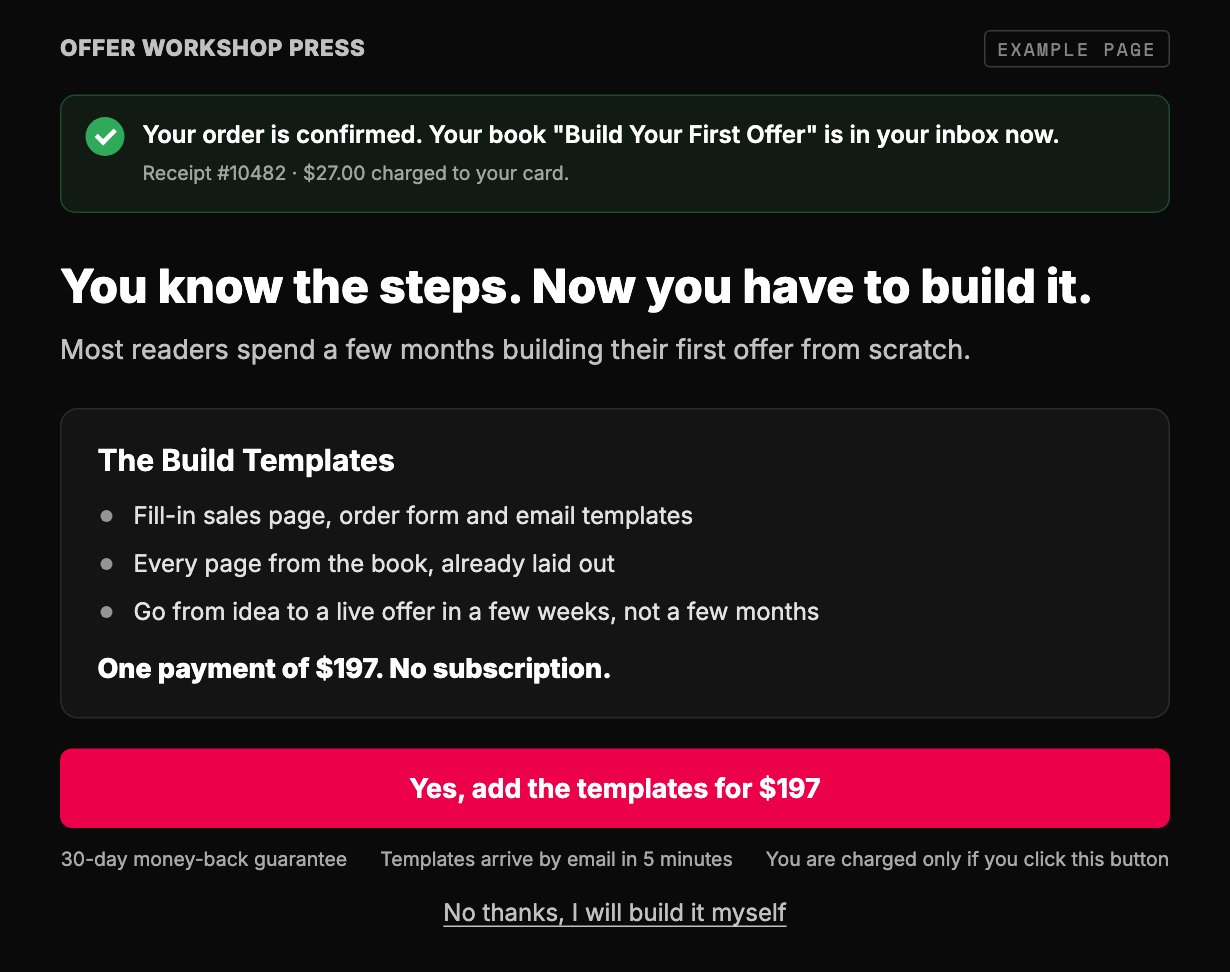
- It opens with the receipt. The order is done, and the buyer knows it.
- It names the problem the book just created.
- The fix comes with a time word.
- The price is on the page and on the button.
- Saying no is one plain click.
Example page built for this article with a made-up brand
Seven parts, from receipt to a plain way out
- 1. Confirm the order The payment went through. Here is where your product is.
- 2. Recap the win One line, in outcome words.
- 3. Name the next problem Now you have to build it.
- 4. Offer the fix with a time word Weeks instead of months.
- 5. Say what the click does Price, charge and what arrives.
- 6. Support the button Guarantee, timeline, what happens next.
- 7. A plain way out No thanks, I will build it myself.
Our upsell page outline.
A button that says what happens beats a generic one
| Generic | Clear and honest |
|---|---|
| Add this to your cart | Yes, add the templates for $197 |
| No | No thanks, I will build it myself |
| Price somewhere above | Price on the button |
| Nothing beside it | Guarantee and next steps beside it |
Our wording. In one business's example, clearer upgrade wording lifted take rate from about 20 to 38 percent.
Is upselling just squeezing the customer?
An upsell is service when it fixes a problem the buyer will really have. It is squeezing when it does not. You have been on the wrong end of the second kind.
How to turn a happy buyer into a chargeback in four easy steps:
1. Pre-tick the add-on box and hope nobody reads the total.
2. Hide the decline link in tiny grey text.
3. Offer something that has nothing to do with what they bought.
4. Stack three downsells (cheaper offers after a no), each one sadder than the last.
Pre-ticked boxes work, in the worst way. For example, one seller reports about 80 percent of buyers keep the add-on when the box is pre-ticked, against 20 percent when it starts empty, plus more refunds and chargebacks. We do not use them, full stop.
Regulators see it the same way. For recurring charges, the FTC's policy statement says a pre-checked box does not count as consent. In the UK, the deals site Wowcher agreed to refund more than 4 million pounds to about 870,000 customers over pre-ticked VIP boxes and false urgency.
Our line is simple. Every add-on starts unticked, every price sits in plain sight, and saying no takes one click. The claims that get sellers in trouble are in the FTC risk drivers.
The tricks that lift take rate fastest are the ones we refuse
| Tactic | Example result | Our call |
|---|---|---|
| Add-on tied to the first purchase | 8.3 to 21 percent take | Yes. Start here. |
| Clear upgrade button, price on the page | About 20 to 38 percent take | Yes. |
| Pre-ticked add-on box | About 80 vs 20 percent, more refunds and chargebacks | No. Not consent for recurring charges, per the FTC. |
| A no button that actually adds the item | Very high take | Never. |
| Fake countdowns and false urgency | Part of a UK refund to about 870,000 customers | Never. |
Example numbers from other businesses. Not our results, and not verified by us. FTC Negative Option Policy Statement (2021); Wikipedia, Dark pattern.
Score the whole path by money per visitor, not page by page
Judge every change by the money the whole path makes per visitor. A page that converts better can still lose you money.
Cut the front price and more people buy. But buyers drawn by a low price may take fewer upsells. The front page wins, and the path loses.
Count every page as a decision. Decision fatigue is the name for how worn out people get after many choices in a row. Downsells add more pages and more choices, so they can drag down every step after them.
One fix: put two choices on one page instead of a chain of yes-or-no pages. One month of access or lifetime access, for example. One business reports about 23 percent more revenue after the switch, with two choices beating three.
And never offer the same thing for $100 less on the next page. The buyer learns your first price was made up, and trust goes with it.
Over a buyer's whole time with you, this adds up to their lifetime value. We track money per visitor as earnings per session.
Example: the cheaper front end sold more but made less per visitor
1,000 visitors, a $197 upsell, two front-end prices. Picture numbers, not results
| $27 front end | $7 front end | |
|---|---|---|
| Visitors who buy | 3% = 30 buyers | 5% = 50 buyers |
| Front-end money | $810 | $350 |
| Upsell take | 20% = 6 sales | 10% = 5 sales |
| Upsell money | $1,182 | $985 |
| Money per visitor | $1.99 | $1.34 |
Worked example with picture numbers. The math is ours.
Map your chain with AI: the copy-paste prompt
Paste the prompt below into your preferred AI. It asks about your main product and your buyer, one question at a time. Then it maps your chain and outlines the first upsell page.
It never invents a take rate or a price. If it needs a number, it asks you.
Want the numbers checked before you build? Run offer economics before launch, or send us your chain.
Paste into your preferred AI. It asks about your product and buyer one question at a time, then maps your chain and outlines the first upsell page.
Act as an offer planner. Map my upsell path with the Next-Problem Chain.

Ask me one question at a time, with the example:
1. What is your main product, and its price? (Example: a book that teaches how to build an offer, $27)
2. Who buys it? (Example: coaches selling their first program)
3. What does the buyer have to deal with the day after they buy? (Example: now they have to build it)
4. What can you deliver well, and what would you rather hand to a partner? (Example: templates yes, running ads no)
5. Do you have real take rates or prices yet? (Example: 12 percent of buyers take the add-on) If not, say so.

Rules:
- Each link fixes a problem the purchase before it creates. Upsell 1 relates to the main product. Upsell 2 relates to both.
- At each link, ask "what is better than that?"
- Sort each link: build it, partner, or skip. Build only what sits close to my main job and what I can deliver well.
- The main product must deliver its promise on its own.
- Upsells cost more than the main product. Checkout add-ons are priced as small additions to the order.
- Every add-on box starts unticked. The full price sits next to every button. A plain, visible "No thanks" link on every page. No fake deadlines, no fake scarcity, no "no" button that adds the item.
- Never invent take rates, prices or results. Use mine, or mark the number "to test".
- Judge the path by money per visitor, never by one page's conversion rate.

Show your reasoning, then answer:
Chain: main product > problem > upsell 1 > problem > upsell 2
Each link: build, partner or skip, and why
Upsell 1 page, seven parts: confirm the order, recap the win, name the next problem, the fix with a time word, what the click does and costs, guarantee and next steps, a plain decline line
What to measure: money per visitor
Next three actions: 1. 2. 3.
What to do this week
1. Run the prompt for your main product. Write the three next problems on one page.
2. Check your current add-on against the first problem on that list. Swap it if it does not fix that problem.
3. Untick every pre-ticked box you have. Then read money per visitor for the next two weeks.
More money per buyer means you can pay more to win each one. That math is in how much you can spend on ads per customer.
Every sale leaves dishes in the sink. Be the seller who brings the dishwasher, with the price on the box.

Filip Kovacevic is the founder of Anar Agency in Phoenix. He spent five years running SEO, Meta ads, email, and content for medical practices across the United States, and now does the same work for healthcare, home-service, legal, and professional-service businesses, alongside AI implementation. More from Filip →
Talk it through in 15 minutes
Bring one question from this article. We will tell you what we would do, whether or not you hire us.
Book a 15-Min Chat →