Why Customers Say No, and How to Build the Offer They Want
Customers say no when an offer asks for something they will not give, like a big payment up front, hours of their time, or a pitch they can see coming. Write down every no in their words. Find the result they still want.
Then build an offer that gives that result without the refused part.
Why customers say no, and what each no tells you to build
Picture a launch that sold 2,000 copies. The team posts the screenshot. Everyone cheers.
Now count the people who did not buy. At a 1 percent sale rate, about 200,000 people saw that offer. So 198,000 of them said no.
You paid to reach every one of them. Nobody posts that screenshot.
Why customers say no is the most useful question in marketing. Each no names something your offer asked for that the buyer would not give.
It might be money up front, hours of their week, or the patience to sit through a pitch.
Behind every refusal sits a want. A market that refuses the gym still wants to lose weight. A market that refuses a $1,000 price still wants the result.
So stop asking what your market wants. Ask what it keeps refusing. Then build the offer that gives the result without that part.
We call this the No-Ledger. The No-Ledger is a written list of what your market refuses, with the want behind each no.
It fits on one page, and your next offer is on it.
Example: 2,000 sales at 1 percent means 198,000 paid nos
One launch, seen from the side nobody screenshots
- People who saw the offer 200000
- Bought, at a 1 percent sale rate 2000
- Said no, and you paid to reach each one 198000
Worked example: 2,000 / 0.01 = 200,000 reached; 200,000 - 2,000 = 198,000. The math is ours.
Every new marketing model is an old one minus a no
A marketing model is the repeatable path from stranger to buyer. The ad, the page, the price and the steps in between.
New models rarely start from nothing. They start from the last model, with the refused part cut out.
Buyers said no to sugar, and diet drinks took shelf space. Drivers said no to filling the tank so often, and carmakers built hybrids.
Shoppers said no to the drive across town. Online shopping sold them the same goods without the trip.
None of these created a new want. People still wanted to lose weight, get around and get their stuff.
The wants stayed the same. There was just one less thing to put up with.
That is the whole move. Find what people put up with. Take it away.
Does it work for a small business, not just a soda brand? Yes. The last two rows in the table below are small offers, and we come back to both.
Each new model kept the want and cut the part people refused
| What people refused | What they still wanted | The model that removed the no |
|---|---|---|
| Sugar | A sweet drink | Diet drinks |
| Filling the tank so often | To get around | Hybrid cars |
| The drive to the store | The goods | Online shopping |
| About $20,000 to test a webinar | A way to find clients | A $27 front-end offer, about $200 to test |
| Hiring a coach | To lose the weight | The full program without the coaching |
Public examples, plus two business examples from this guide. Business numbers are examples, not our results.
The No-Ledger is a written list of what your market refuses, with the want behind each no. Find the nos in what buyers tried and failed at, in their own words. Mark each as time or trade-off and find its layer: model, structure, stories, words or the problem.
Build the offer that gives the same result without the refused part, make the first step small, explain why the old way fails with true costs only, and start a fresh ledger when everyone copies you.
How to find the no: study what people try and fail at
The fastest way to find a no is to watch people try and fail. Look at what they started, paid for and quit, not at what they say they want.
A wish list tells you what sounds nice. A failure tells you what it cost them.
Where do you look? Our list: your own lost sales, refund reasons and cancel notes. Then the comments under competitor ads, and the middle-star reviews of offers like yours.
Why the middle stars? Five-star reviews are polite, and one-star reviews are angry. Three-star reviews are specific.
Write each no in the buyer's own words. "I can't spend that much just to find out" beats "price objection" every time.
Then check each failure against three questions about the result: How much? How easy? How fast?
Most failed attempts miss on at least one of the three.
One warning: people can only refuse what they can see. If the market cannot yet see the cost of the old way, it has not said no yet.
Your job is to show that cost, honestly.

Look where people quit, not where they wish
- Your lost sales The exact reason, in their words, from calls, emails and chats.
- Refund and cancel notes What they paid for and walked away from.
- Competitor ad comments The doubts people post in public under the ad.
- Middle-star reviews Three-star reviews of offers like yours are the most specific.
- "I tried" posts Forum and group posts about attempts that failed.
Our list.
Every failed attempt misses on how much, how easy or how fast
| Question | Weight-loss buyer | Business owner who wants clients |
|---|---|---|
| How much? | How much weight will I lose? | How many new clients will I get? |
| How easy? | Do I have to live at the gym? | Do I have to run live webinars? |
| How fast? | When will I see a change? | How soon is the first client? |
The three questions are the method; the example lines are ours.
Six nos on one page, with the next offer written at the bottom
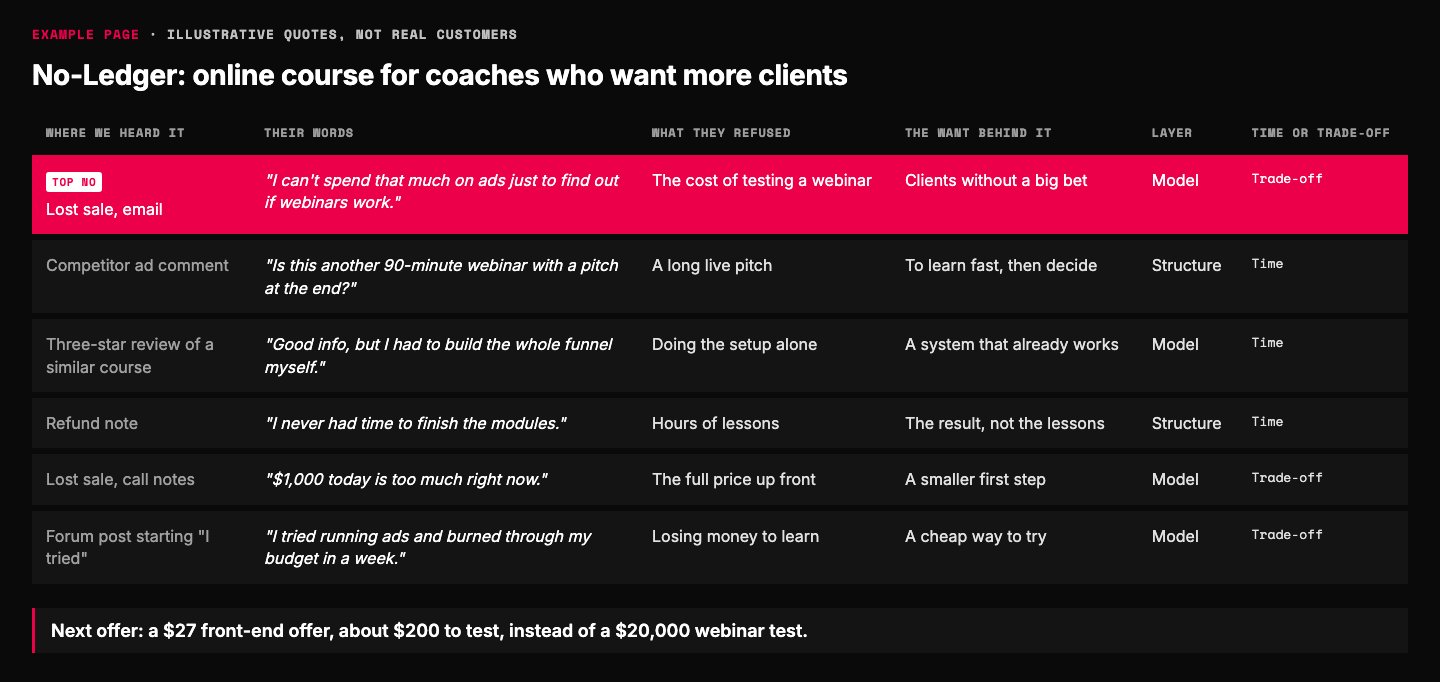
- Write each no in the buyer's own words.
- Middle-star reviews are the most specific.
- Find the layer before you fix anything.
- The no that shows up most and costs the buyer most.
- Same result, without the refused part.
Example page built for this article with a made-up brand. Buyer quotes are illustrative, and the $27, $200 and $20,000 figures are the article's example numbers from another business
Buyers say no to time first, then to the trade-off
Nos tend to arrive in an order. Time comes first.
Why order online instead of driving to a big store? Mostly the hours.
Why pay for a done-for-you service instead of learning the skill? Same reason.
The second no is to the idea itself. It shows up when the cost of trying gets too big. We call that a trade-off no.
For example, testing one webinar can take about $20,000 in ads. Many sellers did not reject webinars because they hated video. They rejected the price of finding out.
Next, find the layer. A buyer can refuse your model, your structure, your stories, your words, or the problem you named.
A no to your words needs a rewrite. A no to your model needs a new model. Mix them up and you rewrite forever.
The first no is to time; the second is to the price of finding out
| No to time | No to the trade-off |
|---|---|
| "This takes too long" | "This costs too much to even try" |
| Driving to the store | About $20,000 to test one webinar |
| Learning a skill from scratch | Hiring a full team before the first sale |
| Fix: make it faster or do it for them | Fix: make the first try small and cheap |
Our comparison. The webinar figure is an example from another business.
The deeper the no, the bigger the change you need
- Words They dislike how it is said. Rewrite the lines.
- Stories The examples do not fit them. Swap the stories.
- Problem named They do not agree with the problem. Name the one they feel.
- Structure The format puts them off. Change the order or the format.
- Model They refuse the whole path to buying. Build a new model.
Five layers of no, from the words at the bottom to the model at the top.
Build the offer that gives the result without the refused part
Once you know the no, design around it. Change the offer, not only the headline.
Example one: the webinar. Sellers kept refusing the cost of a test. A small first offer at $27, called a front-end offer, could be tested for about $200 instead.
That is 100 small tests for the price of one webinar. Less risk per try. More tries.
Why does that matter so much? Loss aversion: people weigh a possible loss more heavily than a gain of the same size. Shrink the possible loss and more people try.
Example two: a weight-loss coaching business. Many leads did not qualify for the coaching. So those leads got a new offer: the whole program without the coaching, for $1,500.
It sold well. Then the owner asked how to get more people to disqualify, because that path needed no coaches and no salespeople.
The best path in the business came from the people who said no.
Both fixes did one thing. They gave the buyer a choice back.
A brand-new format starts most visitors at maybe. A format they already refuse starts them at no. Getting from no to yes is a long climb, and you pay for every step.
Example: one webinar test costs as much as 100 small front-end tests
Rough cost to find out if each model works, in one business's example
- Webinar test 20000
- $27 front-end test 200
Example numbers from other businesses. Not our results, and not verified by us. 100 tests is our math: $20,000 / $200.
The people who said no to coaching became the best path
- 1. Leads take a qualifier Short questions decide who fits the coaching program.
- 2. Many do not qualify In the old model, these leads were simply lost.
- 3. They get a new offer The whole program without the coaching, for $1,500.
- 4. It sells No coaches and no salespeople to pay on these sales.
- 5. The owner wants more of it The new question: how do we get more people to disqualify?
Example numbers from other businesses. Not our results, and not verified by us.
A new format starts buyers at maybe; a refused one starts them at no
| A format buyers already refuse | A new format |
|---|---|
| Most visitors start at no | Most visitors start at maybe |
| Path: no, then maybe, then yes | Path: maybe, then yes |
| The buyer feels cornered | The buyer has a choice |
| You pay more to push each step | Fewer steps to pay for |
Our comparison.
Shrink the first step before you grow the promise
When the no is about money, look at the first payment before you touch the price.
For example, one webinar's $1,000 offer converted 0.3 percent of viewers with the whole price due today. Offered as $100 today and four payments of $200, it converted about 3 percent.
That is ten times the buyers. The total also fell to $900, so the lower total played a part too.
A buyer who will not pay $1,000 today may pay $100 today. Ignore that buyer and the lost sale is on you, not on them.
Our rule: show the full total on the page. Splitting a price does not shrink it. The FTC's policy statement on recurring charges says sellers must clearly show the total cost and how to cancel.
Plans like buy now, pay later work for the same reason. The first step is small. The total is still the total.
And skip the bigger promise. Louder claims add legal risk for you and doubt for the buyer. To set the price itself, use our method for pricing from your buyer's income.
A smaller first payment lifted buying from 0.3 to 3 percent
Share of webinar viewers who bought, by payment option, in one business's example
- $1,000 today 0.3
- $100 today + 4 x $200 3
Example numbers from other businesses. Not our results, and not verified by us. Total of the split option: $900.
Explain why the old way fails, then why yours works
Buyers who refuse the old model often still half-believe in it. Status quo bias keeps people with what they know. So explain the old way before you replace it.
Every model has a mechanism. A mechanism is the sequence of steps that makes it work.
Lay out the old mechanism step by step. Show the exact step where it breaks for this buyer. Then lay out yours the same way.
Explain the old way better than the buyer can, and they will trust you to replace it.
Name the true cost of each option the buyer is weighing. For example: "Webinars work, if you can spend $20,000 to test one." One sentence, one real number.
Our rule: every cost you name must be true and provable. Made-up fear is not a cost. It is a lie told to rush the buyer.
And guard the trust you have. Once a buyer says no to you as a person, no new hook brings them back. A hook is the opening line that grabs attention.
How to make your whole market say no to you in four easy steps:
1. Ask customers what they want, then believe every word.
2. Fix a refused model with a new hook, then another, then another.
3. Answer every no with a bigger guarantee and a louder claim.
4. Copy a competitor's offer, swap the logo, and act shocked when buyers say they have seen it before.
A new hook on a refused model is a fresh paint job on a car nobody wants to drive. For where the offer goes on a teaching page, read how to place and label the offer in your content.
Explain where the old way breaks, then show yours step by step
| Old way: the webinar | Our way: a small front end |
|---|---|
| Ad, sign-up, show up live, long pitch | Ad, $27 offer, follow-up, next step |
| About $20,000 to find out if it works | About $200 to find out if it works |
| Breaks at: the cost of finding out | Removes: the cost of finding out |
| Needs one big yes today | Needs one small yes today |
Example built from the webinar case in this guide. Numbers are examples from another business.
Explain the old way, mark where it breaks, then show yours
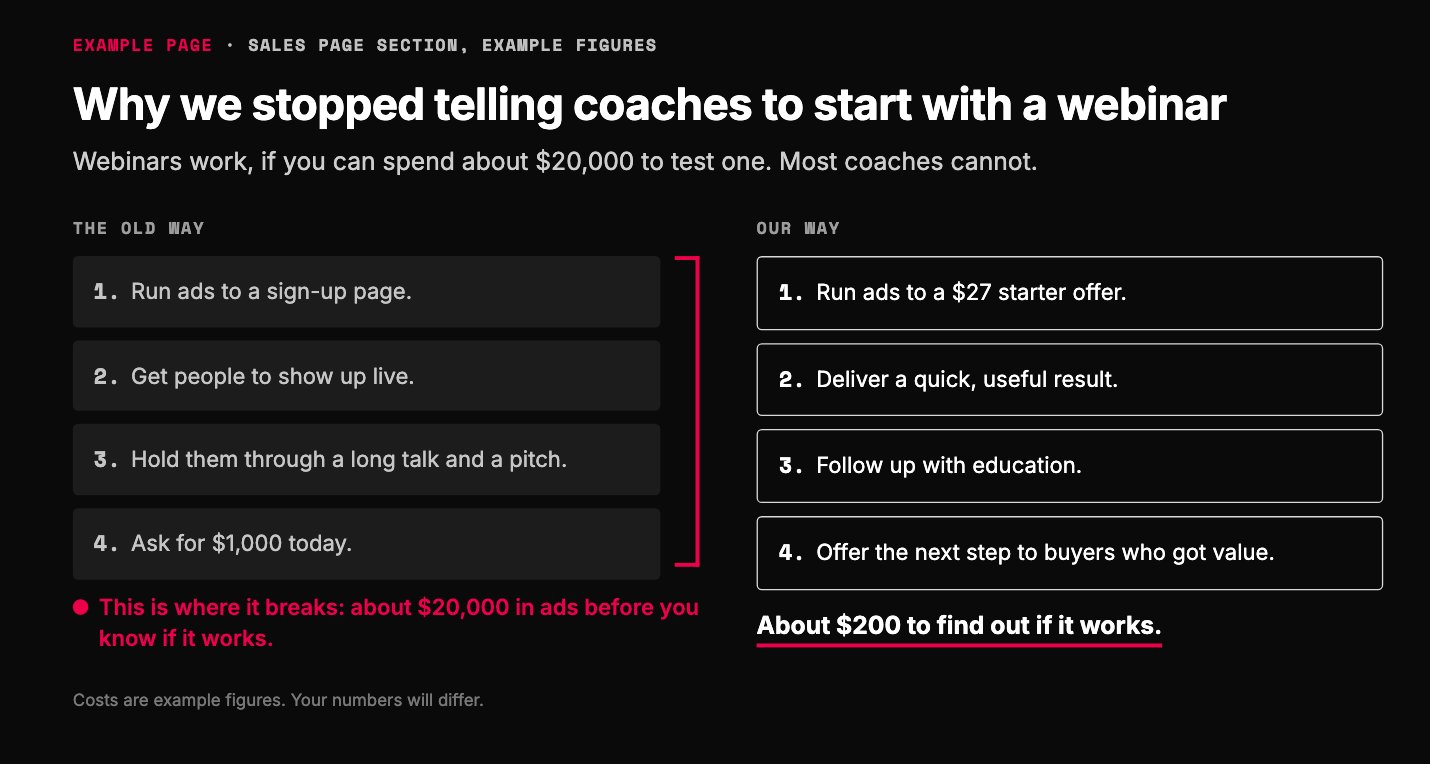
- Name the true cost of the old way in one sentence.
- Lay out the old way step by step.
- Show the exact step where it breaks.
- Then lay out yours the same way.
- Only costs you can prove. No fake urgency.
Example page built for this article with a made-up brand. The costs are the article's example numbers from another business, not our results
When everyone copies you, find the next no
Every model that works gets copied. Then it becomes normal, and normal becomes the next thing people refuse.
That is commoditization: when offers look the same, buyers compare on price.
You can see it coming. Sellers start hiring people just to phone every lead. Or they push financing so buyers can afford the same thing.
Both are signs the model has stopped selling itself. In the first, sellers race to do the same work cheaper. In the second, they race to offer easier loans.
There is a third way out: add value, then add status.
Doing the work is a commodity. Getting the result is not.
Status changes the math. Some goods sell more when the price goes up. Economists call them Veblen goods.
So when every seller goes cheap, someone can win by selling the expensive version.
A cheaper copy does not set you apart. Removing a new no does. That is real product differentiation.
So the ledger never closes. Start a fresh page whenever your numbers slip, and read how to read your market's maturity stage before you change the copy.
Every removed no becomes normal, and normal becomes the next no
- Find the no Study what buyers tried and failed at.
- Remove it Same result, without the refused part.
- Sell it The new model starts buyers at maybe.
- Get copied Competitors build the same thing.
- It turns normal Buyers compare on price and start to refuse it.
The No-Ledger, as a loop.
When sellers race on efficiency or financing, the next no is forming
| What you see | What it means | Your move |
|---|---|---|
| Sellers hire people to phone every lead | The race is now to do the work cheaper | Find the next no before you join the race |
| Sellers push financing to close | The race is now to offer easier loans | Add value and status, or find the next no |
| Buyers say they have seen it before | Your format is visible and refused | Change the model, not the words |
Our reading of the signs.
Build your No-Ledger with AI: the copy-paste prompt
Paste the prompt below into your preferred AI. It asks about your offer and the failures you have seen, one question at a time.
It never invents a buyer quote. With fewer than 10 real nos, it stops and tells you where to collect more.
Then it ranks the nos, picks the biggest one, and sketches the offer that removes it. Check the offer against six checks that show why an offer is not selling.
Want a second pair of eyes? Send us your ledger.
Paste into your preferred AI. It asks four questions, ranks your market's nos, and sketches the offer that removes the biggest one.
Act as an offer strategist. Build my No-Ledger: a list of what my market refuses, and one offer that removes the biggest no.

Ask me one at a time, with the example:
1. What do you sell, at what price, and how is it bought? (Example: a $1,000 course sold on a live webinar)
2. Who buys it, and what result do they want? (Example: coaches who want more clients)
3. What have these buyers tried and failed at? (Example: ran webinars, spent a lot on ads, got few sales)
4. Paste the real words of people who said no: lost sales, refund reasons, ad comments, reviews of similar offers. (Example: "I can't spend that much just to find out if it works")

Rules:
- Use only the words I paste. Never invent a quote, a number or a result. If I give you fewer than 10 real nos, stop and tell me where to collect more.
- For each no, write what they refused, the want behind it, and its layer: model, structure, stories, words, or the problem I named.
- Mark each no as time (it takes too long) or trade-off (the cost of trying is too big).
- Group the nos. Rank the groups by how often they appear and how much they cost the buyer.
- Check the top no against three questions about the result: how much, how easy, how fast.
- Propose one offer that gives the same result without the refused part. If the no is about money or risk, add a smaller first step.
- Write "old way vs our way": the old method step by step, the step where it breaks, then mine. Name only true costs I can prove. No fake urgency and no bigger claims.
- If you suggest a payment plan, state the full total.

Output:
No-Ledger: table of no / want / layer / time or trade-off / times seen
Top no:
New offer: what it is, the first step, the price, the no it removes
Old way vs our way: three lines each
Cheapest test this week:
Next three actions: 1. 2. 3.
Run the No-Ledger this week
1. Collect 20 real nos from lost sales, refunds, ad comments and reviews. Write them in the buyer's words.
2. Run the prompt. Circle the no that shows up most and costs the buyer most.
3. Sketch one offer that removes it, with a small first step. Test it small before you rebuild anything.
If cash is tight while you test, keep an eye on your cash conversion cycle: how long a dollar is out before it comes back. A smaller first step brings dollars back sooner.
Remember the 198,000 people who said no to that launch? They were not wasted. They were research you already paid for.
When the new offer sells, your buyers will find its limits: not enough, not fast enough. That next no is your next offer to sell them.
Your market already told you what to build next. It told you with every no.

Filip Kovacevic is the founder of Anar Agency in Phoenix. He spent five years running SEO, Meta ads, email, and content for medical practices across the United States, and now does the same work for healthcare, home-service, legal, and professional-service businesses, alongside AI implementation. More from Filip →
Talk it through in 15 minutes
Bring one question from this article. We will tell you what we would do, whether or not you hire us.
Book a 15-Min Chat →