Social Proof Framework: The Proof Stack That Leaves Buyers Nowhere to Object

A social proof framework decides what proof goes where on a page. Ours is the Proof Stack. Show the result is possible in the world, for other people, and for this buyer.
Show it worked before, works now, and will keep working. Then show the math. Testimonials cover only one of those spots.
Why a wall of testimonials still fails to convince
A sales page scrolls past forty testimonial screenshots. Each one is the size of a postage stamp. Nobody can read a word.
The owner calls it proof. The buyer sees a blur. Perfect, if you sell to ants.
Here is the bigger problem. Even a readable testimonial answers only one of the questions a buyer asks.
Social proof is our habit of trusting what other people already chose. It works. But it is one layer, and buyers check more places than one before they believe a claim.
A social proof framework is a plan for which proof goes where. The Proof Stack is our version. It stacks three layers: who it works for, when it works, and why the math says it can.
Fill every layer and the buyer runs out of places to object. That is the whole idea.
A testimonial wall answers one question. The stack answers all of them
| Testimonial wall | Proof Stack |
|---|---|
| Forty tiny screenshots | Three testimonials you can read on a phone |
| Proves it worked for someone | Proves it works in the world, for others and for this buyer |
| Silent on whether it still works | Covers the past, the present and the future |
| No numbers | Market math showing the offer only needs a small share |
| Rests on one kind of proof | Several kinds from several sources |
Our method
Start every claim with one question: what has to be true?
Take your biggest promise. Write it at the top of a blank page. Then ask: what has to be true for this to be true?
Each answer is a belief the buyer must hold. Logic calls these necessary conditions. Each one needs its own proof on the page.
Skip one and the buyer finds the gap. They always do.
For example, picture a bookkeeping firm that promises this: close your books in two days a month. What has to be true?
Software has to exist that pulls bank data in on its own. Other small firms have to be working this way already. And it has to work for this owner, with messy receipts and no finance degree.
That one sentence holds three beliefs. Now you know what to prove.
We think this is the most useful question in copy. Answer it well and the emails and ads get easier, because you already know what each one must prove.
Five steps turn one claim into a list of what to prove
- 1. Write the claim Your biggest promise, in one sentence.
- 2. Ask what has to be true For this claim to be true, what must already exist?
- 3. List each belief Every answer is a belief the buyer must hold.
- 4. Find proof for each One piece of evidence per belief, from a real source.
- 5. Place it next to the claim The proof sits where the doubt shows up, not in a gallery at the bottom.
Our method
Example: one bookkeeping promise needs three different kinds of proof
Claim: close your books in two days a month
| What has to be true | Layer | Proof that fits |
|---|---|---|
| Software can pull bank data in on its own | World | A public product page or news story about the feature |
| Other small firms already work this way | Others | A real client story, used with permission |
| It works for an owner with messy receipts | This buyer | A walkthrough that starts from a shoebox of receipts |
Our example, not a real firm
Write the main claim and ask: what has to be true for this to be true? Each answer is a belief that needs its own proof. Layer one, who: show the result can happen in the world, has happened for others, and can happen for this buyer, using their criteria and the person they want approval from.
Layer two, when: show it was possible in the past, is possible now, and will be possible in the future, without killing hope. Layer three, why: psychology, sociology, and math, with big math for the market, medium math for conditions and small math for the offer. Any place that rests on a single piece or source is a risk, so spread the proof.
Score the page on six places. Never invent proof or imply strangers are customers.
Layer one: prove it works in the world, for others, and for this buyer
The first layer answers who. It climbs in three steps: the world, other people, then the buyer.
Possible in the world. Show what changed: a new tool, a new rule, a new way people buy. When the circumstances change, the results can change too.
Possible for others. Show who else did it, how, and what they got. This is where testimonials live.
Possible for this buyer. Show why they fit, and name the doubts they carry: I am not good enough, I do not know enough, I tried before.
Psychologists call the belief in your own ability self-efficacy. We cover those doubts in the three beliefs that stop a buyer. This layer is where you answer them.
Who should a testimonial come from? Often not the buyer's twin. Pick the person the buyer wants approval from.
For example, one men's dating program had reviews only from men. It swapped them for what the men's new partners said about them. Sales took off.
Keep the promise close to the size of a paycheck, too. A million dollars sounds like fiction. A bit more than one month's pay sounds like next month.
The fit has to use the buyer's own criteria. A friend with three kids keeps telling a single man to buy a minivan.
Good advice for the friend. Useless for him. Advice tells you what matters to the adviser.
Proof has to show what matters to the buyer. For the other places trust comes from, see four sources of credibility.
Proof climbs from the world to the buyer in three steps
- Possible in the world What changed that makes this doable now: a tool, a rule, a new way people buy.
- Possible for others Who else did it, how they did it, and what they got.
- Possible for this buyer Why they fit, in their own criteria, with their own doubts answered.
Our method
Pick proof by what the buyer cares about, not what you are proud of
| Weaker | Stronger |
|---|---|
| Reviews from people just like the buyer | Words from the person the buyer wants approval from |
| A claim of a million dollars | A claim of a bit more than one month's pay |
| Fits the seller's criteria | Fits the buyer's criteria |
Our method. The dating program swap in the text is an example, not our result
Layer two: prove it worked before, works now, and will keep working
The second layer answers when. Buyers check the past, the present and the future.
The past. Was this possible before? If not, something must have changed, so name it.
Buyers look backward to give themselves permission to believe. For example, a large online income was rare before the internet existed. The internet changed the circumstances, so the claim became possible.
The present. Something that worked once may not work today. Show proof from now, not from five years ago.
The future. Most pages skip this one. It matters most, because every payoff the buyer wants sits in the future.
Hope lives there too. People go where there is hope.
So never sell by telling buyers their field is dying. An ad that says AI will replace every copywriter kills the hope a copywriting course needs to sell.
Say the opposite, when it is true: this skill matters more than ever, and here is why it will still matter in two years and in five.
Fear can still close a sale. It just builds a scared customer, and scared customers are expensive to keep. More on change and hope in hooks that work.
Buyers check three tenses before they believe
- Was it possible before? Past If not, name what changed.
- Does it work now? Present Proof from now, not from five years ago.
- Will it keep working? Future Every payoff sits here. So does hope.
Our method
Fear about the future kills the sale it is trying to make
| Kills hope | Keeps hope |
|---|---|
| Your field is dying | Your skill matters more than ever, and here is why |
| AI will replace you | Here is what demand looks like in two and five years |
| Buy now or be left behind | Here is the payoff, and when it arrives |
Our method
Layer three: show the math, because nobody can argue with it
The third layer answers why. It has three parts: psychology, sociology and math.
Psychology is what every person wants: to survive, to be safe, to feel secure, to have status. Maslow's list of needs is the classic version. Proof that touches one of those lands harder.
Sociology is how people act in groups. Some buyers want to belong, and others want to be strong. In a crowded market full of noise, belonging usually wins.
Math sits on top of both. You can dislike the answer to one plus one. You cannot argue with it.
Math also decides whether your offer can exist at all. If the numbers cannot support the claim, doubt fills the page.
We use three sizes of math. Big math is the market size: how many buyers, how much money moves. Medium math is the conditions that push it up or down.
Small math is your offer. Does the big math make room for it, or squeeze it out?
For example, picture a market of 2 million buyers. A quarter of one percent is 5,000 customers. That claim is easy to believe.
Now look at the opposite case. If a whole market spends $2 million a year, making $1 million a year means winning half of all that spending.
Riches in the niches? Not in that one.
Conditions count too. A big market can still turn against you, the way home sales slow when loan rates climb.
Selling to consultants? First show that consultants are in demand and getting hired. Without that math, the buyer wonders if there is any payoff at all.
Three kinds of reason, and math sits on top
| Part | Question it answers | Example of proof |
|---|---|---|
| Psychology | Does this make me safer, more secure, or raise my status? | Show the safety or status the result brings |
| Sociology | Will I belong, or will I be strong? | Show the group the buyer joins |
| Math | Can this exist at all? | Market size, the conditions moving it, and the small share the offer needs |
Our method
Example: a quarter of one percent of 2 million buyers is 5,000 customers
Customers won at each share of a 2,000,000-buyer market
- 1 percent 20000
- Half a percent 10000
- A quarter percent 5000
Our arithmetic on an example market. Not a real market figure
Example: a $1 million year needs half of a $2 million market
Share of the whole market's yearly spend needed for $1 million in sales
- $2 million market 50
- $20 million market 5
- $200 million market 0.5
Our arithmetic: $1 million divided by the market's yearly spend
Never let one kind of proof carry the whole page
One testimonial is risky. One source is risky. One kind of proof is risky, no matter how much of it you pile up.
Buyers feel this without a name for it. Investors call the cure diversification: spread the bet so one failure cannot sink you.
Proof works the same way. Use several kinds from several places, so one weak piece cannot sink the page.
Here is a fast test. Picture your buyer hunting for a reason to say no. Where can they go?
There are six places: the world, other people, themselves, the past, the present and the future. Put proof in each, and wherever the mind goes to object, the answer is already waiting.
Score your page out of six. A testimonial wall scores one.
Then put the math under all six, like a floor. When people agree just because a crowd agrees, that is the bandwagon effect. Math shows the crowd has a real reason.
Six places a buyer goes to object, and the proof that waits in each
| Place | The doubt | Proof that answers it |
|---|---|---|
| The world | Is this even possible now? | What changed: a tool, a rule, a shift in buying |
| Other people | Has anyone done it? | Readable stories from real customers |
| Themselves | Fine for them, but me? | Their limits named, their criteria met |
| The past | Why did this not work before? | The change that made it possible |
| The present | Does it still work? | Proof from now |
| The future | Will it last? | Why it matters more in two and five years |
Our method. Math sits under all six
A full Proof Stack on one page: six places, with the math underneath
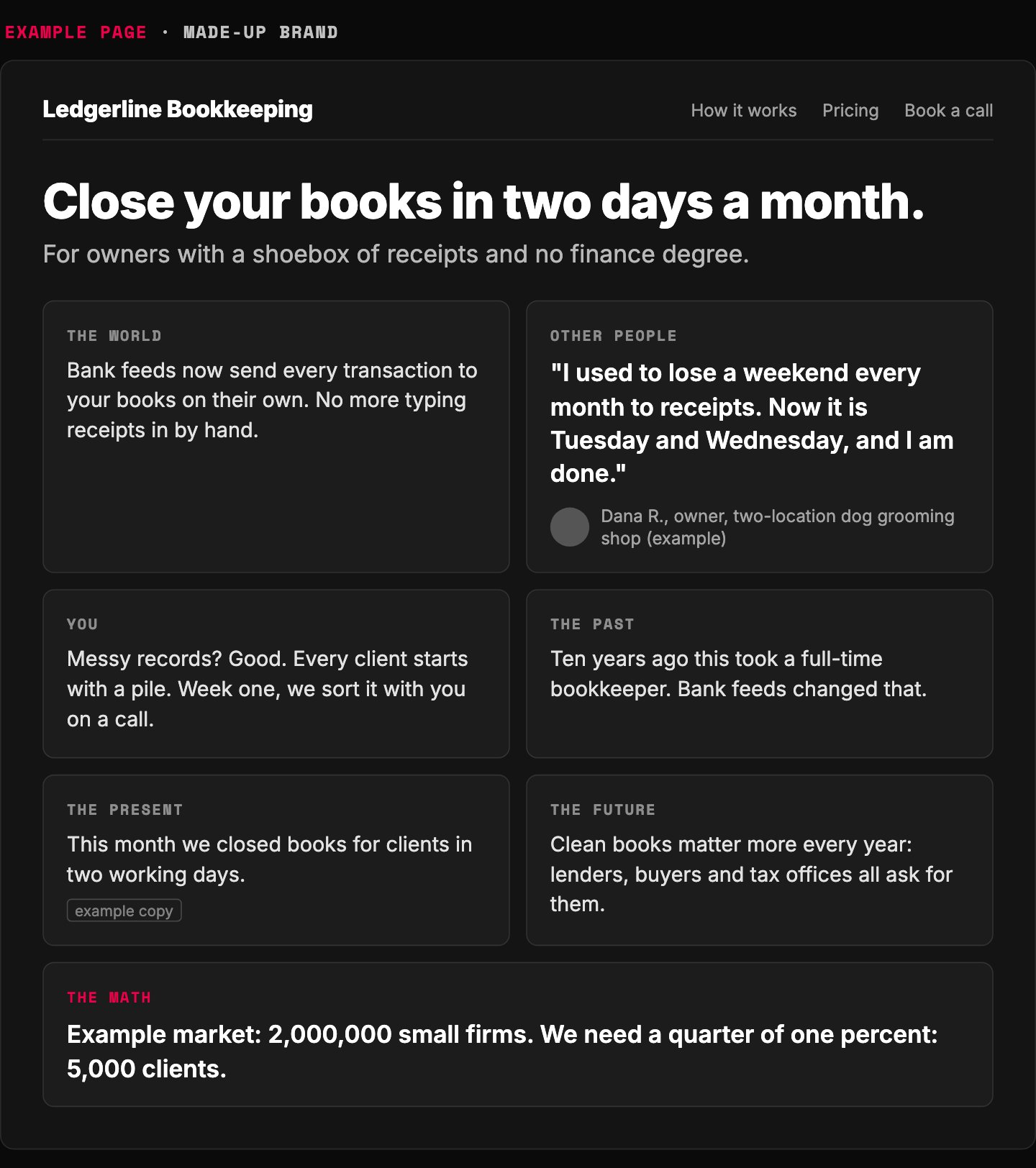
- Big enough to read on a phone. Three like this beat forty tiny screenshots.
- Names the buyer's doubt before they do.
- Says what changed, so the past makes sense.
- Gives a reason it keeps working. Hope lives here.
- The floor under all six: a small share of a big market.
Example page built for this article with a made-up brand.
How do you prove a new offer with no testimonials?
Start with the places that need no customers. The world, the past, the future and the math are all about the market, not about you.
Then borrow voices, honestly. We call news and industry quotes that back your argument borrowed voices. They stand in for testimonials until you have your own.
To find them, search Google News for your market and the change you describe. A news site saying it carries weight your own words cannot. Why news works so well is in the hook is change.
Here is the line we never cross. Do not post screenshots of strangers who use a similar method and let buyers think they are your customers.
That is deceptive. You are using someone's name and face to imply they bought from you. It also traps you, because a business built on tricks needs new tricks forever.
The law agrees. The FTC's rule on fake reviews and testimonials bans fake ones, and its advertising guide for small businesses expects claims to be backed by evidence. Our FTC risk drivers guide covers the rest.
True statements about your product still count. A line like "built to run on the tools you already use" proves it fits the buyer, as long as it is true.
Or lower the first price, deliver more than you promised, and collect real stories fast. More on that in collect, don't invent. The FTC's testimonial questions and answers cover the details.
Borrow voices honestly, never borrow faces
| Honest | Deceptive |
|---|---|
| A news quote about where the market is going | A stranger's screenshot shown as if they were your customer |
| Built to run on the tools you already use, when true | Results you cannot back up |
| A lower first price and real stories collected fast | Made-up reviews |
Our rules. The FTC bans fake reviews and testimonials
Where proof pages go wrong, and the fix for each
Most weak proof pages fail in the same three ways.
Testimonials nobody can read. The sign: a wall of tiny screenshots and no change in sales.
The cause: proof that needs a magnifying glass does not count. The fix: show three that a buyer can read on a phone, and cut the rest.
The future is missing. The sign: buyers agree it worked and still wait. The cause: nothing says it will keep working.
The fix: one paragraph on why it matters more in two years than today.
The claim is bigger than the math. The sign: comments asking if it is real. The cause: the market cannot pay for the promise.
The fix: shrink the claim to a paycheck, or show the market math under it.
How to build a proof page nobody believes, in four easy steps. Step one: paste forty screenshots the size of a stamp. Step two: tell buyers their whole industry is dying.
Step three: promise a million dollars to people who have never seen ten thousand. Step four: when nobody buys, add a longer countdown timer.
Congratulations. You built a hell of a scrapbook.
If buyers still hesitate after the proof is fixed, the fear may be about loss, not belief. Read what buyers fear losing next.
Three ways proof pages fail, and the fix for each
| Sign | Cause | Fix |
|---|---|---|
| A wall of screenshots, no change in sales | Nobody can read them | Three readable ones, cut the rest |
| Buyers agree it worked and still wait | No proof about the future | One paragraph on why it matters more later |
| Comments asking if it is real | The claim is bigger than the math | Shrink it to a paycheck, or show the market math |
Our summary
Build your Proof Stack with AI
The prompt below runs the whole method. Paste it into your preferred AI with your main claim and the proof you already have.
It asks before it guesses. It returns the beliefs your claim depends on, what you have for each of the six places, the math, and what to collect first.
This week: first, run the prompt on your main headline. Second, fill the one empty place your buyer is most likely to hide in. Third, make every testimonial readable on a phone, or cut it.
Want a second pair of eyes on the result? Send it to us. You are not signing up for anything.
Back to that page with forty stamp-sized screenshots. Keep three and make them big. Then fill the five places the buyer was going to look next.
Testimonials prove it worked for them. The stack proves it will work for you.
Paste into your preferred AI. It asks for your claim and your proof, then shows what each of the six places has, the math, and what to collect first.
Act as a careful copy editor building a Proof Stack for my offer. Use only these rules and my answers. Never invent proof, a customer, a quote or a number. If something is missing, mark it as a gap.

Ask one at a time, with the example, and wait:
1. My main claim, in one sentence. (Example: Close your books in two days a month.)
2. Who my buyer is and what they doubt most about themselves. (Example: owners with messy receipts who think they are bad with numbers.)
3. Whose approval my buyer wants. (Example: their business partner.)
4. Every piece of proof I have now, and where each came from. (Example: 3 client quotes, 1 news article, our own time logs.)
5. How many buyers my market has and what it spends, if I know, and the source. (Example: about 2 million firms, from a government report.)

Rules:
- First list what has to be true for my claim to be true. Each item is a belief my buyer must hold.
- Sort every belief and every piece of proof into six places: possible in the world (what changed), for others (who else did it), for this buyer (their limits and their own criteria), in the past, in the present, in the future.
- Add the math: market size, the conditions that move it, and how small a share my offer needs. Show the arithmetic. If I gave no market figure, tell me where to look it up. Do not guess one.
- Risk is measured in one: flag any place that rests on a single piece or a single source.
- Future proof must give hope. Never say my buyer's field is dying.
- You may suggest a news or industry quote for me to find and check. Never write one yourself.
- Never suggest fake reviews, fake scarcity, results I cannot back up, or showing strangers as if they were my customers.
- If my claim is bigger than the math, suggest a smaller claim sized to about one month's pay or one month's revenue.

Use exactly this format:
CLAIM:
WHAT HAS TO BE TRUE:
SIX PLACES (proof I have / gap):
THE MATH:
SINGLE-SOURCE RISKS:
SMALLER CLAIM (if needed):
COLLECT FIRST: the three pieces of proof to get this week, in order.

Filip Kovacevic is the founder of Anar Agency in Phoenix. He spent five years running SEO, Meta ads, email, and content for medical practices across the United States, and now does the same work for healthcare, home-service, legal, and professional-service businesses, alongside AI implementation. More from Filip →
Talk it through in 15 minutes
Bring one question from this article. We will tell you what we would do, whether or not you hire us.
Book a 15-Min Chat →