Let the Prospect Land on the Claim Themselves

Trust in marketing is easier to earn when you stop asking for it. A claim like "our method works" invites doubt. Instead, start from a real event your reader knows.
Walk forward one cause at a time, show what has held them back, and let them reach the claim. Then name it once: "and that's why."
Trust in marketing: why the claim belongs at the end
A good joke never opens with the punch line. Say the punch line first and nobody laughs. They just wait for you to explain it.
Most sales pages tell the joke backwards. They open with "Our method gets results." Then they spend three thousand words defending a line the reader doubted from the start.
The facts are the same. The order is wrong, so the joke dies.
Most advice on trust in marketing says to add more proof. More testimonials, more badges, more guarantees. We think that chases the wrong goal.
Trust is something you ask for, so the reader can refuse it. A true story the reader can check does not ask for anything.
The Landed Claim is a way to write copy so the reader reaches your main claim before you say it. You start at a real origin and walk forward one cause at a time. You name the claim once, at the end.
Put the claim at the end and the reader stops arguing with it
| Claim first | Origin first (the Landed Claim) |
|---|---|
| Opens with "Our method gets results." | Opens with a real event the reader knows |
| Spends the page defending the claim | Walks forward one cause at a time |
| Proof piled up after the claim | Proof placed inside the story |
| The reader hunts for the flaw | The reader finishes the thought |
| Ends asking for trust | Ends with "and that's why" |
Our comparison of the two structures.
Why does a claim make readers push back?
A claim tells the reader you want something from them. So they start looking for the flaw.
Picture a stranger at a bar. He tells you about two friends who vanished for three days in a small town near the border. You believe every word.
Now picture a sales letter that says its program will change your life. You reach for the back button.
Why? The stranger wanted nothing from you. The letter wants your card.
Psychologists have a name for that push. Reactance is the urge to resist when someone seems to be steering your choice. A bold claim feels like steering.
A page built on trust is answering one question: why should I trust you? The reader answers with another question. According to who?
Trust has an opposite, and it is called distrust. One small doubt can tip a claim over. A fact the reader already knows gives doubt nothing to grab.
Our take: the weaker the product, the longer the letter. Forty testimonials are often covering for an offer that cannot explain itself.
Trust can be refused; a fact the reader already knows cannot
| Copy that asks for trust | Copy built on truth | |
|---|---|---|
| Starts with | Your claim | A real origin |
| The source | You | Something bigger than you |
| Has an opposite? | Yes: distrust | No: the reader already knows it |
| Reader's question | "According to who?" | "Of course. What next?" |
| Ends with | More proof | One line: "and that's why" |
Our summary of the Landed Claim.
The Landed Claim is a way to write copy so the reader reaches your main claim before you state it. List what must be true for the buyer to say yes. Give each truth an origin the reader already knows and a source bigger than you.
Chain cause and effect to the limit that has held them back, put proof inside the story, then name the claim once with "and that's why." Every step must be true, because an implied claim is still a claim.
Step one: write down what has to be true for them to buy
Before you write a word, list what your buyer has to believe to say yes. Not what you wish were true. What has to be true.
Each line on that list is one truth. Each truth gets its own small story later.
For example, picture a contract template sold to new interior designers. The buyer has to believe three things.
1. Without a contract, clients can use your ideas and never pay.
2. So you end up working for free.
3. Clients respect people who put the work in writing.
Most offers rest on three to five truths. A profile that works as a sales page can carry more. For example, one coaching business planned about a dozen truths for its Instagram profile and told each one many times.
Where do truths come from? Rarely from desk research. They come from patterns you only see after working with hundreds of clients.
For example, picture a kitchen remodeler who notices that most unhappy clients chose cabinets before the layout. No survey finds that. Three hundred kitchens do.
More on finding them in where real content comes from.
Example: each truth behind a contract template gets its own origin
| The truth the buyer must accept | Where its story starts | The limit it explains |
|---|---|---|
| Clients use free ideas without paying | A party where guests praise rooms built on her ideas | Why so many visits never turn into paid work |
| So you end up working for free | Twenty home visits, one paid job | Why hard work has not turned into income |
| Clients respect work put in writing | Attorneys, plumbers and painters all use contracts | Why clients treat her ideas as free |
Example. A made-up business, used to show the method.
Start the story at an origin your reader already knows
An origin is where a truth starts: a moment, a place or an event the reader recognizes. A place they know works better than a place that sounds impressive.
Picture a course on training cats. The trust version says the secret to training a cat is food, a tree and our method.
That version is flat. The reader has nothing to hold on to.
The truth version starts in Key West, at Ernest Hemingway's old house. Dozens of cats live on the grounds, and about half have extra toes. Then the story moves to what the people who care for them every day have learned.
Most American readers know Key West and Hemingway. A famous singer's house in Bosnia would mean nothing to most of them. The story would be built the same way, but it would start in the wrong place.
An origin also has to add up. If the reader can poke a hole in where the story starts, they distrust everything after it.
Origins do not have to be dates. A change in an industry works too.
For example: finding a factory once took contacts and plane tickets. Then suppliers put their catalogs online. Now anyone with a laptop can do it, and that change is the origin of a whole category of online stores.
Start where the reader already knows the place and can check the fact
- Explain it first True, but it costs words before the story moves.
- Start here Key West and Hemingway's cats. Known and checkable.
- Cut it Nobody knows it, and nobody can check it.
- Use with care Known but unprovable. Add a real source or skip it.
Our decision rule for choosing an origin.
A good origin is a place readers already know, with facts they can check
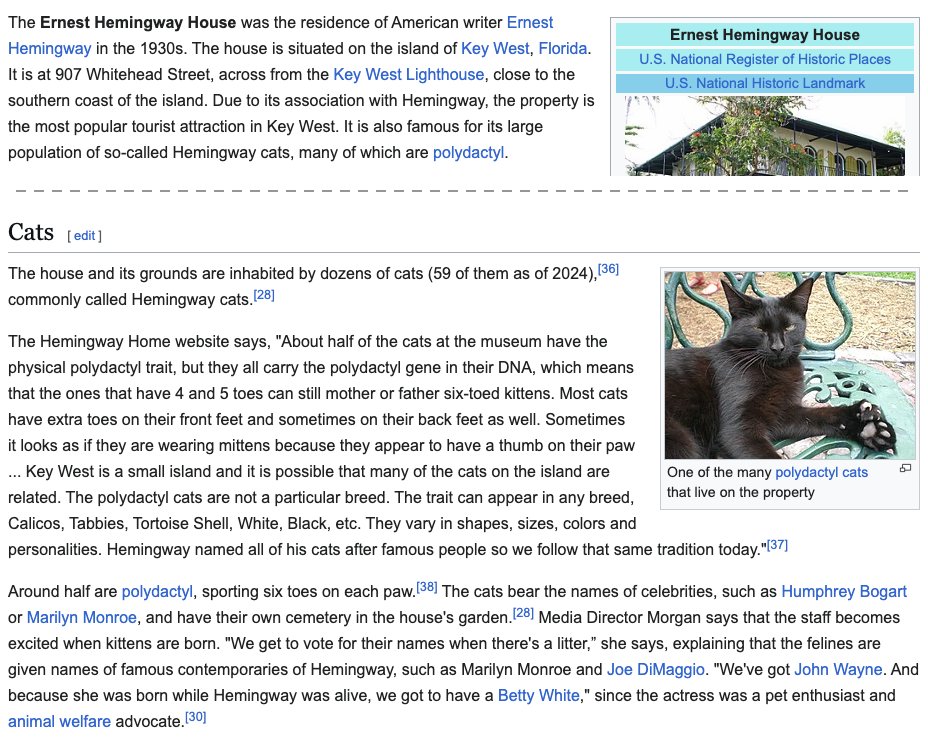
- A place most American readers already know. That is what makes it a good origin.
- A fact anyone can check in ten seconds.
- A detail this specific reads as true because it is true.
- Start the story here. The claim comes at the end.
Screenshot of Wikipedia, Ernest Hemingway House. Pin text is our commentary, taken 2026-10-17
The source of the truth is never you
The source is who or what a truth comes from. Make it bigger than you. Never make it you.
Say you trained the cats yourself. The reader thinks: fine, then go train a tiger.
Say the people who care for the six-toed Hemingway cats taught you, and the doubt has nowhere to go.
Sources rank like a ladder. Your opinion sits at the bottom. A pattern across hundreds of clients sits higher, and something the reader has lived sits at the top.
Watch how much a source moves people. For example, one marketer argued with his partners about every idea. Then they told him an author he admired had said the same thing, and he agreed on the spot.
The author never said it; his partners made it up. A source moves people that much. An argument from authority persuades, but it proves nothing.
So use real sources only: a public event, a record, your clients' own words with their permission. The FTC's rule on fake reviews and testimonials bans made-up endorsements.
The higher the source on this ladder, the less the reader argues
- You "Trust me." The reader asks: according to who?
- One happy customer Better, but easy to wave off as luck.
- A pattern across hundreds of clients What you only see after doing the work many times.
- A public record or event Something anyone can look up.
- Something the reader has lived Their own memory agrees before you finish.
Our ranking. Every source must be real; never invent one.
Build the chain: origin, then so, then the limit it explains
Once you have a truth, an origin and a source, build the chain. Each sentence is the reason for the next one.
Step 1, origin: where it started. A time, a place or an event the reader knows.
Step 2, timeline: if this, then that. Since this happened, that followed.
Words like since and then do the work, as in sequence words.
Step 3, the limit: what has been stopping the reader, now explained. Name the belief too, such as "I'm not good enough" or "nothing works for people like me."
Step 4, cause and effect: this happened, so that happened, and because of that, here we are. This part explains how the problem works.
Step 5, proof inside the story: put each fact where the story needs it, not in a pile at the end. Proof about safety, security or status hits hardest.
Step 6, the landing: the reader reaches the claim. You confirm it in one line.
Here is the contract example, told in order. For example, picture a new designer who works day and night. She builds a website, posts on Instagram and visits homes with her best ideas.
One prospect in ten to twenty hires her. Then she goes to a party at a client's house, and the other guests are her old prospects.
They are praising each other's rooms. Every room uses her ideas. Nobody paid her.
The lost money hurts. Worse, they never respected her work, or they would have paid for it.
Attorneys use contracts. So do plumbers, painters and movie stars. And that's why a contract is less about protection and more about respect.
Six steps from a real origin to a claim the reader reaches first
- 1. Origin A time, place or event the reader knows.
- 2. Timeline If this, then that. Since this, that followed.
- 3. The limit What has stopped them, and the belief that keeps them stuck.
- 4. Cause and effect This happened, so that happened. Here we are.
- 5. Proof inside Facts where the story needs them. Safety, security, status first.
- 6. The landing The reader gets there. You confirm it in one line.
The Landed Claim, in six steps. Step zero is the truth list.
Example: the claim arrives last, after the reader has already reached it
- A new designer works day and night Origin Website, Instagram, home visits full of ideas.
- One prospect in ten to twenty hires her Timeline The rest say thanks and go quiet.
- The party The limit Her old prospects praise rooms built on her ideas. Nobody paid.
- Every professional uses one Proof inside Attorneys, plumbers, painters, movie stars.
- And that's why Landing A contract is less about protection and more about respect.
Example. A made-up business, used to show the method.
The claim is the last line, and the reader reaches it first

- Origin: advice every new designer has heard.
- Timeline: each sentence is the reason for the next.
- The limit, explained: why home visits never turned into income.
- Proof inside the story: every professional works with a contract.
- The landing. The reader got here first. This line agrees.
Example page built for this article with a made-up brand
End with "and that's why" and name the claim once
The close names the claim after the reader is already there. It confirms. It does not argue.
Three lines do most of the work: "And that's why...", "Now you can see why..." and "That's why you can...".
If the chain is right, the reader finishes the thought a beat before you do. Your line just agrees with them.
Here is the same move on one weak sentence. A designer wants to say she never went to college.
The trust version is just that sentence. It reads like an excuse.
The truth version starts at the origin. Everyone told her to get a degree first. A degree meant four years with no clients, no portfolio and no practice.
So she asked what a client hiring a designer really checks. Nobody has ever asked for her degree. They look at the work, and that's why she spent those four years building it.
Why does this stick? People remember what they work out better than what they read, a finding called the generation effect. Psychologists call the wider idea self-persuasion: the reader does the persuading.
The same fact reads like an excuse alone and like a decision with an origin
| Trust version | Truth version |
|---|---|
| "I didn't go to college." | "Everyone told me to get a degree first." |
| No origin, so the reader asks why | A degree meant four years with no clients and no portfolio |
| Sounds like a gap | "Nobody has ever asked for my degree. They look at the work." |
| The reader fills in the rest, usually against her | "And that's why I spent those four years building it." |
Example. A made-up business, used to show the method.
Already opened with a big promise? Loop back to the origin
A page that opens with a promise is not ruined. Add one line after it: "Here is how I know this is true..." Then go back to the origin and walk forward again.
Pick by attention. If your reader will stay for a story, use the full build. If attention is hard to hold, as in a short ad, use short loops: claim, back to the origin, forward again.
A good story pulls the reader in until they feel they are inside it. Researchers call that narrative transportation. A short loop gives a cold scroller a taste of it.
The same chain can point forward, too. To make a future problem feel real, start in the past and run the timeline ahead.
For example, a page for parents saving for retirement might start like this. When you were young, a steady job and some savings looked like enough. Then prices kept rising.
So families work longer hours, but a day still has only 24 hours. Something has to give. And that's why the next move is earning more, not cutting more.
Use the full story when the reader will stay; use short loops when they won't
| Where it runs | Use | How it starts |
|---|---|---|
| A sales page or an email they opened on purpose | The full build | The origin, then the chain |
| A short ad in a cold feed | Short loops | The claim, then back to the origin |
| A page that already opens with a promise | One loop after the promise | "Here is how I know this is true..." |
Our decision rule.
Example: to make a future problem feel real, start in the past and run the timeline ahead
- A steady job looked like enough Then Work, save a little, retire on time.
- Prices kept rising Since then Every bill grew a little each year.
- Longer hours, same 24-hour day Now There is a limit to how much more you can work.
- Something has to give Next The reader sees it before you say it.
- And that's why Landing The next move is earning more, not cutting more.
Example. A made-up business, used to show the method.
Where the Landed Claim breaks, and how to fix it
How to make a reader argue with every line in four easy steps:
1. Open with your biggest claim.
2. Make yourself the only source.
3. Start the story somewhere nobody has heard of.
4. Paste 25 testimonials under it and call it proof.
That is not a sales page. That is a debate you booked with your own buyer, and you are losing the damn thing.
Readers drift during the build. The origin is unfamiliar, or nothing happens for too long. Swap in an origin they know, or switch to short loops.
Readers still doubt at the end. One link in the chain is weak. Read every "so" out loud and ask whether a skeptic would nod.
The close feels like a trick. A step is false, or a needed fact is missing. Fix the step, or drop the claim.
Doubts the page itself creates need answers too, as in answering what readers never ask.
Three ways the chain fails, and the fix for each
| What you see | The cause | The fix |
|---|---|---|
| Readers drift during the build | An unfamiliar origin, or nothing happens for too long | Use an origin they know, or switch to short loops |
| Readers still doubt at the end | One weak link in the chain | Read every "so" out loud; would a skeptic nod? |
| The close feels like a trick | A false step, or a missing fact | Fix the step, or drop the claim |
Our checklist.
Is letting the reader reach the claim a trick?
Only when a step is false. If every step is true and the claim really follows, you have explained something.
Our rule is simple. If a fair expert would follow the same steps to the same place, it is honest. If the chain skips a link that would lead somewhere else, it is manipulation with good manners.
Some marketers think a claim the reader reaches is not a claim at all. It is still a claim. The FTC judges what an ad conveys, both express and implied claims, so a claim you lead someone to counts like one you print.
So check your chain like a skeptic. Is the origin real? Does each step follow?
Last test: would you print the claim in plain words and defend it? If not, do not hint at it either. More on that in the claims that get sellers in trouble.
Proof still matters. The chain needs less of it, but every fact in it needs a source, as in the proof stack. The chain is the persuasion; the facts are the floor it stands on.
The structure is honest only when every step is true
| Guiding | Tricking |
|---|---|
| Every fact in the chain is true | One step is false or stretched |
| A fair expert reaches the same claim | The chain skips a link that leads elsewhere |
| You would print the claim in plain words | You hint at what you could not prove |
| Real sources, named where needed | An invented expert or testimonial |
Our rule. Implied claims are still claims under FTC guidance.
Rewrite your main claim with AI this week
The prompt below runs the whole Landed Claim in your preferred AI. It asks what you sell and what your buyer must believe. Then it drafts the chain and flags every fact you need to confirm.
It never invents a fact, a source or a number. Where it needs one, it writes [CONFIRM]. The truth stays your job.
1. Run it on the biggest claim on your main page.
2. Fill every [CONFIRM] with a real fact a reader could check.
3. Move the claim to the end and read the page out loud.
Next, find the story your market already believes, in arguing against the market's story. Then pair it with a cause your reader already accepts.
Tell it in order, and the punch line lands on its own.
Paste into your preferred AI. It asks what you sell and what your buyer must believe, then writes the chain, a short-loop version and a list of facts to confirm.
Act as a direct-response editor. Rewrite one claim with the Landed Claim method: the reader reaches the claim before I state it.

Ask me one at a time, with the example:
1. What do you sell, and to whom? (Example: a contract template for new interior designers)
2. What claim should the reader reach? (Example: "Every designer needs a contract.")
3. What must your buyer believe is true to say yes? List 3 to 5. (Example: "Clients use free ideas without paying.")
4. What real stories, events or client patterns can I use? (Example: a designer whose free ideas ended up in several clients' homes)

Then, for each truth:
1. Pick an origin: a time, place or event this reader already knows. Say why they know it.
2. Name the source. Never me alone: a public record, an event, a pattern across many clients, or something the reader has lived.
3. Build the chain with "since", "so" and "because". One reason per sentence.
4. Name the limit: what has been stopping the reader, and the belief that keeps them stuck.
5. Put proof inside the story where it is needed. Prefer proof about safety, security or status.
6. Close with one line: "And that's why...", "Now you can see why..." or "That's why you can...".

If attention is hard to hold (a short ad), also write short loops: the claim, then "Here is how I know this is true...", back to the origin, forward again.

Rules:
- Never invent a fact, source, quote, number or testimonial. Write [CONFIRM: what you need] instead.
- Every step must be true for most of my buyers.
- If a fair expert would not reach the same claim from these steps, tell me which link breaks.
- An implied claim is still a claim. Never lead the reader to anything I could not state in plain words and prove.

Output:
A. The truth list, each with its origin and source.
B. The full chain for the main claim, under 200 words.
C. A short-loop version, under 60 words.
D. Every [CONFIRM] item, numbered.
E. The weakest link, and how to fix it.

Filip Kovacevic is the founder of Anar Agency in Phoenix. He spent five years running SEO, Meta ads, email, and content for medical practices across the United States, and now does the same work for healthcare, home-service, legal, and professional-service businesses, alongside AI implementation. More from Filip →
Talk it through in 15 minutes
Bring one question from this article. We will tell you what we would do, whether or not you hire us.
Book a 15-Min Chat →