Problem-Aware Ads: Name It, Fix It, Hand It Over

A problem-aware ad is for a buyer who knows something is wrong but not what fixes it. Write it in three moves. State her problem as a plain fact, not a question.
Say what has to change, but not how. Then offer to do the work, with one clear next step. Keep the problem part short.
What is a problem-aware ad?
Picture a coach who runs a webinar every month. Two hundred people sign up. About a hundred show.
At 10 p.m. she scrolls past an ad that asks, "Struggling to fill your webinars?" She is not. Her webinars fill fine.
Her problem is the half who never show. The ad had no idea. So she kept scrolling.
A problem-aware ad is written for a buyer like her. She knows something is wrong. She does not know what fixes it yet.
Problem-aware ads make three moves: name the problem as a plain fact, say what has to change, and offer to do the work. We call it Name-Fix-Hand.
It works best on buyers with money and little time. Owners, B2B buyers, anyone about to spend real money on a fix.
One warning up front. This is not the ad for someone who has not noticed the problem yet. That reader needs the three-layer ad instead.
The busy buyer stops for the ad that already knows her problem
| Ad she scrolls past | Ad that stops her |
|---|---|
| "Struggling to fill your webinars?" | "Every time you run a webinar, half the people who sign up never show." |
| Guesses at the problem | States the problem as a fact |
| Three paragraphs of pain | One line of pain, then the fix |
| "Learn more" | One next step, with what happens and how long it takes |
Example.
Three moves, in this order
- Name it State the broken part of her situation as a true fact. One or two sentences.
- Fix it Say the two or three things that must change. The what, never the how.
- Hand it over Offer one next step: what happens, how long it takes, what she has at the end.
Anar's method.
Problem aware is not solution aware, and your ad fills the gap between them
Copywriters sort buyers into five awareness levels, from Eugene Schwartz's book Breakthrough Advertising. Unaware, problem aware, solution aware, product aware, most aware.
Our coach sits on the second rung. She feels the problem every month. She has not seen a fix she trusts.
Marketing textbooks describe the same path. The buyer decision process starts with problem recognition. Then comes the search for information.
So where does the ad sit? Not on her rung. It sits in the gap between her rung and the next one up.
Its job is to move her up one step. From "I have this problem" to "there is a fix, and these people have it."
This gap is the missing piece of most awareness models. We think it is the most useful part.
Aim at the wrong rung and you lose her. Prove a problem she already lives with, and you are a step behind. Sell your product before she believes a fix exists, and you skipped a step.
Even if she leaves, the ad did its job. She now knows a fix exists. And she knows you have it.
The ad moves her one rung, from problem aware to solution aware
- Unaware Has not noticed a problem.
- Problem aware Knows something is wrong, not what fixes it. Your buyer starts here.
- Solution aware Knows a fix exists. Your ad gets her here.
- Product aware Knows your offer and what it does.
- Most aware Ready to buy. Needs the terms.
Levels from Eugene Schwartz, Breakthrough Advertising. The one-rung idea is ours.
For buyers who know something is wrong but not what fixes it. Name it: find the broken part of their process and state it as a true fact, never a question, about the situation and never the person. Fix it: say the two or three things that must change, without explaining how.
Hand it over: one next step, what happens in it, how long it takes. Keep the problem to about a tenth of the ad.
Find the broken part before you write a word
Start with one question. What is stopping this buyer from moving forward?
Not what she feels. What is in the way.
Then take her business apart, the way a mechanic takes apart an engine. List the parts. Point at the one that is broken.
Take the coach. Her webinar has five parts: the ads, the sign-up page, the reminders, the show-up and the offer on the call.
Ads work. Sign-ups work. Show-up is broken.
That broken part is your first line.
This is plain root cause analysis, the same habit behind the five whys. Keep asking why until you reach a part you can fix.
Where do you find the broken part? In what buyers complain about. Sales calls, reviews, support emails, and the ads already running in your market in the Meta Ad Library.
Selling through sales calls? Our book-a-call math turns your funnel into four rates. The rate furthest from target is your broken part.
Agree on the cause before you pitch the fix. We explain why in agree on the cause first.
Take the business apart and point at the broken part
- Ask what is stopping her Not what she feels. What is in the way of her next step.
- List the parts Every step of her process, in order.
- Check each part Use her numbers and her complaints, not your guess.
- Point at the broken one One part. The one that stops everything after it.
- Write it as a fact That sentence is the first line of your ad.
Anar's method.
The coach's webinar has five parts and one of them is broken
| Part | Working? |
|---|---|
| Ads | Yes, sign-ups come in |
| Sign-up page | Yes, about 200 a month |
| Reminders | Weak, one automatic email |
| Show-up | Broken: about half never show |
| Offer on the call | Cannot judge until people show up |
Example. The business and numbers are made up.
A live ad opens with a question, then hands over before naming a fix
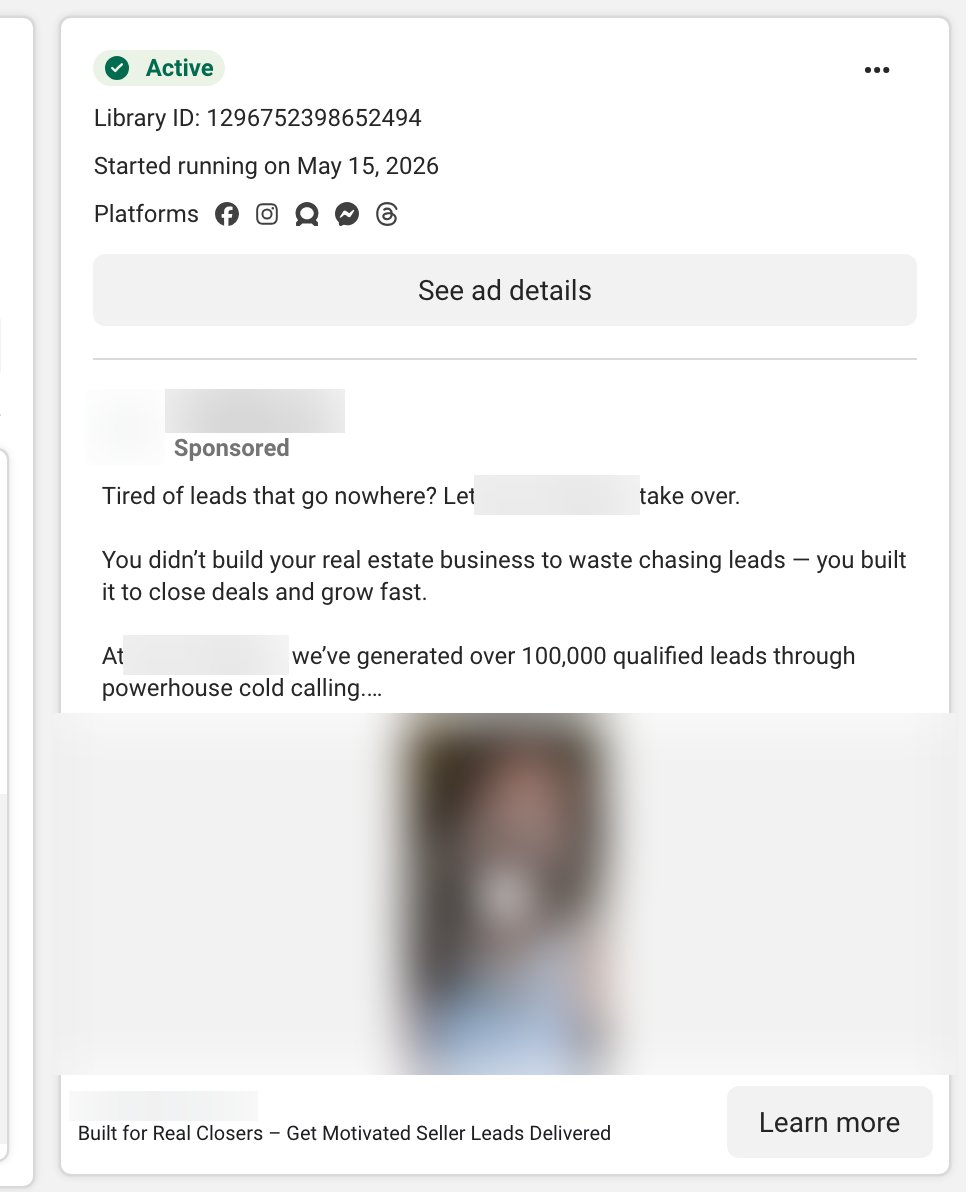
- It opens with a question. To a busy buyer, that reads as a guess, and she can answer no and keep scrolling.
- The hand-over comes in line one, before she believes a fix exists.
- This is where the fix belongs: what has to change for her number to move.
- It ends with Learn more. Learn what? Say what happens next and how long it takes.
Screenshot of the public Meta Ad Library (US, active ads, exact phrase "tired of leads"), taken 2026-10-17. Brand name, logo, link and video blurred.
Name it with a true statement, never a question
Most ads to this buyer open with a question. "Tired of leads that go nowhere?"
It feels friendly. To her, it reads as a guess. Why would you ask if you knew?
A question hands her the job of finding the problem. A rhetorical question also lets her answer "no" and keep scrolling.
Say it as a fact instead. "Every time you run a webinar, half the people who sign up never show."
If that is her life, she stops. Somebody finally said it out loud.
Think of two doctors. One runs tests and tells you what is wrong. The other hands you pills and says you will be fine.
You trust the first one. In medicine, diagnosis comes before treatment for a reason.
Sales research points the same way. In the study behind The Challenger Sale, nearly 40 percent of star performers were reps who taught customers something new about their own business.
Reps who led with warm relationships made up just 7 percent of the stars. Knowing beats being nice.
How to lose a busy buyer in four easy steps:
1) Open with "Are you still struggling?"
2) Spend three paragraphs proving a problem she has lived with for months.
3) Call your fix "a proven system" and say nothing else about it.
4) End with "Learn more." Learn what?
That is not an ad. It is a damn questionnaire. To pick the words for the statement itself, see before-words and after-words.

A question asks her to find the problem. A statement shows you already found it
| Opens with a question | Opens with a true statement |
|---|---|
| "Are your webinars underperforming?" | "Every time you run a webinar, half the people who sign up never show." |
| Could be asked of anyone | Only true for some readers, and those readers stop |
| She can answer it the wrong way | She checks it against her week, and it matches |
Example.
Reps who teach (Challengers) were 27 percent of reps and nearly 40 percent of the stars
Share of all sales reps vs share of star performers, two of the five rep profiles
- Challengers, all reps 27
- Challengers, stars 40
- Relationship Builders, all reps 21
- Relationship Builders, stars 7
Source: Challenger, What is the Challenger Sales Methodology? ("nearly 40%" shown as 40).
Name the broken part as a fact, for six kinds of business
| Business | First line (Name it) |
|---|---|
| Webinar sellers | "Every time you run a webinar, half the people who sign up never show." |
| Ad campaigns | "Your campaign runs fine for the first $100. Then the cost per sale climbs and it falls apart." |
| Coaches selling by call | "Everyone tells you to book sales calls. Few of your leads book one, and most who do are not a fit." |
| Paid lead buyers | "You pay for leads, and most of them were never going to buy." |
| Real estate investors | "Every time you line up a deal, it falls apart at the last step." |
| Facebook group owners | "You built the group. People joined. Nobody talks." |
Example lines in our words. They describe common situations, not data. Use one only if it is true for your reader.
Fix it: say what has to change, not how to do it
The middle of the ad is where most people give too little or too much.
Too little sounds like "We have a proven system." Every vendor she has ever met said that.
Too much is a tutorial. Six steps, a tool list, exact scripts. Now she has a project, and she wanted fewer of those.
The right amount is the what. Name the two or three things that must change for her number to move.
For example, for the coach: "The reminder has to come from a person, by text, the morning of. And stop promising the replay up front."
Why stop at the what? Because she will try to picture the how. When she cannot, she books the call.
Is that a trick? No. The what is the diagnosis, and a diagnosis is worth something. The how is the labor she wants off her desk.
If she can do the how herself, good for her. She was never your buyer.
Say the what. Leave the how for the paid work
| Too little | The what (right) | Too much (the how) |
|---|---|---|
| "We have a proven system." | "The reminder has to come from a person, by text, the morning of." | A six-step reminder playbook with scripts and tools |
| Says nothing she can check | Names what must change | Hands her a project |
| She scrolls on | She wants the how, and books a call | She saves it and never calls |
Example.
Hand it over: one next step, with what happens and how long
The last move offers to take the job. One step. Say what happens in it, how long it takes and what she has at the end.
For example: "If you want help fixing it, book a 20-minute call. We go through your last three webinars and show you where the show-up breaks."
Vague endings kill good ads. "Contact us to learn more" asks her to do the planning again.
Here is an example that shows all three moves, with no ad at all. A well-known marketer went back to a copywriter he had hired before. He already knew his problem.
The copywriter named what was causing it. The marketer asked, "What do I do?" The answer was two words: "You pay."
No pitch deck. No proof stack. The diagnosis did the selling.
The same three moves work outside ads too. A sales email, the opening of a video, a post. Name it, fix it, hand it over, in that order.
A clear next step says what happens and how long it takes
| Vague handoff | Clear handoff |
|---|---|
| "Contact us to learn more." | "Book a 20-minute call." |
| No idea what happens next | "We go through your last three webinars." |
| No idea what she gets | "We show you where the show-up breaks." |
Example.
Name the cause, and the buyer asks what to do
- He knew the problem Before A well-known marketer came back to a copywriter he had worked with.
- The cause, stated Name it The copywriter named what was causing it.
- "What do I do?" Fix it The buyer asked for the next step himself.
- "You pay." Hand it over The diagnosis did the selling.
Example, told in our words.
How much of the ad goes on the problem? About a tenth
For this buyer, keep the problem short. The rule of thumb is about 10 percent problem and 90 percent solution.
She already agrees with you. Every extra line about the pain tells her you are stalling.
That rule is a starting point. Nobody measured it, so test it against your own results.
How you split the other 90 percent is a judgment call. The fix gets most of it. The handoff needs a line or two.
For a buyer who has not noticed the problem yet, the rule flips. Most of that ad goes on the problem. We cover it in moving the unaware majority.
Do not mix the two in one ad. You end up too long for the busy buyer and too short for the cold one.
Example: in a 120-word ad, about 12 words go on the problem
Words per part at about 10 percent problem and 90 percent solution
- Name it (the problem) 12
- Fix it and hand it over 108
Example math from the rule of thumb (about 10 percent problem). Not a measured result.
The busy buyer gets a short problem. The unaware buyer gets a long one
| Knows the problem | Has not noticed it yet |
|---|---|
| About 10 percent problem | About 90 percent problem |
| Opens with a true fact about her situation | Opens by helping her see the problem |
| Moves her to solution aware | Moves her to problem aware |
| This article | See the three-layer ad |
Ratios: a rule of thumb, not measured.
One true line beats a wall of testimonials
Most marketers build trust by stacking proof. Testimonials, logos, a sales page long enough to need chapters.
There is a shorter road. A true statement proves itself. Nobody asks for a testimonial that four plus four is eight.
When your first line matches her week exactly, trust shows up on its own. She thinks: this person gets it.
Add more true details from her world. The software she uses, the day the problem hits, the number she checks every Monday.
Each true detail makes the next line easier to believe. That is why the next rule matters.
Our rule: every detail must be true for the reader you target. Never use true details to sneak in a claim you cannot back. The FTC expects ad claims to be truthful and backed by evidence.
One wrong detail costs more than it earns. Careful buyers weigh a bad choice heavily, which economists call loss aversion. A precise line that is wrong tells her you guessed.
For buyers who have heard every pitch, see selling to buyers who have seen it all. For proof she finds on her own, see letting the prospect land on the claim.
One true line earns more trust than a wall of proof
| Proof stack | One true line |
|---|---|
| Testimonials, logos, guarantees | Her situation, stated exactly |
| She weighs each claim | She checks it against her week |
| Trust has to be argued | Trust shows up when the line matches |
| One false detail is hidden in the pile | Every detail must be true, or cut it |
Anar's rule.
Blame the situation, not the person
Some buyers think the problem is them. Their posts get no comments, so they decide nobody likes them.
Pull them out of that. "You might think it is you, but it is not. Here is what is going on."
A buyer who stops blaming herself tends to think more calmly and spend more freely. That is our view, not a measured result. We use the line only when it is true.
The same habit keeps your ad inside the platform rules. Meta does not allow ads that assert or imply personal traits, such as health, age, religion or money trouble.
Its policy page lists "Are you bankrupt?" as a violation. It also bans ads that imply you know someone's personal or business finances.
So name the situation, not the person and not their private numbers.
"Half your sign-ups never show" describes a situation. "Your company lost $40,000 last quarter" sounds like you read their books.
Selling to consumers about health or money? Write in the third person, about other people instead of "you." Describe what commonly happens and let her recognize herself.
The box below holds the current Meta rules this method touches.
Describe the situation, never a personal trait or private numbers
| Gets rejected | Stays inside the rule |
|---|---|
| "Do you have diabetes?" | "New diabetes treatment available" |
| "Are you bankrupt? Check out our services." | Describe what commonly happens, in the third person |
| "Your company lost $40,000 last quarter." | "Half your sign-ups never show." |
Rows 1 and 2: examples from Meta's Privacy Violations and Personal Attributes policy page. Row 3: example.
Meta bans ads that assert or imply personal traits, money trouble included
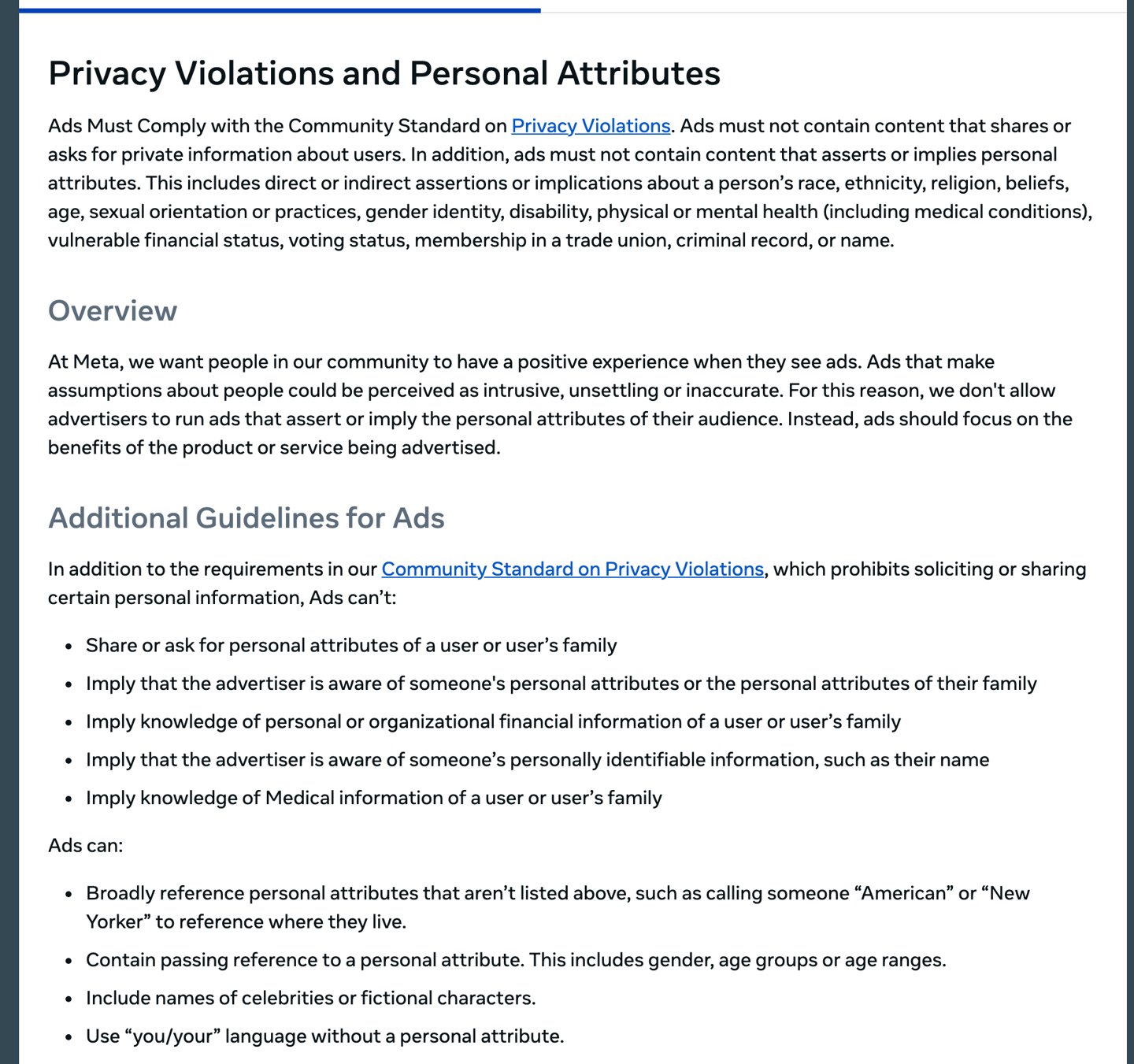
- Meta does not allow ads that assert or imply personal traits.
- Money trouble is on the list, next to health and age.
- No lines that sound like you read their books, like 'your company lost $40,000 last quarter'.
- 'You' is allowed. Name the situation, not the person.
Screenshot of Meta Transparency Center, Privacy Violations and Personal Attributes, taken 2026-10-17.
Run it with AI
The prompt below writes a Name-Fix-Hand ad in your preferred AI. It asks for your buyer, the broken part and your next step. It never invents a number.
This week, do three things. Take one ad you run now and find its broken part.
Rewrite its first line as a true fact. Cut the problem part to about a tenth.
Then run the prompt and test the new version against the old one. Want a second pair of eyes first? Send it to us.
Back to the coach at 10 p.m. The ad that stops her does not ask if she is struggling. It says half her sign-ups never show, and why.
She lives with the problem. Stop proving it to her. Start proving you can end it.
Paste into your preferred AI. It asks for your buyer, the broken part and your next step, then writes three versions.
Act as a direct-response copywriter. Write a Name-Fix-Hand ad for a buyer who already knows she has a problem but not what fixes it.

Ask me these one at a time, with the example. If I give you everything at once, skip the questions and start.
1. Who is the buyer? (Example: coaches who sell through a monthly webinar)
2. What is stopping her from moving forward, in her words? (Example: "Half my sign-ups never show.")
3. List the parts of her process, in order. (Example: ads, sign-up page, reminders, show-up, offer on the call)
4. Which part is broken, and how do you know? (Example: show-up; from her own numbers or what clients tell me)
5. The two or three things that must change. Only the what. (Example: the reminder comes from a person, by text, the morning of)
6. The next step you offer: what happens in it, how long it takes, what she has at the end. (Example: a 20-minute call where we review her last three webinars)

Rules:
- Line one is a true statement of her situation. Never a question.
- Keep the problem to about a tenth of the ad. The rest is the fix and the next step.
- Say what has to change. Never explain how to do it.
- Talk about the situation, never the person. No health, age, religion, money trouble or other personal traits. Never imply you know her private numbers or her company's finances.
- If she may blame herself, add one line that says the cause is the process, not her, but only if that is true.
- Never invent a fact, number or result. Where you need one, write [CONFIRM: what you need from me].
- No fake scarcity, no fake deadlines, no hype words.

Output:
A. Three versions of the ad, each under 120 words.
B. For each version, the first line on its own, so I can test openings.
C. Every [CONFIRM] item, numbered.
D. One line on which version you would run first, and why.

Filip Kovacevic is the founder of Anar Agency in Phoenix. He spent five years running SEO, Meta ads, email, and content for medical practices across the United States, and now does the same work for healthcare, home-service, legal, and professional-service businesses, alongside AI implementation. More from Filip →
Talk it through in 15 minutes
Bring one question from this article. We will tell you what we would do, whether or not you hire us.
Book a 15-Min Chat →