Collect, Don't Invent: A Content Ideas System That Never Runs Dry
A content ideas system collects material instead of inventing it. All week, write down what customers ask, what confused them, the work you did, your own numbers and changes in your trade. Keep their exact words and the source.
Once a week, spend fifteen minutes sorting the notes and pick two or three to write.
Content ideas come from collecting, not from a blank page
Tuesday, 8 a.m. Coffee, laptop, a blank space where your post should go. The cursor blinks.
What should I post? Twenty minutes later, you post a quote about hustle.
Yesterday, a customer asked you a question you have answered a hundred times. You did not write it down. That question was the post.
This content ideas system is for owners and in-house marketers who post because they should, and dread it. You can set it up in one afternoon and run it in fifteen minutes a week.
Here is the whole method. Collect material all week, in the exact words people used. Write from the pile once a week.
We call it the Collect Rule: collect first, write second, never invent. The rest of this guide shows where to look, what to write down, and how one note becomes many posts.

Inventing starts from nothing; collecting starts from what people said
| Invent | Collect |
|---|---|
| Sit down Tuesday and think of something | Write things down all week as they happen |
| Your words, your guess | Their words, their worry |
| Sounds like every other post | Sounds like you were in the room |
| Gets harder every week | Gets easier as the box fills |
The Collect Rule, as set out in this guide.
Why inventing content fails: you are making the bricks yourself
Inventing content is like making your own Lego bricks before you can build anything. You melt the plastic, fill the mold and wait. By the time the bricks are ready, you are too tired to build.
Collecting is different. The bricks already exist. Your job is to pick them up and snap them together.
The bricks are things you heard, saw and counted.
A customer's question. A fix you made on Thursday. A number from your own books.
Why does the blank page give such weak posts? Nothing specific is in front of you. So what comes out is general, and general sounds like everyone else.
AI made this worse. Anyone can now make a hundred general posts before lunch, so every feed is full of them.
Ask your preferred AI for a post from nothing, and you get the average of the internet. It reads flat. There is nothing real inside it.
No AI can make up the sentence your customer said to you yesterday. Nobody else has it.
Google points the same way. Its guide to helpful content asks whether a page gives original information and shows first-hand expertise.
A collected note is first-hand from the start. An invented one has to fake it.
Google asks for first-hand, original material, and collected notes are both
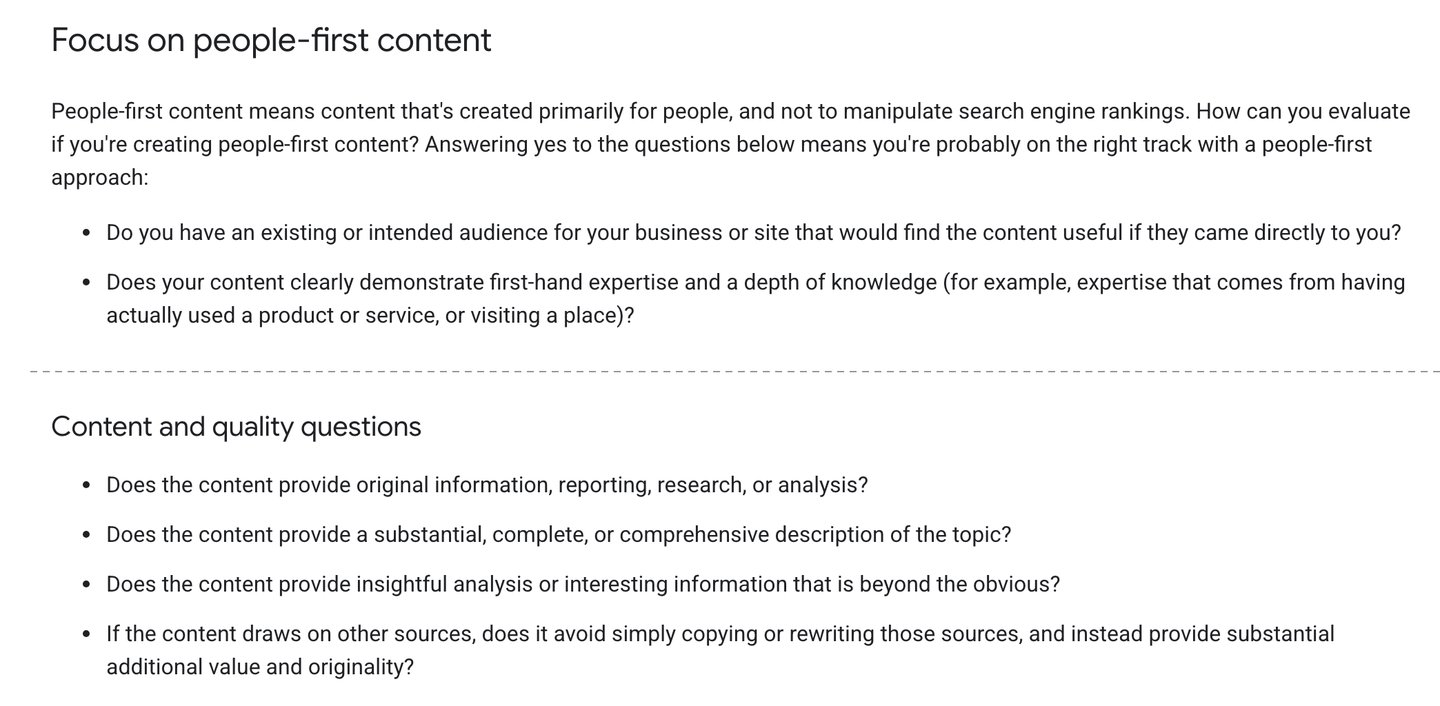
- A customer's exact words are first-hand. Nobody else heard them.
- Google's checklist for any page you publish.
- A collected note is original from the start.
- Collecting is not copying. Credit the idea and add your own.
Screenshot of Google Search Central, Creating helpful, reliable, people-first content, taken 2026-10-17. Two parts of the page, joined at the dashed line
A post can only be as specific as what you start with
| You start from | What you get | Could a competitor post it? |
|---|---|---|
| A blank page | A general post about your field | Yes, word for word |
| An AI prompt with no notes | The average of the internet | Yes, and many already did |
| One collected note | A post built on a real question | No. Only you heard it |
The Collect Rule, as set out in this guide.
The Collect Rule is a content ideas system: collect first, write second, never invent. Gather from five sources: sales calls, support and email, your own work, your own numbers, and changes in your trade. Write each note the same day in four parts: the exact words, where they came from, why they struck you, and what they could become.
Keep one place for notes. Sort for fifteen minutes a week and write the two or three strongest, starting with anything three different people said. Reuse each note with a new opening and format about every 90 days.
Credit other people's ideas, check every quote, protect customer identities, and never call one remark a trend.
Where do content ideas come from? Five places you pass every week
For a service business, content ideas come from five places. You pass all five every week. Most people walk right by.
Sales calls. The questions people ask before they buy, in their own words. This is the richest source, and the most wasted.
Support and email. What confused people after they bought. Each confusion is a post that should already exist.
Your own work. What you fixed this week, and what changed because of it.
Your numbers. Counts and comparisons from your own accounts. Nobody else can publish them, which is why they get quoted.
See what AI answer engines actually cite.
Your trade. A rule that changed, a price that moved, a public report. Add what it means for your customers, and you have a post.
Here is how to turn a news event into a hook.
Marketers call the first two sources the voice of the customer: customers describing what they want, in their own words. We go deeper on capturing it in how to build a customer truth system.
Five sources you already pass every week hold your next posts
| Source | What to write down | Example note |
|---|---|---|
| Sales calls | Questions asked before they buy | "How long until I see anything?" |
| Support and email | What confused them after they bought | "Where do I find the invoice?" |
| Your own work | What you fixed and what it changed | Rebuilt a form; calls started coming in |
| Your numbers | Counts only you have | How many quotes turned into jobs last month |
| Your trade | A rule, price or report that moved | A new permit fee in your county |
Example notes for a home services business, made up for illustration.
Write down the exact words, not your summary
A note is only as good as the words in it. Write what the person said, not what you think they meant.
"I just want to know if it is working" is a headline. "Client wants better reporting" says almost nothing.
Your summary uses your words. Your buyer searches and thinks in theirs. A post in their words reads like you were in the room.
On sales calls, listen hardest for the future tense: "I need to", "I want to" and "I'm going to."
What someone says they need next often shows what they lack now. "I'm going to learn to run the ads myself" can mean they no longer trust whoever runs them today.
When you hear a phrase like that, ask one follow-up: "Is that how you put it to yourself?" Then write the answer down word for word.
Why go to that trouble? A phrase you made up only fits you. A phrase they said will fit the next buyer who thinks the same way.
Their exact words make a headline; your summary says almost nothing
| Your summary | Their exact words |
|---|---|
| "Client wants better reporting" | "I just want to know if it is working" |
| "Prospect worried about cost" | "I've been burned by two agencies already" |
| "Asked about timing" | "Can I get this live before the busy season?" |
Example notes, made up for illustration.
What people say they need next shows what they lack now
| You hear | It often means | Post idea |
|---|---|---|
| "I need to get more reviews" | They feel invisible next to competitors | How to ask for a review in one text |
| "I'm going to learn the ads myself" | They do not trust who runs them now | Five numbers to ask any ad manager for |
| "I want to stop doing it all myself" | They are the bottleneck | The first task to hand off, and how |
Example phrases and readings, made up for illustration. Always check the reading with a follow-up question.
Write every note in four parts, on the same day
A note worth keeping has four parts. It takes about thirty seconds to write.
1. The exact words. Keep the quote marks: "I just want to know if it is working."
2. Where it came from. Sales call, a roofing company, Tuesday.
3. Why it struck you. "Third owner this month to say this."
4. What it could become. "A post on the one number an owner should check."
The last two lines feel optional. They are not. Six months from now, they are the only reason the note still makes sense.
Why the same day? Memory fades fast. In the 1880s, the psychologist Hermann Ebbinghaus tested his own memory, and his forgetting curve drops hardest in the first hours.
A note written within the hour keeps the exact phrase. A note written on Friday keeps your summary of it.
The first note gives you a brick to build with. The second only gives you a memory of one.
One note in four parts, written the same day
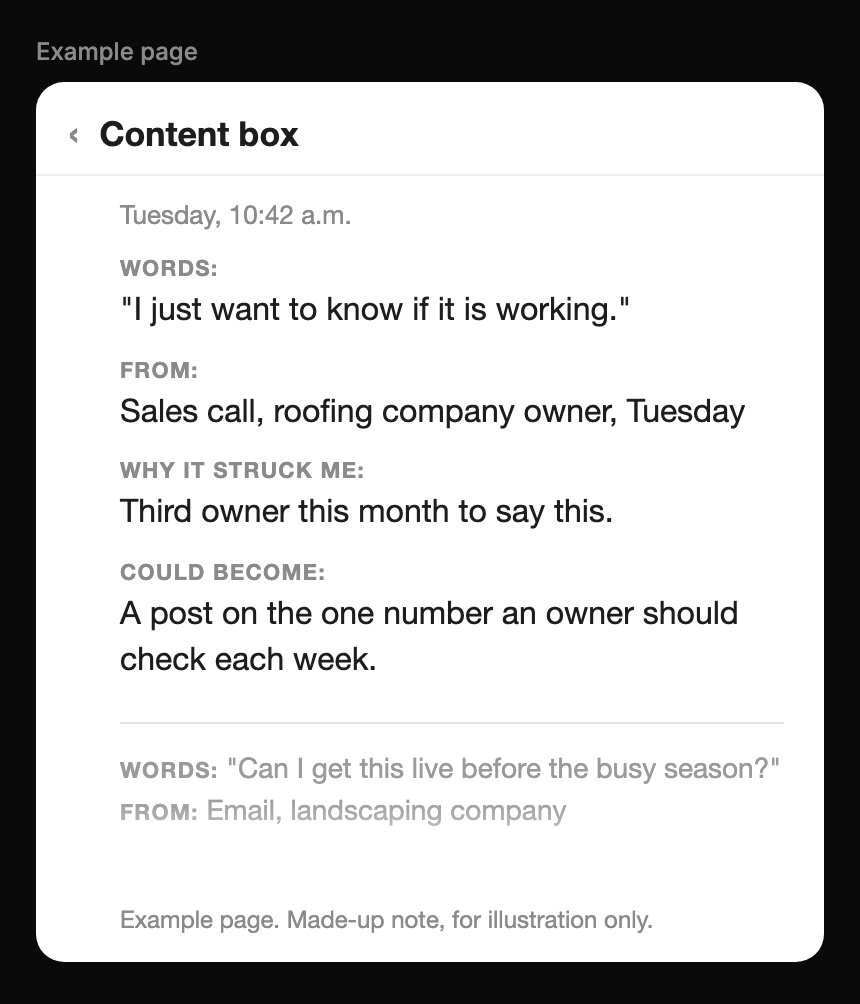
- Their exact words, in quote marks. Not your summary.
- Where it came from, with no name that identifies the customer.
- Why it struck you. This is what makes it usable in six months.
- What it could become. The post is half written.
- Written the same day, within the hour.
Example page built for this article with a made-up note
A useful note has four parts and takes thirty seconds
- 1. The exact words "I just want to know if it is working."
- 2. Where it came from Sales call, a roofing company, Tuesday.
- 3. Why it struck you Third owner this month to say it.
- 4. What it could become A post on the one number an owner should check.
The Collect Rule, as set out in this guide. Example note.
Memory drops fastest in the first day, so write the note the same day
Ebbinghaus's savings score: how much of a learned list was still known, by time since learning
- 20 min 57
- 1 hour 47
- 9 hours 34
- 1 day 30
- 6 days 25
- 31 days 21
Computed from Ebbinghaus's equation (c = 1.25, k = 1.84) on Wikipedia, Forgetting curve. One person, nonsense syllables, 1885.
Keep every note in one place, like Luhmann's 90,000 cards
Niklas Luhmann was a German sociologist. He published more than 70 books and nearly 400 scholarly articles.
He kept a slip box, called a Zettelkasten. It held about 90,000 index cards, built up over about 45 years. Each card had a number, so it could point to other cards.
He credited the box with making his huge output possible. His university has since put the cards online, in the Niklas Luhmann Archive.
Was he simply smarter than everyone else? Maybe.
But he did not write from nothing. He wrote from a box.
The habit is old. For centuries, people kept a commonplace book: a personal notebook of quotes, facts and notes worth keeping.
Copywriters still keep a swipe file of proven ads, for the same reason. Nobody good starts from zero.
The tool does not matter. A notes app, a shared document, a box of cards. What matters is that there is only one.
Notes kept in six places are as good as no notes. You will never look in five of them.
Luhmann wrote from about 90,000 cards, not from a blank page
- Index cards in his slip box, about 90000
- Books published 70
- Scholarly articles, nearly 400
Source: Wikipedia, Niklas Luhmann, read 2026-10-17.
Sort your notes for fifteen minutes a week
Once a week, read the week's notes. Group the ones that belong together. Pick two or three to write.
Anything three different customers said goes to the top. When one person says it, it is a remark. When three people say it, it is a headline.
Delete vague notes with no exact words. If three people said something but you only kept your summary, go back and get the words.
Then writing is just putting pieces together. One note becomes a short post through the six openings. A cluster of notes becomes an article you can cut into twenty pieces.
How to run out of content ideas in four easy steps:
1. Wait for inspiration. Book it for Tuesday at 8.
2. Hear a great question on a sales call, and trust yourself to remember it.
3. Keep notes in six apps, two notebooks and the back of a receipt.
4. Ask an AI for "10 engaging post ideas", post the fourth one, and blame the damn algorithm.
That is not a content system. That is a slot machine.
Collect every day, sort once a week, write from the pile
- Collect Monday to Thursday A four-part note the same day you hear something.
- Sort, 15 minutes Friday Group notes. Three voices go to the top. Delete vague ones.
- Pick Friday Choose two or three notes to write.
- Assemble Next week Write from the notes, not from a blank page.
The Collect Rule, as set out in this guide.
Exact words from three people go first; vague one-offs get deleted
- Keep it Exact words, one voice. Watch for a second.
- Write it this week Exact words, three voices. This is a headline.
- Delete it One voice, no words. Nothing to build with.
- Go get the words Three voices, no quote. Ask the next one.
The Collect Rule, as set out in this guide.
Use one note many times: change the opening, the format and the timing
A good note is not used once. Change how it opens and what shape it takes, and one note gives you many posts.
There are three openings: an observation about your field, a story about yourself, or a contrarian take. A contrarian take disagrees with common advice.
There are three formats: plain text, a simple image that shows a process, or a short video.
Three openings times three formats makes nine versions of one note. That is simple math, not a promise of nine good posts.
Then rotate. Bring the same topic back about every 90 days, with a new opening and format. Most followers will not remember the last one.
A new format also reaches new people. Someone who skips text may watch the video.
Collected quotes work the same way. A line from a well-known person can open or close a post and back up your point. Keep good ones in the same box, with their source.
Three openings times three formats turn one note into nine posts
| Opening | Plain text | Process image | Short video |
|---|---|---|---|
| Observation about your field | 1 | 2 | 3 |
| Story about yourself | 4 | 5 | 6 |
| Contrarian take | 7 | 8 | 9 |
The Collect Rule, as set out in this guide. Nine versions, not nine guaranteed winners.
Collect, sort, assemble, rotate, and the box never empties
- Collect Four-part notes, the same day.
- Sort Fifteen minutes on Friday.
- Assemble Write two or three posts from notes.
- Rotate New opening and format, about every 90 days.
The Collect Rule, as set out in this guide.
Is collecting just copying other people? No, and here is the line
Collecting your customers' words is not copying someone else's posts. Copying is a different thing, and we are against it.
Google's helpful content guide asks the same thing: if a page draws on other sources, does it add value, or just copy them?
Other people's ideas can go in the box, with their name on the note. When you use one, credit it and add something of your own.
Quotes need extra care. Lines found online are often pinned to the wrong famous name. Check each one at Quote Investigator or a sourced page like Wikiquote, and drop it if you cannot find where it came from.
Two rules for customer material. Never publish anything that identifies a customer without their permission. Change the details, or ask.
And never turn one remark into a trend. "A customer asked" is true. "Everyone is asking" needs more than one call behind it.
Collected material is true. Invented material has to be dressed up to sound true. Readers can usually tell, and so can search systems looking for first-hand experience.
Collecting gathers your own material; copying lifts someone else's
| Copying | Collecting |
|---|---|
| Another brand's post, reworded | Your customer's question, quoted |
| No credit | Their name on the note when you use their idea |
| Adds nothing | Adds what you saw or counted |
| Anyone could post it | Only you could post it |
The Collect Rule, as set out in this guide.
Three checks keep collected material honest
| Material | The risk | The check |
|---|---|---|
| A famous quote | Pinned to the wrong person | Find the original source, or drop it |
| A customer's words | Someone can tell who said it | Remove names and details, or ask permission |
| One remark | Sold as a trend | Say "a customer asked" until three have |
The Collect Rule, as set out in this guide.
Turn this week's notes into posts with AI: the copy-paste prompt
Paste the prompt below into your preferred AI, along with your notes. It groups them, finds what three people said, and drafts posts from your words only.
It never invents a quote, a number or a story. If a note is too thin, it asks you about it.
Here is what to do this week:
1. After your next three customer calls, write down one sentence each person said, word for word.
2. Add where it came from and why it struck you.
3. On Friday, run the prompt and post the best draft. Build it on a real change, the way we show in all content is about change.
Next Tuesday at 8 a.m., the cursor will still blink. This time, the post is already in the box.
The blank page only wins when the box is empty.
Paste into your preferred AI with your notes. It groups them, ranks what three people said, and drafts posts from your words only.
Act as a content editor. Turn my collected notes into posts with the Collect Rule: collect first, write second, never invent.

Ask me one at a time, with the example:
1. Who is your buyer? (Example: owners of small roofing companies)
2. What do you sell them? (Example: lead generation)
3. Paste this week's notes. Each note should have: the exact words, where they came from, why they struck me, what it could become. (Example: "I just want to know if it is working." / sales call, roofer, Tuesday / third owner this month to say it / a post on the one number to check)
4. Where do you post, and in what formats? (Example: LinkedIn text posts and short videos)

Rules:
- Use only what is in my notes. Never invent a quote, a number, a customer or a story. If a note is too thin to write from, ask me one question about it.
- Keep the speaker's exact words. Do not polish them into my words.
- Group notes that say the same thing. Anything said by three or more different people goes to the top. One remark is never a trend: write "a customer asked", not "everyone is asking".
- Remove anything that could identify a customer: names, companies, towns, exact dates. Tell me what you removed.
- For each top note, offer three openings: an observation about my field, a story about me, or a contrarian take. Then pick a format: plain text, a simple process image, or a short video.
- If I want a quote from a well-known person, only use one I can check at its original source. Flag every quote as "check before posting".
- Short sentences. No hype.

Then give me:
Groups: [each group, how many notes, how many different people]
Top three notes: [note, why it ranks]
Drafts: [one post per top note, under 150 words, with its opening type and format]
Rotate in 90 days: [each top note with a new opening and format]
Missing: [what I should listen for next week]

Filip Kovacevic is the founder of Anar Agency in Phoenix. He spent five years running SEO, Meta ads, email, and content for medical practices across the United States, and now does the same work for healthcare, home-service, legal, and professional-service businesses, alongside AI implementation. More from Filip →
Talk it through in 15 minutes
Bring one question from this article. We will tell you what we would do, whether or not you hire us.
Book a 15-Min Chat →