How to Write a News Hook: Turn a Real Event Into a Post People Read
A news hook is a real, recent event that makes your message worth reading today. To write one, pick a change from this week that moves your buyer's money, time or risk. State it in one line, fact first.
Say what it means for one buyer, check every fact, then show them how to handle it.
How to write a news hook: lead with what changed this week
Picture two posts in the same feed on the same morning. One says, "We do bookkeeping for contractors."
The other says, "The rule on truck deductions just changed. Here is what it means for your next tax bill."
Which one would you read? The second one.
Nobody wakes up wanting a bookkeeper. Everybody wants to know what just changed.
That second opening is a news hook. A news hook is a real, recent event that makes your message worth reading today.
Reporters use the term for the angle that makes a story timely. We use it the same way in posts, emails and ads. Marketers also call it newsjacking, after a book of that name.
Here is the whole method in one breath. Find one real change, and say what it means for one buyer.
Check every fact. Then show them how to handle it.
One post describes the firm; the other reports a change
| About the firm | News hook |
|---|---|
| "We do bookkeeping for contractors." | "The rule on truck deductions just changed." |
| Says what you sell | Says what changed for the reader |
| True every day, so never urgent | True this week, so worth reading now |
| Reader thinks: an ad | Reader thinks: does this touch me? |
Example lines, made up for this guide.
Why does news grab attention? It tells people what to watch for
People follow the news for a simple reason. If they know what is coming, it cannot catch them off guard.
The reflex runs deep. A sudden change makes us turn our head before we even decide to look. Scientists call it the orienting response.
So the person who reports the change starts to feel like a safe source. People trust that person, and trust is what gets the reply.
Old news does not work. Nobody tunes in for a breaking story from fifteen years back.
A change from five years ago is history. It is not a hook.
Does news ever run out? TMZ has run on one question since 2005: what did a famous person do today? It never runs out of answers.
Your post sits right next to that news. About half of US adults, 53 percent, get news from social media at least sometimes. Facebook and YouTube lead.
So your post competes with the news. Or it becomes the news for one small group: your buyers.
The bigger idea, that every good post reports a change, lives in all content is about change. This guide covers one piece of it: the hook.

Your posts share a feed with the news: 38 percent of US adults regularly get news on Facebook
Share of US adults who say they regularly get news on each site
- Facebook 38
- YouTube 35
- Instagram 20
- TikTok 20
- X 12
- Reddit 9
- Nextdoor 6
Source: Pew Research Center, Social Media and News Fact Sheet, September 25, 2025.
The News Hook turns a real, recent event into the opening of a post, email or ad. Test the event with four questions: recent, close to the buyer, moves their money, time or risk, unexpected. Two yes answers or more, and you lead with it.
Find events weekly in rules, prices, your own numbers and the season. Write five beats: the event with the fact first, what it means for one buyer, three years out, a familiar comparison, and the way through. Check every fact, skip tragedies, and never invent a threat.
Run the four-question news test before you write
Not every event earns a hook. Editors judge stories with lists called news values. We cut them down to four questions.
Is it recent? This week or this month. Not five years ago.
Is it close? It lands in your buyer's town, trade or customer list.
Does it matter? It moves their money, time or risk. Interesting is not enough.
Is it unexpected? It breaks something people assumed.
Our rule: two yes answers or more, and you lead with it. Zero or one yes means it is just an announcement, not news.
Nobody stops scrolling for an announcement.
Two yes answers or more, and the event is worth leading with
| Question | Yes looks like | No looks like |
|---|---|---|
| Is it recent? | This week or this month | Five years ago |
| Is it close? | The buyer's town, trade or customers | Another country, another industry |
| Does it matter? | Moves their money, time or risk | Just interesting |
| Is it unexpected? | Breaks what people assumed | What everyone already knew |
Our test, cut down from journalism's news values.
Only an event that is recent and touches the buyer makes a news hook
- Background True and useful, but not news. Save it for a guide.
- News hook Lead with it this week.
- History Skip it.
- Trivia Fun to read, no reason to act. Skip it.
Our framework.
Find news in four places every week
You do not need a newsroom. You need four places to look, checked every Monday.
Rules. A new regulation, a platform policy, a tax change. The Federal Register publishes new federal rules and proposed rules daily, free to search.
Every rule change is news to someone who has to follow it.
Prices. What materials, ads, labor or insurance cost now against last year. Every buyer feels a price change.
Your own numbers. What you saw across your jobs this month. Nobody else has that news, so nobody can beat you to it.
More on gathering it in collect, don't invent.
The season. The first cold week, the tax deadline, the summer slowdown.
Predictable to you. Still news to the person living it.
There is a fifth source hiding in plain sight. Time itself. We get to it below.
Four places, checked every Monday, keep the news coming
| Place | Where to look | Example hook (made up) |
|---|---|---|
| Rules | The Federal Register, your trade body, platform policy pages | "A new rule starts next month. Here is who it touches." |
| Prices | Supplier invoices, ad costs, insurance renewals | "Our supplier raised prices this month. Here is how to buy before it hits you." |
| Your numbers | Your bookings, calls and jobs this month | "Evening calls rose across our jobs this month." |
| The season | Your own calendar from last year | "The first cold week is two weeks out. Here is what breaks first." |
Our list. The example hooks are made up for this guide.
Find one change on Monday and post it by Wednesday
- Scan Check the four places. Fifteen minutes.
- Test Two yes answers or more.
- Write Five beats, one buyer.
- Check Every fact against its source.
- Post Then send the email version.
Our routine.
The Federal Register lists new and proposed federal rules every business day, free
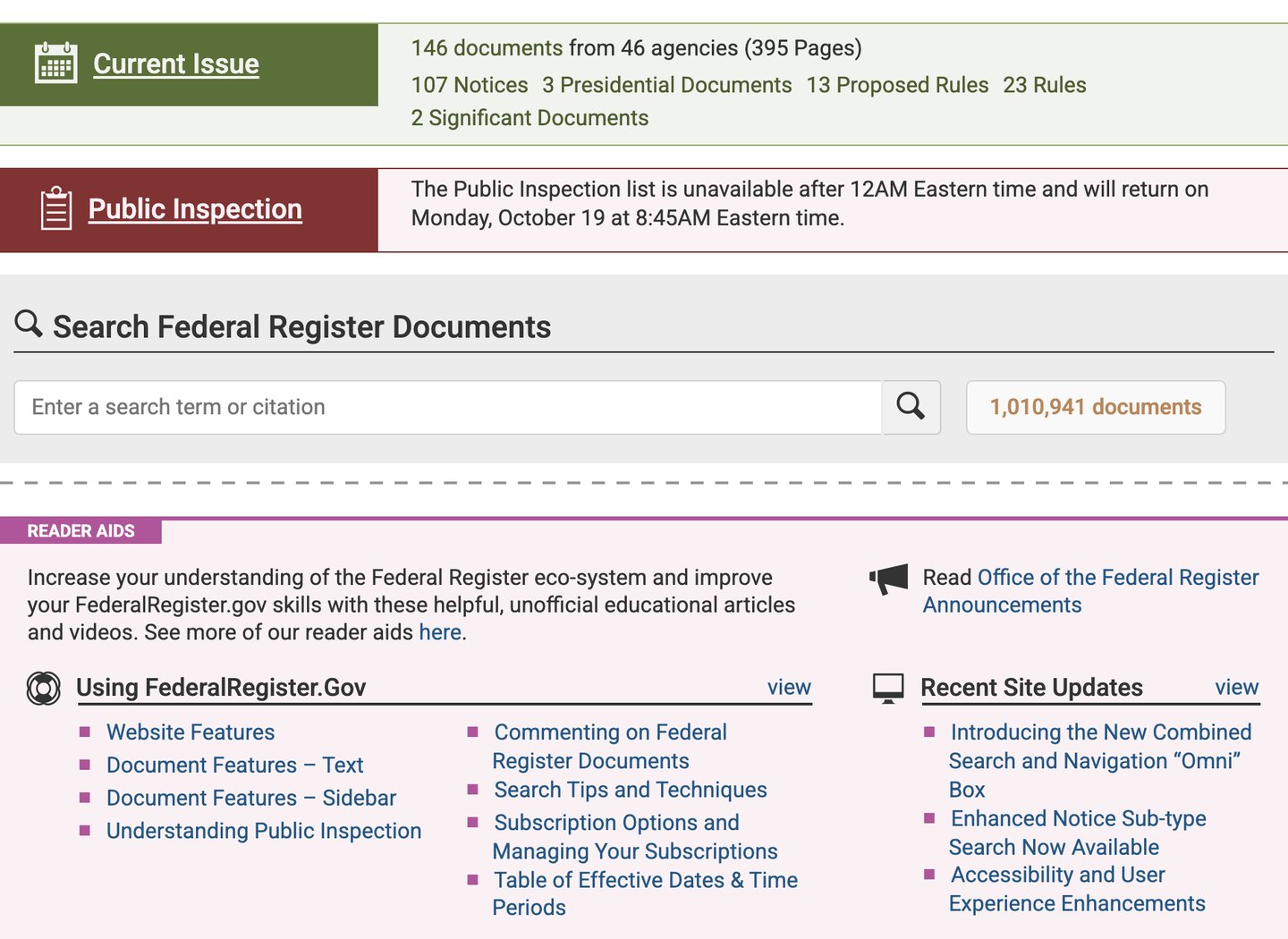
- A new issue every business day. Check it on Monday.
- Final rules. These change what your buyers must do.
- Proposed rules are news before they take effect. An early warning for your buyers.
- Search your buyer's trade, like roofing or dental.
- Save a search so new rules come to you.
Screenshot of the Federal Register home page (federalregister.gov), taken 2026-10-17. Document counts change daily.
Write the news hook in five beats
Once an event passes the test, the hook comes in five beats. Each beat is one or two sentences.
Beat 1: state the event. One line, with the real number and a date. Put the most important fact first, the way reporters do in the inverted pyramid.
Beat 2: name one buyer. "If you run a roofing company, here is what this means for you." One buyer, not everyone.
Beat 3: picture three years out. Describe their week if nothing changes on their side. Stay inside what the event really points to.
Beat 4: compare it to something everyone knows. Milk delivery is a good one. It faded once supermarkets and home refrigerators let people store milk themselves.
Beat 5: show the way through. Who is doing fine, and what do they do differently? End with one thing to try this week.
Beats 1 and 2 are the hook. Beats 3 to 5 earn the next click.
Keep the tone calm. A hook that shouts "BREAKING" reads like an ad. A plain sentence about a real change reads like a friend with a warning.
Want more ways to open a post? See six openings every post can start from.
Five beats turn a real event into a hook for one buyer
- 1. State the event One line, real number, a date. Most important fact first.
- 2. Name one buyer "If you run a roofing company, here is what this means for you."
- 3. Three years out Their week if nothing changes. Only what the event points to.
- 4. A familiar comparison Something everyone knows, like the milkman.
- 5. The way through Who is doing fine, what they do, one action this week.
The News Hook, in five beats.
A plain opening talks about you; a news hook talks about their week
| Plain opening | News hook |
|---|---|
| "We help roofers get more leads." | "Insurers just changed how they pay roof claims in our state." |
| About the seller | About the reader's week |
| No date, no reason to read today | A date and a reason to read today |
| Ends with a pitch | Ends with a way through |
Example lines, made up for this guide.
One honest post, five beats, from the event to one action for this week
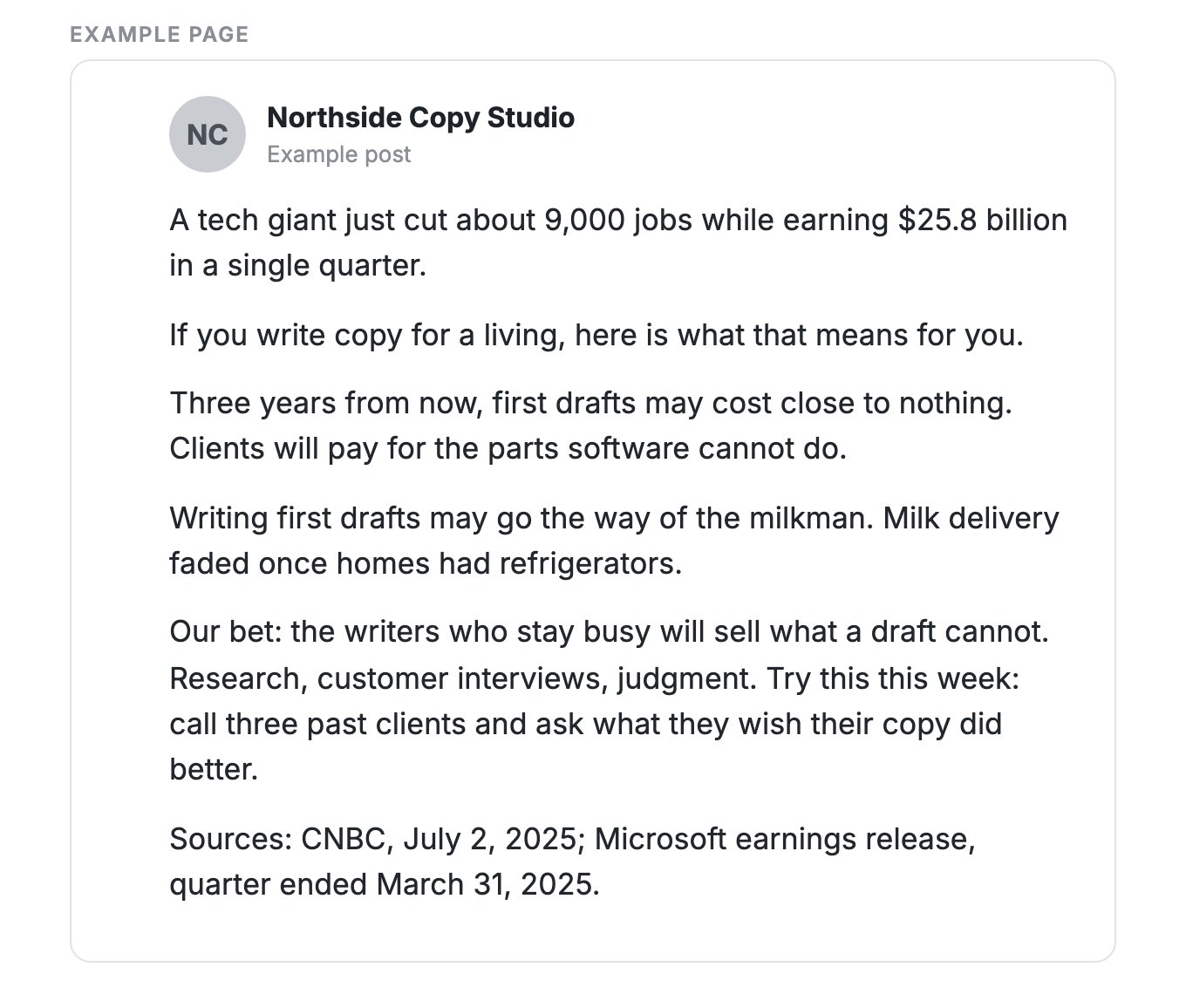
- Beat 1: the event, fact first, with numbers you can check.
- Beat 2: one buyer, named.
- Beat 3: three years out, kept to what the event points to.
- Beat 4: a comparison everyone knows.
- Beat 5: the way through, with one action for this week.
Example page built for this article with a made-up brand (Northside Copy Studio). Facts in the first line: CNBC, July 2, 2025; Microsoft FY25 Q3 earnings release.
Check every fact before you post: a worked example
Here is a draft hook for freelance copywriters. "A tech giant just cut 9,000 jobs and made $25 billion doing it, all thanks to AI."
Strong line. Is it true? Check each claim on its own.
The 9,000 jobs: true. Microsoft said on July 2, 2025 that it would cut about 9,000 jobs, under 4 percent of its staff.
The $25 billion: true, for three months. That was one quarter's profit, $25.8 billion for January to March. The full year's profit was $101.8 billion.
"All thanks to AI": not what the company said. Its statement talked about "organizational changes" for "a dynamic marketplace." It did not name AI as the cause.
So the honest hook reads: "A tech giant cut about 9,000 jobs while earning $25.8 billion in a single quarter." Same punch. Every word checks out.
Round a number up and the hook turns into bullshit the moment a reader checks. And readers check.
The law agrees. The FTC says advertising must be truthful and backed by evidence. A hook in an ad is a claim like any other.
The job cut was real; the $25 billion was one quarter, not one year
- Jobs Microsoft said it would cut, July 2, 2025 9000
- Profit (net income), January to March 2025 25.8
- Profit (net income), full year to June 30, 2025 101.8
Sources: CNBC, July 2, 2025; Microsoft earnings releases for FY25 Q3 and FY25 Q4.
The job cut checked out, the profit needed a time frame, and the AI claim had to go
| Claim in the draft | What the source says | Keep it? |
|---|---|---|
| Cut 9,000 jobs | About 9,000 jobs, under 4 percent of staff | Yes |
| Made $25 billion | $25.8 billion in one quarter; $101.8 billion for the year | Yes, with "in a single quarter" |
| All thanks to AI | The statement cited "organizational changes"; AI was not named as the cause | No, cut it |
Sources: CNBC, July 2, 2025; Microsoft earnings releases. The draft hook is our example.
Use time as news: the "why I think you're crazy" email
Time is the news source that never runs dry. A change over twenty years is still news to anyone who missed it.
The shape is simple. Twenty years ago, one idea sounded crazy. Today, doubting it sounds crazy.
For example: "Twenty years ago, if I said you could book jobs while you sleep, you would have laughed. Today, if you told me your customers cannot book online, I would laugh."
Put it in a subject line: "Why I think you're crazy." Then walk through the years: crazy, a little crazy, maybe, obvious.
Then name what changed. That is the hook.
This one shines in email, where the subject line has to earn the open. More on building a sequence in each email isolates one lever.
Walk the years from crazy to obvious, then name what changed
- Crazy 20 years ago Booking jobs while you sleep? Nobody would believe it.
- A little crazy 15 years ago A few early movers try it.
- Maybe 10 years ago Competitors start doing it.
- Obvious Today Saying your customers cannot book online is the crazy part.
Example email, made up for this guide. The years show the shape, not a measured history.
Where people get stuck writing news hooks
Three stuck points come up again and again. Each has a plain cause and a plain fix.
"Nothing ever happens in my industry." The symptom is a blank page every Monday. The cause is looking only at headlines, where small trades rarely show up.
The fix is the two sources nobody else has. Your own numbers and your own season. A plumber who writes "burst pipe calls doubled the week the cold hit" has news, as long as the count is real.
The hook gets likes but no replies. People enjoyed the news, then moved on. The cause is usually a missing Beat 2 or Beat 5.
Nobody was named, so nobody felt it was about them. Or nobody was shown a next step, so nobody took one. Name one buyer and end with one action.
"By the time I post, the news is old." A rule that takes effect next quarter is still news today. So is a price rise your buyer has not paid yet.
Our test for freshness: has your buyer already acted on it? If not, it is still news to them. If they have, find the next change.
Is newsjacking tasteless? Only when you pick the wrong news
It can be. Using a tragedy, a disaster or a political fight to sell is how firms end up apologizing in public.
The news that works for a small business is usually boring.
A rule changed. A price moved. A season started.
Our rule on fear: name a real risk, never invent one. If the event is not real, or the way out is not real, do not post it.
How to turn real news into a public apology in four easy steps:
1. Find a disaster that is trending.
2. Add a discount code.
3. Round the numbers up. Way up.
4. Promise a way out you do not sell.
That is not a news hook. That is ambulance chasing with a coupon.
Search engines want the honest version too. Google's guidance asks whether a page gives original information, reporting, research or analysis.
Your own take on a change gives that. A copy of someone else's headline does not.
Claims in a hook follow the same rules as any ad claim. See the claims and refund rules that get sellers in trouble.
An honest hook names a real risk; a scare hook invents one
| Honest news hook | Scare hook |
|---|---|
| Real event, linked source | Rumor or a stretched headline |
| Numbers checked and dated | Numbers rounded up |
| One buyer and what it means for them | Everyone, and the sky is falling |
| A real way through | A fix you may not even sell |
Our rules.
Write your news hook with AI: the copy-paste prompt
Paste the prompt below into your preferred AI. It asks for your buyer and one real event. Then it runs the news test and drafts all five beats.
It never invents a fact. It asks for your source, checks each claim, and tells you what to cut.
Facts first. Then words.
Want a second read before you post? Send it to us. Or sharpen the idea behind it with change plus hope.
Paste into your preferred AI. It asks for your buyer and one event, runs the news test, checks the facts, then drafts the hook, the post and a subject line.
Act as a news editor for a small business. Help me write one news hook: the opening of a post or email built on a real, recent event.

Ask me one at a time, with the example:
1. Who is the one buyer? (Example: owners of roofing companies)
2. What do I sell them? (Example: bookkeeping)
3. What changed? Paste the event, its date and a source link. (Example: a rule change, a price change, a number from my own work, or a seasonal event)

Rules:
- Never invent a fact, number, date or quote. If you can browse, open my source and check each claim. If you cannot, ask me to confirm each one.
- Run the news test: recent (this week or month), close (the buyer's town, trade or customers), matters (moves their money, time or risk), unexpected. Two yes answers or more, or tell me to pick another event.
- Skip tragedies, disasters and political fights.
- Write five beats: 1. the event in one line, most important fact first. 2. what it means for this one buyer. 3. their week three years out if nothing changes, only what the event points to. 4. a comparison to something everyone knows. 5. the way through, with one action for this week.
- Name a real risk. Never make one up or make it bigger.
- Keep it calm. No "breaking", no hype words, no exclamation points.

Then give me:
News test: four answers, yes or no
Fact check: each claim, its source, keep or cut
Hook: three first-line options under 20 words
The five beats as one post, under 150 words
Email subject line, plus a time-shift version ("Twenty years ago... Today...")
Next three actions: 1. 2. 3.Run it this week
1. On Monday, check the four places. Pick one change with two yes answers.
2. Run the prompt. Check every fact against its source.
3. Post the hook. Then send the time-shift email to your list.
Remember the two posts in the same feed? One told people what the firm does. The other told them what changed in their own week.
Most of your buyers do not know yet that anything changed. That is your opening. More in most of your market is unaware.
Be the first to tell your buyer what changed, and you become the first one they call.

Filip Kovacevic is the founder of Anar Agency in Phoenix. He spent five years running SEO, Meta ads, email, and content for medical practices across the United States, and now does the same work for healthcare, home-service, legal, and professional-service businesses, alongside AI implementation. More from Filip →
Talk it through in 15 minutes
Bring one question from this article. We will tell you what we would do, whether or not you hire us.
Book a 15-Min Chat →