Assumptive Questions: Answer What Your Reader Never Asks
An assumptive question is one you treat as already asked. In sales it closes the deal: "What day works for you?" On a page, it answers doubts before the reader voices them.
You find each question a reader would have. You answer it as if she just asked. No "you might be wondering."
Just the answer.
Your reader has a question you will never see
In the early 1960s, Avis was number two in car rental. Hertz was number one. Every customer at the Avis counter had the same question.
Why rent from number two? Avis answered before anyone asked. "We Try Harder" became the motto in 1962.
It ran for 50 years. The biggest weakness became the best line.
Most guides on assumptive questions teach a sales close. Fine on a call. A salesperson can hear a doubt; a page cannot.
Your reader has her own Avis question. Why you? She will never email it to you.
Most people scan web pages instead of reading every word. So she fills the gap herself. Usually against you.
An unanswered question is not neutral. It turns into a no later.
The whole method: type each silent question in red, answer it on the next line, delete the question. We call it the Red-Question Edit.
Leave a question open and the reader answers it, usually against you
| The question the reader holds | The answer she supplies if you do not |
|---|---|
| What does it really cost? | "Probably too much." |
| Will it work for a firm my size? | "Probably built for bigger companies." |
| What happens after I click? | "A sales call I cannot get out of." |
Example.
What are assumptive questions?
Assumptive questions are questions you treat as already asked, so you give the answer and skip the question. In sales the term means a closing question that assumes the buyer said yes. You will also see it called presumptive questions or assumptive language.
The worst offender is filler copy that asks instead of answers. "You might be wondering why the scale won't move."
Wondering? She steps on that scale every morning. Of course she's wondering.
The line sounds like a script. Worse, it lets her pick the answer.
Our take: "You might be wondering" is a copywriter stalling. It is polite bullshit.
That is the trap of a rhetorical question on a page. She can answer it the wrong way. And you are not there to correct her.
How to make a reader leave in four easy steps:
1) Open with "You might be wondering."
2) Raise doubts you never answer.
3) Hide the price.
4) Ask for a phone number with no reason.
That is not copy. That is a list of reasons to leave.
What the reader does when you ask, and when you answer
| Asked out loud | Answered in passing |
|---|---|
| "Do you want more clients?" | "The number one reason firms like yours stall is..." |
| She stops and weighs a doubt you handed her. | She gets a reply and keeps reading. |
| She decides what the answer is. | You give the answer, and it has to be true. |
Example.
A live ad asks the reader a question, then moves on
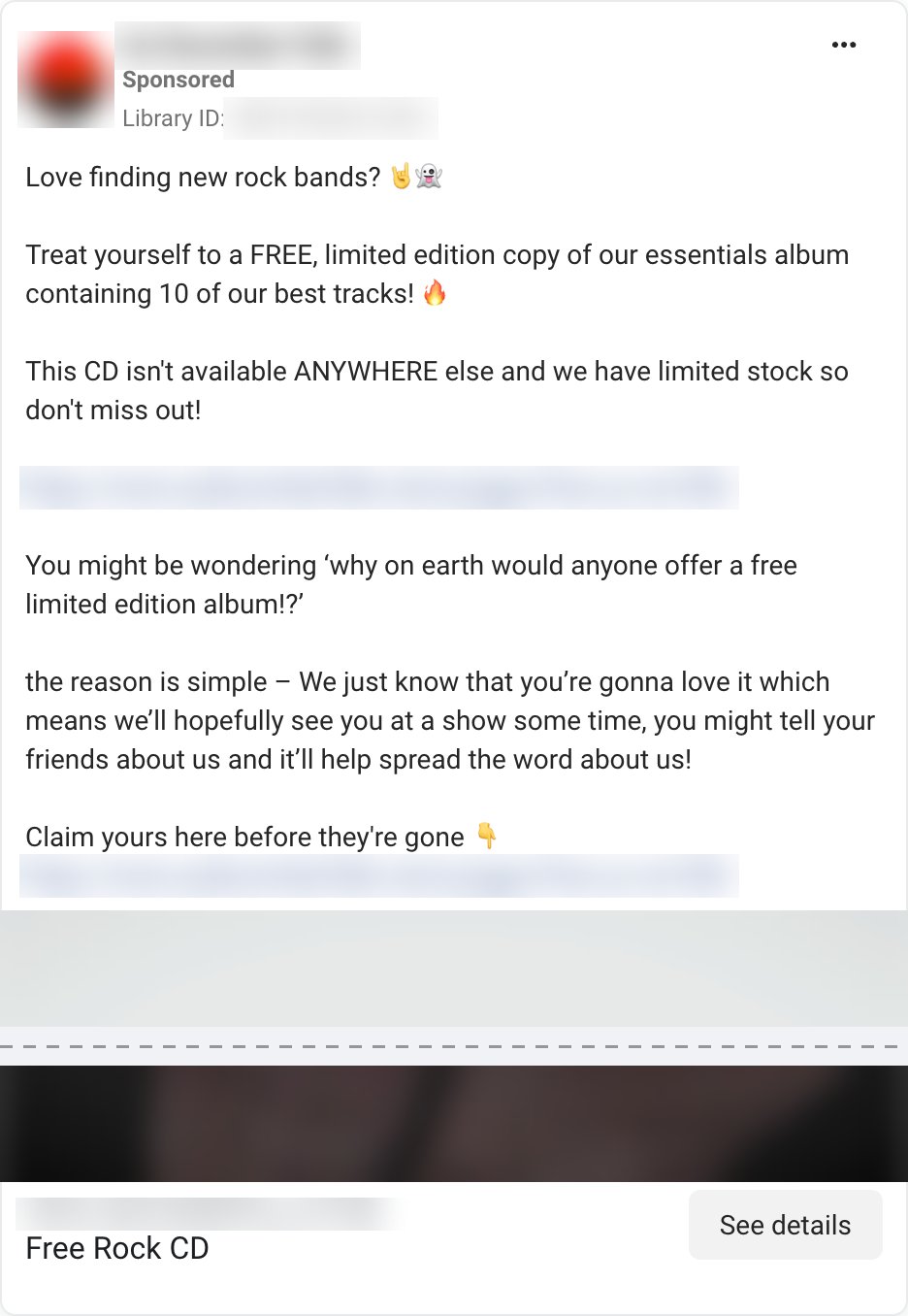
- The ad opens by asking. The reader now decides the answer.
- Check this line: does it answer the question, or move on and leave it open?
- Every open question above this button is a reason not to click.
- The answer comes late and is filler: we just know you will love it. A real reason belongs at the top, with no fake scarcity.
Screenshot of the public Meta Ad Library (US, active ads, exact phrase "you might be wondering"), taken 2026-10-16. Brand, links and video blurred; the middle of the video is cut out.
Type each question a stranger would have into your draft in red, answer it on the next line with an opener like "The reason...", tie it to something she already knows, then delete the question. A loud doubt your page itself creates gets named once in a skeptic's words and answered in the next line, and forms are the only place you ask the reader a question, with a true reason under each.
The Red-Question Edit: six steps for any draft
The Red-Question Edit is a six-step pass that answers every question a reader would ask, without printing it. It works on a page, an email or an ad.
Step 1: write down the one belief your offer rests on. What do you assume about your buyer? Example: "women over 30 have a harder time losing weight."
Under it, write one line on how your offer differs from what failed before. Most red questions are doubts about those two lines. So your answers keep pointing back to them.
Step 2: type each question in red. Read like a stranger. Wherever she would think "says who," type her question in red.
Step 3: answer it on the next line. Open with "The reason..." or "That's why..." so it reads as a reply. Not a speech.
Step 4: tie the answer to something she already knows. A bare claim gets checked against her memory. If her memory disagrees, the claim is dead.
Step 5: delete the red question. Read the line above and your answer together.
If they read as one thought, you are done.
Step 6: sweep your body copy. Use Find and replace in Google Docs to search it for question marks and "you might be wondering."
Every hit is a question you asked instead of answered. A question mark in body copy is homework you handed the reader.
An example draft with red questions typed between the lines
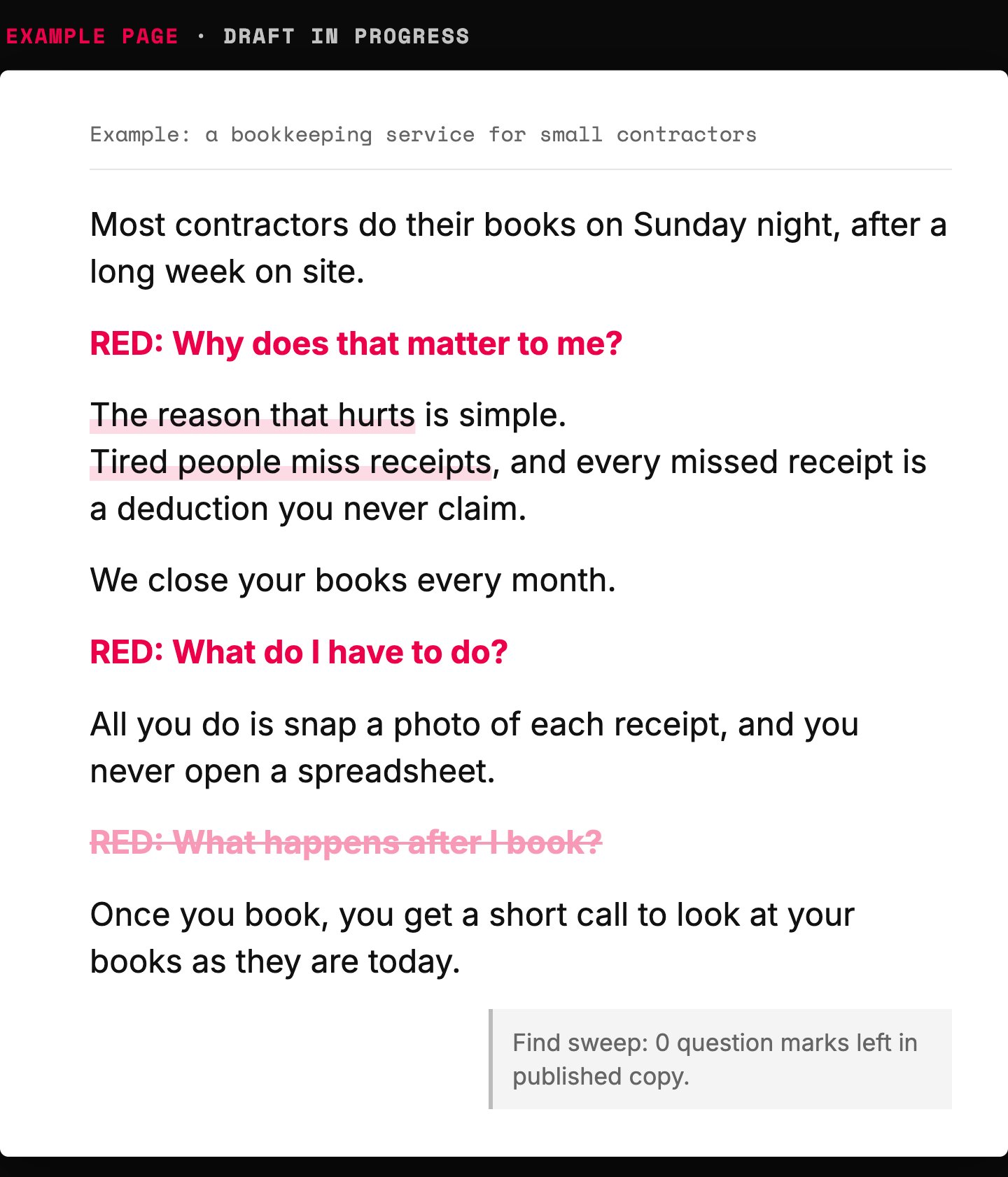
- Step 2: the stranger's question, typed in red where she would frown.
- Step 3: the answer opens with 'The reason', so it reads as a reply.
- Step 4: a truth she has already lived.
- Step 5: the question is deleted before the page goes live.
- Step 6: sweep for question marks and 'you might be wondering'.
Screenshot of an example page built by Anar, taken 2026-10-16. The business and copy are made up.
What are some examples of assumptive language?
Assumptive language reads like a reply to a question nobody had to ask. The first two rewrites come from a live edit of a sales page. The third, like every made-up example on this page, is ours.
Rewrite 1, the scale. Before: "You might be wondering why the scale won't move."
After: "And still, after all of it, the scale won't move. The reason it won't move is..." Same doubt, no script.
Rewrite 2, the promise. Red question: "What are you going to show me?" The answer, in one line: "Here is how to lose the weight that would not move, so you can finally trust the scale again, without another crash diet."
Then a second red question: "Do I have to count calories?" The fix was four words on the end: "and no calorie counting."
Rewrite 3, an email. A roofer emails past customers: "We offer free inspections this month." Red question: what's the catch?
After: "The inspection is free for a simple reason. Most roofs we climb only need a repair, and the ones that need more are the jobs we want to quote."
Free with no reason reads as a trap. Free with a reason reads as a deal.
Three rewrites, from draft to published copy
| Draft with the question | Published copy |
|---|---|
| "You might be wondering why the scale won't move." | "And still, after all of it, the scale won't move. The reason it won't move is..." |
| [RED: What are you going to show me?] [RED: Do I have to count calories?] | "Here is how to lose the weight that would not move, so you can finally trust the scale again, without another crash diet, and no calorie counting." |
| "We offer free inspections this month." [RED: What's the catch?] | "The inspection is free for a simple reason..." (example) |
Example copy edits.
Start each answer with an opener, then add a truth she has lived
An opener like "The reason..." tells her a reply is coming. So her mind waits for it. The table has eight.
The opener is half the job. The other half? A truth she already knows.
Her mind goes looking for evidence anyway. Make sure it finds proof from her own life.
For example, a good pitch to freelance writers does not ask if clients were easier to find two years ago. It tells them: back then any event got you paid work, and now you are one of 50 people applying for every job.
It does not ask them to remember. It tells them what they remember. Their memory agrees.
It works like letting a prospect reach the claim on her own.
Each opener answers a question nobody had to ask
| Start the answer with | The silent question it answers |
|---|---|
| The reason... | Why? |
| That's why... | So what? |
| And that's how... | How does it work? |
| Which brings us to... | What comes next? |
| The real question is... | What should I be asking? |
| What this means is... | What does that mean for me? |
| The only difference is... | How are you different? |
| All you have to do is... | How hard is this? |
Source: openers common in sales copy.
Tie a claim to her own life and her memory backs it up
| Claim alone | Claim plus a truth she has lived |
|---|---|
| She checks it against her memory. | She checks it against her memory. |
| Her memory may disagree. | Her memory agrees, because the proof is hers. |
| The claim is cancelled. | The claim holds. |
| "Clients are harder to find now." | "Two years ago any event got you paid work. Now you are one of 50 people applying for every job." |
Example: a pitch to freelance writers.
Forms are the only place you ask the reader a question, and each needs a reason
On a form, you have to ask. You need the answers. But when a stranger asks, it feels like he wants something from her.
Her first thought? What do you want from me.
The fix is one short line under each field that says why you ask. For example, one business saw booked calls rise about 30 percent after adding them. That is one example, not a measured result.
Big asks need real reasons. In a 1978 study by Langer, Blank and Chanowitz, a filler reason got people to let a stranger cut in line at a copy machine for a small favor.
For a big favor, it did nothing (the paper's own table). Small asks forgive filler. Big asks don't.
A phone number is a big ask. Baymard Institute found that a short reason next to a required phone field settles most shoppers' privacy worries. The UK government tells form writers to know why you are asking every question and only ask what you need.
Our take: a lot of forms ask for a phone number because sales wants it, not because she needs a call.
Our rule: small field, short reason. Big field, specific reason. Or no field.
The reason lines from our example form sit below. Adapt them.
One more question earns its spot, right after they book, when they care most: what outcome do you want from this call? Her answer tells you what to cover on the call and in each reminder. See setting expectations before the call and the reminders that get people to show up.
First name:   So the cleaner who calls you knows who they are talking to.
Phone number: We text the arrival window the day before. No sales calls.
Home size:    So the quote fits your home, not a guess.
After booking, ask: What outcome do you want from your first clean?
We plan the visit around your answer.A filler reason worked for a small ask and did nothing for a big one
Share who agreed to let a stranger use the copy machine first, by size of favor and reason given
- 5 pages, no reason 60
- 5 pages, filler reason 93
- 5 pages, real reason 94
- 20 pages, no reason 24
- 20 pages, filler reason 24
- 20 pages, real reason 42
Source: Langer, Blank and Chanowitz (1978), Journal of Personality and Social Psychology, Table 1.
Reason lines are cheap to add, and most sites still skip them
| What was found | Who says so | How sure |
|---|---|---|
| 39% of ecommerce sites require a phone number with no explanation | Baymard Institute benchmark | Measured |
| Booked calls up about 30% after explaining each question | One business (example) | Example, not verified |
Sources: Baymard Institute, Explain Why the Phone Field Is Required. Row 2: example from one business, not verified.
Every question on the form says why it is there
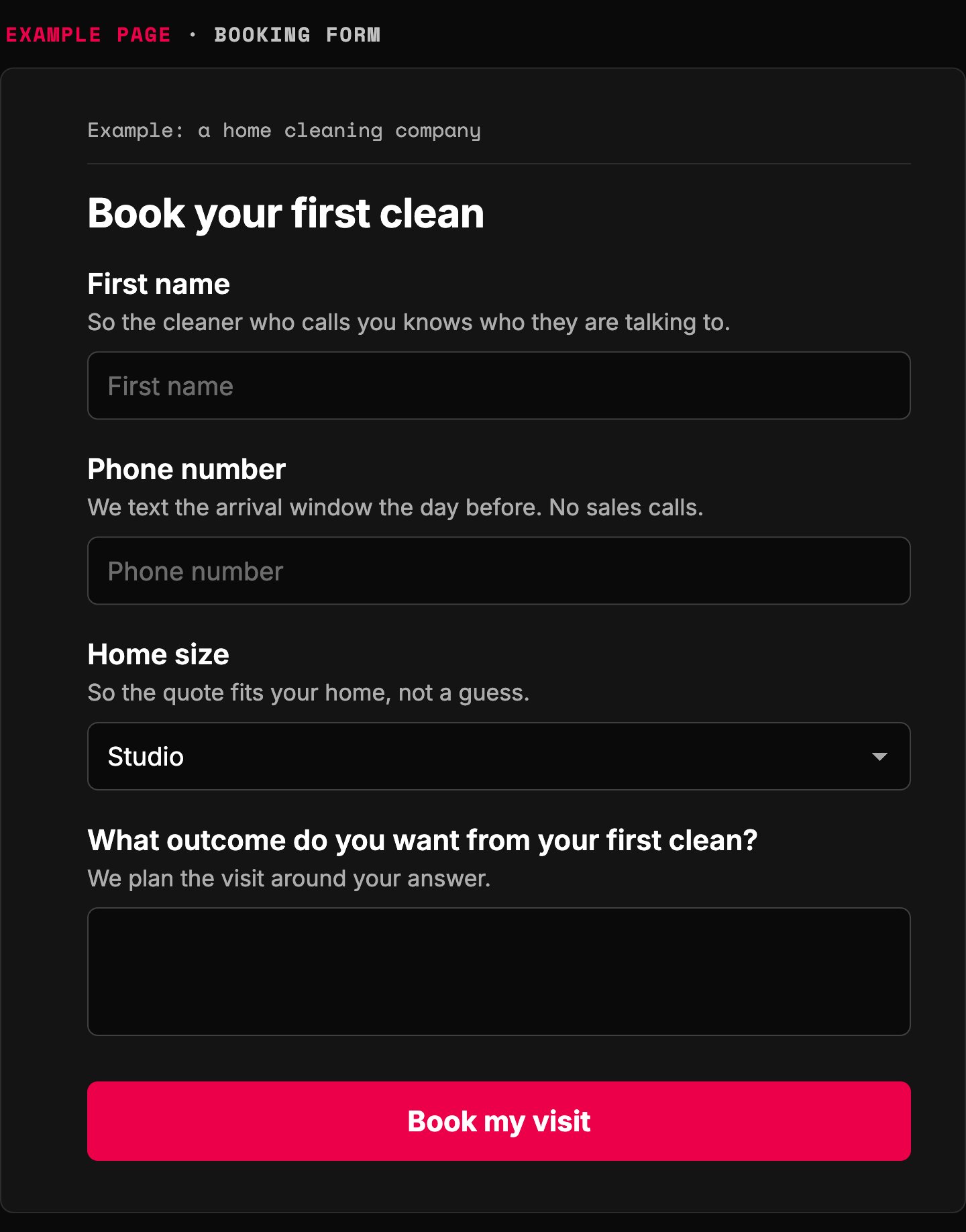
- Small field, short reason.
- Big ask, specific reason. A filler reason does little here.
- Right after they book, when they care most: what outcome do you want?
- Every question above it now says why it is there.
Screenshot of an example page built by Anar, taken 2026-10-16. The business and wording are made up.
Two ways the edit goes wrong, and the fix
People like the page but do not buy. The cause is a page that hides every objection.
Our take: most pages hide objections because the writer is scared of them. The reader is not fooled.
So remove the questions, never the objections. Name one real objection in her words. Answer it on the spot.
Sales stay flat, so you keep adding. One sales page converting around 1 percent had tried everything. Recordings of real visitors showed people scrolling straight past the offer.
Watch your own visitors with a free tool such as Microsoft Clarity. Note where they speed up. The stuck question usually sits right above that spot.
Remove or replace one line there. Do not add five more. More copy is not more answers.
Two problems, and the fix for each
| Symptom | Cause | Fix |
|---|---|---|
| "Sounds too good to be true" | Zero objections on the page | Keep one real objection, answered |
| Flat sales, so you keep adding | A stuck question above where readers speed up | Watch recordings, remove or replace one line |
Source: common sales-copy fixes.
Delete quiet doubts, and voice loud ones once
Answer quiet doubts without printing the question. A loud doubt your page itself creates gets named once in a skeptic's words, then answered in the next line.
And forms are the only place you ask the reader a question.
Quiet or loud? Ask one thing: did my own page cause this doubt, so every reader will notice it?
Yes means loud. No means quiet.
One video script said people with a winning formula never share it. Then it offered to build one for others. Loud doubt.
So the fix named it. A skeptic asks how this is different, and the writer explains.
A page that dodges its loudest doubt is not confident. It is hiding, and the reader damn well knows it.
If you cannot answer a loud doubt honestly, delete the line that caused it. More on that in what not to say in copy.
Delete quiet doubts, voice loud ones, ask only on forms
- Name it once, as a skeptic "Hold on, how is that different?" Then answer it in the next line.
- Ask on the form With a true reason under each question.
- Red-Question Edit Answer it with "The reason..." and delete the question.
- Ask on the form Right after they book: what outcome do you want from this call?
Anar's rule.
Pre-answer only what is true
A pre-answer is an answer to a question the reader has not asked yet. A true one shows respect. A false one is manipulation.
We do not publish filler reasons. We do not invent scarcity. We do not write answers built to stop a reader from thinking.
Fake scarcity is not urgency. It is a lie with a timer.
Never pre-answer with something that is not true for most of your customers. The FTC expects ad claims to be truthful and backed by evidence.
And never write a loaded question, one that assumes something the reader never accepted. "Why are you still losing customers?" Says who?
Meta's personal attributes policy rejects ad copy that asserts or implies things about the viewer, such as a health condition. So "Struggling with your weight?" can get an ad rejected before anyone reads it.
Fair pre-answers next to loaded questions to avoid
| Fair to pre-answer | Loaded, keep out |
|---|---|
| "Because most clients have small teams, setup takes an afternoon." | "Have you stopped wasting money on ads?" |
| "When you book, Sam calls within the hour." | "Why are you still losing customers?" |
Example.
Run it with AI
The prompt below runs the whole Red-Question Edit in your preferred AI. It asks for the belief your offer rests on, then your draft. You get back the edited copy and a list of facts only you can confirm.
It never makes up a reason or a number. Where it needs a fact, it writes [CONFIRM]. The truth stays your job.
This week, do three things. Run it on your main page and fill every [CONFIRM] with a true fact. Then run it on your booking form and use the reason lines it writes.
Then one email you send often. Check the result against the six questions every landing page has to answer, or have us run the pass as part of our conversion work.
Avis never asked customers why they should rent from number two. It just answered. Do the same, one red question at a time.
Paste into your preferred AI with your draft. It finds the silent questions, drafts answers, and flags every claim only you can confirm.
Act as a careful copy editor running the Red-Question Edit.

Ask me these one at a time. If I give you everything at once, skip the questions and start.
1. What belief does my offer rest on? (Example: "Women over 30 have a harder time losing weight.")
2. How is my offer different from what failed before? (Example: "Built for their bodies.")
3. The draft: a page, email, ad or form.

Then edit:
1. Read as a skeptical stranger. Wherever the reader would think "why?" or "says who?", write the question as [RED: ...].
2. Answer on the next line with an opener: "The reason...", "That's why...", "The only difference is...", "All you have to do is...".
3. Tie each answer to something the reader knows from their own life.
4. Delete the red question; the lines around it must read as one thought.
5. Cut questions asked out loud in body copy ("You might be wondering..."), but never the objections: keep each one, answered.
6. Answer quiet doubts without printing the question. A loud doubt the draft itself creates gets named once, as a skeptic would, then answered.
7. Forms are the only place to ask the reader a question. Under each, write a true reason: small field, short reason; big field (effort to answer or private, like phone, budget, call volume, health details), specific reason, or suggest cutting it.

Rules:
- Never invent a fact, number or reason. If an answer needs one, write [CONFIRM: what you need from me].
- No filler reasons, invented scarcity or loaded questions.
- Every answer must be true for most of my customers.

Output:
A. The edited draft, with every red question already deleted.
B. Every [CONFIRM] item, numbered.
C. If there is a form, each field with its reason line.
D. The 3 doubts most likely to still stop a reader.
Filip Kovacevic is the founder of Anar Agency in Phoenix. He spent five years running SEO, Meta ads, email, and content for medical practices across the United States, and now does the same work for healthcare, home-service, legal, and professional-service businesses, alongside AI implementation. More from Filip →
Talk it through in 15 minutes
Bring one question from this article. We will tell you what we would do, whether or not you hire us.
Book a 15-Min Chat →