Handling Objections in Copy: Find What the Buyer Is Afraid to Lose
Handling objections in copy starts with one question: what does the buyer lose if they pay? Price and time are what they give up. The real objection is the loss behind them that they cannot get back, like their safety cushion or their evenings.
Answer that loss on the page. Show it is not lost, or replace it.
Handling objections in copy: find what the buyer is afraid to lose
A buyer reads your whole page. They like the results. They scroll to the price, sit still for a second, and close the tab.
Ask them why and you get two words. Too expensive.
That answer is honest. It is also useless. The price is what they would give up, and the real objection is what they think they would lose.
Handling objections in copy usually means a FAQ full of rebuttals at the bottom of the page.
The price gets a payment plan. The time gets lifetime access.
Those answers aim at the wrong thing. Nobody is scared of the $297 itself. They are scared of what that $297 was going to cover.
So we use one question to find the real objection, and two ways to answer it. The rest of this guide is how.
A rebuttal FAQ answers the price; the Give-Up Chain answers the fear
| Rebuttal FAQ | Give-Up Chain |
|---|---|
| Starts from what buyers say | Starts from what buyers would lose |
| Answers the price and the time | Answers the loss behind them |
| Sits at the bottom of the page | Sits in the promise line at the top |
| One answer for every buyer | An answer for each buyer's real loss |
Our comparison.
Action is desire minus objections, and both sides count
Here is the formula we work from. Action equals desire minus objections.
Desire is how much they want the result. Objections are everything that holds them back. When objections outweigh desire, nothing happens.
Which side should you work on? Both.
If the buyer does not want the result, removing objections does nothing. So you still have to show the gap first, which we cover in desire is a gap.
But most pages stop there. They pile on benefits and never touch the objections.
Look at a normal sales page. For example, if 3 in 100 visitors buy, 97 leave.
Most copywriters chase the 3. They tweak a headline, move from 3 buyers to 3.3, and call it a win.
The bigger prize is the 97. What do the people who leave have in common? Usually the same loss nobody answered.
The best offer is the one with no objections left. You will never get to zero. You can get a lot closer.
Example: when 3 in 100 buy, the lesson is in the 97 who left
Visitors to one sales page, out of 100
- Bought 3
- Left 97
Example to show the method. Not data, and not a benchmark.
Example: a headline tweak adds 0.3 buyers per 100; the 97 who leave matter more
Buyers per 100 visitors before and after a headline tweak, against everyone who still left
- Before the tweak 3
- After the tweak 3.3
- Still left 96.7
Example to show the method. Not data, and not a benchmark.
The Give-Up Chain finds the real objection behind "too expensive" or "no time". Ask what the buyer gives up, then what they lose because of it, then whether they believe they can replace it. A loss they cannot replace is fear, and fear is the objection.
Answer each loss by showing it is not really lost or by replacing it with something better, and put the answer to the biggest loss in the promise line, not the FAQ.
The real objection is what buyers lose, not what they give up
Every purchase asks for something. Money, time, energy, or the chance to use them somewhere else.
Economists call that last one the opportunity cost. It is the next best thing you could have done with the money or the hour.
That is the give-up layer. It is logical, and buyers can say it out loud. It is also where most copy stops.
Under it sits a second layer. If they give up the money, what do they lose?
Maybe the cushion for a bad month. Maybe the trip. Maybe the feeling of being the careful one in the family.
That layer is a gut feeling. Buyers rarely put it into words. Psychologists describe two kinds of thinking: one slow and deliberate, one fast and automatic.
The give-up layer is the slow one. The lose layer is the fast one. The fast one often wins.
Losses also hit harder than gains. In the research on loss aversion, people treat a loss as if it were about twice the size of an equal gain.
And people value what they already have more than what they could get. That is the endowment effect. Your price takes something they have and offers something they do not have yet.
The loss sits in the future. It is what they will not have next month. That is why buyers rarely name it, and why the FAQ never answers it.
The price is what they hand over; the objection is what it costs them later
| What they give up | What they lose |
|---|---|
| $297 | The cushion for a bad month |
| 20 minutes a day | Time with the kids before bed |
| A weekend at a workshop | The one weekend they rest |
| Switching from what they use now | Being the one who picked right last time |
Examples written to show the two layers. Our wording.
Three findings explain why the loss outweighs the price
| Finding | What it says | What it means for your page |
|---|---|---|
| Loss aversion | A loss feels about twice as big as an equal gain | Answer the loss before adding benefits |
| Endowment effect | People value what they own more than what they could get | Your price takes something real; show what comes back |
| Two kinds of thinking | A slow, deliberate mind and a fast, automatic one | The price is argued slowly; the loss is felt fast |
Sources: Wikipedia, Loss aversion; Endowment effect; Dual process theory.
The Give-Up Chain: give up X, lose Y, cannot replace Y
The Give-Up Chain is our name for one sentence you can run on any objection. If they give up X, they lose Y, and they believe they cannot replace Y.
The last part is the trigger. A loss you can get back is a cost. A loss you cannot get back turns into fear.
Picture two coaches looking at the same $3,000 program. One has 30 people on a waiting list. The other has two clients and rent due.
Same price. Different fear.
The first can lose a month of income and win it back in a week. The second cannot. So the second one says too expensive.
Push any loss far enough and it ends in the same place: fewer choices. Less money means fewer options. Less time means fewer evenings that belong to them.
Listen for "I can't" too. It almost always means one of two things. They lack the skill, or they do not want the trade.
A missing skill is something your product may fix. Not wanting the trade means there is a loss you have not found yet.
The objection is the top step; fix the step under it
- Give up Money, time, energy, other options.
- Lose What that costs them later.
- Cannot replace They see no way to get it back.
- Fear The gut feeling at the price.
- Objection "Too expensive." "No time."
The Give-Up Chain, as set out in this guide.
Fear lives where the loss is big and the buyer sees no way back
- A cost Show the way back in one line.
- The real objection Answer it first, in the promise line.
- Barely matters Leave it out.
- A small worry Replace it with one bonus.
Our method.
How do you find what your buyer loses?
Start with how they spend their day. What people give their time to is what they care about.
Then count what limits them. A job, a commute, young kids, a fixed income. Each one shrinks what they can spare.
Each limit also tells you what a purchase could take away. A parent with a long commute does not have a spare hour. They have a spare twenty minutes, maybe.
Next, find what they can least afford to spend. When money is tight, it is money. For high earners it is usually time.
For people with plenty of both, it is the other things they could be doing. They cannot be in two rooms at once.
Then ask people who already made the change. What did it cost you to get here? Their answers are your list of likely losses.
Last, study the people who left. A scroll map shows where readers stop on your page. The loss you have not answered usually sits right above that line.
One warning. Describe a person, not an activity.
"They code" tells you nothing about what they would lose. "They code at night after a full shift, on a tight budget" tells you a lot.
Five places to find the loss in one afternoon
- 1. Their day What they give time to is what they care about.
- 2. Their limits Job, commute, kids, fixed income. Each one shrinks what they can spare.
- 3. The heavy resource Money, time or other options. Pick the one that weighs most.
- 4. People who changed Ask what they had to give up to get there.
- 5. People who left Check where the scroll map stops.
Our method.
What buyers can least spare depends on their situation
| Buyer situation | Heaviest resource | Loss to look for | Answer that fits |
|---|---|---|---|
| Tight budget, fixed income | Money | Bills, the safety cushion | A small first step and payback math |
| Busy professional, good income | Time | Evenings, family, rest | A small daily step, done-for-you parts |
| Owner with money and staff | Other opportunities | Being needed in two places | Proof it runs without them |
Our method. Starting points to test, not rules.
Answer every loss one of two ways: negate it or replace it
Once you know the loss, you have two moves. Show it is not really lost. Or replace it with something better.
Negate it. Make the loss smaller, or make it disappear. A course that needs an hour a day feels like losing your evenings.
Make the daily step small and true, like about five minutes a day. Then there is not much left to lose.
For example, one business described its program as about five minutes a day. Sales of its add-on offer rose about 50 percent. That is their result, not ours, and it only works if five minutes is the truth.
You can also fold the time into what they already do. Practice in the car, or while you cook.
Now it adds nothing to the day.
Replace it. Hand back what they lose.
Losing hours to set-up? Give them the templates as a bonus.
That is what a bonus is for. Not a pile of extras. One bonus per loss.
Money works the same way. Ask what one new client is worth to them, then show the math with their number.
If a client is worth $7,500 to them and the price is $5,000, one client covers it. Now the money is not gone. It comes back.
Just never promise them the client. The math is theirs, and any result you claim has to be real.
One move to skip. "The average person watches hours of TV a day, so you have time." It tells the reader they are average, and nobody likes hearing that.
Every loss gets one of two answers: negate it or replace it
| What they lose | Negate it | Replace it |
|---|---|---|
| Evenings | About five minutes a day, if true | Templates so set-up takes no time |
| Daily time | Fits into the drive or the cooking | A done-for-you first week |
| The safety cushion | Payback math with their own numbers | A smaller first step |
| Rest on the weekend | No live sessions to attend | Recordings they watch any time |
Examples written to show the method. Our wording.
Example: when one client is worth $7,500, a $5,000 price comes back
Price against the value of one client, using the buyer's own number
- Price 5000
- One client 7500
Worked example with example numbers. Use the buyer's own client value, and never promise them the client.
Example: a small, true time claim lifted sales of one add-on offer
| The case | What changed | What happened | How sure |
|---|---|---|---|
| A program whose video made it look like a lot of work | Anchored as about five minutes a day | Upsell up about 50 percent | Example from another business; we have not seen the data |
Example from another business. Not our result, and not verified by us.
Where should objection answers go in your copy? In the promise, not the FAQ
Answer the biggest loss at the top of the page. Attention drops as people scroll.
Eye-tracking research from Nielsen Norman Group found readers read across the top first, then scan down the left side. Its advice: put the most important points in the first two paragraphs.
So the biggest loss gets answered in the promise line. Use this shape: if you do X, you get Y, without losing Z.
For example: "Speak Spanish with your kids in 20 minutes a day, without giving up your evenings." The without part is the objection answer.
Then turn the next losses into bullets. One bullet per loss, in the order buyers feel them.
Do the same on the button. "Get the first lesson" gives something. "Buy now" takes something.
Which one would you rather click?
If you are not sure which questions your page must answer first, read the unasked questions every landing page has to answer. For the words that open the page, see before-words and after-words.
Answer the biggest loss in the promise line, not the FAQ
| Answer in the FAQ | Answer in the promise |
|---|---|
| "Is it a big time commitment?" at the bottom | "20 minutes a day, without giving up your evenings" at the top |
| Read by the few who scroll that far | Read by everyone who reads the first lines |
| Defends the price | Removes the loss before the price shows up |
| "Buy now" on the button | "Get the first lesson" on the button |
Example lines written for this guide.
Each loss gets its answer where the reader actually reads
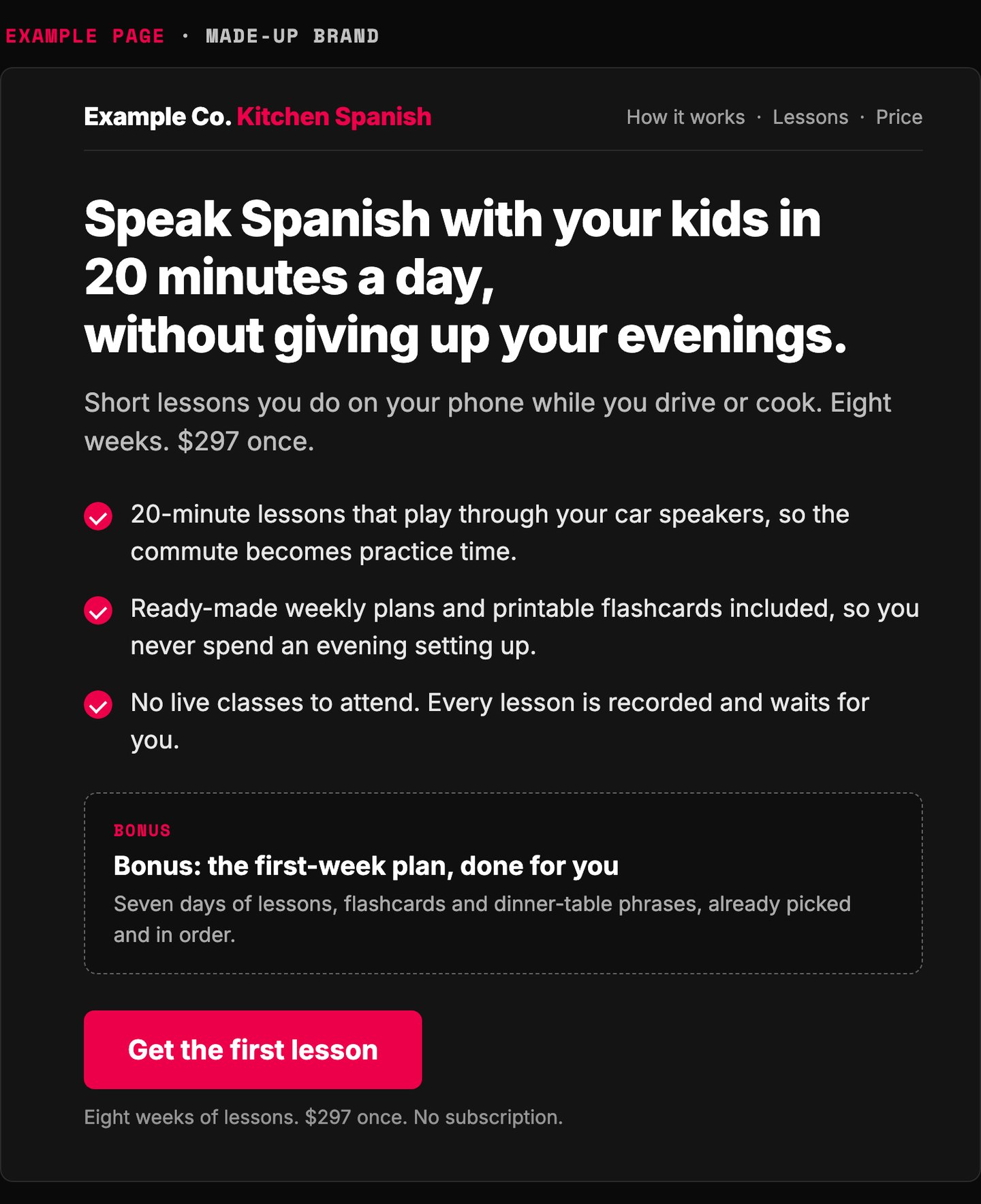
- The biggest loss, answered in the promise line, not the FAQ.
- A small, true daily step. Only write the number if it is true.
- Negate the loss: the time folds into the drive, so it adds nothing to the day.
- Replace the loss: one bonus that hands set-up time back.
- The button gives something instead of taking something.
Example page built for this article with a made-up brand. All page text and the price are invented.
People read the top lines and scan the rest, so answer the biggest loss up top
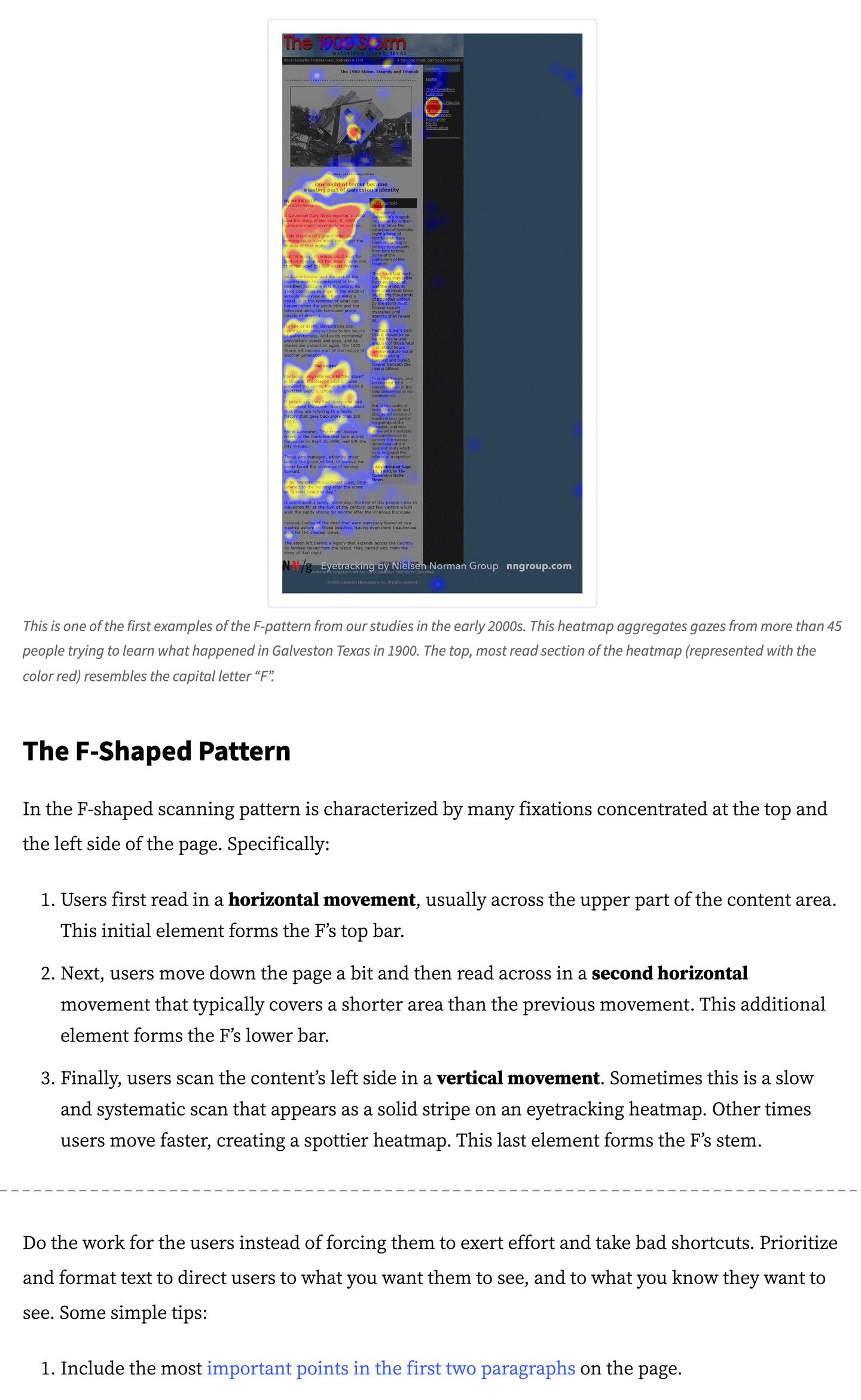
- Red means the most eye time. It sits across the top lines.
- The first lines get read. This is where the biggest loss gets answered.
- Lower down, people scan. A FAQ at the bottom gets skimmed at best.
- Their advice matches ours: the objection answer goes in the promise line.
Screenshot of Nielsen Norman Group, F-Shaped Pattern of Reading on the Web, taken 2026-10-17. Two parts of the page joined at the dashed line.
Should you use the cost of inaction in copy?
We don't. "What happens if you do nothing?" pokes at the loss without removing it.
People are where they are for a reason. Researchers call the pull toward the current state status quo bias.
Often there is a hidden payoff too. Psychology has a name for a benefit someone gets from a problem: secondary gain.
Someone who never sings in public never gets judged on a stage. That is a payoff. Threaten it and they defend it.
Research on fear appeals describes the same reflex. When a scary message gives people no clear way to act, they often deny the threat or attack the message.
And push on someone's choice and they push back. That reaction is called reactance.
Worst of all, they connect the bad feeling to you. So find the payoff and replace it instead.
It is harder. It works better.
How to lose a ready buyer in four easy steps:
1. Answer the price. Never the loss.
2. Tell them what doing nothing will cost them. Twice, in bold.
3. Compare them to the average person.
4. Put the real answer at the very bottom of the FAQ. Then wonder why the hell nobody buys.
Some losses are about pride. Buying can mean admitting something hurts. We cover that in why buyers avoid admitting the problem.
Threatening the payoff makes buyers defend it; replacing it lets them move
| Cost-of-inaction copy | Replace the payoff |
|---|---|
| "What if you do nothing for another year?" | Find what staying put gives them |
| Pokes at the loss | Removes the loss |
| Pushes on their choice | Leaves the choice with them |
| They link the bad feeling to you | They link the relief to you |
Our stance. Background: Wikipedia, Status quo bias; Fear appeal; Reactance (psychology).
Where people get stuck with objection handling
Three stuck points show up again and again. Each has a symptom, a cause and a fix.
Your FAQ answers the price, and people still leave. You answered the give-up, not the loss. Ask the second question and put the answer in the promise line.
You cannot guess the loss. You describe the buyer by an activity. Describe their day, their limits and their money instead.
The answer sounds too good to be true. You promised five minutes a day for a program that takes forty. Write only what is true and show the proof.
A false time claim is still a false claim. It also comes back as a refund.
If the loss is "what if it does not work for me", that is a guarantee problem. Read risk reversal built on what buyers fear losing.
If the loss is belief in themselves, start with the three beliefs that stop a buyer. And if you want to design the next offer around the no, read what they say no to.
Three stuck points, and the fix for each
| Symptom | Cause | Fix |
|---|---|---|
| The FAQ answers price and people still leave | You answered the give-up, not the loss | Ask what they lose; answer it in the promise |
| You cannot guess the loss | You describe an activity, not a person | Describe their day, limits and money |
| The answer sounds too good | It is not true | Write only what is true; show proof |
Our method.
Find the hidden loss with AI: the copy-paste prompt
Paste the prompt below into your preferred AI. It asks four questions, then builds the objection table and a promise line.
It uses only facts you give it. Anything that needs proof gets marked, so you know what to check before it goes live.
This week, step 1: collect the exact words people use when they say no. Lost deals, replies, comments.
Step 2: run the prompt on your top two objections. Read the losses out loud and ask a buyer if they ring true.
Step 3: rewrite your promise line with the without part. Then watch where the scroll map stops.
Want a second set of eyes on the page? Send it to us.
Remember the buyer who closed the tab? They said too expensive. They meant something else.
Price is what they say. Loss is why they leave.
Paste into your preferred AI. It asks four questions, then builds an objection table, a promise line and three bullets.
Act as a direct-response copy editor. Use the Give-Up Chain to find the real objection behind "too expensive" or "no time", then write the lines that answer it.

Ask me one at a time, with the example:
1. What do you sell, at what price, and how much time does it take the buyer? (Example: an online Spanish course, $297, 20 minutes a day for 8 weeks)
2. Who buys it? Describe their day, their limits and their money, not just their job. (Example: working parents, kids under 10, drive to work)
3. What do people say when they do not buy? (Example: "too expensive", "no time right now")
4. What is true about your results and your time demand that you can show? (Example: most students do lessons on their phone in the car)

For every objection, work the chain:
- Give up: what the buyer hands over (money, time, energy, other options).
- Lose: what that costs them later. Example: money -> the cushion for a bad month; evenings -> time with the kids.
- Replace: do they believe they can get it back? If not, that loss is the real objection.
- Answer it one of two ways: show the loss is not real (a smaller true step, fits into what they already do) or replace it with something better (a bonus that hands the time back, payback math with the buyer's own numbers).

Rules:
- Use only facts from my answers. Never invent a result, a number or a testimonial. Mark any line that needs proof I did not give as "needs proof".
- No cost-of-inaction threats, no fake deadlines, no "the average person watches X hours of TV".
- Describe the situation, never the buyer's flaws.
- Never promise the buyer a result. Payback math uses their numbers and says so.

Output:
Objection table: objection / give up / lose / can they replace it / answer type
Promise line: "If you ___, you get ___, without losing ___."
Three bullets, one per top loss
One button line that gives something
Lines that need proof
Next three actions: 1. 2. 3.

Filip Kovacevic is the founder of Anar Agency in Phoenix. He spent five years running SEO, Meta ads, email, and content for medical practices across the United States, and now does the same work for healthcare, home-service, legal, and professional-service businesses, alongside AI implementation. More from Filip →
Talk it through in 15 minutes
Bring one question from this article. We will tell you what we would do, whether or not you hire us.
Book a 15-Min Chat →