Email Nurture Sequence: Eight Emails, Written Out, and What Comes After
An email nurture sequence is a short series of emails sent to a new lead, each with one job. Ours has eight over about two weeks. Five give something useful and ask for nothing.
Three ask for one offer. After that, send one or two emails a week, and fix the weakest email once a month.
What is an email nurture sequence? Six small signs in a row
In 1926, a shaving cream company put six small signs in a row beside a Minnesota highway.
Each sign held one line of a short rhyme. The last sign held the brand name. Drivers read them one at a time.
The signs spread across most of the country and stayed up until 1963. At its peak, the brand was the second-best-selling brushless shaving cream in the US.
One big billboard could have held every word. But it would not have worked as well. The signs worked because drivers read them one by one, in a row.
An email nurture sequence works the same way. It is a short row of emails sent to a new lead, one at a time, each with one job.
Ours is eight emails over about two weeks. Five of them ask for nothing. Then the lead gets a steady weekly email, and once a month we fix the weakest email in the row.

A row of small messages does what one big message cannot
| One welcome email | An eight-email row |
|---|---|
| Does one job: the receipt | Does four jobs, one email at a time |
| Shows up once, then silence | Shows up every two days for two weeks |
| Asks or says nothing | Gives five times, then asks for one offer |
| Ends the conversation | Hands the lead to a weekly email |
Our comparison. The row is the Lead-First Sequence set out in this guide.
Why one welcome email is not enough
A new lead just told you two things. They have a problem. And they are thinking about it today.
Most businesses answer with a receipt. Here is your download, thanks. Then silence, or a sales call out of nowhere.
A receipt, then silence, then a pitch is not nurture. It feels like a stranger asking for money.
A new lead needs four things before they buy. They need to know who you are. They need to trust that you know the subject.
They need to see someone like them win. And they need an answer to the doubt that stops them.
That is four jobs, and one email cannot do all four.
Speed matters too. In a Harvard Business Review study of online leads, companies that answered within an hour were nearly seven times as likely to qualify the lead as companies that waited longer.
A lead's interest fades fast. So the row starts right away and runs close together for two weeks.
Marketers call a timed row of messages drip marketing. People read a little at a time. They delete a flood.
Four jobs stand between a new lead and a sale, in this order
- Know who you are Two lines in the welcome email.
- Trust that you know the subject One useful idea they can use today.
- See someone like them win One customer story, before and after.
- Get past the doubt The belief in the way, then the top objection, answered.
Our model. Each job maps to one or more emails in the row.
The Lead-First Sequence is eight emails to a new lead over about two weeks, each with one job: welcome right away, one useful idea on day 2, a customer story on day 4, the belief in the way on day 6, a useful email with one line about the offer on day 8, the offer on day 10, the top objection told by a real customer on day 12, and a short last note on day 13. Five give and ask for nothing; three ask for the same offer with one button. After the row, send one or two emails a week.
Once a month, read clicks, replies and unsubscribes for each email and fix only the weakest. To wake a cold list, thank people first, get replies, then sell the click to a separate short page.
The eight emails in an email nurture sequence, in order
Here is the row we start from. Each line gives the day it goes out and its one job.
Email 1, right away: the welcome. Deliver what they asked for, say who you are in two lines, and say what arrives over the next two weeks.
Email 2, day 2: one useful idea they can use today. It also shows how you see the problem.
Email 3, day 4: a customer story. Tell about one customer like them, where they started and what changed.
Email 4, day 6: the belief in the way. Name what most people in their spot assume, then show why it is wrong.
Email 5, day 8: useful again. Give another idea, plus one line that mentions your offer. No link yet.
Email 6, day 10: the offer. Say what it is, who it is for and how to start, with one button.
Email 7, day 12: the objection. A real customer who felt the same way answers the top reason people say no. Same button.
Email 8, day 13: the last note, three or four lines. The offer is open, here is the link, and the weekly email keeps coming either way.
Count the asks. Emails 1 to 5 give. Emails 6 to 8 ask, and all three ask for the same thing.
One offer. One button. That is the whole ask.
Give, give, give, then ask. Don't ask, ask, ask, then wonder why nobody opens.
The giving half is its own skill. We cover it in lead-first nurture. A lead who asked for a quote needs a faster row, covered in email as the profit center.
Eight emails in 13 days: five give, then three ask for one offer
- 1. Welcome Right away Deliver what they asked for. Who you are, what comes next.
- 2. One useful idea Day 2 Something they can use today.
- 3. A customer story Day 4 Someone like them, before and after.
- 4. The belief in the way Day 6 What they assume, and why it is wrong.
- 5. Useful again Day 8 One line mentions the offer. No link.
- 6. The offer Day 10 One offer, one button.
- 7. The objection Day 12 A real customer answers it. Same button.
- 8. Last note Day 13 Three or four lines. The weekly email follows.
Our default spacing. Test it; a quote request needs a faster row.
Five of the eight emails ask for nothing
- emails in the row 8
- give and ask for nothing 5
- offer, with one button 1
- days from first email to last 13
The Lead-First Sequence as set out in this guide.
Email 1 delivers, introduces and previews. One link, nothing to buy
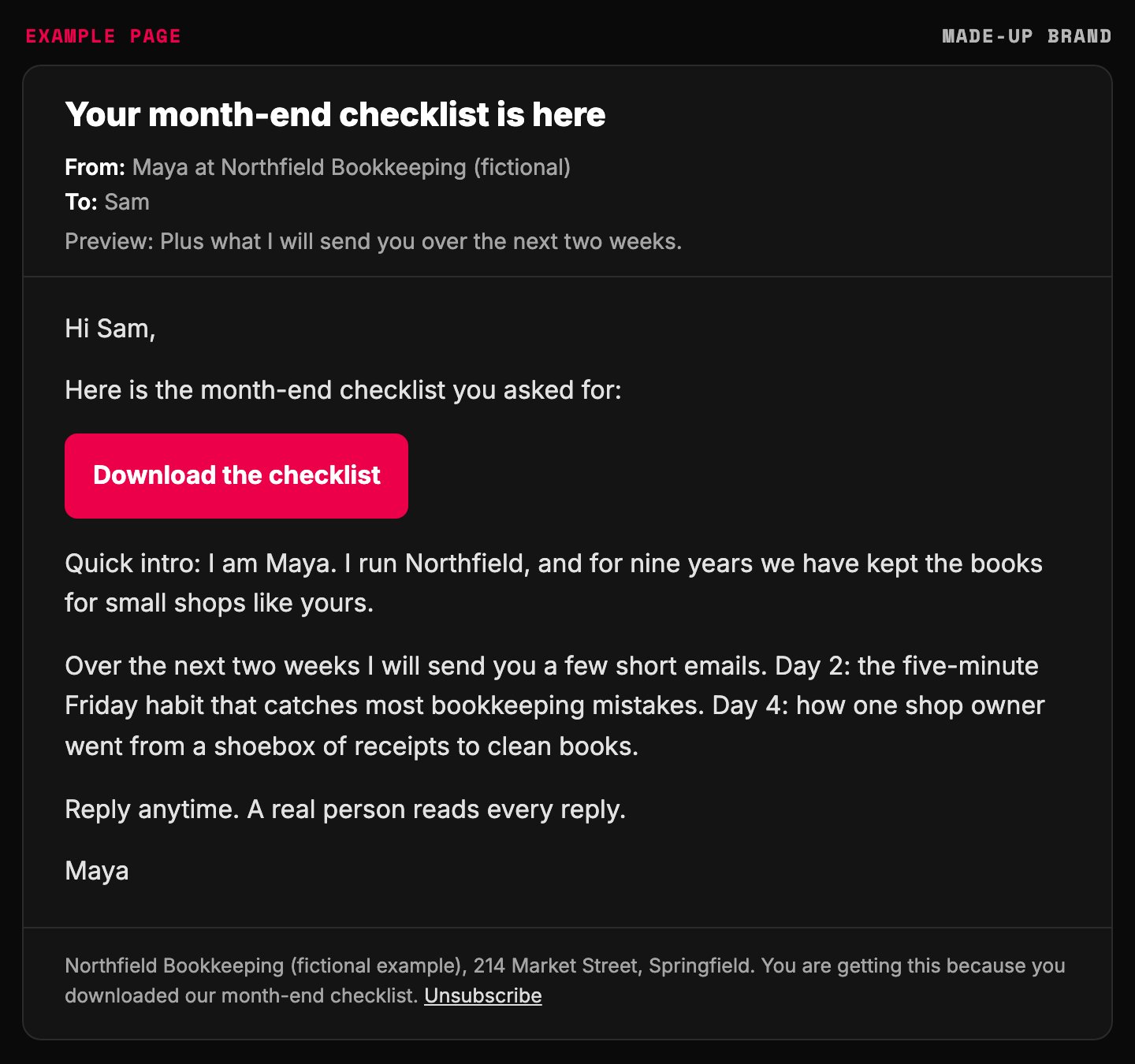
- Says exactly what they asked for. No clever hook needed.
- Deliver the thing first. The only link in this email.
- Who you are, in two lines.
- Tell them what is coming, so the next email is expected.
- Postal address and a clear unsubscribe link in every email.
Example page built for this article with a made-up brand
Write every email with one job, one story and one next step
The sequences people read to the end look plain. No fancy design. No five-topic roundups.
One job. If you cannot say what an email is for in one sentence, it is really two emails.
A subject line a person would write. "The quote nobody followed up on" gets opened. "Newsletter #3: Five Tips" gets ignored.
Open on the reader. The first line is about their situation. Your company comes later, if at all.
One story. A real customer, with the detail that makes it believable. Ask permission or change the name.
One next step, or none. A link, a question to reply to, or just a sign-off. If you ask for two things, you usually get neither.
Point to the next email. End with one line about what comes next, like "Thursday: the step most people skip."
Does that preview line work because people remember unfinished things? Probably not. The famous Zeigarnik effect says we remember interrupted tasks better, but a large review found no such memory boost.
The same review did find that people tend to go back and finish what got interrupted. That is the preview line's real job. It gives them a reason to open Thursday's email.
Stuck on how to start each one? Use the six openings.
Each email gets one job, one story and one next step
| Part | The rule | It breaks when |
|---|---|---|
| Job | One. You can say it in a sentence. | The email teaches, sells and announces at once |
| Subject line | Written the way a person writes | It reads like a newsletter issue number |
| First line | About the reader's situation | It opens on your company |
| Story | One real customer, with detail | Three thin examples crowd each other out |
| Next step | One link, one question, or none | Two buttons split the click |
| Last line | Points to the next email | The email just stops |
Our writing rules for the Lead-First Sequence.
A subject line a person would write gets opened
| Reads like a newsletter | Reads like a person |
|---|---|
| Newsletter #3: Five Tips | The quote nobody followed up on |
| Our Spring Update | What changed for you this month |
| Special Offer Inside | Meet Dana. She was sure she had no time for this. |
Our examples, written for this guide.
How do you answer objections in a nurture email? Let a real customer say it
Answer the top objection with a real customer who had the same doubt and bought anyway. That is the job of email 7, the hardest one in the row.
Start with the real reason people say no. If you take sales calls, you already hear it. Write down the three or four doubts that come up most.
Then find a customer who had the biggest one, and put their first name in the subject line.
For example: "Meet Dana. She was sure she had no time for this."
The body tells her story in three parts: what she worried about, what made her try, and what happened next.
Why a customer and not you? Because you get paid to say it works. Dana does not.
Two rules keep it honest. Ask the customer first, and use their real words.
The FTC's endorsement guidance says a testimonial must reflect the customer's honest opinion. If their result beats what most customers get, say what most customers get.
No real story yet? Answer the doubt yourself, plainly, and go collect the story this month. Never invent Dana.
To find the fear behind a no, read handling objections in copy.
Build the objection email from one real customer in four moves
- 1. Name the top doubt The reason that comes up most on sales calls or in replies.
- 2. Find the customer who had it Someone who felt the same and bought anyway.
- 3. Ask first Get permission. Use their real words.
- 4. Tell it in three beats The worry, what made them try, what happened. Then the same button.
Our method for email 7. Testimonials follow FTC endorsement guidance.
What happens after email 8? One or two emails a week
After email 8, send one or two emails a week. The row ends. The relationship should not.
Keep giving. Now and then, add one line for the people who were not ready the first time: here is how to start when you are.
Many businesses save everything for one big sales email every three months. That leaves a long, silent gap.
A lead who joins in the first week of a quarter can wait about 13 weeks for the next email. By then they have forgotten your name.
Familiarity grows with repeat contact, a pattern called the mere-exposure effect. Silence undoes it.
Make the weekly emails timely. Tie them to what your buyer already watches in the news: tax season, a market drop, a new rule.
This works best for buyers who want certainty, like finance clients. When the world feels shaky, an email that explains what the news means for them gets read.
Write it the way a person talks. Explain the news. Do not scare people.
How often can you sell without wearing people out? See how often to sell to your audience.
Planning promos for the year? Use the promotion calendar.
Example: one email every three months can leave a lead waiting 13 weeks
Longest wait between emails for a lead who joins right after a send, by schedule
- One email every 3 months 91
- One email a week 7
- Two emails a week 3.5
Worked example: 13 weeks x 7 days = 91. The math is ours.
The mailbox rules every sequence lives inside, from Google's own page
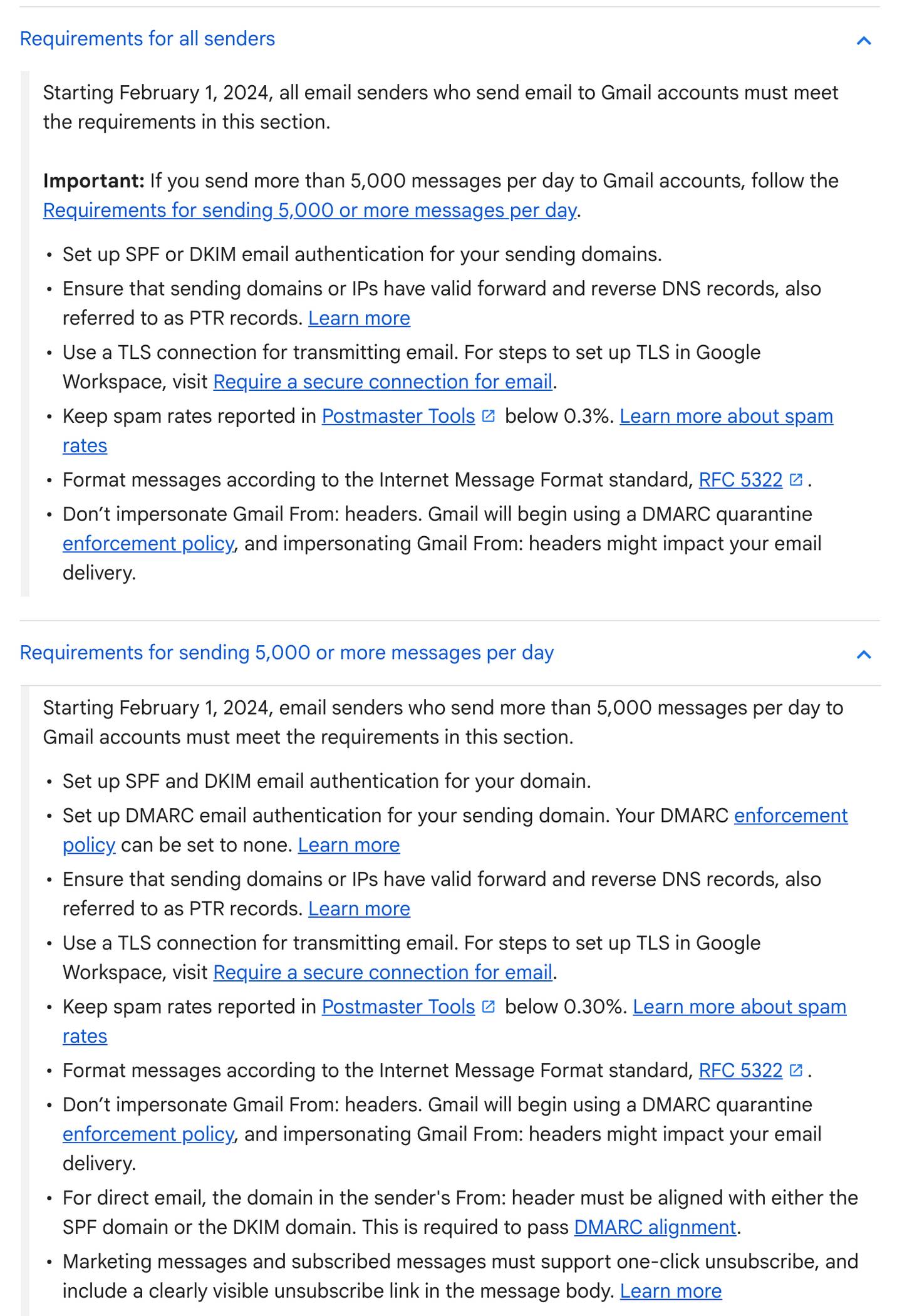
- These apply to every sender, even a list of 50.
- The spam limit. An email that annoys people pushes the whole row toward spam.
- Bigger senders get stricter rules.
- One-click unsubscribe plus a visible link in the body.
Screenshot of Google's Email sender guidelines help page, taken 2026-10-17
Audit the sequence once a month, one email at a time
Once a month, open your email report and read it one email at a time. Put it on the calendar as a habit, not a project.
Lots of leads coming through? Check every two weeks, or every week.
For each email, read three numbers: clicks, replies and unsubscribes. Then find the one email doing worst.
Fix that one. Only that one. Then wait for next month's numbers.
Why not opens? Because they are no longer reliable. Apple's Mail Privacy Protection stops senders from seeing whether a reader opened an email.
So trust the numbers that need a reader to act: clicks, replies and unsubscribes. A spike in unsubscribes at one email means that email is the problem.
An open count is a guess. A reply comes from a real person.
The mailbox rules matter too. Gmail and Yahoo both set spam limits and unsubscribe rules, listed in the box below. Break them and your row lands in spam.
Under US law, every marketing email needs a working opt-out and a valid postal address, per the FTC's CAN-SPAM guide.
The pre-call version of this audit, for booked calls, lives in pre-call sequences that get people to show up.
Fix one email a month and the whole row gets better
- Pull the numbers Clicks, replies, unsubscribes, per email.
- Find the weakest The one email doing worst.
- Rewrite that one Only that one.
- Wait a month Then read the numbers again.
Our audit routine. Check every week or two at high volume.
Clicks, replies and unsubscribes beat opens
| Number | What it tells you | Act when |
|---|---|---|
| Clicks | The email made someone want the next step | One email clicks far below the rest |
| Replies | A person read it and cared | Replies stop on an email that used to get them |
| Unsubscribes | The email cost you readers | One email spikes above the rest |
| Opens | Little; some mail apps hide opens | Never act on opens alone |
Our audit rules. Apple, Use Mail Privacy Protection, for hidden opens.
How to restart an email list that has gone cold
Restart a cold list with a thank-you, not an offer. A list you have not emailed in months has stopped expecting to hear from you.
If your first email is a sales pitch, people stop opening. Some mark it as spam.
So open with gratitude, in a few plain lines like these:
"Here is what we have been working on. Thank you for being part of it. We would not be here without you."
Then send a few emails about the subject itself. Ask a question. Get people opening and replying again.
Then send the sales email. Its only job is to get the click, not to sell the product. Keep it short, add proof, and use one link to a separate, simple page.
Do not drop them into the upsell flow built for brand-new buyers. That page talks to someone who bought five minutes ago.
For example, one seller had a list of about 130 people, past buyers and leads from his ads, that he had barely emailed. A list that small can skip the cleanup and start with the thank-you.
Big list? A few weeks before the launch, send a first wave only to people who opened or clicked in the last 365 days.
Remove bounced addresses and people who never engage. Then launch to the people who are still there.
Thank people first, sell the click last
- 1. Thank them What you have been working on, and thanks for being part of it. No offer.
- 2. Talk about the subject A few useful emails. Ask a question.
- 3. Get replies Opens and replies tell you the list is awake again.
- 4. Sell the click A short email with proof and one link.
- 5. Send them to a separate page Simple and short. Not the upsell flow for brand-new buyers.
Our order for restarting a list. Big lists start with people who engaged in the last 365 days.
A cold list wants a thank-you before it wants an offer
| Launch cold | Warm it first |
|---|---|
| First email is a promo | First email is a thank-you |
| Whole list, bounces and all | Big list: 365-day engagers first, bounces removed |
| Full sales page built for new buyers | Short separate page with proof |
| Long copy | Short copy, one link |
Our comparison, using an example from one seller's list (not our result; we have not seen the account). The 130-person list skipped the 365-day step.
Where nurture sequences go wrong, and how to fix them
Most broken sequences break in the same three places. Each has a sign, a cause and a fix.
Unsubscribes jump at one email. Usually it asks too early, or it talks about you instead of them. Rewrite it to give, or cut it.
Nobody clicks the offer. Often email 4 never answered the belief in the way. Rewrite it with the real doubt from your sales calls.
Leads go quiet after day 13. There is no weekly email after the row. Start one the week after email 8.
How to burn a fresh lead in four easy steps:
1. Send a receipt and nothing else.
2. Wait three months. Then send five sales emails in one week.
3. Judge it all by open rates.
4. Never touch the sequence again. It worked once, so it works forever.
That is not a sequence. That is a hell of a way to waste a list.
Three signs your sequence is broken, and the fix for each
| The sign | The likely cause | The fix |
|---|---|---|
| Unsubscribes jump at one email | It asks too early or talks about you | Rewrite it to give, or cut it |
| Nobody clicks the offer | Email 4 never answered the belief in the way | Rewrite email 4 with the real doubt from sales calls |
| Leads go quiet after day 13 | No weekly email after the row | Start one or two emails a week after email 8 |
Our diagnosis rules for the Lead-First Sequence.
Write your email nurture sequence with AI
The prompt below drafts the whole row. Paste it into your preferred AI and answer its questions.
It asks for your real story and your real objection. It will not make up a customer, a number or a result.
This week, do three things. First, run the prompt and load the eight emails into your email tool. Second, set the weekly email to start after email 8.
Third, put the monthly audit on your calendar.
Want a second pair of eyes on the row? Send it to us.
Think back to those six signs. Nobody remembered a single sign. People remembered the whole rhyme.
One email gets skimmed. A row gets read to the end.
Paste into your preferred AI. It asks seven questions, then writes all eight emails, a weekly plan and your audit date.
Act as an email copywriter. Write my email nurture sequence with the Lead-First Sequence. Use only my answers. Never invent a customer, a quote, a number or a result. If something is missing, ask me.

Ask me one at a time, with the example, and wait:
1. What do you sell, and who buys it? (Example: bookkeeping for small shop owners)
2. What did the lead sign up for? (Example: a month-end checklist)
3. One idea a new lead can use today. (Example: match bank deposits every Friday)
4. The belief that stops people from buying. (Example: "I'm too small to need a bookkeeper")
5. The top reason people say no, from sales calls or replies. (Example: "I don't have time to switch")
6. A real customer who had that doubt and bought anyway, with permission: name, worry, what changed. (Example: Dana, shop owner, was sure she had no time; now closes her books in two days.) Say "none" if you have none.
7. The offer, how to start, and the one link. (Example: first month for $300, link)

Rules:
- Eight emails. 1, right away: deliver what they asked for, who I am in two lines, what comes next. 2, day 2: one useful idea. 3, day 4: one customer story. 4, day 6: the belief in the way, and why it is wrong. 5, day 8: useful again, plus one line about the offer, no link. 6, day 10: the offer, one button. 7, day 12: the top objection, told by the real customer, same button. 8, day 13: a last note of three or four lines.
- Each email: one job, one story at most, one next step or none. Open on the reader. End by pointing to the next email.
- Subject lines a person would write. No fake urgency, no fake scarcity, no invented deadlines.
- No real customer story? Answer the objection plainly in my voice and flag it for me.
- Every footer: an unsubscribe link and my postal address.
- After email 8: one or two emails a week, mostly useful, tied to what my buyer is watching in the news. Explain, never scare.
- Monthly audit: per email, read clicks, replies and unsubscribes, not opens. Fix only the weakest email.

Output: for each email, the day, the subject, a body under 200 words, and the one next step. Then: WEEKLY PLAN (four topics), AUDIT DATE (one month from today), THREE THINGS TO DO THIS WEEK.

Filip Kovacevic is the founder of Anar Agency in Phoenix. He spent five years running SEO, Meta ads, email, and content for medical practices across the United States, and now does the same work for healthcare, home-service, legal, and professional-service businesses, alongside AI implementation. More from Filip →
Talk it through in 15 minutes
Bring one question from this article. We will tell you what we would do, whether or not you hire us.
Book a 15-Min Chat →