VSL Template: Twelve Beats for the Body of a Sales Video
A VSL (video sales letter) template is the order of beats in a sales video. Ours has twelve, adapted from the hero's journey used in film. Beats 1 to 7 tell a true story.
Beats 8 to 10 make the argument: the old method dies, with numbers, and a new one works. Beats 11 and 12 make the offer.
A VSL template borrowed from film
A story analyst at Disney once wrote a seven-page memo for his coworkers. It boiled a famous study of myths down to steps a screenwriter could use.
The memo got copied and passed around Hollywood. Later it became a book with twelve stages.
You have seen those stages in a lot of films. You just never noticed them.
The same twelve stages make a dependable VSL template. VSL means video sales letter: a sales pitch told as one video.
Most VSL templates cover the opening and the close. The middle gets almost nothing. Our take: most of them are copied scripts that never explain why each part is there.
Here is the short version. Twelve beats, in order. Beats 1 to 7 tell the story, beats 8 to 10 make the argument, and beats 11 and 12 make the offer.
The beat most scripts get wrong is number 8. It is not the moment the hero nearly fails. It is the moment the old method dies, with the math to prove it.
Twelve beats do three jobs: story, argument, offer
- Beats 1 to 7: the story A true story the viewer sees themselves in.
- Beats 8 to 10: the argument The old method dies with numbers. A new one works.
- Beats 11 and 12: the offer Life after the problem, and the method packed into what you sell.
The Twelve Beats, as set out in this guide.
Why a story works on a viewer who expects a pitch
A sales video has a problem a film does not have. The viewer knows it is a pitch. They are on guard.
Hand them a list of claims and they weigh each one. Then they argue with it.
A story gets around that. Researchers call it narrative transportation: a viewer pulled into a story is less likely to argue with it.
So there are two kinds of viewer. One is inside the story and loses track of time. The other stands outside it and turns critic.
Which one finishes your video? Not the critic.
Pulling the viewer in during the first minute is its own job. We cover it in the first 90 seconds of a VSL.
A list of claims gets argued with; a story gets followed
| A list of claims | A story in twelve beats |
|---|---|
| The viewer weighs each claim | The viewer follows a person |
| Every point invites a counterpoint | The viewer reaches the conclusion with the hero |
| The viewer stands outside and judges | The viewer is inside and loses track of time |
| Order does not matter, so nothing builds | Each beat sets up the next |
Our comparison. Reduced counterarguing: Wikipedia, Transportation theory (psychology).
The Twelve Beats is a VSL template for the body of a sales video: ordinary day, the jolt, the wall, the first step, the first guide, trials and temptations, the turn, death of the old method, the new way, the proof, the new level and the handover. Beats 1 to 7 tell a true story, 8 to 10 make the argument, 11 and 12 make the offer. Beat 8 names the old method and proves it is dead with numbers.
Carry about five ideas, size the script at one page a minute, shorten the story for buyers who want the how, and never invent a beat.
The Twelve Beats, in order
The Twelve Beats is our VSL template for the body of a sales video. It adapts the twelve stages in Christopher Vogler's version of the hero's journey.
Vogler built on Joseph Campbell. Campbell's book, The Hero with a Thousand Faces, lays out 17 stages. Twelve is easier to write to.
Beats 1 to 3: the ordinary day (the viewer's life now), the jolt (something outside forces a change) and the wall (something the viewer also lacks).
Beats 4 to 6: the first step (a way in), the first guide (help that only goes so far) and trials and temptations (problems, and a pull back to safety).
Beats 7 to 9: the turn (a second guide shows the hero was wrong), the death of the old method (proven with numbers) and the new way (the mechanism).
Beats 10 to 12: the proof (doubt, then it works), the new level (the problem is gone for good) and the handover (the method, packed into the offer).
Write one true sentence for each beat before you write anything else. A beat you cannot fill shows you the gap in your script.
Or, how to write a VSL nobody finishes, in four easy steps:
1. Open on the jolt. Skip the ordinary day.
2. Make yourself the hero, odd childhood details and all.
3. Let the hero nearly fail, and leave the old method alive.
4. Cram in twenty ideas. Then add a summary, in case anyone survived.
Example: twelve beats, one true line each, for a bookkeeping firm
| Beat | What it does | Example line |
|---|---|---|
| 1. Ordinary day | The viewer's life now | Every Sunday night, the owner opens the spreadsheet. |
| 2. The jolt | Outside force, no choice | A missed tax filing brings a penalty. |
| 3. The wall | Something the viewer also lacks | No budget for a full-time bookkeeper. |
| 4. The first step | A way in | A bookkeeping app sorts half the receipts. |
| 5. The first guide | Help that only goes so far | A forum thread shows how to set rules. |
| 6. Trials and temptations | Problems, and a pull back | Rules break. The spreadsheet looks safe again. |
| 7. The turn | A second guide; the belief was wrong | Another owner: the problem was never the tool. |
| 8. Death of the old method | Proven with numbers | 260 hours a year, worth $15,600. |
| 9. The new way | The mechanism | A bookkeeper closes the books every Monday. |
| 10. The proof | Doubt, then it works | Three months of books closed on time. |
| 11. The new level | Problem gone for good | Sunday nights belong to the owner again. |
| 12. The handover | The method, as the offer | The same weekly close, one flat monthly fee. |
Example outline for a made-up bookkeeping firm. Beat 8 math: 5 hours x 52 weeks x $60.
Vogler's twelve film stages, built on Campbell's seventeen, are where the beats come from
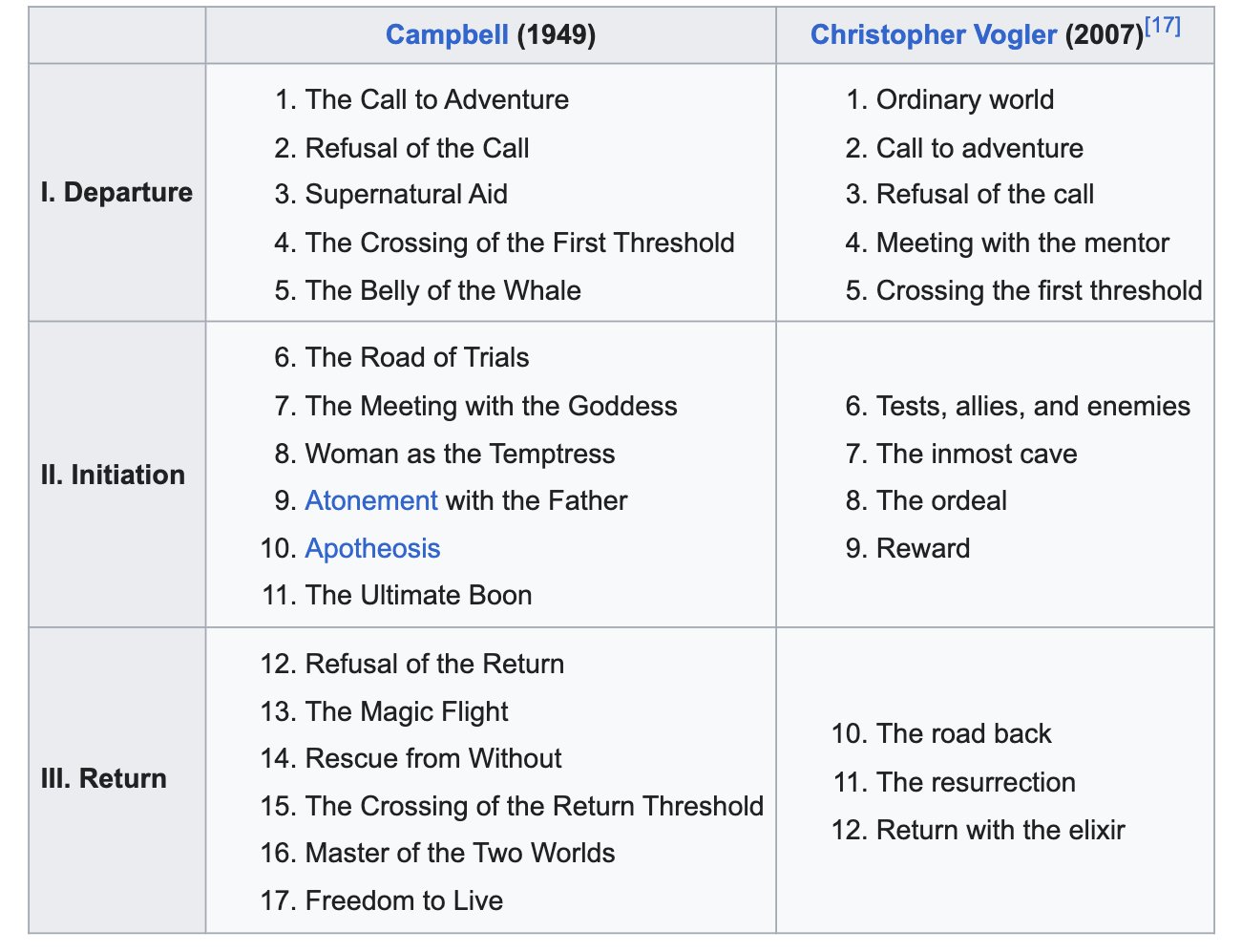
- Twelve stages. The Twelve Beats adapt this column for a sales video.
- Beat 1. The beat scripts skip most often.
- The hero does not want to go. In beat 2, something outside takes the choice away.
- The film low point. In a sales video, what dies here is the old method.
- The original: 17 stages. Twelve is easier to write to.
Screenshot of Wikipedia, Hero's journey, comparison table, taken 2026-10-17
Beats 1 to 4: the hero did not want to go
Never skip the ordinary day. It is one of the beats scripts skip most often. Without it, the viewer never sees their own life on screen, so nothing after it feels true to them.
Make the jolt come from outside. Heroes are reluctant. Change costs them something, so they stall.
The jolt takes the choice away. The big client left, the rent doubled, or the doctor called.
That reluctance does real work. Your viewer is stalling too. They see themselves in a hero who stalled.
Build the wall from the viewer's own limits. Beat 3 is the first thing that blocks the hero. Make it something the viewer also lacks: money, time or skill.
If your buyers have no ad budget, the hero had no ad budget either. One sentence. It builds recognition and answers an objection before anyone raises it.
Then let the hero find a way in. Beat 4 is small. A first try, a first win, a foot in the door.
Example: give the hero the same lack your buyer has
| Your buyer | What they lack | The line in your story |
|---|---|---|
| Contractors | Time | "I was on roofs all day. I had no time to post anything." |
| New coaches | Money | "I had no budget for ads either." |
| Small clinics | Skill | "Nobody on my team knew how to build a page." |
| Shop owners | Help | "It was just me and one part-timer." |
Example lines, written for illustration. One sentence in beat 3 answers the objection early.
Beats 5 to 7: one guide is never enough
The first guide does not have to be a person. A book, an article, a forum thread or a video all count. Anything that teaches the hero something.
But the first guide only goes so far. It gets the hero moving. It does not get them over the line, which is why a second guide shows up later.
Trials are the problems your market already knows. Name the ones your buyers have hit. They will nod along.
Add a temptation. Something pulls the hero back to safety: a steady paycheck, comfort or pride.
Why bother? Your viewer feels that same pull right now. It is the reason they have not changed yet.
The second guide delivers the turn. Beat 7 is where the hero learns that what they believed was wrong.
Not a little wrong. Completely wrong.
The turn sets up the next beat. If the hero's beliefs can be wrong, so can the viewer's.
The first guide starts the hero; the second guide changes their mind
- The first guide Beat 5 A book, article, forum or person. Enough to start.
- Trials Beat 6 The problems your market already knows.
- Temptation Beat 6 A paycheck, comfort or pride pulls the hero back.
- The second guide Beat 7 Shows that what the hero believed was wrong.
The Twelve Beats, beats 5 to 7.
Beat 8: kill the old method, then show the math
Beat 8 is the death of the old method, not the death of the hero. This is where most scripts go wrong.
In films, the low point is often a brush with death. In a sales video, what dies is an idea: a plan, a system, the method your viewer still trusts.
Nobody buys a new way while the old way still looks alive. So beat 8 kills it, in front of the viewer. It takes three moves.
Name the old method. Pick the one your viewer still uses today. Doing the books on Sunday nights, say, or posting online and hoping.
Prove it is dead, with logic and numbers. A feeling will not do it. Math will.
Match the proof to the market. Crowded markets have heard every promise, so they need more proof here. Quieter markets need less.
For example, picture a bookkeeping firm. The old method is the owner doing the books on Sunday nights.
Five hours a week is 260 hours a year. At $60 an hour of the owner's time, that is $15,600 a year. That number is what kills the old method.
Another example: one debt-relief sales video named the two usual ways out, the snowball and the avalanche. A second guide then showed the narrator a third way. Both old methods were dead before his method appeared.
Skip the math, and viewers will not believe they need the new way in beat 9. For more, read how to argue against the story your market believes.
Kill the old method in three moves
- 1. Name it The method your viewer uses today, in their words.
- 2. Do the math Hours, dollars or results that show it no longer works.
- 3. Match the proof to the market Crowded markets need more proof. Quieter ones need less.
The Twelve Beats, beat 8.
Example: the old method costs the owner 260 hours a year; the new one about 13
Owner hours a year on bookkeeping. Old: 5 hours a week. New: 15 minutes a week to review.
- Sunday-night books 260
- Weekly review only 13
Worked example for a made-up firm: 5 x 52 = 260; 0.25 x 52 = 13. The math is ours.
Beat 8 kills the old method with plain math, not feelings
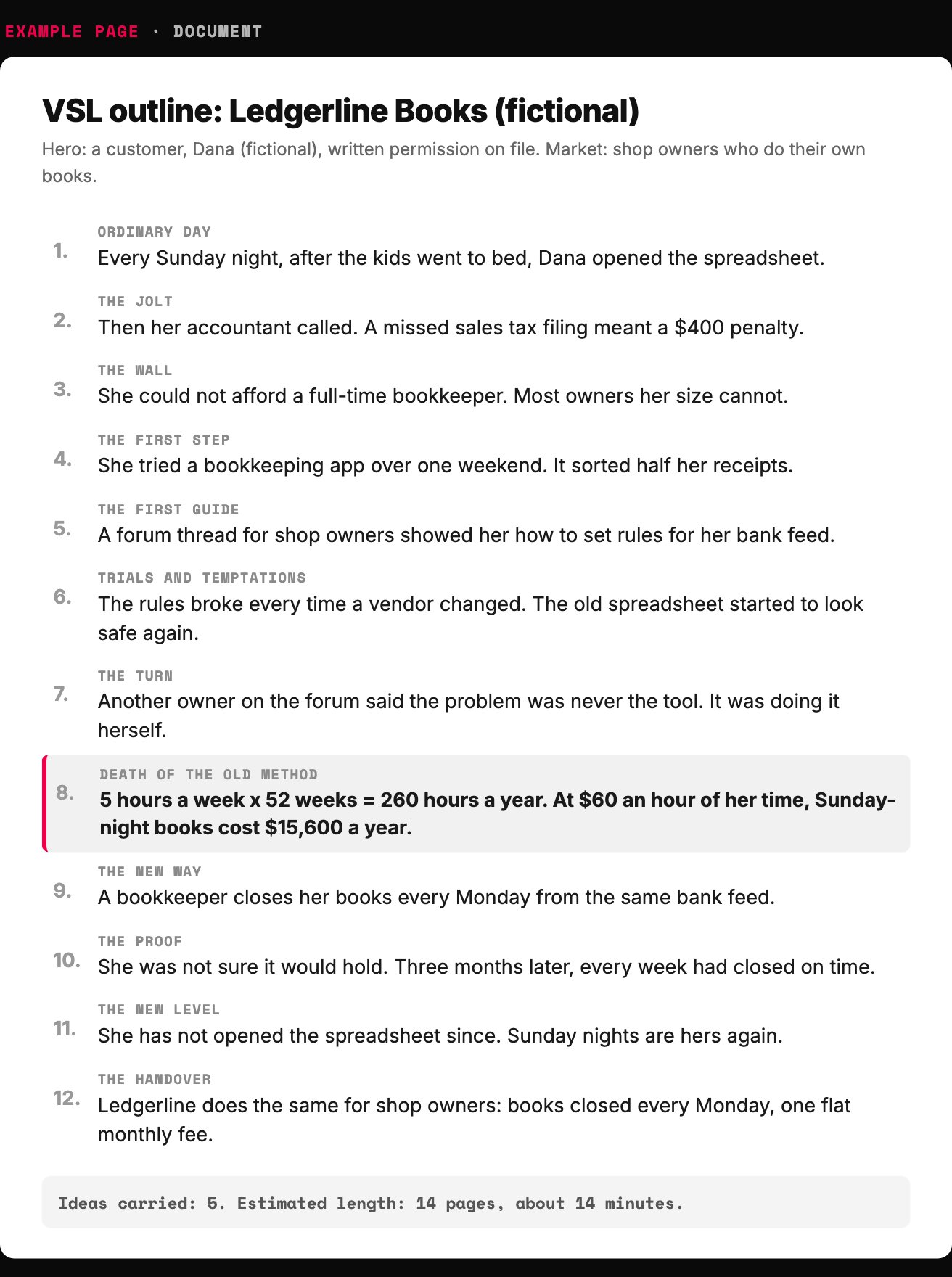
- The ordinary day comes first. The viewer sees their own Sunday night.
- The wall is something the buyer also lacks, so the objection is answered early.
- The old method dies with numbers, not feelings.
- The problem is gone for good, not just solved once.
- About five ideas, and one script page is about one minute.
Example page built for this article with a made-up brand
Beats 9 to 12: sell a problem gone for good, not just a result
Beat 9 is the new way. The hero builds a better method. This is your product's mechanism: how it works, in plain words.
Beat 10 starts with doubt. The hero is not sure it will work. Then it does, and then it works for other people too.
That second half is where real proof goes. Which proof, and in what order, is in the Proof Grid.
Beat 11 is the new level. Show what life looks like now. Say it as a problem that is gone for good.
Why that wording? People do not want to arrive at a result. They want to get through a problem so it never comes back.
So skip "get organized books." Write "you will not have to think about your books again."
The first sells a result. The second sells relief that lasts.
More on that switch in sell outcomes, not deliverables.
Beat 12 is the handover. The new method, packed into what you sell. Then the close takes over, which is its own job: the stacked close.
Sell a problem gone for good, not just a result
| Just a result | Gone for good |
|---|---|
| "Get organized books." | "You will not have to think about your books again." |
| "Lose 20 pounds." | "Stop starting over every January." |
| "Get more leads." | "Stop wondering where next month's work comes from." |
Example lines, written for illustration.
How long should a VSL be?
A VSL should be as long as its beats need, and no longer. One rule sizes it: one script page runs about one minute, in 11-point type.
A 55-page script runs close to an hour. A 15-page script runs about 15 minutes.
Who is watching decides which beats you shorten. Picture the twelve beats as a circle.
One half is the why, the story. The other half is the how, the method.
Calm, capable buyers mostly want the how. For them, keep beats 1 to 7 short and spend the time on how it works.
Stressed buyers need the whole circle, told evenly. They have to see themselves before they believe the method.
Carry about five ideas. George Miller's 1956 paper put short-term memory at about seven items, plus or minus two. Later memory research suggests even fewer.
Five is the target. Nine is the most. Stressed viewers hold fewer.
Does your draft need an "in summary" section? Then you wrote a book, not a sales video. Cut it.
One more limit. The full twelve beats work best for big, broad markets that do not know you yet. A small market that knows the problem well wants a shorter video that gets to the how.
Length is a guess until you see where people stop watching. That part is in VSL retention.
One page is a minute, five ideas is the target, nine is the ceiling
- Video per script page, at 11-point type 1
- Ideas to aim for in the body 5
- Ideas at most, before viewers tune out 9
Our sizing rules. Memory limits: Wikipedia, The Magical Number Seven, Plus or Minus Two.
Shorten the story for buyers who want the how
- Shortest Keep beats 1 to 7 brief. Most of the time goes to the method.
- Short story, full argument Brief story, then a full beat 8 and plenty of how.
- Even, but compact All twelve beats, evenly, with fewer ideas.
- The full twelve Every beat, told evenly. This is where the template is strongest.
Our decision rule for VSL length.
What if I do not have a dramatic story?
Good. Do not invent one. You can still use all twelve beats.
The hero can be a customer. Get their written permission. It is often stronger this way, because your viewer is a customer too.
Then you play the guide. You are the mentor in their story, not the star.
If a customer tells it, the FTC's endorsement guidance applies. Their story has to match what really happened to them.
The hero can be the market. For example: "For years, a directory listing was enough. Then search changed."
The ordinary day, the jolt and the trials belong to the whole trade.
Your own founder story still has a home. Put it on your About page, not in the sales video.
Keep the outline, drop the odd details. Keep the same struggle, the same goal and similar steps.
A shared struggle builds trust. Strange personal details break it.
What the story cannot be is false. A sales video is advertising, and the FTC says ad claims must be truthful and backed up. The story counts as a claim.
The FTC's final rule on fake reviews and testimonials also bans made-up testimonials. An invented low point is still a lie, however well it is built.
Where to find true stories: collect, don't invent.
Three heroes you can use without inventing anything
| The hero | Where it works | What you need |
|---|---|---|
| A customer | The sales video | Written permission and their real story |
| The market | The sales video | The real history of how the trade changed |
| You, the founder | The About page | Your true story, odd details trimmed |
Our rule. Truth standard: FTC, Advertising FAQs and Endorsement Guides.
Outline your VSL with AI: the copy-paste prompt
Paste the prompt below into your preferred AI. It asks what you sell, who the hero is and what old method your buyer still uses.
Then it asks for one true event per beat. It writes your twelve lines and shows the beat 8 math.
It never fills a gap with a made-up event. A beat with no true event comes back marked MISSING, with what to go collect.
That list is the useful part. Fill it with real events, not good guesses.
Paste into your preferred AI. It asks six questions, then writes your twelve lines, shows the beat 8 math and flags every missing beat.
Act as a sales video script editor. Help me outline the body of my VSL with the Twelve Beats. Never invent an event, a customer, a number or a result.

Ask me one at a time, with the example:
1. What do you sell, and to whom? (Example: monthly bookkeeping for shop owners)
2. Who is the hero: me, a customer who gave written permission, or my whole market? (Example: a customer)
3. What old method does my buyer use today? (Example: doing the books on Sunday nights)
4. What numbers show that old method fails? (Example: 5 hours a week, at $60 an hour of the owner's time)
5. Do my buyers mostly want to know how it works, or are they stressed and need to see themselves first?
6. Is my market broad and new to me, or small and well informed?
Then ask for one true event per beat.

The Twelve Beats:
1 Ordinary day: the viewer's life now. Never skip it.
2 The jolt: the hero did not want to change; something outside forced it.
3 The wall: something the viewer also lacks (money, time, skill).
4 The first step: a way in.
5 The first guide: a book, forum or person; it starts the hero, it does not finish the job.
6 Trials and temptations: problems my market knows; a pull back to safety.
7 The turn: a second guide shows the hero's belief was wrong.
8 Death of the old method: name it, prove it is dead with logic and numbers. More proof for crowded markets.
9 The new way: the mechanism, in plain words.
10 The proof: doubt, then it works, then it works for others.
11 The new level: the problem gone for good.
12 The handover: the method, packed into the offer.

Rules:
- Show the beat 8 math step by step.
- About five ideas, nine at most. No summary section.
- How-focused buyers: shorten beats 1 to 7. Stressed buyers: all twelve, evenly.
- Keep the shared struggle; drop odd personal details.
- A beat with no true event: write MISSING and tell me what to collect.
- One script page is about one minute.

Output:
Hero: [who, permission yes or no]
Twelve lines: [one sentence each]
Beat 8 math: [shown]
Ideas carried: [count and list]
Beats shortened: [which, why]
Length: [pages, minutes]
MISSING: [beats]
Next three actions: 1. 2. 3.
Write your twelve lines this week
1. Run the prompt for your main offer. Answer its six questions.
2. Write beat 8 first. Name the old method and do its math.
3. Fill every MISSING beat with a true event. Ask customers, read old emails, check your notes.
Then tell the whole story once, in the video or on day one of an event. After that, point back to one beat at a time in emails and ads. "Remember the Sunday-night books?"
The memo that shaped Hollywood was seven pages. Your outline is twelve lines.
Bury the old method first. Nobody moves into a house while the last owner still lives there.
Three sittings from blank page to a full outline
- Run the prompt Day 1 Answer its six questions for your main offer.
- Write beat 8 Day 2 Name the old method and do its math.
- Fill the gaps Day 3 Collect a true event for every MISSING beat.
Our plan for this guide.
Tell the story once, then reuse one beat at a time
- Tell it whole Once, in the video or on day one of an event.
- Point back One beat per email or ad.
- Customer finishes They land back at an ordinary day.
- Next problem Start a new journey with the next offer.
Our model of story reuse.
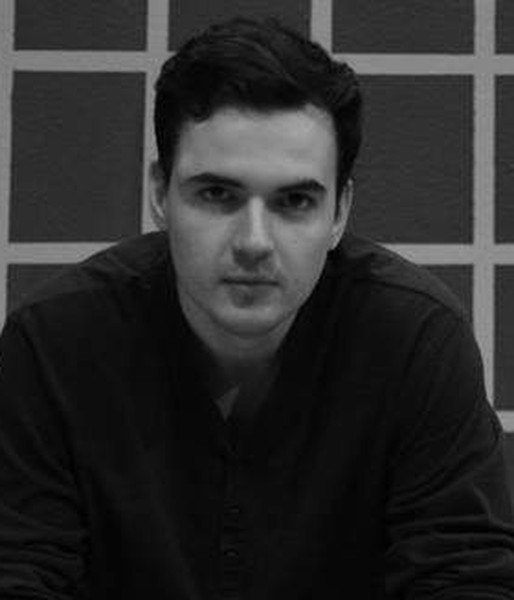
Filip Kovacevic is the founder of Anar Agency in Phoenix. He spent five years running SEO, Meta ads, email, and content for medical practices across the United States, and now does the same work for healthcare, home-service, legal, and professional-service businesses, alongside AI implementation. More from Filip →
Talk it through in 15 minutes
Bring one question from this article. We will tell you what we would do, whether or not you hire us.
Book a 15-Min Chat →