What Each Platform Is For

Each social platform has one main job. People open YouTube to learn, Facebook to be entertained, Instagram to look at lives they admire, and LinkedIn to look good at work. A post works when it fits that reason.
For most B2B firms, start with LinkedIn or YouTube, where buyers go to judge suppliers.
Which social platform for B2B? Start with why people open each app
Picture a firm that films one good how-to video on Monday. By lunch it is on five apps. Same video, same caption, same link.
On YouTube it gets found. On Facebook it gets scrolled past. On LinkedIn it gets two likes, both from staff.
Was it a bad video? No. It was the wrong shape for those apps.
Which social platform is right for B2B, or for any business? The answer starts with one question. Why did this person open this app right now?
In Pew Research's survey of US adults, 84 percent said they use YouTube, 71 percent Facebook and 50 percent Instagram. Many people use all three. They do not open them for the same reason.
Researchers call this way of thinking uses and gratifications. It asks what people want from a TV channel, a magazine or an app. We plan every post the same way.
So the question is not where the most people are. It is what they came to do.
Most US adults use YouTube and Facebook; half use Instagram
Share of US adults who say they ever use each platform
- YouTube 84
- Facebook 71
- Instagram 50
- TikTok 37
Source: Pew Research Center, Social Media Fact Sheet, survey of 5,022 US adults, Feb. 5 to June 18, 2025.
The same adults use several apps; the newest row shows it
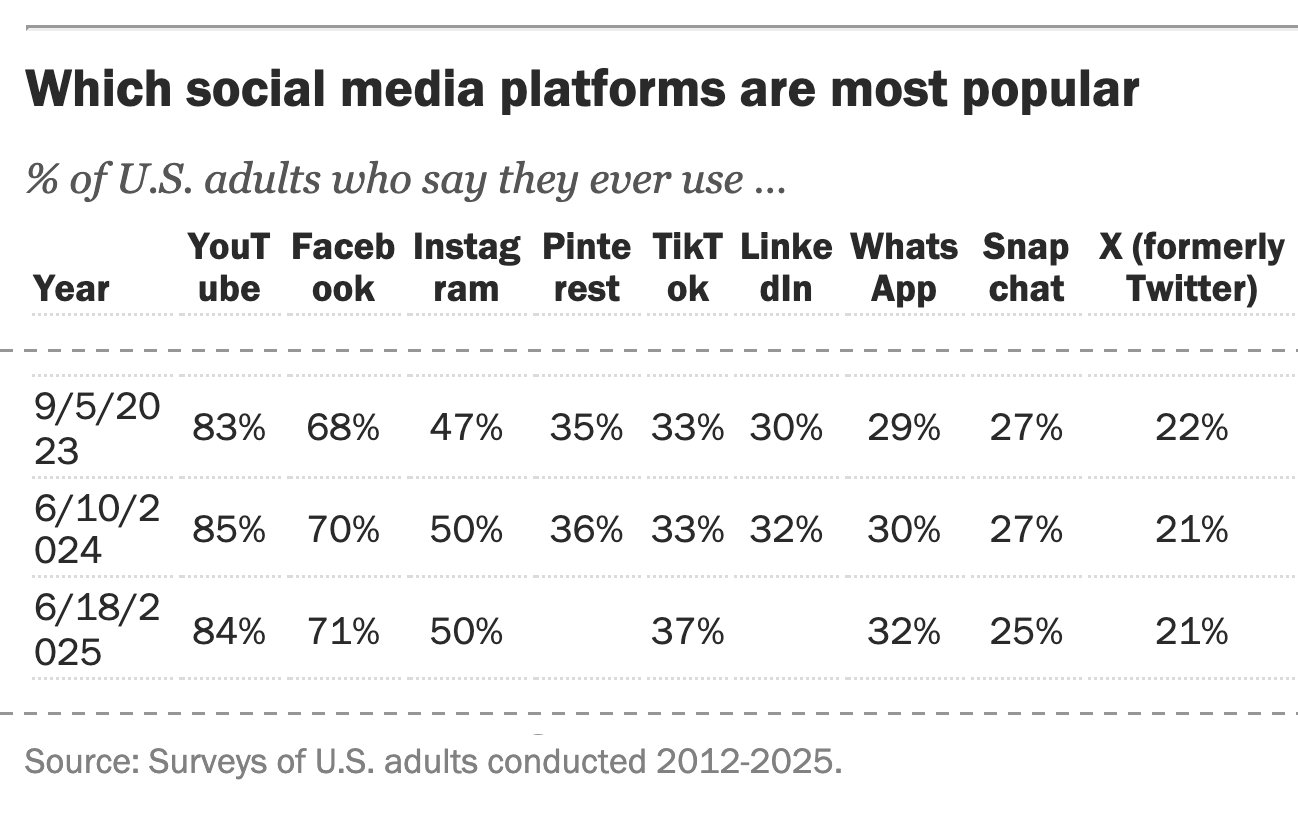
- YouTube: 84 percent of US adults. Most go there to learn.
- Facebook: 71 percent. Mostly for a break and for people.
- Instagram: half of adults. They come to look.
- The page updates. Read the newest row.
Screenshot of Pew Research Center, Social Media Fact Sheet (data view), taken 2026-10-17. Three parts of the page joined at the dashed lines.
Each platform has one main job
Every app does many things. But one job usually leads. That job decides what works there.
YouTube is for learning. People search it for how-to answers. A good how-to video can keep finding viewers for years.
Facebook is for entertainment. Stories, humor and people beat lessons. A lesson still works there if a story carries it.
Instagram is for showing. People look at faces, places and lives they admire. Call it the look-at-me app.
LinkedIn is for work reputation. People read what makes them better at their job. They share what makes them look good to their boss.
TikTok is for discovery. TikTok says neither follower count nor past hit videos are direct factors in what it recommends. Strangers meet you first.
That changes what a follower is worth. More on that in reach is not audience size.
Even inside one app, the parts have jobs. Instagram says people look for close friends in Stories, find new creators in Explore and go to Reels to be entertained.
So a platform is not just a place. It is a reason to open the app.
Each app has one main job, and the post has to fit it
| Platform | Why people open it | Shape that fits | Shape that flops |
|---|---|---|---|
| YouTube | To learn how to do something | A clear how-to that answers a search | A rant with no answer |
| To be entertained, and keep up with people | A story, with the lesson inside it | A lecture | |
| To look at people and lives they admire | Show the person, the place, the result | A wall of text | |
| To look good at work | Advice they can repeat in a meeting | An overshare with no lesson | |
| TikTok | To discover something new | A fast first second for strangers | A post that needs context |
Our working model. Each app does several jobs; one usually leads.
Even one app splits into parts with different jobs
| Part of the app | What people go there for |
|---|---|
| Stories | Their closest friends |
| Explore | New content and creators |
| Reels | To be entertained |
Source: About Instagram, Instagram Ranking Explained, read 2026-10-17.
The Platform Roles model says people open each app for one main reason: YouTube to learn, Facebook for entertainment and people, Instagram to look at lives they admire, LinkedIn to look good at work, TikTok to discover. A post works when it fits that reason. Pick one main platform where buyers decide, keep one idea and change its shape per app, expect new accounts to rise and dip, sell in steps, and test two platforms for 30 days.
Which social platform is best for B2B? The one where buyers judge you
For most B2B firms, the best platforms are LinkedIn and YouTube. That is where buyers go to judge a supplier.
LinkedIn, because your buyer's job is on the line when they pick you. A post that makes them look smart in a meeting gets read. Then it gets passed on.
LinkedIn also suits selling expert help. Busy people there do not want twenty tutorials. They want someone to show them where to click.
So sell exactly that. Offer a short paid call that saves them the time. Price it low enough that a manager can say yes without asking anyone.
YouTube, because buyers research before they call. A clear video that answers their search keeps working long after you post it.
Facebook and Instagram still matter for local and owner-run firms. The owner who buys from you is also a person scrolling at night.
What stops most experts from posting? The feeling that everyone already knows this stuff.
Your peers may know it. Your buyers do not.
People know different amounts about your field. The basics that bore your peers are news to a busy owner. Post the basics.
It may feel boring to you. It is useful to them.
Buyers relax in one app and judge you in another
| Where buyers relax | Where buyers judge you |
|---|---|
| Facebook and Instagram at night | LinkedIn and YouTube during work |
| They want a break | They want to look smart, or learn fast |
| Stories and faces win | Advice and clear how-tos win |
| Good for local, owner-run firms | Good for most B2B firms |
Our comparison, from the Platform Roles model.
Sell the time you save them, not the tutorial
- 1. Post the basics The things your peers find boring. Your buyers do not.
- 2. Show where to click One short how-to that saves a busy person an hour.
- 3. Offer a short paid call Priced so a manager can say yes alone.
- 4. Grow from there Bigger work only after the first call delivers.
Our method for selling expert help on LinkedIn.
How fast does each platform reward a new account?
Each one moves at its own speed. Facebook, Instagram and TikTok will show good posts from a brand-new account to strangers. YouTube is slower to push a new channel.
That fits what the platforms say. TikTok says follower count is not a direct factor. YouTube says it weighs the reputation and quality of a channel when it decides who sees a video.
A new channel has no reputation yet. So the new channel has to wait.
For example, one brand-new Facebook page posted short podcast-style videos with no ad spend. Its first three videos got about 30,000, 120,000 and 150,000 views. It passed 10,000 followers in about 13 days.
Then views dropped. That pattern is common on a new page: generous reach early, then a dip while the feed works out who your audience is.
The page kept posting. A later video got about 400,000 views and took about an hour to make.
Those numbers are the owner's own report, and we have not seen the data. The pattern is the useful part. Do not quit in the dip.
On YouTube, plan for search and a slow start. Judge it after months, not days. How those podcast-style videos get made is in the AI podcast clip pipeline.
Example: a brand-new page with no ads still reached strangers fast
Views per video on one new Facebook page, as its owner reported them
- Video 1 30000
- Video 2 120000
- Video 3 150000
- A later video 400000
Example from one page owner's own report. Not our results, and not verified by us. Views dipped between video 3 and the later video.
Expect a rise, then a dip, then the real audience
- Generous reach First posts The feed tests you on strangers.
- The dip Next weeks Views fall while the feed works out who your audience is.
- Your real audience After the dip Reach settles on the people who actually watch. Keep posting.
The pattern one new page reported. Our advice: never judge a new account in week one.
Three apps push good posts early; YouTube makes a new channel wait
| Platform | New account, good post | What the platform says |
|---|---|---|
| Facebook and Instagram | Shown to strangers early | Ranking is tailored to how people use each part of the app |
| TikTok | Shown to strangers early | Follower count is not a direct factor |
| YouTube | Slow to push a new channel | Weighs channel reputation and quality |
Sources: TikTok Newsroom; How YouTube Works; About Instagram. The early-reach column is common experience, not a platform promise.
Keep one idea, change its shape for each app
Being on many apps is fine. Posting the same thing on all of them is the mistake.
A how-to video on Facebook feels like homework. A personal story on LinkedIn with no lesson feels like oversharing.
The idea is fine. The shape is wrong.
So keep the idea and change the shape. Teach it on YouTube. Tell it as a story on Facebook.
Show it on Instagram. Turn it into advice on LinkedIn.
On Facebook, one story can run across many posts. For example, one page planned a simple three-part story and told it across about 50 short videos. The how-to lessons sat inside the story.
The same face can work across apps, too. For example, one made-up AI influencer posts podcast-style videos on Facebook. On Instagram it adds the posed photos an influencer would post.
It also saves work. You research once and write four short versions, not four new ideas. More in one article, twenty pieces.
Each version still needs a reason for people to stop scrolling. Open it with what changed, as in all content is about change.
Change the shape, never the facts.
Same facts, four reasons to stop scrolling
| App | Shape | Example of the same idea |
|---|---|---|
| YouTube | Teach it | How to read a cost per lead report, step by step |
| Tell it | The owner who paid for leads nobody ever called | |
| Show it | A day behind the work of one good month | |
| Advise on it | Three numbers to read before you approve ad spend |
Illustrative wording, written by us.
How to sell on social media without losing your reach
Every platform wants people to stay inside the app. A post that sends everyone away works against that.
Our working rule: the harder a post pushes people off the app, the less reach it tends to get. No platform publishes that rule. We treat it as a thing to test, not a law.
So sell in steps. Give the first ten or so posts no call to action at all. Earn the follow first.
Then sell where followers already are. Use Stories, and posts made only to sell. People who follow you know where to find you.
Next comes the comment-to-message funnel. A post offers something useful, people comment, and you send them a private message. Meta's rules let a business page send one private reply to a person who commented.
This is where asking for comments can get you in trouble. Facebook pushes down engagement bait: posts that push people to like, share or comment just to get more reach. Posts that ask for help or advice are not pushed down.
Our decision rule: ask for a comment only when the comment gets the person something real. Never ask for one just to get more reach.
How to get ignored on every platform in four easy steps:
1. Post the same video to five apps at once.
2. End every post with link in bio, DM me and comment YES.
3. Judge the results after three days.
4. Quit in the dip and blame the damn algorithm.
How often to sell is its own question. See how often to sell without wearing out your audience.

Earn the follow first, then sell where followers already are
- First ten or so posts No call to action. Just posts your buyers like.
- Stories Sell to the people who already follow you.
- Sell-only posts A few posts made only to sell, clearly.
- Comment to message Offer something real in the post. Message the people who ask for it.
Our selling order for organic social.
Ask for a comment only when it gets them something real
| Engagement bait (demoted) | A fair comment ask |
|---|---|
| Like this if you agree | Comment GUIDE and we send you the guide |
| Comment YES to win reach | Ask a question you will actually answer |
| Tag three friends | Ask for help or advice |
| Gets the post pushed down | Lets the page send one private reply |
Sources: Meta Newsroom, Fighting Engagement Bait; Meta for Developers, Private replies. The right column is our rule.
Facebook pushes bait down but leaves real requests for help alone
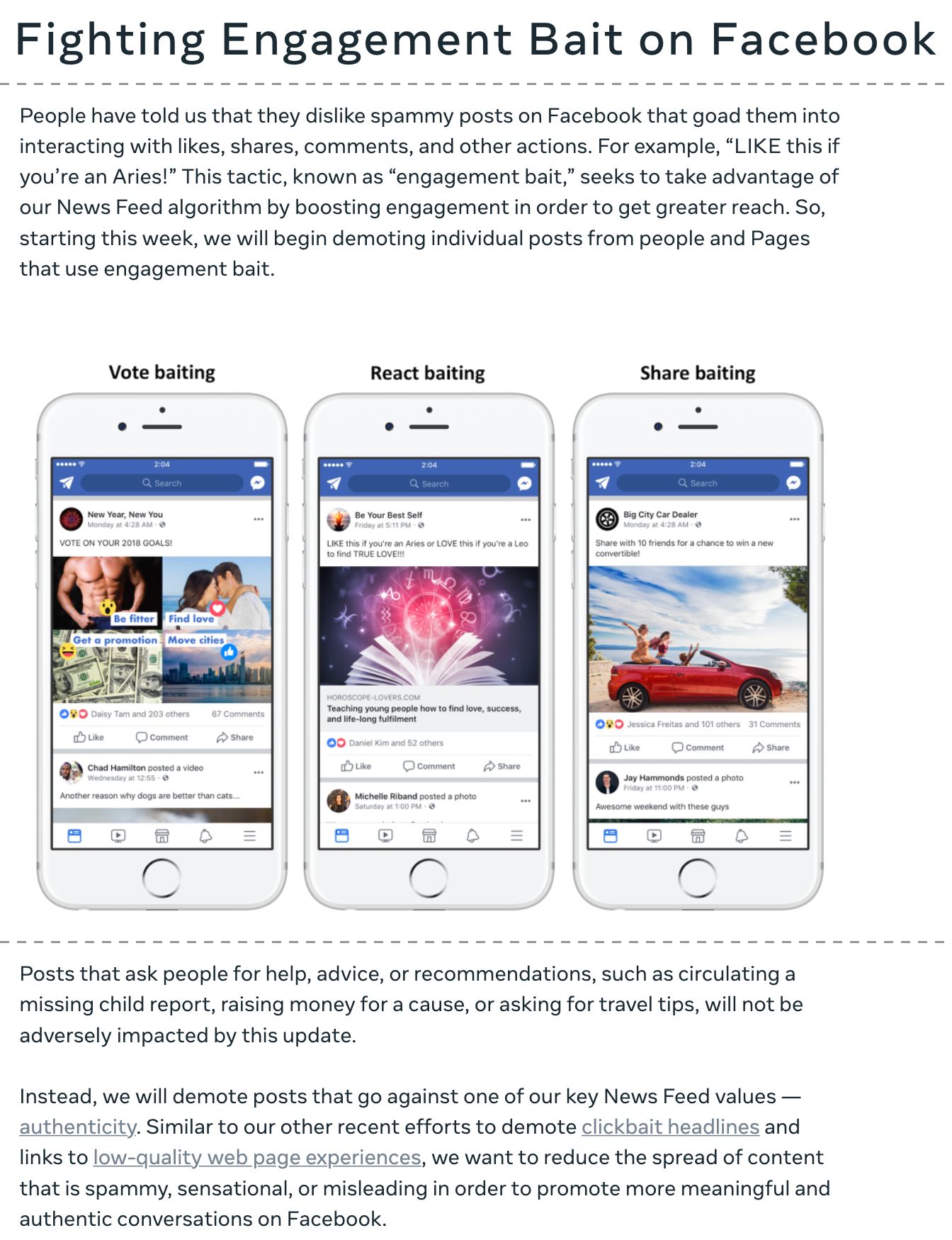
- Bait: asking for a reaction just to win reach.
- Bait gets pushed down in the feed.
- Asking for help or advice is fine.
- The test: is the ask real, or a trick?
Screenshot of Meta Newsroom, Fighting Engagement Bait on Facebook, taken 2026-10-17. Three parts of the page joined at the dashed lines.
Pick one platform, then test it for 30 days
Pick one main platform. Choose it by where your buyers decide, not where they spend the most time.
A buyer may scroll Facebook for hours and still pick a supplier after a search on YouTube. The scrolling is not the decision.
Then run a 30-day test. Post the same idea on two platforms, each shaped for its job. Track where the people who contact you came from.
Tracking takes one step: add campaign tags to every link. These are short labels on the end of a web address, and Google Analytics lets you build them. Each visit then shows which platform and which post sent it.
Count three things per platform. Visits, enquiries, and enquiries that became a real conversation. Ignore likes.
Why ignore likes? Because views are not buyers. For example, the new page above reached about a million views and sold about $130 of an ebook.
The fix was not more views. It was a better match between the audience and the offer. Give your audience data to your preferred AI and ask what these people would actually buy.
Email works for some audiences and not others. A newsletter can suit busy owners. A teenage audience may not even use email.
Remember the dip. Do not judge a new account in week one.
Repeat the test every six months. Feeds change, and so do buyers. Then set your rhythm with posting volume that rises and falls.
Two platforms, tagged links, three numbers
- 1. Pick two platforms Your best guess at where buyers decide, plus one more.
- 2. Shape one idea for each Same facts, the shape each app wants.
- 3. Tag every link Campaign tags show which platform and post sent each visit.
- 4. Count three things Visits, enquiries, real conversations. Not likes.
- 5. Read it at day 30 Not in week one, while new accounts dip.
Our 30-day test.
Count what pays; ignore what flatters
| Count this | Ignore this | Why |
|---|---|---|
| Visits from tagged links | Likes | A like costs the viewer nothing |
| Enquiries | Follower count | Feeds now show posts to non-followers |
| Real conversations | Views | One page reported about 1 million views and about $130 in sales |
Our rule. The views example is one page owner's own report, not verified by us.
Plan your platforms with AI: the copy-paste prompt
Paste the prompt below into your preferred AI. It asks who you sell to and where they decide. Then it picks your main platform and shapes one idea for it.
It never invents your numbers. If it can browse, it checks each platform's current rules first and tells you what changed.
Want a second pair of eyes on the plan? Send it to us.
Paste into your preferred AI. It asks what you sell and where your buyers decide, then picks your main platform, shapes one idea and sets up a 30-day test.
Act as a social media planner. Pick my main platform with the Platform Roles method, then shape one idea for it.

Ask me one at a time, with the example:
1. What do you sell, and to whom? (Example: bookkeeping for restaurant owners)
2. Where do your buyers go to judge a supplier before they buy? (Example: they ask peers, then search YouTube)
3. Which platforms do you post on now, and what comes back from each? (Example: Facebook, lots of likes, no enquiries)
4. One idea you want to post this week. (Example: three numbers to check before hiring a bookkeeper)

Rules:
- Each platform has one main job. YouTube: learning and how-to. Facebook: entertainment and people. Instagram: showing faces, places and results. LinkedIn: looking good at work. TikTok: discovery by strangers.
- Pick ONE main platform: where buyers decide, not where they spend the most time. For most B2B firms that is LinkedIn or YouTube.
- Keep the idea, change the shape: teach it on YouTube, tell it as a story on Facebook, show it on Instagram, advise on LinkedIn.
- New accounts: Facebook, Instagram and TikTok can show good posts to strangers early, then views often dip. YouTube is slower. Never judge a new account in week one.
- Selling: no call to action for about the first 10 posts. Then sell in Stories and in posts made only to sell. Ask for a comment only when the comment gets the person something real.
- Never invent my numbers. If you can browse, first check each platform's current help pages on recommendations, trial posts and comment replies, and tell me what changed.

Then answer in this format:
Main platform: [name, and why in one line]
Second platform: [name, or none yet]
My idea, shaped for the main platform: [hook line plus 3 bullet outline]
The same idea for the second platform: [one line]
30-day test: [two platforms, link tags, what to count: visits, enquiries, real conversations]
Next three actions: 1. 2. 3.
What to do this week
1. Write down why your buyer opens each app. One line each.
2. Pick the app where they judge suppliers. Run the prompt for it.
3. Shape your next idea for that app, tag the link and start the 30-day clock.
And that how-to video from Monday? Post it on YouTube. Tell its story on Facebook.
Next comes making each post worth stopping for. Start with how to write a hook.
Post where your buyers are. Shape it for why they are there.
Pick, shape, test, read, then pick again
- Pick One main platform, where buyers decide.
- Shape One idea, in the shape that app wants.
- Test Two platforms, 30 days, tagged links.
- Read Visits, enquiries, real conversations.
The Platform Roles loop.

Filip Kovacevic is the founder of Anar Agency in Phoenix. He spent five years running SEO, Meta ads, email, and content for medical practices across the United States, and now does the same work for healthcare, home-service, legal, and professional-service businesses, alongside AI implementation. More from Filip →
Talk it through in 15 minutes
Bring one question from this article. We will tell you what we would do, whether or not you hire us.
Book a 15-Min Chat →