Organic Reach Is Not Your Follower Count
Organic reach is the number of people who saw a post you did not pay to promote. It is not your follower count, and it is usually much smaller. To judge your content, divide each post's reach by the audience in that place.
Compare it with your own median. Then check shares, watch time and replies.
Organic reach is not your follower count
A Facebook group has 52,000 members. Its best posts get 5,000 to 8,000 views. Its record is about 10,000.
That is a real example from one online marketing community. Even the record post missed about four members out of five.
The member count looks like a stadium. Most of the seats are empty on any given day.
Organic reach is the number of people who saw a post you did not pay to promote. It is not your follower count. Most of the time, it is a lot smaller.
So stop asking how big your audience is. Ask how many people each post actually reached, and why.
The Reach Count is our audit for that. For each place you post, it divides each post's reach by the audience there, compares it with your own median, and checks what the winners did.
It skips other people's numbers and feel-good counts. It uses just your posts, counted honestly.

Example: even the record post reached about 1 in 5 members of a 52,000-member group
Views on a Facebook group's posts compared with its member count
- Members in the group 52000
- A good best post 5000
- A great best post 8000
- The record post 10000
Example from one online marketing community. Not our data, and not verified by us.
Does follower count matter? It helps, but it does not decide
Follower count helps a little. It does not decide who sees a given post.
TikTok's own explanation says an account with more followers is likely to get more views. It also says "neither follower count nor whether the account has had previous high-performing videos are direct factors in the recommendation system."
Instagram gives a more mixed answer. Its ranking explainer lists the number of followers as one popularity signal. It also says a reel you see was likely made by someone you have never heard of.
So who is right? Both. Followers give a post a head start, and the post has to do the rest.
The older model was a social graph. You posted, and your followers saw it, more or less.
The newer model is a recommender system. The platform picks posts for each viewer, including posts from accounts they do not follow.
A big following is a head start, not a finish line.
Followers used to set your reach; now each post earns its own
| Follower graph (older feeds) | Recommendations (most feeds now) |
|---|---|
| Your post goes to people who follow you | Your post can go to people who do not follow you |
| Reach grows with audience size | Reach grows with how people respond to each post |
| A big account always wins | A small account can win with one strong post |
| Follower count is the scoreboard | Each post's reach is the scoreboard |
Our summary of TikTok's and Instagram's published ranking explainers.
The platforms say followers help, but do not decide
| Platform | What it says about followers | What it means for you |
|---|---|---|
| TikTok | Follower count is not a direct factor in its recommendations | A strong post from a small account can travel |
| Number of followers is one popularity signal; a reel you see was likely made by someone you have never heard of | Followers are a head start, not a ceiling | |
| YouTube | Recommendations use viewing behavior, likes, dislikes and satisfaction surveys | Satisfied viewers matter more than subscriber count |
Sources: TikTok Newsroom; Instagram Ranking Explained; How YouTube Works, read 2026-10-17.
Followers help, but they do not decide what TikTok recommends
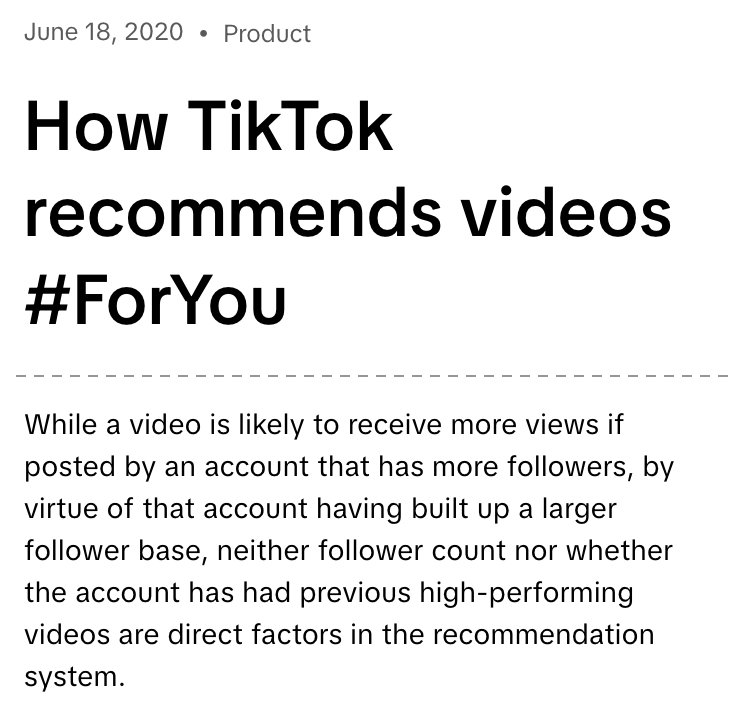
- TikTok's own explanation of its For You feed.
- Followers help. A bigger account starts with more views.
- But follower count is not what decides whether a post is recommended.
- Published in 2020 and still live. Check the page for updates.
Screenshot of TikTok Newsroom, How TikTok recommends videos #ForYou (June 18, 2020), phone view. Quoted words are the page's own text, taken 2026-10-17
The Reach Count audits organic reach post by post. For each place you post, divide each post's reach by that place's audience size and compare it with your own median: under half is a miss, twice or more is a winner, over 100 percent means strangers carried it. Judge winners on non-follower views, watch time, shares and saves, and replies, then make more like them.
How to run a Reach Count in five steps
A Reach Count is an audit of your last 10 posts in each place you post. Have the numbers open and it takes about an hour.
First, one definition. Meta's help page defines reach as the number of accounts that saw something at least once.
Impressions count repeat views by the same people, so they are always higher. Use reach.
Step 1: write down your audience size in each place. Followers on the page, members in the group, followers on the profile.
Step 2: pull the reach for your last 10 posts in each place. Most insights pages show it per post.
Step 3: divide each post's reach by that place's audience size. That is the reach rate.
For example, picture a page with 2,000 followers. A post that reached 180 people has a reach rate of 9 percent.
Step 4: split followers from non-followers where the insights show it. Non-follower views tell you the platform took the post to strangers.
Step 5: sort the posts and mark the top three and the bottom three. Write one line on what each was about.
Why count each place on its own? A group, a page and a profile hold different people. Mix them and the numbers stop meaning anything.
Five steps from a follower count to a real reach rate
- 1. Audience size Write it down for each place you post.
- 2. Reach per post Your last 10 posts in each place. Reach, not impressions.
- 3. Reach rate Reach divided by that place's audience size.
- 4. Strangers Split followers from non-followers where the insights show it.
- 5. Sort Mark the top three and bottom three. One line on what each was about.
The Reach Count, in five steps.
Example: on a 2,000-follower page, one post reached more people than follow it
| Post | Reach | Reach rate | What it tells you |
|---|---|---|---|
| Offer announcement | 120 | 6% | Your followers scrolled past |
| Team photo | 180 | 9% | Normal for this page |
| Answer to a common customer question | 640 | 32% | A winner; find out why |
| Short video on a change in the industry | 2,600 | 130% | Strangers carried it |
Made-up numbers. Reach rate = reach divided by 2,000 followers. The math is ours.
What is a good reach rate? Beat your own median
A good reach rate is one that beats your own median. There is no honest number that fits every account.
Reach rates swing by platform, by format and by place. A number from someone else's account only tells you about their account.
Your median is the middle reach rate of your last 10 posts. Half of them did better. Half did worse.
Then compare each post with it. These are our rules, and the ladder below shows them.
A post under half your median missed. A post around your median was normal. A post at twice your median or more is a winner worth copying.
Over 100 percent? Then more people saw it than follow you. Most of its views came from strangers, so study that post first.
Here is the math once. Say your 10 posts reached 4, 5, 6, 6, 7, 8, 9, 10, 15 and 32 percent of your followers.
The two middle numbers are 7 and 8, so your median is 7.5 percent. A winner needs 15 percent or more. A miss is anything under about 3.8 percent.
Why the median and not the average? One viral post drags an average up. The median barely moves.
For scale, take the 52,000-member group. Its best posts reach about one member in ten to one in seven. A normal post reaches fewer.
This also changes how often you can sell. Base it on the people who actually see you, not the member count. More on how often to sell to your audience.
Twice your median is a winner; over 100 percent means strangers carried it
- Under half your median A miss. Check the topic and the first line.
- Around your median Normal. This is your baseline.
- Twice your median or more A winner. Find what it did and do it again.
- Over 100 percent of your audience More people saw it than follow you. Study this post first.
Our reading rules for the Reach Count.
The same post gets a different result in each place
Where you post can matter as much as what you post. The same words can do well in one place and badly in another.
For example, one marketer posts the same piece in two places. On his personal profile it gets 50 to 100 likes. In a group built around the topic, it gets hundreds of comments and likes.
The words were the same. The place changed the result.
So count each place on its own, and put each idea where its people already gather. We cover that in what each platform is for.
Groups add one more choice: public or private. Facebook's help page says anyone on or off Facebook can see posts in a public group. In a private group, only current members can.
Some group owners report faster growth after making a group public. We have not tested it. Treat it as a claim.
Our rule: if your posts are safe for strangers to read, test public for 30 days and compare the reach rate. If members share private details, keep it private. Their trust is worth more than your reach.
Example: the same post got 50 to 100 likes in one place and hundreds in another
| Personal profile | Group built around the topic |
|---|---|
| Same post, word for word | Same post, word for word |
| 50 to 100 likes | Hundreds of comments and likes |
| Friends and family, mixed interests | People who joined for this topic |
Example from one marketer's posts. Not our data, and not verified by us.
A public group can reach strangers; a private one cannot
| Group type | Who can see posts | How sure |
|---|---|---|
| Public | Anyone on or off Facebook | Facebook's help page |
| Private | Current members only | Facebook's help page |
| Switching private to public | Some owners report faster growth | A claim; we have not tested it |
Facebook Help Center, Differences between public and private Facebook groups, read 2026-10-17.
Public groups can reach strangers; private groups stop at the member list
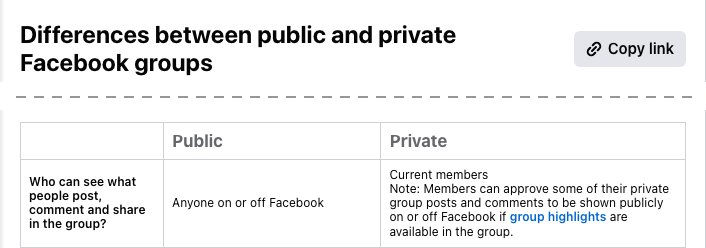
- Facebook's own comparison of the two group types.
- Public: posts can be seen by people who are not members.
- Private: only members can see posts. Reach stops at the member list.
- Private groups can still show some approved posts publicly, if the feature is on.
Screenshot of Facebook Help Center, Differences between public and private Facebook groups. Quoted words are the page's own text, taken 2026-10-17
Each post has to earn its reach, so measure what earns it
Each post earns its own reach. Here is why.
There is more content than ever, and getting a glance is cheap. Writers on the attention economy call attention the scarce thing. We think the scarcer thing is the energy to act.
Watching, reading, tapping through and signing up all take effort. People spend that effort only when the post pays them back.
Platforms say they watch for that payback. Instagram names its most important predictions for reels: how likely you are to reshare one, watch it all the way through, and like it.
YouTube says it uses viewing behavior, likes, dislikes and feedback from satisfaction surveys. It reports average view duration for every video.
So judge each post on four numbers. Views from non-followers and watch time come first.
Then shares and saves. Then replies and messages.
For a service business, replies and messages sit closest to revenue. A post with modest reach and five real messages beats a viral post with none.
How to build a big audience nobody sees in four easy steps:
1. Celebrate the follower count every month.
2. Post your offer every day. Call it consistency.
3. Count likes. Ignore replies.
4. Blame the algorithm when the stadium stays empty.
Followers you never reach are a number on a screen. That is the whole damn problem.
Organic reach is earned media: attention you get without paying for it, so nobody can buy it for you. We think the best way to earn it is a post that reports a change. More in all content is about change.
Each thing a platform says it predicts has a number you can check
| What the platform says it looks at | The number to check |
|---|---|
| Showing posts from accounts you do not follow | Views from non-followers |
| Watching a reel all the way through; viewing behavior | Average watch time or view duration |
| Resharing a reel | Shares and saves |
| Satisfaction and feedback | Replies and messages |
Sources: Instagram Ranking Explained; How YouTube Works; YouTube Help. The pairing is ours.
Reach shows who saw it; replies show who cared
- Give it a stronger first line Your people love it. Few saw it.
- Make more like it Wide reach and real conversations.
- Retire the topic Few saw it and nobody cared.
- Add a next step Popular, but it starts no conversations.
Our sorting rule for the Reach Count.
Test new posts on strangers before your followers see them
The fastest way to learn what earns reach is to test on strangers first.
Instagram has a tool for it. Trial reels go to accounts that do not follow you, and your followers do not see them in feed or Reels.
You get insights within 24 hours. You can share a trial reel with your followers at any time.
Make two versions of one idea. Change one thing, like the first line. Compare non-follower reach and watch time, then share the winner with everyone.
Not on Instagram? Post the test where most viewers are strangers, like a public group or a short video feed. Then run the same Reach Count on it.
Openings decide most of these tests. See the first three seconds and six ways to open a post.
Test on strangers first. Then show your followers.
Count, test, copy the winner, count again
- Count Reach rate per post, per place.
- Sort Misses, normal, winners.
- Test Two versions of the winning idea on strangers.
- Repeat Share the winner. Count again in 30 days.
The Reach Count as a monthly loop.
Where a Reach Count goes wrong, and the fix
Most bad audits make one of three mistakes. Each one is easy to spot and easy to fix.
Mixing places: The symptom: your group posts look great and your page posts look dead. The cause: you compared rates across places with different people. The fix: one median per place.
Counting the wrong number: The symptom: every post looks huge. The cause: you used impressions or likes instead of reach. The fix: reach first, then the four numbers.
Too few posts: The symptom: one lucky post rewrites your plan. The cause: three posts are not a pattern. The fix: wait for 10 posts in a place before you call a winner.
Still stuck? Count the posts that started a conversation. That number rarely lies.
Run your Reach Count with AI: the copy-paste prompt
Paste the prompt below into your preferred AI. It asks where you post and for your last 10 posts, one question at a time.
Then it works out your reach rates, sets your median, and marks the misses and the winners. It tells you what the winners share.
It never makes up a number. If you are missing a figure, it marks the gap instead of guessing.
Got a winner? Turn it into more pieces with one article, twenty pieces.
Paste into your preferred AI. It asks where you post and for your post numbers, then gives you your median, your winners and your next three posts.
Act as a social media analyst. Run a Reach Count audit on my organic posts.

Ask me one at a time, with the example:
1. Where do I post, and how big is each audience? (Example: Facebook page, 2,000 followers; Instagram, 900 followers)
2. For each place, my last 10 posts: reach (people who saw it at least once, not impressions). If shown: share of views from non-followers, average watch time, shares, saves, replies or messages. (Example: Post 1, reach 180, 20 percent non-followers, 4 shares, 1 message)
3. What each post was about, in one line. (Example: answer to a common customer question)

Rules:
- Never invent a number. If I do not have a figure, mark it missing.
- Reach rate = reach divided by audience size for that place. Compare posts only within the same place.
- Baseline = the median reach rate of the 10 posts in that place.
- Under half the baseline: a miss. Twice the baseline or more: a winner. Over 100 percent of the audience: non-followers carried it.
- Judge winners on non-follower share, watch time, shares and saves, and replies or messages. Not on likes or follower growth.
- For the winners, tell me what they share: the topic, the change they report, the format and the first line.
- If you can browse, first check each platform's current help pages for where reach and follower versus non-follower views appear, and tell me if anything has changed.

Show your math, then answer:
Baseline per place: [percent]
Table: post, reach, reach rate, verdict
What the winners share: [3 lines]
Next three posts to make: 1. 2. 3.
One test to run on non-followers: [what, where, what number decides it]
Run it this week
1. Run the prompt for the one place you post most. Write down your median.
2. Make two new posts on the topic of your best post. Test one on strangers first if you can.
3. Put a Reach Count on the calendar for 30 days from now. Compare the new median with the old one.
A 52,000-member group sounds like a stadium. The Reach Count tells you how many seats were filled.
Want reach from the news of the day? Read how to hook a post to the news. Then vary how much you post with a rise-and-fall cadence.
Followers are the guest list. Reach is who showed up.
One hour now, one check in 30 days
- Run the prompt Day 1 One place, last 10 posts. Write down your median.
- Make two posts Days 2 to 7 Both on your best post's topic. Test one on strangers first.
- Count again Day 30 Compare the new median with the old one.
Our plan for the first month.

Filip Kovacevic is the founder of Anar Agency in Phoenix. He spent five years running SEO, Meta ads, email, and content for medical practices across the United States, and now does the same work for healthcare, home-service, legal, and professional-service businesses, alongside AI implementation. More from Filip →
Talk it through in 15 minutes
Bring one question from this article. We will tell you what we would do, whether or not you hire us.
Book a 15-Min Chat →