Meta Andromeda: How Many New Ads to Make Each Week, and How
Meta Andromeda is the part of Meta's ad system that picks which ads get a chance with each person. It treats look-alike ads as one ad, so winners tire faster. Launch clearly different new ads every week, sized to your budget: about a quarter of it, with one sale's worth of spend per new ad.
Meta Andromeda shortened the life of a winning ad
Picture a winning ad. It sells for nine days. Then the cost per sale doubles, and nothing you touch brings it back.
The old fixes were easy. Show it to a new audience, try a new interest, or retarget the people who almost bought.
Meta now controls most of those choices. Its ad system, which includes a step called Meta Andromeda, decides which ads each person sees. Each ad gets a certain amount of life, runs a little longer if it does well, then fades.
Why would Meta do that? A feed that shows the same ad for a year is a bad feed. People scroll past it.
So the job changed. It used to be finding one great ad. Now it is building a line that makes new ones every week.
Most accounts are still hunting for one great ad. The ones that last build the line.

The advertiser used to stretch a winner; now each ad runs its course
| Before | Now |
|---|---|
| One winner could run for a year | Each ad gets a set amount of life |
| Tired? Show it to a new audience | Meta picks the audience for every ad |
| Add an interest or retarget to revive it | Those levers do little; a new ad does more |
| The job: find one great ad | The job: make new ones every week |
Our summary of the shift, consistent with Meta's Andromeda and creative diversification posts.
What is Meta Andromeda? The step that picks which ads get a chance
Meta Andromeda is the first step of Meta's ad delivery. It scans tens of millions of ads and keeps a few thousand worth showing to one person, as Meta's engineers describe it.
They built it for a flood of ads. In one month, more than a million advertisers made over 15 million ads with Meta's AI tools.
Here is the part that matters for you. Meta's system groups ads that look or feel alike and treats them as versions of one creative.
So ten small tweaks of one idea can count as one idea. A new button on the same photo still counts as the same ad.
Meta splits the problem in two. Creative fatigue is when people see one ad too often. Creative similarity is when your ads look too much alike, even if each file is new.
Both end the same way: a higher cost per result. Both have the same cure: ads that differ in look, story and message.
Our take: many accounts that say they test fifty ads are testing five ideas ten times each. That is not volume. That is one ad in ten outfits.
How delivery then matches each ad to a person is in how Meta finds your buyers.
Meta built its ad picker for a flood of ads
- Ads scanned for each person Tens of millions
- Ads kept as candidates A few thousand
- Ads made with Meta's AI tools in one month 15
Source: Engineering at Meta, Meta Andromeda post, December 2024. Read 2026-10-17.
Fatigue means seen too often; similarity means ads look too alike
| Problem | What it means | The sign | The fix |
|---|---|---|---|
| Creative fatigue | The same people see one ad too often | Cost per result climbs as the ad ages | Retire it and release a new one |
| Creative similarity | Your ads look too much alike, even as new files | Meta treats them as one creative | Change the look, story and message, not the button |
Definitions: Meta for Business, Demystifying Creative Diversification, December 16, 2025. Fixes are ours.
Look-alike ads count as one creative, and fatigue is not the same as similarity
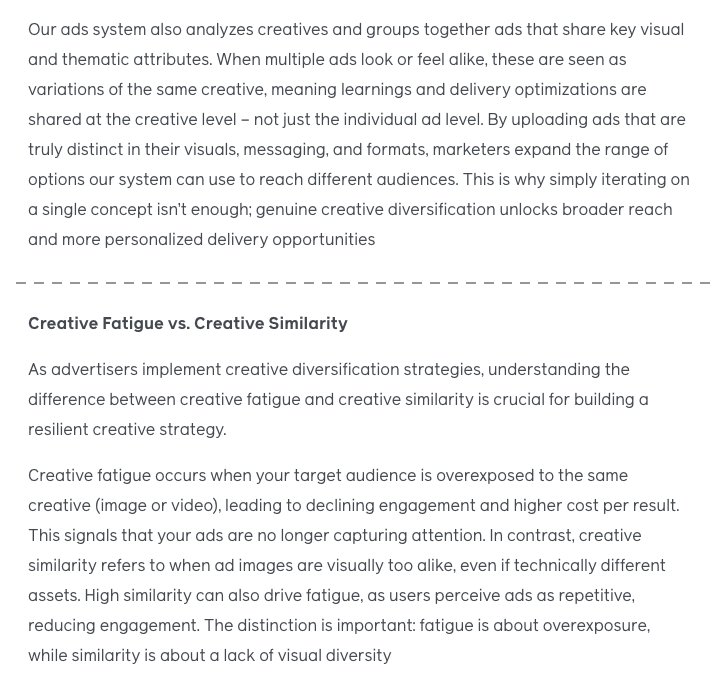
- Look-alike ads get grouped. Ten tweaks can count as one ad.
- A new button on the same photo is not a new ad to Meta.
- Fatigue: the same people saw it too often. Retire it.
- Similarity: your ads look too much alike. Change the look, story and message.
Screenshot of Meta for Business, Demystifying Creative Diversification (December 16, 2025). Pinned phrases are quoted from that page, taken 2026-10-17
The Volume Line is a weekly production line for Meta ads with six stations. One: a line bank of 30 or more openings sorted by pain, outcome, objection and proof. Two: a scene bank and a reusable actor library.
Three: assembly in numbered, word-timed pieces. Four: a person checks every ad for facts, picture, sound, rules and invented customers. Five: one batch a week into a new ad set, sized at 25 percent of the budget with one sale's worth of spend per new ad.
Six: a weekly review that retires tired ads and sends the winners' shared reason back to station one.
How many new ads should you make each week? Let the budget decide
Make as many clearly different ads as your budget can test, and launch them every week. For most accounts that is 3 to 15 ads, not fifty.
Meta's own guide to creative diversification says the strongest advertisers launch new ads weekly. For its shopping campaigns, it suggests 20 to 30 percent of the budget for testing new ads.
Meta also gives advice that points the other way. Its learning phase page says to avoid high ad volumes, because the system learns less about each ad when there are many.
Both are true. Test many ideas over the month, but only a few ads at a time.
Our rule: spend about 25 percent of the budget on new ads. Give each new ad about one sale's worth of spend in its first week.
The math is short. Multiply your weekly budget by 0.25, then divide by your cost per sale. That is your batch.
Example: $100 a day is $700 a week. A quarter of that is $175. At $35 a sale, that buys five new ads.
At $1,000 a day, the same math gives fifty. Fifty ads a week only makes sense at about $1,000 a day.
Is your batch under three ads? Release every two weeks instead, with two weeks of that budget.
Do you collect leads instead of sales? Use your cost per lead, and set it with your max allowable cost per customer.
Put each batch in a new ad set. Meta treats adding an ad to a live ad set as a significant edit, which sends it back into the learning phase. That is the testing period, when results are less steady.
How to burn a month of ad budget in four easy steps:
1. Make ten copies of your winner with new button colors. Call it testing.
2. Drop all ten into the ad set that already works.
3. Let an AI write the claims. Skip the read-through.
4. When costs climb, blame the algorithm.
Brand-new offer with no sales yet? Size that test with how much to spend on a new offer first.
Example: fifty new ads a week only fits a $1,000-a-day budget
New ads per week = daily budget x 7 x 25 percent, divided by a $35 cost per sale, rounded down
- $50 a day 2
- $100 a day 5
- $300 a day 15
- $1,000 a day 50
Worked example with a made-up $35 cost per sale. At $50 a day the batch is under 3, so release 5 every two weeks. The math is ours.
Meta says launch weekly and avoid too many ads; both fit one rule
| Who | What they say | What to do with it |
|---|---|---|
| Meta's diversification guide | Launch new ads weekly. For shopping campaigns: 20+ diversified ads, 20 to 30 percent of budget on new ads. | Release every week. |
| Meta's learning phase page | Avoid high ad volumes. Many ads means less learning per ad. | Keep each batch small. |
| Our rule | About 25 percent of budget on new ads, one sale's worth of spend per new ad. | Batch = weekly budget x 0.25 / cost per sale. |
Sources: Meta for Business, Three steps to optimize your performance with creative diversification; Meta Business Help Center, About the Learning Phase. Read 2026-10-17.
Station one: write the lines before you make any pictures
The Volume Line starts with words. A line bank is a list of 30 or more ad openings, written before anyone makes an image.
Sort each line by what it leads with: a pain, an outcome, an objection or a piece of proof. That sorting makes ads different. Colors do not.
Meta says the same thing in its own example: one ad on emotional appeal, another on product features.
The best openings name the exact moment your buyer is in. For example, an ads service might open: you doubled the budget on a winner, and your cost per sale tripled overnight.
Where do lines come from? Your buyers. Sales calls, reviews, refund notes, the questions people ask before they pay.
AI can sort, trim and vary those lines. It cannot know your buyer for you. Left alone, it writes the average of everything it has read.
To teach it your voice, use the rule-building loop in our AI marketing workflows guide. For which words to lead with, see before-words and after-words.
Pictures got cheap. Knowing your buyer never did.
Sort every opening by what it leads with
| Pile | It leads with | Example opening (made-up cleaning service) |
|---|---|---|
| Pain | What hurts right now | You get home at seven and the kitchen still looks like breakfast. |
| Outcome | The life after | Walk in Friday night to a house that is already done. |
| Objection | The doubt that stops the buy | Worried about strangers in your home? Same cleaner every visit. |
| Proof | Something they can check | Read the reviews from families on your street before you book. |
Example lines written for a made-up business. Proof lines must point to real proof.
Station two: build a scene bank and an AI actor library once
A scene bank is a small library of pictures and short clips that look nothing alike. A kitchen, a truck cab, a desk, a street at night.
For video ads with people, add an actor library. That is a set of made-up presenters you build once and reuse in every ad.
Build it in one sitting, as the steps below show. Then make versions of the same face: older, younger, a new outfit, a new room.
For example, one AI ad producer made more than 800 actors in a day for about $52. From one set of about 200, he kept about 180.
The same producer made 18 one-minute videos for $22 in generation fees. That is about $1 a finished minute. Prices move fast, so check today's rates.
The pieces are cheap now. Good judgment is the costly part.
One hard rule. An AI actor may show and explain. Never use one to fake a before-and-after or a result nobody got.
Does the actor have to look perfectly real? No. For example, one skin-care brand's AI ad scaled to about $100,000 a day and looked obviously AI.
A more realistic batch for that brand had a weaker hook rate. Hook rate is the share of viewers who keep watching past the first seconds.
What wins is the opening, not how real the actor looks. More on that in the first three seconds of an ad and our UGC ad format library.
Five steps to an AI actor library
- 1. Collect references About 200 real phone-camera style photos of people in everyday places.
- 2. Generate actors Many faces, settings and angles from those references, in one sitting.
- 3. Keep the usable ones Drop anything with odd hands, eyes or skin. Expect to lose some.
- 4. Make versions Same face, older, younger, new outfit, new room. Never a fake before-and-after.
- 5. Log each actor An ID and a note, so any ad can pull the same presenter again.
The method, in five steps.
Example: the pieces now cost dollars, not days
| What was made | Example cost | How sure |
|---|---|---|
| More than 800 AI actors in one day | About $52 | Example; we have not seen the bills |
| About 180 usable from a set of about 200 | Included above | Example; not verified |
| 18 one-minute AI videos | $22, about $1 a finished minute | Example; prices change fast |
Example numbers from other businesses. Not our results, and not verified by us.
Station three: assemble in numbered pieces so one bad clip costs one fix
Assembly pairs lines with scenes. Ten lines times five scenes makes fifty ads, and nobody had to write fifty ads.
For video, cut each script into short chunks of about 120 characters. Each chunk becomes one clip.
Then put a small number in the corner of every clip. Clip one, clip two, clip three.
Why bother? When clip three goes wrong, you ask for clip three again. The rest of the ad stays put.
Without numbers, one bad second means rebuilding the whole ad. That is how a fifty-ad week turns into a five-ad week.
Trim with word timings. A transcript with a time on every word shows where each word starts, so cuts land between words.
Keep a pronunciation list. Computer voices trip on some words. Spell them the way they sound, put a space inside joined brand names, and skip all caps.
Cutting real footage instead? The same numbered, word-timed method runs our clip pipeline.
Cut, number, trim, fix one clip at a time
- 1. Chunk the script About 120 characters per chunk. One chunk, one clip.
- 2. Number every clip A small number in a corner of each clip.
- 3. Trim on word timings Cut between words, never inside one.
- 4. Fix by number Bad clip three? Remake clip three only, then join again.
- 5. Update the word list Every mispronounced word gets a sound-it-out spelling for next time.
The method, in five steps.
Number every clip, so one bad word costs one remake
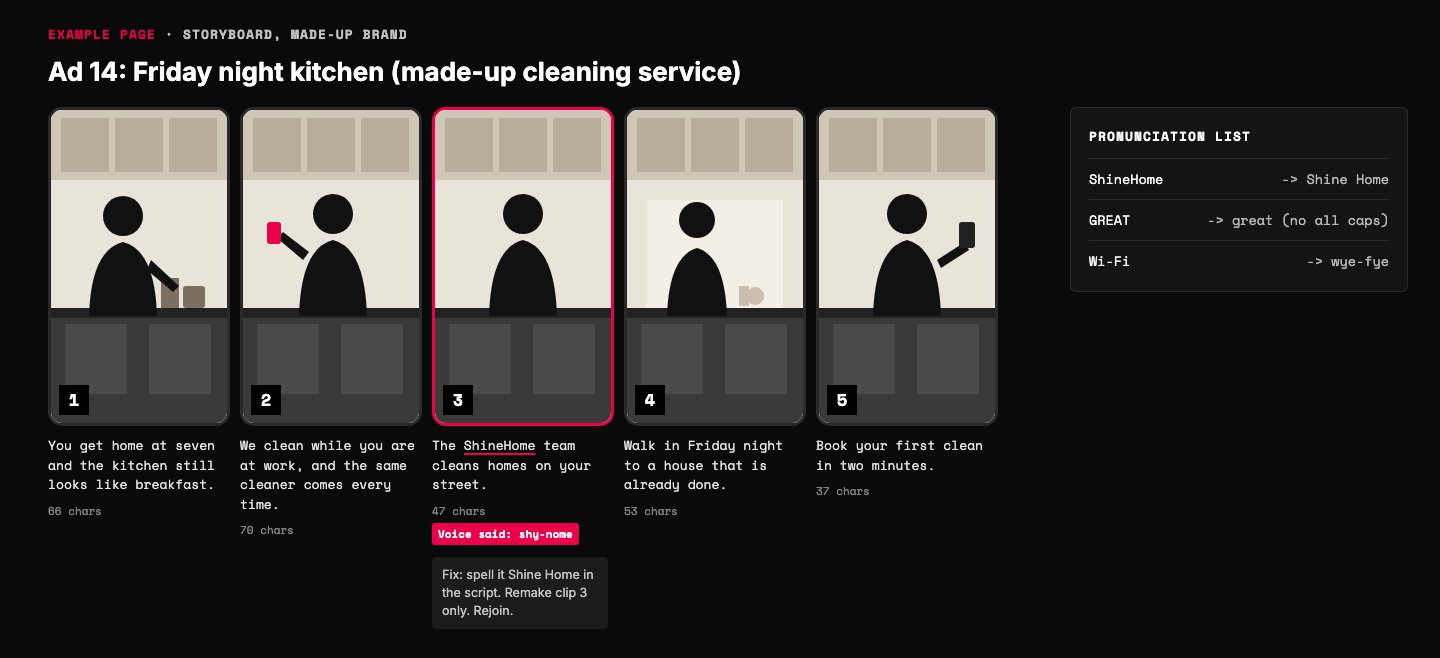
- Every clip carries its number. Bad clip? Ask for that number again.
- About 120 characters or less per clip.
- The gate caught a mispronounced word.
- Every fix goes on the list, so it never happens twice.
Example page built for this article with a made-up brand
Station four: a person checks every ad before it goes live
The gate is a person who looks at every ad before release. They check every ad, not just a few.
Volume multiplies mistakes as fast as it multiplies ads. One bad claim in a template ships fifty times.
Check five things: the facts, the picture, the sound, the rules and the people. The table below says what fails at each one.
Sound gets missed most. A clean studio voice over a shaky phone video on a busy street sounds wrong at once.
Rules matter at volume too. Meta's personal attributes policy applies to all fifty ads, not just the first.
The legal line is about fake people with fake stories. The FTC's rule on reviews and testimonials bans testimonials from people who do not exist or who never used the product.
The FTC's own answers say there is no blanket ban on AI avatars. The problem is a fake or false testimonial. Courts can impose civil penalties for knowing violations.
Our rule is stricter. AI presenters explain. Only real customers, with written permission, say it worked for them.
An invented customer is not a creative choice. It is a legal risk with a face.
Five checks a person runs on every ad
| Check | What fails | The fix |
|---|---|---|
| Facts | A number or claim nobody can source | Trace it or cut it |
| Picture | Extra fingers, melted letters, a logo that is almost right | Remake that piece |
| Sound | Studio voice on a street scene; a mangled word | Match the room; fix the spelling |
| Rules | A line that tells the viewer what they are | Rewrite it about the situation |
| People | An AI face saying it worked for them | Real customers only, with permission |
Our gate checklist. Rules: Meta personal attributes policy. People: FTC reviews and testimonials rule.
An AI presenter may explain; it may never pose as a customer
| Allowed | Not allowed |
|---|---|
| An AI presenter explains how the product works | An AI face says the product changed its life |
| A real customer's words, with written permission | Invented reviews or quotes |
| An AI actor in different rooms and outfits | An AI before-and-after of a result nobody got |
Our rule, stricter than the law. FTC: no blanket ban on AI avatars, but fake or false testimonials are banned.
Stations five and six: release on a schedule, retire on a rule
Release one batch on the same day each week, into a new ad set. That way, each weekly review looks at one full week of results.
The review asks two questions. Which ads are tired? What did the winners have in common?
Tired means the cost per result has climbed while the same people keep seeing the ad. Turn it off. Do not edit it, because a change to the creative restarts learning.
Then write one line about why the winners won. Write the reason, not a description of the ad. That line goes back to station one.
How to read each result without fooling yourself is in our creative testing engine.
Hiring this out? Pay for a quality bar, not a count. A fixed number of ads a week tempts anyone to cut corners, like dropping the extra footage that makes a video feel real.
Stations one to three are where AI saves time. Station four is where it never works alone.
Meta's settings change often, so they live in the dated box below.
The Volume Line runs every week, and the review feeds the next batch
- Line bank 30+ openings in four piles.
- Scene bank Different scenes and reusable actors.
- Assembly Numbered, word-timed pieces.
- The gate A person checks every ad.
- Release One batch a week, new ad set.
- Review Retire tired ads; feed the reason back.
The Volume Line, as set out in this guide.
Plan your Volume Line with AI: the copy-paste prompt
Paste the prompt below into your preferred AI. It asks what you sell, your budget and your cost per sale. Then it sizes your weekly batch and drafts your first line bank.
It never invents your numbers. If it can browse, it checks Meta's current help pages first and tells you what changed.
It writes the lines. You still run the gate.
Paste into your preferred AI. It asks four questions, then sizes your batch and drafts your line bank.
Act as a creative planner for my Meta ads. Use only my answers and the rules below. Never invent a number; if one is missing, ask me.

If you can browse, first read Meta's current help pages on the learning phase, significant edits and Advantage+ creative, and tell me if anything below has changed.

Ask me one at a time, with the example:
1. What do you sell, and to whom? (Example: house cleaning for busy parents)
2. Your daily Meta budget? (Example: $100)
3. Your cost per sale, or per lead if leads are the goal, over the last 30 days? (Example: $35)
4. Five things buyers say before they pay: pains, hopes, doubts or proof. (Example: "I come home to a mess every night")

Rules:
- Weekly batch = daily budget x 7 x 0.25, divided by cost per sale. Round down.
- Under 3 ads: release every two weeks and use two weeks of that budget.
- Each batch goes into a new ad set. Never add ads to a live ad set.
- Each ad must differ in its opening line AND its scene. A new button or color is not a new ad.
- Sort lines into four piles: pain, outcome, objection, proof. Spread each batch across at least three piles.
- No made-up customers, results, statistics or before-and-after pictures. An AI presenter may explain; only a real customer, with written permission, may say it worked for them.
- A person checks every ad for facts, picture errors, sound and Meta policy before release.
- Retire an ad when its cost per result climbs while the same people keep seeing it. Never edit a live ad; replace it.

Show your math, then answer in this format:
Weekly batch: [number] ads, released every [week / two weeks]
Budget for new ads: $[ ] a week
Line bank: 30 openings, each marked with its pile
This week's batch: [each line paired with a scene idea]
Gate checklist: [5 checks]
Review day and retire rule:
Next three actions: 1. 2. 3.
Start the line this week
1. Run the prompt. Write down your batch size and your review day.
2. Write the line bank. Thirty openings in four piles.
3. Ship the first batch into a new ad set, after a person checks every ad.
That nine-day winner will not come back. The next one is already on the line.
Stop hunting for the perfect ad. Build the place where good ads come from.

Filip Kovacevic is the founder of Anar Agency in Phoenix. He spent five years running SEO, Meta ads, email, and content for medical practices across the United States, and now does the same work for healthcare, home-service, legal, and professional-service businesses, alongside AI implementation. More from Filip →
Talk it through in 15 minutes
Bring one question from this article. We will tell you what we would do, whether or not you hire us.
Book a 15-Min Chat →