Direct Mail Marketing Cost: What a Mailing Costs and Who to Send It To
Direct mail costs three things per piece: postage, printing and the mailing list. Postage and printing are close to fixed, so the list is the cost you shop for. To judge a mailing, divide your cost per piece by the profit on one sale.
That is the reply rate you need to break even.
Direct mail marketing cost comes down to three numbers
A postcard lands on a kitchen counter. It sits between a power bill and a pizza menu.
Someone picks it up. They have to, even to throw it away.
That is the case for direct mail in one scene.
And the post office uses the same price list for you as for a bank. No auction. No bidding war.
So what does direct mail marketing cost? Three things per piece: postage, printing and the list of names you mail.
Postage is a published price. Quotes from online printers tend to land within pennies of each other. The list is the cost that really moves.
For example, one direct mail business priced a full postcard mailing at $600 to $750 per thousand pieces, list included. Letters ran $700 to $900 per thousand.
Expensive? Wrong question. The right one is how many replies you need to get the money back.
Example: the list is the part of the price that moves
All-in cost per 1,000 pieces in one direct mail business's example, and list rental alone
- Postcards, per 1,000, list included $600-750
- Letters, per 1,000, list included $700-900
- List rental alone, per 1,000 names $80-350
Example figures quoted by a direct mail business in 2024. Example numbers from other businesses. Not our results, and not verified by us.
Postage and printing are fixed, so the list is what you shop for
Every piece has three costs. Postage and printing barely change from one mailer to the next. The list changes everything.
Online ad prices go up and down because advertisers bid against each other. Mail has no bidding. Sending more never raises your price per piece.
That is why a mailing that works can keep working. For example, one mailer ran the same campaign for six years with no change to the piece, at the same conversion rate.
A compiled list is names gathered from public and business data, sorted by traits like trade, age or ZIP Code. A buyer list is people who already bought something by mail or online. Buyer lists cost more to rent.
Own the list and that cost drops to zero. Remember that. It decides where you start.
Current postage sits in the box below, read from the USPS price list. Our stamp rule: postcards go First-Class or presorted First-Class, a lower rate for mail sorted ahead of time. Letters get a real stamp, because a printed postage mark tells the reader it is an ad.
Want every home on a street instead? The Postal Service runs Every Door Direct Mail for that.
No list needed. You pick the routes on a map.
Example: one list can cost more than four times another
Rental price per 1,000 names, by type of list
- Compiled list, low end 80
- Buyer list, typical high end 220
- Highest-priced lists seen 350
Example rental prices quoted by a direct mail business in 2024. Example numbers from other businesses. Not our results, and not verified by us.
Today's postage lives on one free USPS page. Read the date first.
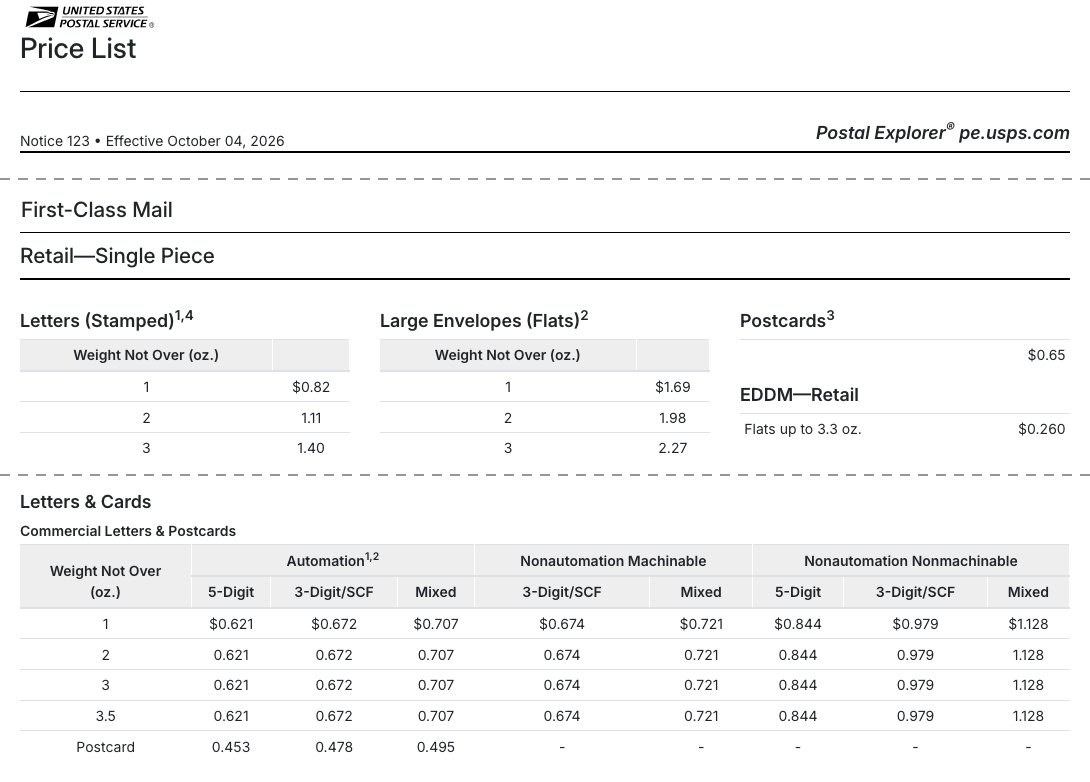
- Prices change. Check this date first.
- The stamp price for one postcard.
- A real stamp on a one-ounce letter. Our rule for every letter.
- Every home on a route, no list needed.
- Presorted postcards through a mail service cost less per card.
Screenshot of the USPS Price List (Notice 123, pe.usps.com), effective October 4, 2026, taken 2026-10-17
The List Ladder is our order for choosing who gets your mail: your own customers, then quiet subscribers matched to postal addresses, then the newest buyers on a rented list, then older buyers on that list, then compiled lists. Before mailing, divide cost per piece by profit per sale to get the break-even reply rate. Mail one rung, count replies on a number only that mailing uses, repeat what beats break-even, and step down a rung only when the one above pays.
How many replies do you need to break even?
Divide your cost per piece by your profit on one sale. The answer is the reply rate you need to get your money back.
This is a break-even sum, and it takes one line. Profit means what is left from a sale after the cost of delivering it.
Example: postcards at $0.75 each, with everything included. A sale that leaves you $500. Divide $0.75 by $500 and you need 0.15 percent, or three sales per 2,000 pieces.
Now the same postcard for a sale that leaves $50. You need 1.5 percent, ten times as many replies.
Possible? Sometimes. Comfortable? No.
This is why a cheap one-time product struggles in the mailbox. For offers sold to businesses, mail usually needs a price of about $3,500 or more.
Low prices can still work with repeat buying. For example, one mail-order company sold only $39 products, but it had 17 of them. Its average customer was worth about $450, so it could afford to lose money on the first sale.
Count that full value, called customer lifetime value, when one sale is too small. It is the same math we use to set a maximum allowable cost per customer.
One widely shared figure puts cold-list response at 2.7 to 4.4 percent. It blends very different mailings, so treat it as a rough check. Your break-even rate is the number that decides.
Three numbers tell you the reply rate a mailing needs
- 1. Cost per piece Postage plus printing plus the list, per name.
- 2. Profit per sale What is left from one sale after the cost of delivering it.
- 3. Divide Cost per piece divided by profit per sale is your break-even reply rate.
The break-even sum, as set out in this guide.
Example: the bigger the profit per sale, the fewer replies you need
Break-even reply rate for a $0.75 postcard, by profit on one sale
- $50 profit 1.5
- $100 profit 0.75
- $500 profit 0.15
- $1,500 profit 0.05
Worked example: $0.75 divided by each profit figure. The math is ours.
Example results show what a mailing can carry, not what yours will do
| The case | The numbers | How sure |
|---|---|---|
| Marketing training sold to power-washing companies | 5,000 pieces, about $3,000 cost, about $45,000 back | Example; we have not seen the data |
| A mail-order company with 17 products at $39 | Average customer worth about $450 | Example; not verified |
| A widely shared industry figure | Cold-list response of 2.7 to 4.4 percent | Blends very different mailings; a rough check only |
Example numbers from other businesses. Not our results, and not verified by us.
Climb the List Ladder: mail the people who know you first
The List Ladder is our order for choosing who gets the mail. Start with the people most likely to answer. Step down one rung only after the rung above pays.
Rung 1: your own customers. They already paid you. Mail them for repeat buys, upgrades and the next thing they need.
Rung 2: your own quiet list. Leads and email subscribers who stopped responding. A postcard can wake them up.
Rung 3: the newest buyers on a rented list. List owners call them the hotline. These are people who bought in the last 30 to 60 days.
Rung 4: older buyers on the same list. Go about six months further back, then further again.
Rung 5: compiled lists. Every accounting firm in three states, or every home in two ZIP Codes. Cheapest to find, least likely to answer.
Why this order? People who have bought before answer more than people who only fit a description. Buyers win.
Our take: most businesses start at rung 5 because it feels like growth. Their best list is already in their own inbox.
Is your customer anyone nearby? Then mail routes and compiled lists are your lower rungs. More on that in local lead gen ads.
Start at the top rung and step down only when the rung above pays
- 5. Compiled lists Sorted by trade, size or ZIP Code. Cheapest to find, least likely to answer.
- 4. Older buyers The same rented list, about six months back, then further.
- 3. The hotline Newest buyers on a rented list, last 30 to 60 days.
- 2. Your quiet list Leads and subscribers who stopped responding, matched to postal addresses.
- 1. Your customers People who already paid you.
The List Ladder, our order for choosing who gets the mail.
Your best two rungs cost little or nothing to get
| Rung | Where you get it | Example cost |
|---|---|---|
| 1. Your customers | Your own sales records | Free |
| 2. Your quiet list | Your email tool, plus an address-matching service | About 3 cents a record |
| 3. The hotline | A list broker or a list search site | $200 to $350 per 1,000 |
| 4. Older buyers | The same broker | Ask for the older bands |
| 5. Compiled lists | Data vendors, sorted by trade, size or ZIP Code | From about $80 per 1,000 |
Example prices quoted by a direct mail business in 2024. Ask for current quotes.
Wake up the email subscribers who stopped opening
Most email lists have a quiet majority. If one in five people opens your emails, four in five never see them.
Mail reaches them. Here is how.
1. Pull everyone who has not opened an email in 90 days.
2. Upload that file to a data append service. It matches each email address to a postal address.
3. Mail a plain postcard with one phone number. Say you have emailed a few times, the emails may not have reached them, and you have something worth a talk.
4. Answer the phone. Or send the calls to whoever books your appointments.
Expect a partial match. A good file can match up to about 75 percent of addresses. In one example, a five-year-old list still matched about 40 percent.
For example, one business mailed this postcard to its 90-day non-openers. The calls came in fast. We have not seen its numbers.
One legal warning. The service may also hand back phone numbers. Do not text them without permission; the Telephone Consumer Protection Act covers texts as well as calls.
People who call back belong in a nurture email sequence, not back in the quiet pile.
Example: even a five-year-old email list matched 40 percent of addresses
Share of email addresses matched to a postal address by an append service
- A good, fresh file 75
- A five-year-old list 40
Example match rates quoted by a direct mail business in 2024. Example numbers from other businesses. Not our results, and not verified by us.
One card, one reason, one number to call now
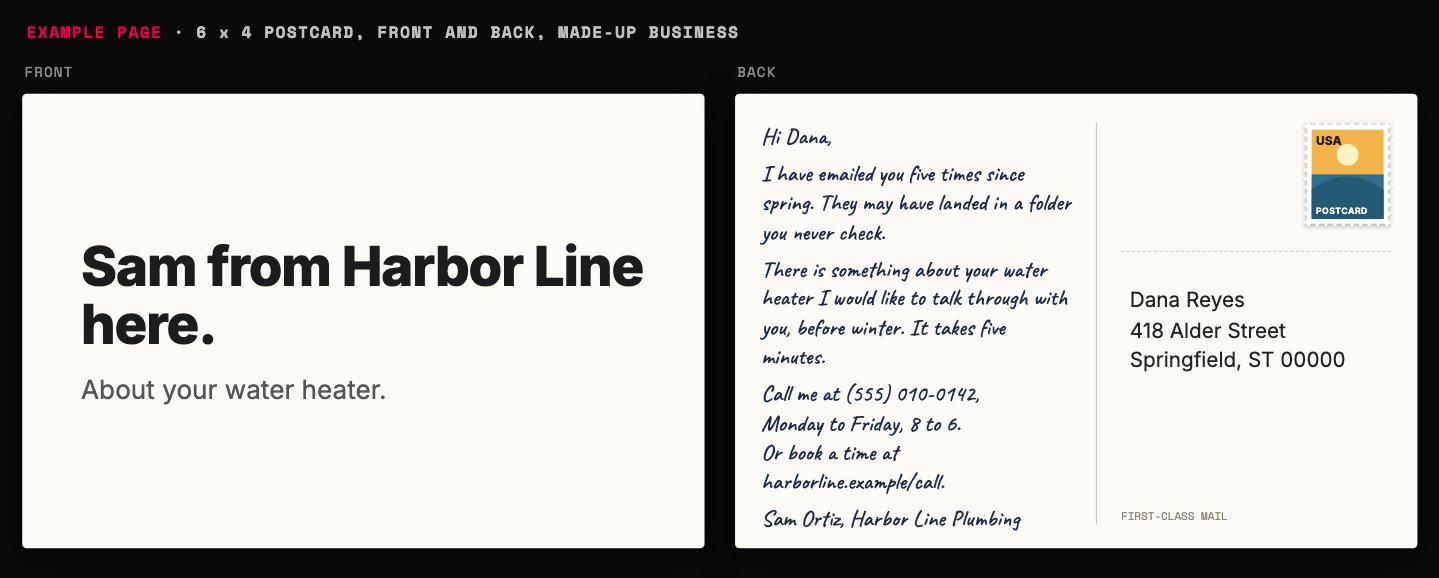
- Say what happened. Emails were sent, maybe missed.
- One reason to call. No pitch on the card.
- One number only this mailing uses, so every call gets counted.
- Hours tell people they can call right now.
- A calendar for people who want a slot, second.
Example page built for this article with a made-up brand
How do you rent a mailing list?
You rent a mailing list through a list broker, an agent who finds and books lists for you. Most rentals are for one mailing only.
Search first. NextMark works like a search engine for rentable lists. Search your buyer's topic and open the data card.
A data card is the list's spec sheet. It shows the price per thousand names, what these people bought, and whether they bought, replied or only signed up.
Then let a broker call you. Ask what else these buyers buy. Brokers do well when your mailing works, so they will point you to more lists.
Rent the hotline first. If it pays, rent the next group of names, about six months older. Then older again.
For example, in one business-opportunity market, a hotline returned $4 to $5 for every $1 spent. Older names on the same list returned $2 to $3. Less, but still profit.
Mail it once. A rented list is single use unless the contract says you own it. List owners hide decoy addresses, called seed names, so they see every reuse.
Reuse it and you get a warning, then a ban from that broker. Everyone who replies, though, is yours to mail again.
Rent a mailing list in four moves
- 1. Search Use a list search site and read the data card: price, what they bought, how they joined.
- 2. Talk to a broker Ask what else these buyers buy.
- 3. Rent the hotline The newest buyers first. Older bands only if it pays.
- 4. Mail it once Single use. Seed names catch reuse. Replies are yours.
The rental steps, as set out in this guide.
Example: older names on a winning list still paid, at about half the rate
- The hotline Last 30 to 60 days Rent first. Example return: $4 to $5 for every $1 spent.
- The next band About 6 months older Rent only if the hotline paid.
- The back file Older still In some markets, even five-year-old names paid. Example return: $2 to $3 for every $1.
Example returns from one business-opportunity market. Example numbers from other businesses. Not our results, and not verified by us.
Postcard or letter? Pick by what the reader must decide
Pick the format by what the reader must believe before they reply. Not by your price.
A postcard is enough when all you need is a reply. Use a letter when you must qualify people, or when they have never heard of you.
Price does not decide it. For example, a single postcard with no letter brought one gold IRA seller about $800,000 from its first mailing.
For a business letter, write one page of about 250 words. Sound like a person inviting someone they half know to talk.
Say a little about you. Say who you help and what one client got. Then say why you are writing.
Stiff business language sinks it. The reader smells a pitch and stays off the phone.
Higher price? Add lumpy mail, meaning a small object in the envelope. For example, one company mailing contractors tucks in a $5 coffee gift card with a note that the coffee is on them.
Selling to doctors or government buyers? Check the gift rules in that field first.
Choose the format by what the reader must decide, not by your price
| Postcard | One-page letter |
|---|---|
| You only need a reply | You need to qualify people first |
| They already know you | They have never heard of you |
| First-Class or presorted postage | A real stamp, always |
| One offer, one number | About 250 words, plain and friendly |
Our rules for choosing a mail format.
Let people call now, not only book a call
Give the reader one easy way to reply, and make it a phone number when you can. A booked call gets fewer replies than a call right now.
Why? A booking asks for a time in the future. People forget, or cool off, and miss it.
The call itself changes too. When they call you, they just read your piece and they want something. When you call them back days later, their first question is, "What do you do again?"
So offer both. A calendar for people who want a slot. A phone number, with your hours, for people ready now.
Other reply routes work in some markets: a web address, a QR code, a text line or a plain email address. An email address has a bonus. Every reply hands you their email.
Whatever you pick, use a number or code that only this mailing uses. Then you can count replies per list. Do the book-a-call math if you keep the calendar.
How to waste $3,000 on postcards in four easy steps:
1. Rent a cold list before you mail your own customers.
2. Print a glossy letter with no stamp, so it looks like junk.
3. Make people book a call for next Tuesday.
4. Reuse the rented list, get banned, and call it a lesson.
That is not marketing. That is expensive recycling.
A call right now beats a call next Tuesday
| Book a call | Call now |
|---|---|
| Picks a time in the future | Talks while the piece is in their hand |
| Some forget or cool off and miss it | No slot to miss |
| You call them: 'What do you do again?' | They call you, ready to ask |
| Keep it for people who want a slot | Print it with your hours, on every piece |
Our rules for reply routes. Offer both; lead with the number.
Mail it, count it, then repeat what works
Mail one rung of the ladder, count the replies against your break-even rate, then decide.
Above it? Mail again.
Below it? Change one thing.
Change the list or the offer, never both in one test. The same rule runs our one-variable ad tests.
A first test costs real money. Our math: at $0.60 to $0.75 a piece, 1,000 postcards cost $600 to $750.
That price is a filter. It keeps out people who only dabble, and it makes you do the sum first.
When a mailing beats its break-even rate, leave it alone. Same list, same piece, same offer, every month. That is the Repeat step.
Then test the next rung down. Your winner keeps paying while you look for the next one.
The rules stay light but real. Mail is advertising, so claims must be truthful and backed up. Mail fraud is policed by the Postal Inspection Service.
Honor every request to stop mailing. If you rent consumer lists, ask the broker whether names are screened against DMAchoice, the mail opt-out list.
Mail, count, decide, repeat, then test the next rung
- Mail One rung, one piece, one number
- Count Replies on that number only
- Decide Above break-even or below
- Repeat Same list, piece and offer while it pays
- Step down Test the next rung, one change at a time
The List Ladder loop.
Cost your first mailing with AI
Paste the prompt below into your preferred AI. It asks for your costs and your profit per sale. Then it works out your break-even rate and your first rung.
It never guesses postage. It reads the current USPS price list if it can browse, or it asks you.
Run it before you print anything. A prompt is free. A print run is not.
Paste into your preferred AI. It asks about your costs, profit and lists, then gives you a cost per piece, a break-even rate and a first rung.
Act as a direct mail planner. Work out what one mailing costs and whether it can pay, using the List Ladder.

Ask me one at a time, with the example:
1. What do you sell, and what profit is left from one sale after delivery costs? (Example: roof repair, $1,200 profit)
2. How many customers and email subscribers do you have? How many have not opened an email in 90 days? (Example: 800 customers, 6,000 subscribers, 4,500 not opening)
3. Postcard or letter, and how many pieces? (Example: postcard, 2,000)
4. Your quotes for printing, and for any list rental or address matching. (Example: printing $0.08 a piece, list $0.20 a name)

Postage: never invent a price. If you can browse, read the current USPS Price List (Notice 123) on pe.usps.com and tell me the date it took effect. If not, ask me for the price.

Rules:
- Cost per piece = postage + printing + list or matching cost per name.
- Break-even reply rate = cost per piece / profit per sale. Show it as a percent and as replies per 1,000 pieces.
- If one sale cannot cover it, say so. Suggest counting repeat purchases, or a higher-value offer.
- List Ladder order: own customers, quiet subscribers matched to postal addresses, newest buyers on a rented list, older buyers on that list, compiled lists. Recommend the highest rung I have that is big enough to test.
- Rented lists are for one mailing. People who reply become mine.
- Postcard when I only need a reply. One-page letter of about 250 words when the reader must be qualified or does not know me. A real stamp on every letter.
- One reply route only this mailing uses: a call-now number with hours, plus a calendar for people who want a slot.
- No texts to matched phone numbers without permission. Truthful claims only. Honor every request to stop mailing.

Show your math, then answer:
Cost per piece: $
Total cost: $
Break-even: % (replies per 1,000)
First rung to mail:
Reply route:
Mail again if: / Change one thing if:
Next three actions: 1. 2. 3.
What to do this week
1. Export everyone who has not opened an email in 90 days. Get a quote to match postal addresses.
2. Run the prompt with your real profit per sale. Write down your break-even rate.
3. Mail your own customers first, with a call-now number only this mailing uses.
Before you scale it, check the numbers on the whole offer.
Your subscribers stopped opening email. They never stopped picking up the mail.

Filip Kovacevic is the founder of Anar Agency in Phoenix. He spent five years running SEO, Meta ads, email, and content for medical practices across the United States, and now does the same work for healthcare, home-service, legal, and professional-service businesses, alongside AI implementation. More from Filip →
Talk it through in 15 minutes
Bring one question from this article. We will tell you what we would do, whether or not you hire us.
Book a 15-Min Chat →