Marketing Systems Audit: 20 Questions That Show Where Your Growth System Breaks

A marketing systems audit checks whether your marketing runs on systems or on people remembering things. Ours asks 20 yes-or-no questions about lead data, reply speed, feedback, ownership and goals. A yes counts only if someone opens the proof within five minutes.
Fix any zero in the basics first, then the deepest fix your team can make this quarter.
What a marketing systems audit should tell you
Someone asks where last month's leads came from. The marketing lead says the CRM tracks that. Easy.
So you open five leads. Three of them say Unknown.
The tracking was set up. Nobody checked it.
That gap is what a marketing systems audit checklist is for. Ours has twenty yes-or-no questions, and a yes counts only if someone opens the proof in five minutes.
Most marketing audits grade your ads, your site and your copy. This one grades the machine behind them. Do leads, feedback and decisions move on their own, or only when one person remembers?
A low score is not an insult. It is a short list, in the order you should fix it.
An opinion audit tells you how the team feels; a proof audit tells you what to fix
| Opinion audit | Proof audit |
|---|---|
| Asks "do we track lead source?" | Opens five leads from last week |
| Scores on a 1 to 5 feeling | Scores 0 or 1 on evidence |
| One person fills it in | Three people, proof on screen |
| Ends with a long list of ideas | Ends with one fix, an owner and a number |
Our method, not a study result
Marketing engineering means deciding with data, then building the tools
The term is older than the job title. Gary Lilien and Arvind Rangaswamy used it in the late 1990s, and their textbook Principles of Marketing Engineering and Analytics, written with Arnaud De Bruyn, gives the definition.
In plain terms, marketing engineering means turning data, know-how and judgment into tools that help marketers decide better. The authors set it against two other modes. Conceptual marketing decides from the gut, and automated marketing hands the whole decision to software.
Their rule for choosing still works. Automate a decision when a wrong call is cheap, like a product recommendation or a keyword bid. Keep a person in the loop when a wrong call is expensive, like how the company is positioned.
We add one thing: the building. The book already says the models have to be built and put to work inside support systems.
Today those systems are pipelines, agents, tests and reports. Someone has to build them, and that person is the marketing engineer described in what a marketing engineer is.
So what does an audit check? Whether those systems exist. And whether anyone can prove it.
Automate the cheap decisions; keep judgment for the expensive ones
| Mode | How the decision gets made | Use it when |
|---|---|---|
| Conceptual marketing | From experience and gut feel alone | Rarely on its own: there is nothing to check it against |
| Marketing engineering | Data and models, plus a person's judgment | A wrong call is expensive, such as positioning |
| Automated marketing | Software decides end to end | A wrong call is cheap, such as a product recommendation or a keyword bid |
Modes and the cheap-versus-expensive rule: Lilien, Rangaswamy and De Bruyn, Principles of Marketing Engineering and Analytics. Wording ours.
The Five-Minute Proof is the scoring rule of our marketing systems audit. Score 20 yes-or-no questions in five groups: foundations, speed, feedback, rules and goals. A yes counts only if someone opens the proof on screen within five minutes.
Fix zero-scoring foundations first, then the zero highest on the ladder (goals, then rules, feedback and speed) that your team can change this quarter. Date the sheet and re-score every 90 days.
A yes counts only if you can open the proof in five minutes
The Five-Minute Proof is our scoring rule. A yes counts only when someone opens the evidence on screen within five minutes: a file, a log, a report or a dated note.
Self-scored checklists are not new. The Organizational Checkup in Gino Wickman's Traction has owners rank 20 statements from 1 to 5, turns the total into a percentage, and repeats every 90 days.
We like the format. We do not trust the self-rating.
Wickman writes that most organizations run below 50 percent, on a checkup they score themselves. Picture the score when every yes needs a receipt.
Software researchers hit the same wall. The Accelerate team of Nicole Forsgren, Jez Humble and Gene Kim never asked teams if they practiced continuous integration, because nearly everyone says yes. They asked whether automated tests start each time new code goes in.
Ask about the behavior, not the label. "Do we track lead source?" gets a yes. "Open five leads from last week" gets the truth.
"We have that somewhere" scores zero. So does "Sam handles it," unless Sam's method is written where the next person can find it.
Engineers call that risk the bus factor: how many people could leave before nobody knows how a thing works. Any yes that lives in one head has a bus factor of one.

Every label question has a proof question that cannot be bluffed
| Label question | Proof question |
|---|---|
| Do we track lead source? | Open five leads from last week. |
| Do we send results back to the ad platforms? | Show the last import and its date. |
| Do we listen to customers? | Show last week's summary with quotes. |
| Do we test our ads? | Show the plan dated before launch. |
Our questions, after the survey method in Forsgren, Humble and Kim, Accelerate (2018): ask about the behavior, never the label.
Check the boring basics first, because that is where the misses are
Rare problems are fun to find. Basic misses cost more.
Atul Gawande tells this story in The Checklist Manifesto. A Johns Hopkins doctor asked ICU nurses to watch, for one month, how often doctors followed five well-known steps for placing a central line. In more than a third of patients, at least one step was skipped.
Later, Gawande's team ran a World Health Organization pilot that tracked six basic surgical safety steps in eight hospitals. The best one missed a step about once in every 16 patients. On average, the hospitals missed at least one step in two of every three patients.
Most of those hospitals had no idea of their own rates until someone counted. Our reading: marketing teams are no different.
So the audit opens with four foundations: lead source on every lead, data checked for blanks, a report someone can rebuild, and a spend plan tied to revenue. Skip them and no other score can be checked.
The data check matters more than it sounds. The Lean Analytics authors pass on a data scientist's first warning: never assume your data is clean, and ask whether a tracking bug is blanking out 30 percent of your numbers.
Question 4 comes from the marketing engineering textbook. Its authors call a plan "dumb" when ad spend shows up only as a cost line, with nothing tying it to sales.
Even the best hospital missed a basic safety step for 1 patient in 16
Share of patients for whom at least one of six basic surgical safety steps was missed, eight hospitals, before the checklist
- Best hospital 6
- Average hospital 67
Source: WHO safe surgery pilot, as reported in Gawande, The Checklist Manifesto (2009). The average is given there as two-thirds.
Open five leads from last week. If three say Unknown, question 1 scores zero
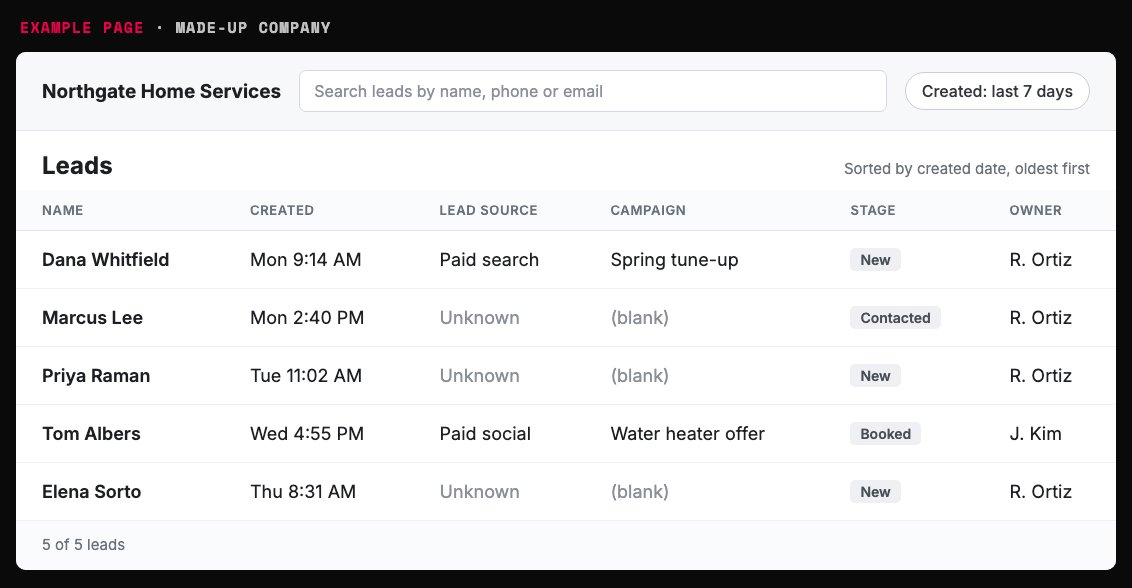
- Question 1 proof: open five leads from last week. Not a report, the leads themselves.
- No source means nobody can say which ad paid for this lead.
- Three of five. This line scores 0, even though tracking was set up.
- A blank campaign field also breaks question 8: this lead can never be sent back to the ad platform as a sale.
Example page built for this article with a made-up company and made-up people. The test (open five leads from last week, a yes needs proof) is question 1 of the article's own method.
The 20 questions of the marketing systems audit
Here is the full list, in five groups. Copy it into a sheet with four columns: score, link to the proof, owner and date.
Each line scores 0 or 1. A half-yes is a no.
The groups are not random. They climb from the basics to the deepest causes, and the next section explains why that order decides what you fix.
Each zero also has a build. Question 8 is server-side conversion tracking, questions 9 and 10 are the customer truth system, and question 7 is the growth cockpit.
Questions 16 and 19 live in the creative testing engine. For a sense of pace, the authors of Trustworthy Online Controlled Experiments say a team just starting runs about one test a month, and each stage after that runs four to five times more.
The 20 questions, one point each, and the proof that earns the point
| # | Question | The proof to open | Group |
|---|---|---|---|
| 1 | Every lead carries its source into the CRM | Open five leads from last week. Each shows its campaign or channel. | Foundations |
| 2 | Someone checked the lead data for blanks and duplicates this quarter | The dated check and what it found. | Foundations |
| 3 | The weekly report can be rebuilt from raw data | Rerun it today. The numbers match what was sent. | Foundations |
| 4 | The spend plan links each channel to revenue, not only to cost | The sheet shows cost per customer or revenue per channel. | Foundations |
| 5 | A new lead gets a first reply within five minutes in working hours | Form time against first reply for the last ten leads. | Speed |
| 6 | A broken form or tracking tag gets noticed within a day | The alert or daily check, and the last time it fired. | Speed |
| 7 | A weekly note tells the decision maker what changed, why, and what to try next | The last four notes, dated. | Speed |
| 8 | Closed deals are sent back to the ad platforms | An import or server event from the last 30 days. | Feedback |
| 9 | Someone reads calls, tickets or reviews every week and writes it up with quotes | Last week's summary. Three lines, three quotes. | Feedback |
| 10 | Last month's ads used words a customer actually said | The quote and the ad, side by side. | Feedback |
| 11 | Sales writes down why deals are lost | Loss reasons on the last ten lost deals. | Feedback |
| 12 | Every system has one named owner | A written list: system, owner, number. | Rules |
| 13 | The work still shipped the last time its owner was away | The dates of the absence and what went out. | Rules |
| 14 | Each recurring process is written where a new hire finds it in five minutes | A new hire finds it while you watch. | Rules |
| 15 | A person approves the first send of any automated or AI output to customers | The approver's name and date on the newest sequence. | Rules |
| 16 | Every test has a finish line written before launch | The plan, dated before launch, with the rule for a winner. | Rules |
| 17 | Each system is judged on what buyers did, not on what the system did | Last month's report counts meetings or sales, not sends or posts. | Goals |
| 18 | Targets come from your best recent results, not from an average | The target sheet and where each number came from. | Goals |
| 19 | A test log keeps the losers, and you can count last quarter's tests | The log. Losing tests are still in it. | Goals |
| 20 | Every new tool was bought with a written number it should move | The last purchase and its number. | Goals |
Our method, not a study result A yes with no proof scores 0. Total out of 20.
Each stage of testing maturity runs about four to five times more tests
Rough number of tests per year at each phase
- Crawl 10
- Walk 50
- Run 250
- Fly (thousands) 1000
Source: Kohavi, Tang and Xu, Trustworthy Online Controlled Experiments (2020), a rough rule of thumb. Fly is given as thousands a year.
Rank what you find by how deep the fix goes
A list of twelve zeros is not a plan. You need an order.
Donella Meadows gave us one. In Thinking in Systems she ranks twelve places to intervene in a system, from weakest to strongest.
Numbers sit dead last: budgets, rates, settings. She guessed that 90, then 95, then 99 percent of our attention goes there, for very little effect.
Delays, information flows, rules and goals sit higher up the list. Each one changes more of the system than the one below it.
Her favorite example is a Dutch housing estate. Homes with the electricity meter in the front hall used 30 percent less power than the same homes with the meter in the basement.
Nothing changed except who could see the number. She calls missing information flows one of the most common reasons a system fails.
Our reading for marketing: most audits stop at the bottom rung. Bids, budgets, button colors.
Our groups map onto her list. Speed is her delays, feedback is her information flows, rules are her rules, and goals are her goals.
The rule: fix any zero in the foundations first. Then fix the zero highest on the ladder that your team can change this quarter. Higher levers do more, but they are harder to move.
Fix the foundations, then the deepest zero your team can change
- Numbers Budgets, bids, button colors. Most audits stop here. Weakest lever.
- Speed (questions 5 to 7) How long a lead, a broken tag or a result waits before someone acts.
- Feedback (questions 8 to 11) Whether results and customer words reach the people and platforms that decide.
- Rules (questions 12 to 16) Owners, written processes, approvals and finish lines.
- Goals (questions 17 to 20) What the system is judged on. Strongest lever, and the hardest to change.
Order from Meadows, Thinking in Systems (2008), places to intervene in a system, condensed to five rungs. Mapping to marketing: ours.
Moving one meter where people could see it cut electricity use by 30 percent
- less electricity used in Dutch homes with the meter in the front hall instead of the basement 30
Source: Meadows, Thinking in Systems (2008).
Find the cheap step that is holding back an expensive one
Andy Grove ran Intel, and in High Output Management he treats any kind of work as a production line. Every line has a limiting step, and the whole flow should be built around the right one.
His sharpest example is the justice system seen as a factory. By his rough math, each conviction cost well over a million dollars, while a jail cell cost about $80,000 to build.
So when cells ran short, the cheap step limited the expensive one. Grove calls that letting the wrong step limit the process.
Marketing does this every day. You pay for a lead, then lose it to a reply that takes a day. Same mistake, smaller numbers.
Picture a company that pays $150 for each lead. A reply within five minutes costs a few minutes of someone's time. If slow replies are what cap sales, the cheapest step in the chain is limiting the most expensive one.
Grove adds a second rule: catch a defect at the lowest-value stage. A junk lead is cheapest to stop at the form, costs more on a sales call, and costs the most after a contract is signed.
If question 5 scored zero, start with speed to lead.
A process costing over $1 million per result was held back by an $80,000 step
Grove's rough figures for the justice system viewed as a production line
- Cost per conviction 1000000
- Cost of a jail cell 80000
Source: Grove, High Output Management (1983, revised 1995). He gives the conviction cost as well over a million dollars.
Example: where a cheap step limits an expensive one in marketing
| Expensive step | Cheap step that limits it | Audit question |
|---|---|---|
| A paid lead | A first reply within five minutes | 5 |
| Months of ad spend | Sending closed deals back to the ad platforms | 8 |
| A sales call | A screening question on the form | 1 |
| A new tool | Writing down the number it should move | 20 |
Our application of Grove's limiting-step rule. Example for illustration.
Watch for the one person everything waits on
Some zeros hide inside a yes. The work gets done, but always by the same person. One person is not a system.
Matthew Skelton and Manuel Pais list the warning signs in Team Topologies. Requests keep going to the same people, even when they are busy or away. Other teams wait on one team, and people complain that nothing is written down.
They wrote that about software teams. Our reading: marketing teams show the same signs, usually around the CRM, the website forms and the ad accounts.
That is why question 13 asks for proof from an absence. When the owner was last away, did the work still ship?
If not, the fix is a written process plus a second person who has run it once. How to write that process so a new hire or an AI agent can follow it is in the agent job spec.
The software warning signs show up in marketing teams too
| Warning sign | Marketing version | Audit question |
|---|---|---|
| Changes always go to the same people, even when they are busy or away | Only one person can edit the forms or the CRM | 13 |
| Other teams wait on a single team | Sales waits a week for a list or a report | 7 |
| People complain about missing documentation | Nobody can find how the lead routing works | 14 |
Warning signs: Skelton and Pais, Team Topologies (2019), about software teams. Marketing versions: ours.
What a 7 out of 20 means, and what to fix first
Add the points. The bands below are our rule of thumb, not a benchmark.
Here is an example company at 7. It tracks lead source, its spend plan shows cost per customer, and it notices a broken form within a day. It also uses customer words in ads, names owners, writes processes down and keeps a test log.
Everything else is a zero. Nobody checks the data, the report cannot be rebuilt, and replies take hours. Closed deals never reach the ad platforms, and outbound is judged on emails sent.
Foundations come first, so this month it cleans the data and scripts the report. Then it changes what it counts: outbound moves from emails sent to replies that became meetings.
That second fix costs almost nothing. It is also the highest lever on the sheet.
Count sends and you get more sends. That is Goodhart's law: once a measure becomes a target, it stops measuring well.
How to ace a marketing audit without changing a thing, in four easy steps:
1. Let the head of marketing score it alone, from memory.
2. Count "we have that somewhere" as a yes.
3. Fix the lowest score by buying a dashboard.
4. Never run it again, so the number cannot drop.
That is not an audit. It is a compliment you paid for.
Re-score in 90 days, and set each new target from your best recent week, not your average one. The change in the total is your first honest number on whether the work is working.
What your score means, and what to fix first
| Score | What it means | Fix first |
|---|---|---|
| 0 to 5 | The work happens only while someone remembers | Questions 1 to 4, before anything else |
| 6 to 10 | Some pieces run, but they do not connect | Foundation zeros, then the deepest zero you can change |
| 11 to 15 | Several systems run with owners | The highest zero on the ladder |
| 16 to 20 | A working marketing engineering function | Re-score every 90 days and fund the next test |
Our method, not a study result Bands are a rule of thumb, not a benchmark.
Example: a 7 out of 20 hides its cheapest fix in the goals group
Points scored by group for one example company
- Foundations (of 4) 2
- Speed (of 3) 1
- Feedback (of 4) 1
- Rules (of 5) 2
- Goals (of 4) 1
Worked example from the method, not a real company.
The finished sheet: a link behind every point, a total, and one fix with an owner and a date
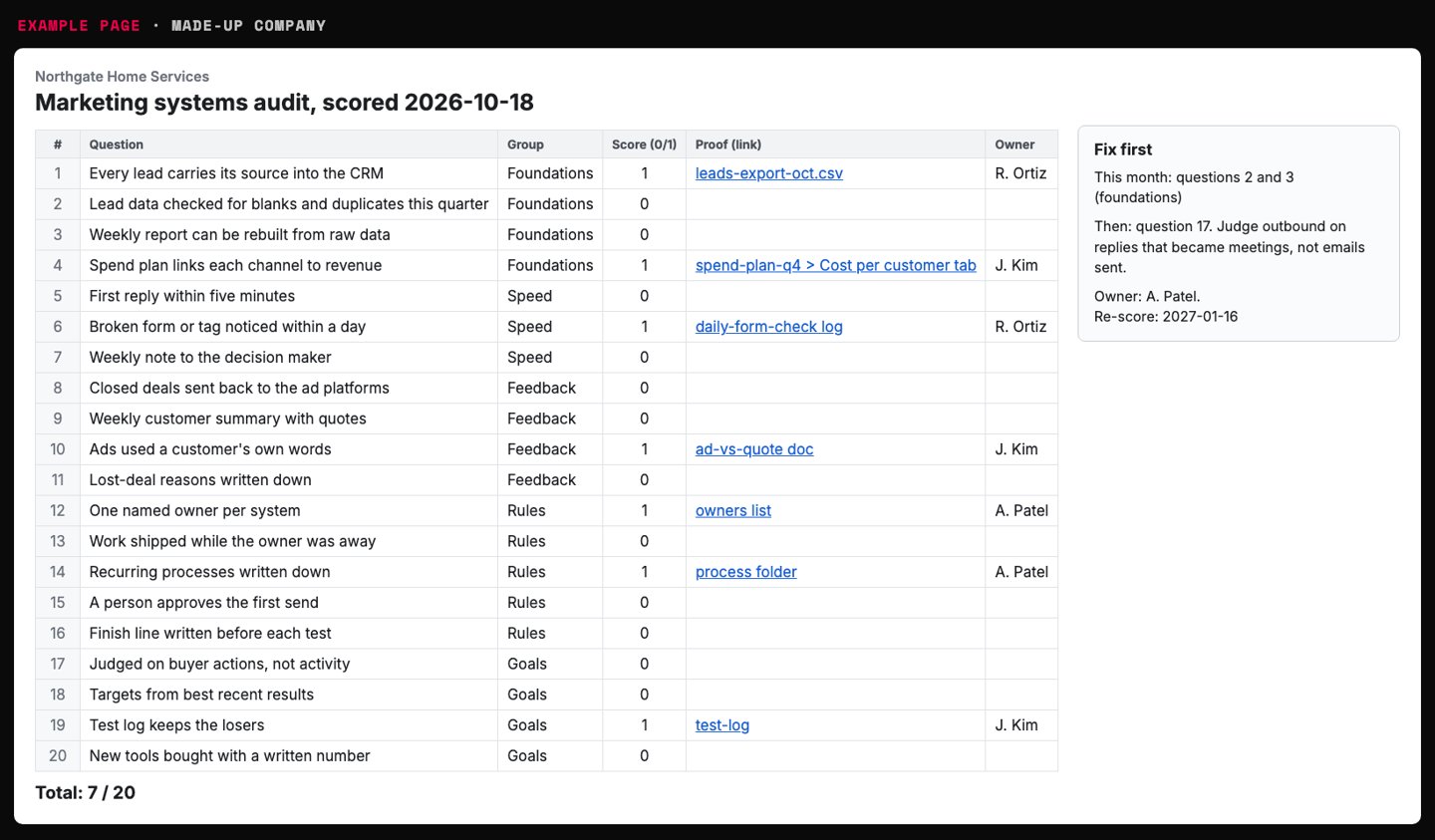
- Every 1 has a link someone opened on screen. No link, no point.
- Foundations come first. Without clean data no other score can be checked.
- The highest lever on the sheet, and it costs almost nothing to fix.
- Date the sheet. The change in the total is the first honest number.
Example page built for this article with a made-up company. The 20 questions, the 0 or 1 scoring, the ranking rule and the 7 out of 20 worked example are the article's own method and example.
Is this audit just an agency lead magnet?
Partly, and we would rather say it first. Our paid work starts with an audit, and we explain why audits make good offers in customized audits as lead magnets.
But the 20 questions work without us. There is no form on this page, and your own team can answer every line in an afternoon.
Score 16 or more and you do not need outside help for this. Spend the money on your next test.
Want a smaller paid first step? The shape we prefer is in quick win offers.
How do you run a marketing systems audit in 90 minutes?
Get three people in a room for 90 minutes: whoever owns marketing, whoever owns sales, and whoever lives in the CRM.
Go line by line. The owner opens the proof on screen or the line scores zero. Proof or zero, five minutes max.
Then paste the prompt below into your preferred AI with your answers. It ranks the zeros by how deep the fix goes and flags any cheap step that is holding back an expensive one.
It never invents a score. Every yes needs proof you name, and every cost needs a number you give it.
Three people, 90 minutes, one fix with an owner
- Set up Minutes 0 to 10 Share the sheet with the 20 lines. Agree that no proof means zero.
- Score Minutes 10 to 70 Line by line, proof on screen. No line gets more than five minutes.
- Rank Minutes 70 to 80 Total the score. Circle foundation zeros, then the highest zero on the ladder.
- Commit Minutes 80 to 90 One fix, one owner, one number, and a re-score date 90 days out.
Our method, not a study result
Paste into your preferred AI. It asks the 20 questions one at a time, scores only the proof you name, ranks the zeros and gives you one fix.
Act as a marketing systems auditor. Run the Five-Minute Proof audit with me.

Rules:
- Ask the 20 questions below one at a time. For each, ask what proof I can open on screen now: a file, log, report or dated note. (Example: "Yes, last week's lead export has a source column.")
- A yes counts only with proof I can open within five minutes. "We have that somewhere" scores 0, and so does "one person handles it" with nothing written down.
- Score 0 or 1. Never assume proof exists. Never invent a score.

Questions:
Foundations: 1 lead source on every lead; 2 lead data checked for blanks and duplicates this quarter; 3 weekly report rebuildable from raw data; 4 spend plan links each channel to revenue, not only cost.
Speed: 5 first reply to new leads within five minutes in working hours; 6 a broken form or tag noticed within a day; 7 a weekly note on what changed, why, and what to try next.
Feedback: 8 closed deals sent back to the ad platforms; 9 calls, tickets or reviews summarized weekly with quotes; 10 last month's ads used customer words; 11 lost-deal reasons written down.
Rules: 12 one named owner per system; 13 work shipped while its owner was away; 14 recurring processes written where a new hire finds them in five minutes; 15 a person approves the first send of any automated or AI output to customers; 16 every test has a finish line set before launch.
Goals: 17 systems judged on buyer actions, not activity; 18 targets set from our best recent results; 19 a test log that keeps the losers; 20 every new tool bought with a written number it should move.

Then:
- Total the score, overall and by group.
- Rank the zeros: foundations first, then goals, rules, feedback, speed. Mark the ones we can change within 90 days.
- Flag any cheap step limiting an expensive one, such as a slow reply wasting a paid lead. Ask me what a lead costs; do not guess.

Answer in this format:
Score: [x/20, by group]
Fix first: [question, owner, the number that proves it worked]
Fix next: [one line]
Cheap step limiting an expensive one: [or none]
Re-score date: [90 days from today]
Next three actions: 1. 2. 3.
What to do this week
1. Book the 90 minutes with the three people. Ask them to bring proof, not opinions.
2. Open five leads from last week before the meeting. You will know your first answer before anyone sits down.
3. Pick one fix, name its owner, and put the re-score date in the calendar.
Remember the three leads marked Unknown? That was not bad luck. That was your score, showing up early.
When the fix is plumbing, like lead routing or CRM fields, that work sits under CRM and RevOps. Once a system runs, grade it with how to evaluate a marketing engineer's work.
An audit from memory is a mirror. An audit with proof is an X-ray.

Filip Kovacevic is the founder of Anar Agency in Phoenix. He spent five years running SEO, Meta ads, email, and content for medical practices across the United States, and now does the same work for healthcare, home-service, legal, and professional-service businesses, alongside AI implementation. More from Filip →
Want the deeper version of this audit?
Bring your score. In 15 minutes we will tell you which system we would build first and the number that would prove it worked.
See how we build them →Want to do this work yourself? See how we train marketing engineers.