Marketing Engineering for Local Businesses: The First System to Build

Marketing engineering for a local business means building a few small systems so the next step happens without anyone remembering it. Start with your records, not new software. Find the handoff that drops the most customers, like an unreturned call or an unsent quote.
Fix that one with a plain rule, and measure it for four weeks.
What should a local business automate first?
In High Output Management, Andy Grove books dinner by phone. The woman who takes the call is new. It seems nobody told her the restaurant had lost its liquor license.
So nobody brings wine. The maitre d' walks from table to table, apologizing, all night long.
One missing sentence on one phone call. Every guest in the room pays for it.
That is what marketing automation for small business is really about. Not more emails, not a fancier website. The handoff from one step to the next.
A local service business rarely has a lead problem first. It has a dropped-handoff problem: the call nobody returned, the quote nobody sent, the patient nobody rebooked.
The proof is ugly. In a secret-shopper study by the legal software company Clio, only 40 percent of law firms picked up when called. Almost half could not be reached by phone at all, even after a message.
Those callers had already found the firm, picked it and dialed. The marketing worked. The handoff died.
Most law firms in a secret-shopper test missed the first call
Share of US law firms contacted as a new client, by what happened
- Picked up when called 40
- Reached by phone at all, callbacks included 52
- Could not be reached by phone 48
- Replied to the email 33
Clio Legal Trends Report 2024, secret-shopper study, read on the live page 2026-10-18
More leads feed the same broken step; a fixed handoff keeps them
| Buy more leads | Fix the dropped handoff |
|---|---|
| More calls into a phone nobody answers | Every call answered or returned within the hour |
| More repairs, still no replacement quotes | Every finished job writes the next quote |
| Cost goes up with every lead | Cost is mostly one afternoon and a rule |
| Judged on leads | Judged on booked jobs |
Our comparison, used across this guide
Marketing engineering, sized for a 20-person shop
Marketing engineering is building the systems behind your marketing, so the next step happens because a system does it. The term began in a 1998 marketing textbook as a way to make decisions with data, models and judgment.
That textbook already said simple models stay useful for small firms without big databases. Good news. You do not need a data team.
A marketing engineer also builds the systems that make those calls every week. At a software company that means pipelines and agents. In a shop with three trucks it means four or five plain rules.
Every system we build has the same five layers: signal, memory, decision, action and feedback. Here is the small version.
Signal is your call log, your calendar and your reviews. Memory is the price list, the service menu and what each customer told you. Decision is the rule, like who gets a callback and when a quote goes out.
Action is the text, the quote or the reminder. Feedback is one number you read every Monday.
Do you need a full-time hire for that? Usually not. You need one person who owns each system once it runs, and approves anything a customer will see.
A system counts when it still works next Tuesday with nobody remembering it.
Every layer of a marketing system already exists in a local shop
| Layer | What it is in a service shop | The first thing to build |
|---|---|---|
| Signal | Call log, calendar, reviews | Missed calls by hour, one report |
| Memory | Price list, service menu, what each customer said | Notes on the customer record, shown on the next ticket |
| Decision | Who gets a callback, when a quote goes out | One written rule per drop |
| Action | Texts, quotes, reminders, review requests | One message a person approved |
| Feedback | Last week's numbers | One Monday number, paired with a quality check |
Anar's five-layer map from what is a marketing engineer, applied to a service shop
The Handoff Map is a one-page list of the seven steps a customer takes with a service business: found, first contact, booked, showed, next job written, reviewed, came back. For one kind of customer and one service, write two numbers per step from last month's records: how many arrived and how many moved on. Found is reach, so among the six handoffs after it, the one with the lowest share kept gets the first system, built as one plain rule that a person runs by hand before anything is automated, with a named person approving every customer-facing message.
Read one paired number for four weeks against last month before starting a second system, and redraw the map every quarter, because the biggest drop moves once you fix it.
Map your seven handoffs from last month's records
The Handoff Map is a one-page list of the steps a customer takes with you, from finding you to coming back, with two numbers on each step. It takes one afternoon.
It borrows its rules from the Critical Client Flow in David Jenyns's SYSTEMology. Map one kind of customer and one service. Use two or three words per step, and list only what you actually do today.
Here are the seven steps for most service shops. Found, first contact, booked, showed, next job written, reviewed, came back. Found is reach, not a handoff, so you score the six steps after it.
For each step, write two numbers for last month. How many arrived at it? How many moved on?
Pull every number from a record. Your phone provider shows missed calls by hour. Your calendar shows bookings and no-shows, and your job or practice software shows the quotes and treatment plans written.
Why records and not memory? You remember the ad you paid for. You forget the quote nobody sent.
Seven steps, two numbers each, from last month's records
- 1. Found They search, see an ad, or get a referral.
- 2. First contact A call, form, text or chat arrives.
- 3. Booked The inquiry gets a time on the calendar.
- 4. Showed The visit, consult or service call happens.
- 5. Next job written The quote, treatment plan or next visit is written and sent.
- 6. Reviewed A happy customer is asked, and every review gets a reply.
- 7. Came back The next service, recall, rebooking or referral.
Handoff Map, Anar. Rules adapted from the Critical Client Flow in SYSTEMology (Jenyns)
Every number on the map comes from a record you already keep
| Step | Arrived | Moved on | Record to pull |
|---|---|---|---|
| First contact | Calls, forms and texts in | Answered or returned within the hour | Phone provider log, form inbox |
| Booked | Inquiries answered | Appointments set | Calendar |
| Showed | Appointments set | Visits that happened | Calendar no-show list |
| Next job written | Jobs finished with a next step flagged | Quotes or plans sent and followed up | Job or practice software |
| Reviewed | Jobs finished | Reviews in, and replies sent | Your Business Profile |
| Came back | Customers due back | Customers booked | Recall or service-due list |
Handoff Map, Anar
A filled map shows the biggest drop in one look, and it is rarely where the owner guessed
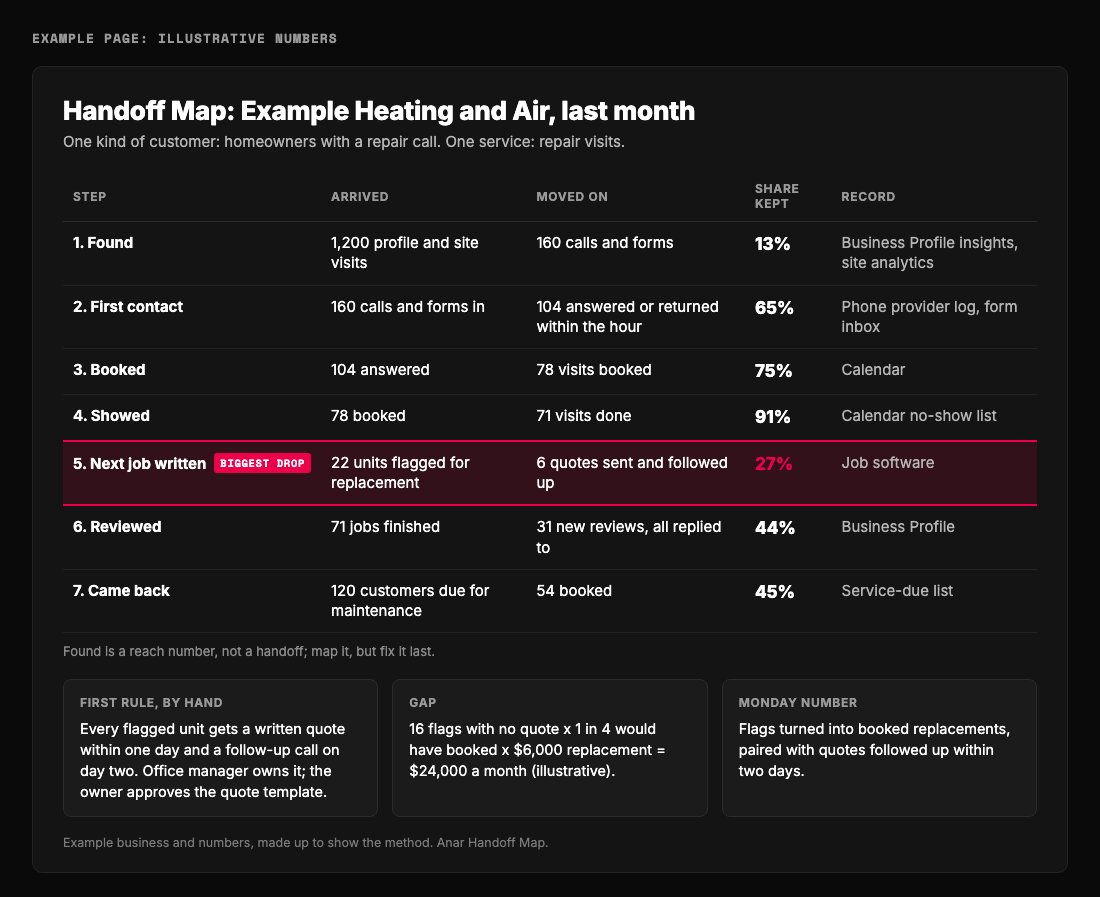
- Every number comes from a record, never from memory.
- Lowest share kept among the handoffs: this is where the first system goes.
- Found measures reach. The map is about what happens after someone reaches you.
- One plain rule, run by hand first, with a named owner and approver.
- One count, one paired quality check, read for four weeks.
Example page built for this article with a made-up brand, 2026-10-18. Illustrative numbers; rules adapted from the Critical Client Flow in SYSTEMology (Jenyns)
Fix the biggest drop first, because one step sets the pace
Your shop can only book as fast as its slowest handoff. Think of a relay team. The fastest runners still lose the race on one dropped baton.
So speed up any other step and nothing changes downstream.
There is always one slowest step, and once you fix it, the bottleneck moves somewhere else. That is normal. It means the fix worked.
Grove gives a second rule. Build the flow around the most expensive step, and catch problems before it, where they are cheap.
At Intel the costly step in hiring was flying graduates to the plant. So phone screens came first, and more plant visits ended in offers.
In a service shop the expensive step is the truck roll, the consult chair or the attorney's hour. That is our reading of the rule. Put the cheap check right before it: two questions on the phone, a confirm text the day before.
And if the drop is in delivery, more leads make it worse. One agency in the same SYSTEMology book went from three or four new clients a month to thirty, fell months behind, and had to stop its ads.
Once it mapped its flow and trained new hires from the map, it ran ads for a full year without a pause. First time ever.
More ads into a broken step is not growth. It is a faster way to let people down.
Fix the biggest drop, and guard the most expensive step
- Fix it fast Big drop, cheap step. A rule fixes it this week.
- Fix it first Big drop before the truck roll or consult. Add a cheap check right before it.
- Leave it Small drop, cheap step. Not this month.
- Watch it Small drop, expensive step. Track it on Monday.
Our reading of the limiting-step and lowest-value-stage rules in High Output Management (Grove)
Example: more demand into a backed-up delivery step meant pausing the ads
| What happened | The drop | The fix | How sure |
|---|---|---|---|
| An agency for chiropractors went from 3 or 4 new clients a month to 30 | Delivery: months behind | Mapped the client flow, trained hires from it | Reported in the book; not verified by us |
| Ads paused until the work caught up | Same step | Ads then ran a full year without a pause | Reported in the book; not verified by us |
SYSTEMology (Jenyns). Results as reported by the authors. Not our results, and not verified by us.
Most local businesses do not need more demand
The cleanest proof comes from a homebuilder, told in Demand-Side Sales 101 by Bob Moesta. When he joined the Detroit builder, it sold about a hundred houses a year from seven sites.
Every visitor got the same features pitch. Most stopped listening after about three minutes.
So the team interviewed recent buyers. Many were downsizers stuck on the move itself: the packing, the basement, the dining room table.
The builder raised its price and bundled movers, packing and a storage unit across the street. Sales rose 22 percent, by the author's account.
Then it moved its ads from the real estate pages to the obituaries, where buyers were already deciding. Traffic rose 37 percent and ad costs fell 70 percent.
Three questions about where each buyer stood cut a twenty-minute pitch to two minutes. The builder grew to fourteen sites and three hundred homes a year.
What did not change? The houses.
Every fix was a handoff: the pitch, the move, the moment of deciding. The homeowner who calls at 9 p.m. with no heat is deciding too. Do not drop that call.
A homebuilder tripled homes sold by fixing handoffs, not by building different houses
| Change | Handoff it fixed | Reported result | How sure |
|---|---|---|---|
| Bundled movers, packing and storage, at a higher price | Fear of moving stalled the decision | Sales up 22 percent | Author's account |
| Ads moved to the obituaries | Reach buyers when they start deciding | 37 percent more traffic, 70 percent lower ad cost | Author's account |
| Three timeline questions instead of the pitch | Visitors stopped listening after about 3 minutes | Two minutes instead of twenty | Author's account |
| All of it, over time | The whole path from visit to move-in | 7 sites and 100 homes a year to 14 sites and 300 | Author's account |
Demand-Side Sales 101 (Moesta), the Detroit homebuilder case. Results as reported by the authors. Not our results, and not verified by us.
Change the setup, not the reminder
Run every new step by hand from a written rule until it works, then automate it. That is SYSTEMology's rule, and it saves you from automating a mess.
Jenyns tested it on his own agency, where some accounts ran 120 days overdue. Three automated overdue emails barely moved anything.
Then the agency changed the setup: new clients paid up front by automatic billing before work began. Payments arrived in advance, on time, every time.
Michael Gerber's team in The E-Myth Revisited fought blue marker on white walls for more than three weeks. Meetings, memos, signs and spot checks all failed.
A clear plastic collar, four inches wide, around each board ended it at once. Engineers call that mistake-proofing.
Most small-shop automation is a memo campaign with a software bill. A reminder text is a memo. A rule that holds a slot only after the customer confirms is a collar.
So pick the first system from your biggest drop. Answer every inquiry in minutes, as speed to lead lays out, with an AI receptionist for after hours.
Or make every finished job write the next one. Or ask for every review and answer every one.

A reminder asks people to remember; a setup change removes the need
| Reminder | Setup change |
|---|---|
| Three automated overdue emails | Pay up front by automatic billing before work starts |
| Memos and signs about ink on the walls | A four-inch plastic collar around each board |
| A text asking a patient to confirm | For example: the slot is released if not confirmed by noon |
| A voicemail that says call us back | For example: calls roll to a second person after four rings |
Rows 1 and 2: SYSTEMology (Jenyns) and The E-Myth Revisited (Gerber). Rows 3 and 4 are our examples
The first system follows the biggest drop, not a vendor's feature list
| Biggest drop at | First system | First rule, by hand | Number to watch |
|---|---|---|---|
| First contact | Answer in minutes | Every inquiry answered or returned within the hour | Share returned within the hour |
| Showed | Confirm or release | Confirm the day before; release unconfirmed slots | No-shows per week |
| Next job written | Every job writes the next | A flagged job gets a quote within a day, a follow-up in two | Flags turned into booked jobs |
| Reviewed | Reviews in, replies out | A review link after every finished job; a person replies to all | New reviews and replies per week |
| Came back | Due-back list | Everyone due this month gets a personal message | Due customers booked |
Handoff Map, Anar
Write down what customers tell you, once
The best system in a small business is memory that never forgets. Gerber tells of a small hotel that asked his coffee brand and his newspaper, once.
Every visit after that, both were waiting. Nobody asked again. His words: "somebody had heard me."
Your shop hears things like that all day. The gate code, the dog's name, the filter size, the patient who hates needles.
Most of it lives in one person's head, and leaves when she does. Write it into the customer record and put it on the next job ticket.
Reviews work the same way. Read them weekly for the words customers use, the small version of a customer truth system. Then reply to every one, with a person sending it.
Is that marketing? It is the reason they come back.
Asked once, written down, used on every visit after
| What the customer said | Where it lives | Where it shows up next |
|---|---|---|
| Gate code, dog's name, parking | Customer record | The next job ticket |
| Filter size, unit model | Equipment notes | The next service call and the replacement quote |
| Hates needles, prefers mornings | Patient notes | The booking screen and the chair-side brief |
| Coffee brand and newspaper | The hotel's guest file | The room, every visit (Gerber's example) |
Rows 1 to 3 are our examples. Row 4: The E-Myth Revisited (Gerber)
A finished job feeds the next one when each step is written down
- Job done The tech or provider flags the next need
- Note saved What the customer said goes on the record
- Review asked A direct link, and a reply from a person
- Due-back list Everyone due this month gets a message
- Referral For example, a contractor's open-house cookout on the new deck
Handoff Map, Anar. Cookout example: StoryBrand (Miller), where a few parties filled a contractor's next twelve months
Google tells you to ask with a link, reply to everyone, and never pay for reviews
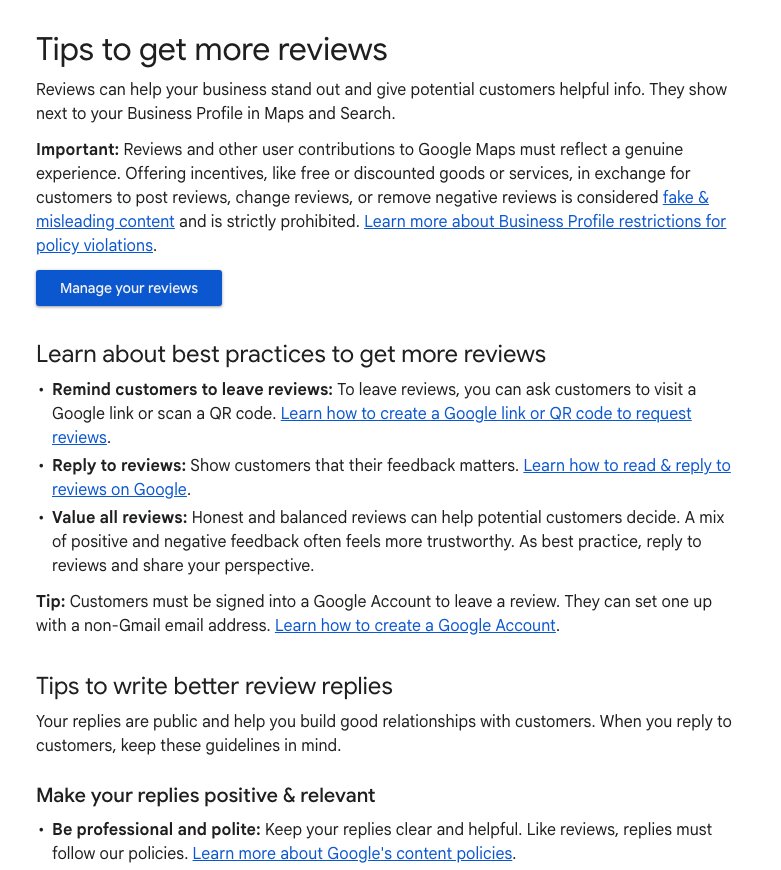
- No rewards for reviews, positive or negative. Ask, never pay.
- Send this link in a text after every finished job.
- Reply to every review, with a person sending it.
- Tell customers this up front, or the link stalls.
Screenshot of Google Business Profile Help, Tips to get more reviews, taken 2026-10-18. Platform rules change; see the dated box below
What it costs, and what to skip
The honest cost is mostly time, not software. The first build is usually a rule inside tools you already pay for.
So price the gap, not the tool. Here is the sum with illustrative numbers.
Say your map shows 30 slow or missed inquiries a month, one in four would have booked, and a first job is worth $400. That is $3,000 a month going to someone else. If catching them costs less, build it.
Then count the owner's time. Plan on 30 minutes every Monday, plus an hour a week in the first month to correct drafts. A system you will not read is one you should not buy.
How to automate a 20-person shop into chaos in four easy steps. Step one: buy the tool from the conference demo.
Step two: connect it to everything on day one. Step three: let it text customers while nobody reads the drafts.
Step four: blame the tool and buy another damn one. Four half-built systems are four new ways to drop a customer.
Skip three things outright. AI that calls strangers without consent, tracking pixels on patient pages, and anything that games reviews. The rules sit in the dated box below, because rules change.
Example: 30 slow inquiries a month can cost $3,000
- slow or missed inquiries a month 30
- that would have booked, at one in four 7.5
- a month, at $400 per first job 3000
Illustrative inputs; the math is ours: 30 x 0.25 x $400
Read one number every Monday
A Monday number is one count you read every week that shows whether the system you built is working. Restaurants do this better than most offices.
In Lean Analytics, the Solare restaurant's staff report one ratio every day: yesterday's staff cost as a share of revenue. About 24 percent is right; over 30 percent is bad.
The authors like it because it is simple, immediate, actionable, comparable and tied to how the business makes money. The owner also counts reservations at 5 p.m. and multiplies by five to staff the night.
Your shop's version is short. Inquiries, booked, showed and sold, by source, for last week. Pair each count with a quality check, like reviews answered or quotes followed up.
Why pair them? A count on its own gets chased at any price. Grove pairs each volume number with a quality one, so the second shows what the first one costs.
Read it for four weeks against last month before you start a second system. If it does not move, change the rule, not the tool.
Then send booked jobs back to your ad platforms, so they learn from buyers instead of form fills. Server-side conversion tracking covers the how, and the full weekly memo is the growth cockpit.
One restaurant runs on two numbers it gets every day
- staff cost as a share of revenue: about right 24
- above this is bad 30
- covers per reservation counted at 5 p.m. 5
Lean Analytics (Croll and Yoskovitz), the Solare restaurant case
Every count gets a quality check next to it
| Count | Paired quality check | Why pair them |
|---|---|---|
| Inquiries in | Share returned within the hour | Volume alone hides missed calls |
| Booked | No-shows | Bookings that never show are not jobs |
| Jobs finished | Next jobs written and followed up | Repairs without quotes waste the visit |
| Sold, by source | Booked jobs sent back to the ad platforms | Ads learn from buyers, not form fills |
Our sheet. Pairing rule from High Output Management (Grove)
One system, one number, four Mondays, then decide
- Baseline Week 0 Last month's number from the map.
- By hand Week 1 Run the rule from a written note. Fix what breaks.
- Automate the part that works Weeks 2 to 3 A person still approves customer messages.
- Decide Week 4 Moved? Keep it and redraw the map. Flat? Change the rule, not the tool.
Handoff Map, Anar
Run the Handoff Map with AI this week
The prompt below runs the whole method. Paste it into your preferred AI, answer five questions from last month's records, and it names your biggest drop and the first rule to build.
1. Pull last month's call log, calendar and invoices. Fill the seven steps.
2. Run the prompt. Write the one rule on paper and run it by hand for a week.
3. Set a check date four weeks out. Read the number every Monday until then.
Want to score the rest of your systems? The marketing engineering audit does it in 20 questions.
Rather have the first one built for you? That is our marketing engineering work.
Remember the restaurant? One missing sentence on one call cost the whole dining room its wine for a night.
Most shops do not need more water poured into the bucket. They need to find the hole.
Paste into your preferred AI. It asks five questions from last month's records, finds the biggest drop, prices the gap and names one rule to build.
Act as a marketing engineer for a local service business. Use only my answers and these rules. Never invent a number; ask me.

Ask one at a time, show the example, and wait:
1. What do you sell, to whom, with how many staff? (Example: HVAC repair for homeowners, 22 staff)
2. Pick one kind of customer and one service for this map. (Example: homeowners with a no-heat call)
3. For last month, per step, how many arrived, how many moved on, and from which record? Steps: Found, First contact, Booked, Showed, Next job written, Reviewed, Came back. (Example: First contact: 140 in, 96 answered within the hour, phone log)
4. What is one first job worth on average? (Example: $400)
5. Who owns the fix, and who approves what customers see? (Example: office manager; I approve)

Rules:
- Only steps we do today, two or three words each.
- Share kept = moved on / arrived. Found is reach: report it, fix it last. Among the six steps after it, the lowest share kept is the biggest drop. On a tie, pick the earlier step.
- Flag any number from memory, not a record; I check it before building.
- First system: one plain rule a person can run by hand from a note. Prefer a setup change (who, when, what is required) over a reminder.
- A named person approves every new customer message before it goes live.
- No AI voice calls without consent, no tracking tools on patient or client pages without my compliance adviser, no fake or paid-for reviews. If you can browse, check my country's current rules and say what you found.
- Gap per month = (arrived minus moved on) x share that would have booked x first job value. Ask me for that share.
- Read one number for four weeks against last month. No second system until it moves.

Show your math, then use exactly this format:
BIGGEST DROP:
GAP PER MONTH:
FIRST SYSTEM (one rule):
WHO OWNS IT / WHO APPROVES:
NUMBER TO WATCH + PAIRED QUALITY CHECK:
CHECK DATE (four weeks out):
NEXT THREE ACTIONS:

Filip Kovacevic is the founder of Anar Agency in Phoenix. He spent five years running SEO, Meta ads, email, and content for medical practices across the United States, and now does the same work for healthcare, home-service, legal, and professional-service businesses, alongside AI implementation. More from Filip →
Want the first system built for you?
Bring your Handoff Map, or just last month's call log. In 15 minutes we will tell you which handoff we would fix first and how you would know it worked.
See how we build them →Want to do this work yourself? See how we train marketing engineers.