Hub-and-Spoke SEO for Service Businesses: Why Your Blog Does Not Rank

Hub-and-spoke SEO organizes a site so Google sees one topic, not a pile of posts. One long guide covers a service broadly. Two or three deeper posts, the spokes, each cover one hard subtopic.
Every page links to the guide, to each other, and to the page that sells the service.
Hub-and-spoke SEO: why a pile of good posts does not rank
Picture a plumber with forty blog posts. Each one took a Saturday, and each one is pretty good.
Google sends almost nobody to any of them. Why?
Nothing ties them together. To Google, forty loose posts look like forty strangers, not one expert.
Hub-and-spoke SEO fixes that. You write one long guide on a service you sell. That guide is the hub.
Then you write a few deeper posts on its hardest subtopics. Those are the spokes. Every page links to the others, and to the page that sells the service.
Google even describes it this way. Its page on how search works says it finds new pages when a known page links to them: "a hub page, such as a category page, links to a new blog post."
Most blog advice says post more. We say post less, and link all of it.
A pile of posts looks like strangers; a map looks like an expert
| A pile of posts | A hub-and-spoke map |
|---|---|
| One short post per keyword | One long guide per service |
| Posts link only to the blog index | Every page links to the guide and the money page |
| Ten posts compete for one topic | One guide owns the topic, spokes own the hard parts |
| Traffic, if any, stops at the post | Traffic flows toward the page that books the call |
Our comparison, from the method in this guide.
What is hub-and-spoke SEO? One guide, a few spokes, one money page
The Guide-and-Spokes Map is our name for the method. For each service you sell, you build one guide, two or three spokes and one money page, all linked together.
The guide is the hub. It covers the whole topic at a broad level, with no deep detail. Think of a table of contents that also gives real answers.
A spoke is one subtopic, in depth. Pick the two or three subtopics that are hardest to rank for, or that need the most explaining.
The money page is your service page. It is the page that books the call. Every other page in the map points at it.
Why one guide and not ten short posts? Google wants proof that you cover the whole topic, not one corner of it.
Sales pages and videos do not prove that. A guide does.
For example, one paver manufacturer runs three guides of 4,000 to 5,000 words each. One is a buying guide. Another explains how to choose pavers for a project.
Pavers are not exciting. The guides still pull steady traffic.

Three kinds of page, three different jobs
| Page | Its job | Links to |
|---|---|---|
| The guide (hub) | Covers the whole topic broadly, no deep detail | Every spoke and the money page |
| A spoke | Goes deep on one hard subtopic | The guide, sibling spokes, the money page |
| The money page | Sells the service and books the call | The guide, so ready buyers can still find proof |
The Guide-and-Spokes Map, as set out in this guide.
Example: a boring product, three long guides, steady traffic
- Guides, including a buying guide 3
- Words in each guide 4,000 to 5,000
- What the company makes Pavers
Example from another business. Not our result, and not verified by us.
The Guide-and-Spokes Map gives each service you sell one long guide that covers the topic broadly, two or three spokes that go deep on its hardest subtopics, and one money page that books the call. Thin posts get merged into the guide. Every page links to the guide, to its siblings and to the money page, with link words that say what the page is about.
Finish one cluster, build links to the whole set, and judge it after about 90 days.
Merge thin posts into one guide before you write anything new
Most service sites already own the raw material. It is spread across a dozen thin posts, one per keyword.
One short post per keyword was the usual advice for years. A few posts got lucky. The rest got only a trickle of visits.
For example, one SEO team took 50 small pages on one topic and merged them into one long guide. The guide started ranking fast. Then the two or three biggest subtopics got their own spokes, and both kinds of page ranked.
Here is how we run the merge. List every post on the topic. Group them by subtopic.
Fold the thin ones into the guide as sections. Keep the two or three big subtopics as their own spokes.
Then send each old address to its new home with a permanent redirect, called a 301. Google's guide to redirects says a 301 means the page has permanently moved, and its page on duplicate URLs explains how it picks one page to show.
Deleting work feels wrong, but it is the right call. Ten weak pages that compete with each other help nobody.
Example: 50 thin pages became one guide plus a few spokes
| Before the merge | After the merge |
|---|---|
| 50 small pages on one topic | 1 long guide on the whole topic |
| Each page chases one keyword | The guide covers every subtopic broadly |
| Hard subtopics get a thin page | The 2 or 3 hardest get their own spoke |
| Old addresses left as they were | Old addresses send visitors on with a 301 |
Example from another business. Not our result, and not verified by us. Redirect step from Google's guide to redirects.
Five moves turn a pile of posts into one guide
- 1. List Every post on the topic, with its address.
- 2. Group Sort the posts by subtopic.
- 3. Fold Thin posts become sections inside the guide.
- 4. Keep The 2 or 3 biggest subtopics stay as spokes.
- 5. Redirect Each old address points to its new home with a 301.
Our merge process, from the method in this guide.
How long should a pillar page be? Check the top 20 results first
A pillar page is another name for the guide. Its length comes from the search results, not from a rule.
Search the keyword your guide targets, and look at the top 20 results.
Are they long guides or short posts? How long are they?
Write the kind of page that already ranks there.
There is one catch. Some page-one results have sat there for years, and they rank partly on age. A new page will not get there by copying them.
So copy the newest page on page one instead. It shows what works for a page that starts today.
Our starting ranges: a guide runs 4,000 to 8,000 words, and most land at 4,000 to 6,000. A spoke for a hard subtopic runs 3,000 to 4,000. Easy subtopics stay as short sections inside the guide.
Google says it has no favorite length. Its helpful content guidance asks if you write to a word count because Google prefers one, and answers: "No, we don't."
Our decision rule: the top 20 sets the length, and our ranges are only a first guess. Long never means padded. Fluff buries the words that tell Google what the page is about.
Before you write, check what kind of page ranks and how new the newest one is
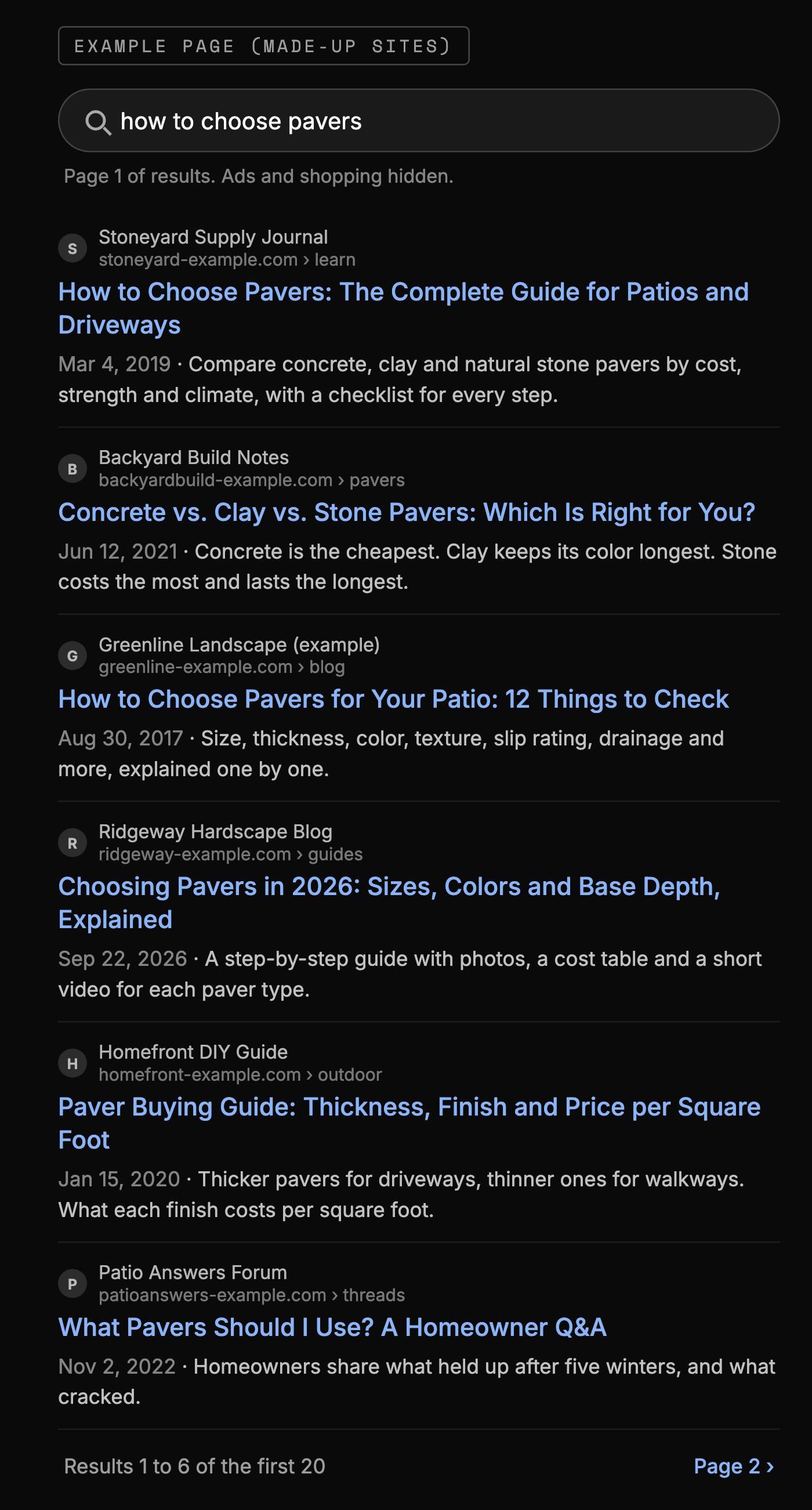
- Search the keyword your guide will target.
- Long guides here? Then write a long guide.
- Check the dates. Old pages rank partly on age.
- Copy the format of the newest page on page one, not the oldest.
- Read all 20 before you pick a length.
Example page built for this article with made-up sites
The top 20 results decide what kind of page to write
| What you see in the top 20 | What to write |
|---|---|
| Mostly long guides | A long guide, in the length range the newer ones use |
| Mostly short posts | A shorter page that answers fast |
| Old pages at the top, a newer one lower on page one | Copy the newer page's format, not the old one's |
| A mix | Copy the newest page on page one |
Our top-20 check, from the method in this guide.
Our first guess for length, before the top 20 corrects it
- Words in a guide 4,000 to 8,000
- Words in a spoke on a hard subtopic 3,000 to 4,000
- Results to read before you write 20
Our starting ranges. Google says it has no preferred word count; the results page sets the final length.
Choose spokes that walk a reader toward buying
Traffic is not the goal. A blog full of beginner posts can pull visits all day and sell nothing.
So plan spokes for every stage of the old AIDA model: attention, interest, desire, action. The guide covers the first stage. It serves people doing early research.
Interest spokes go deeper into strategy, for readers who know the basics. Desire spokes are step-by-step guides, checklists and fixes for one painful problem.
Action is the money page. By the time a reader gets there, the spokes should have made one point clear. The job is complicated, and paying you is the easy way out.
Small niche where few people search? Write comparison spokes. Compare your service with the options buyers already search for, side by side.
Skip vague titles. A post called "Ambition" has to beat the dictionary for that word, and it will lose. More on reaching buyers early in how to move an unaware market, and on pages built around the buyer's problem.
Each spoke moves a reader one step closer to the money page
- Attention: the guide Broad answers for people doing early research.
- Interest: strategy spokes Deeper posts for readers who know the basics.
- Desire: how-to spokes Step-by-step guides, checklists, fixes for one painful problem.
- Action: the money page The service page that books the call.
AIDA model stages, applied to a topic cluster.
Write first where buyers are close to buying
- Write early Comparison and cost posts. Few searches, but they convert.
- Write first The hardest buying questions. Make these spokes.
- Skip or merge Vague posts. Fold them into the guide.
- Cover in the guide Broad questions. A section, not a spoke.
Our planning grid, from the method in this guide.
How do you link a topic cluster? Five rules
Links are what turn separate posts into one map. Google is blunt about it in its guide to crawlable links: "Every page you care about should have a link from at least one other page on your site."
1. The guide links down to every spoke, from a short intro section on that subtopic.
2. Every spoke links back up to the guide.
3. Spokes link to each other where it helps the reader.
4. Every page links to the money page.
5. The link words say what the target page is about.
Google calls good link text descriptive, reasonably concise and relevant. "Read more" is none of those.
Two quick checks while you are in there. Your page title and your main heading (the H1) should target the same keyword. Theme headings like "Leave a reply" and "Related posts" tell Google nothing, so turn them into plain text.
For example, one blog had strong content and no internal links at all. The advice was to link it, not to rewrite it.
Good writing with no links is a library with no shelves. Put a real author on every page too; our E-E-A-T checklist covers what Google looks for.
A good guide links down to its spokes and over to the page that sells
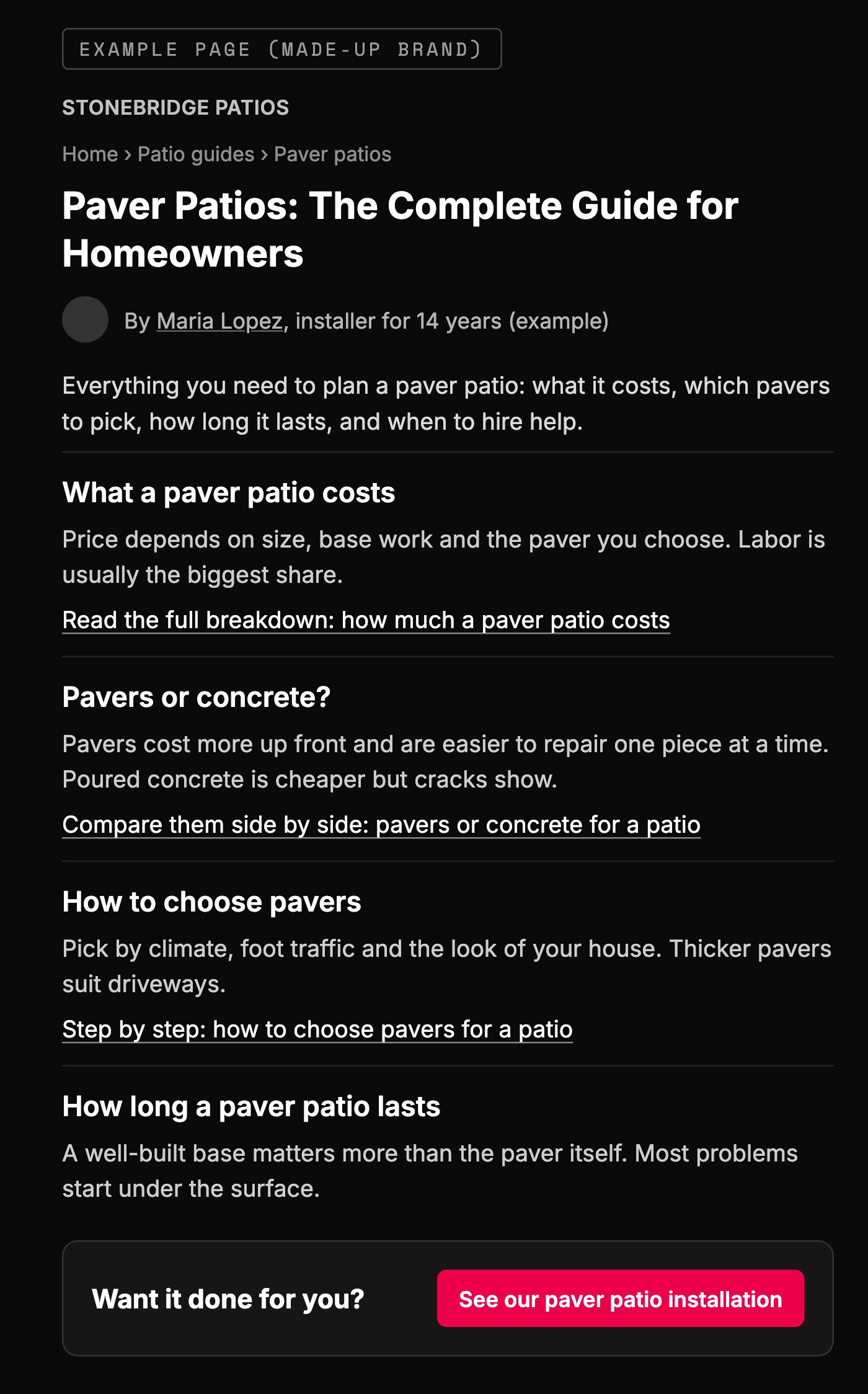
- Page title and H1 target the same keyword.
- The guide links down to each spoke, from a short intro section.
- Link words say what the page is about. Never just read more.
- Easy subtopics stay inside the guide. No spoke needed.
- Every page in the cluster links to the money page.
Example page built for this article with a made-up brand
Every page in the cluster links up, across and down
| From | Links to | How |
|---|---|---|
| The guide | Every spoke | From a short intro section on that subtopic |
| Each spoke | The guide | Near the top, in plain words |
| Each spoke | Sibling spokes | Only where it helps the reader |
| Every page | The money page | With the words a buyer would use |
| Every link | Its target page | Link words say what that page is about |
Our linking rules. Google: every page you care about needs a link from another page on your site.
Link words should say what the page is about
| Tells Google nothing | Tells Google the topic |
|---|---|
| Read more | how much a paver patio costs |
| Click here | pavers or concrete for a driveway |
| This post | how to choose pavers for a patio |
| Our services | paver patio installation |
Google, Link best practices: good link text is descriptive, reasonably concise and relevant. Examples are ours.
Finish one cluster, then build links to all of it
Build one finished cluster at a time, not one post at a time. A finished cluster is the money page, the guide and two or three spokes. Four or five pages.
Then get other websites to link to the whole set, not just one page. A full set of linked pages on one subject tends to climb together, and faster than one page alone.
For example, one health brand published a 5,000-word guide with three or four supporting posts. A major brand later linked to it, without being asked.
Then build the next cluster. Steady growth looks like a real business.
Dumping thousands of AI pages in one month does not. Google's spam policies have a name for it: scaled content abuse.
How to bury a good blog in four easy steps:
1. Write one short post per keyword. Call it a content strategy.
2. Link each post to nothing but the blog index.
3. Title every post with one vague word, like "Momentum".
4. Generate 500 more with AI over a weekend. Wonder why the hell nothing moved.
Point outside links at the whole cluster, not one page
| One page at a time | One finished cluster |
|---|---|
| One post goes live | Money page, guide and 2 or 3 spokes go live together |
| Outside links point at that one post | Outside links point at the whole set |
| Google sees one page on the subject | Google sees a full body of work on the subject |
| Climbs slowly, alone | Tends to climb together, and faster |
Our build order, from the method in this guide.
One cluster, from list to verdict, in about 90 days
- Map Week 1 Run the prompt. List, group and plan the merge.
- Merge and write Weeks 2 to 3 Build the guide. Redirect the old posts.
- Spokes and links Week 4 Publish 2 or 3 spokes. Apply the five linking rules.
- Outside links Months 2 to 3 Point them at the whole set. Check Search Console monthly.
- Judge Day 90 Read the results. Then start the next cluster.
Our working plan. Week counts are a guide for one person, not a rule.
Why does hub-and-spoke SEO take about 90 days?
Plan on about 90 days before you judge a cluster. Google picks up small changes as you make them. Bigger ranking changes come later, after Google has watched the site for about three months.
Google checks your rivals on the same schedule. So you are not racing the clock. You are racing them.
Google gives a wider range. Its SEO starter guide says some changes show up in a few hours and others take several months. It suggests waiting a few weeks before you judge.
Our decision rule: look every month, judge at 90 days. Week three is too early to call it.
Track the cluster in Search Console, Google's free report on your site. For each page, check how often it showed up in search, how often people clicked, and its average position.
Shown often, clicked rarely? Fix the title first, since that is what searchers see.
Never shown after 90 days? Check that Google has indexed the page (added it to its list) and that other pages link to it, before you write anything new. We walk through one of these fixes in the page-two problem.
Google says hours to months; we judge a cluster at 90 days
| Who | What they say | What to do |
|---|---|---|
| Google's SEO starter guide | Some changes show in a few hours, others take several months. Wait a few weeks to assess. | Do not panic in week two. |
| Our rule | Small changes get picked up as you go; bigger reshuffles come after about 90 days. | Look monthly. Judge at 90 days. |
Google Search Central, SEO Starter Guide; our working rule.
Three numbers per page, one fix per pattern
- 1. Pull the numbers Times shown in search, clicks, average position, for each page.
- 2. Shown a lot, clicked little Fix the title first. It is what searchers see.
- 3. Shown never, after 90 days Check it is indexed and linked before writing more.
Our monthly review in Google Search Console.
Map your first cluster with AI
Paste the prompt below into your preferred AI. It asks what you sell, which page sells it, and which posts you already have. Then it builds the guide outline, the spokes, the merge list and the link map.
It never guesses search numbers. If it can browse, it reads the top 20 results itself. If it cannot, it asks you to paste what you see.
The same work helps with AI search. Google's page on AI features says normal SEO best practices still apply to AI Overviews and AI Mode, with no extra rules. More in what AI answer engines cite.
Paste into your preferred AI. It asks what you sell and what posts you have, then gives you a guide outline, spokes, a merge list and a link map.
Act as an SEO planner. Help me build one hub-and-spoke cluster (the Guide-and-Spokes Map) for one service I sell.

Ask me one question at a time, with the example:
1. What service do you sell, and to whom? (Example: paver patios for homeowners in one metro area)
2. What is the URL of the page that sells it? (Example: /patios/)
3. List every post on my site about this topic, with URLs. (Example: 12 posts)
4. What do buyers ask before they buy? (Example: cost, how long it lasts, pavers or concrete)

Never invent search volume, rankings or word counts. If you can browse, search the main keyword and read the top 20 results: long guides or short posts, and about how long? Copy the format of the newest page on page one, not the oldest. If you cannot browse, ask me to paste what I see.

Rules:
- One guide (the hub) covers the whole topic broadly, with no deep detail. Usually 4,000 to 8,000 words, but the top 20 decides.
- Two or three spokes: only the subtopics that are hardest to rank for or need the most explaining. About 3,000 to 4,000 words each if the results are long pages.
- Spokes move a reader toward buying: deeper strategy, then step-by-step help, then the money page.
- Merge thin posts on the same subtopic into the guide or a spoke. Give each old URL a 301 redirect to its new home.
- Links: guide to every spoke and back; spokes to each other where it helps; every page to the money page. Link words say what the target page is about.
- Page title and H1 target the same keyword.
- Publish the whole cluster, then build outside links to all of it.
- Judge it after about 90 days in Search Console, not before.

Output:
Keyword for the guide:
Guide outline: H2s, one line each
Spokes: title, keyword, what it covers
Merge list: old URL -> new home
Link map: from page -> to page -> link words
Next three actions: 1. 2. 3.
Run it this week
1. Run the prompt for the service that makes you the most money.
2. Merge the thin posts on that topic into the guide, and redirect the old addresses.
3. Add the five link rules to every page in the cluster. Put a date on your calendar 90 days out.
Back to the plumber with forty posts. He does not need post number forty-one. He needs his forty posts to link to each other.
Next problem: making sure Google knows who you are. Start with how a small firm gets a knowledge panel, or send us your map for a second look.
Forty loose posts look like a crowd of strangers. Forty linked posts look like one expert.

Filip Kovacevic is the founder of Anar Agency in Phoenix. He spent five years running SEO, Meta ads, email, and content for medical practices across the United States, and now does the same work for healthcare, home-service, legal, and professional-service businesses, alongside AI implementation. More from Filip →
Talk it through in 15 minutes
Bring one question from this article. We will tell you what we would do, whether or not you hire us.
Book a 15-Min Chat →