Productized Service SEO: Pick Searches You Can Win and That Pay

Productized service SEO on a small budget means writing only for searches you can win and that pay. Pick terms with 100 to 1,000 searches a month. Multiply the searches by 2 percent and by your profit per sale.
Skip terms where the top five sites all score 80 or more out of 100.
Productized service SEO: beat the forgotten page, not the giant
Search for pink flamingo lawn ornaments. A giant online store may sit at number one.
Nobody at that store wrote a page for that search. The page ranks because the whole store is strong. Nobody is looking after it.
A small site cannot beat the store at everything. It can beat one forgotten page. That is the whole game.
A productized service is one service, sold at a set price, delivered the same way every time. Think a flat-fee website audit, or tutoring sold by the hour.
Productized service SEO on no budget comes down to two checks before you write a word. Can you win the search? Does it pay?
Here is the short answer. Pick searches with 100 to 1,000 a month. Multiply by 2 percent and by your profit per sale.
Then look at the top five results. All giants? Walk away.
One giant with a forgotten page? Build a better page.

You cannot beat the giant. You can beat its forgotten page
| Fighting the giant | Beating its forgotten page |
|---|---|
| A search the big company built a page for on purpose | A search the big company ranks for by accident |
| Their SEO team keeps improving the page | Nobody owns or updates the page |
| More than 1,000 searches a month | 100 to 1,000 searches a month |
| Years of links before you show up | One dedicated page can pass it |
Our comparison, from the method in this guide.
How do I choose keywords I can rank for? Start at 100 to 1,000 searches
Choose keywords with 100 to 1,000 searches a month. That band is big enough to pay and small enough to win.
Above 1,000, you meet companies with budgets and SEO teams. They built those pages on purpose. You will not outspend them.
Below 100? Not dead. It can still pay when each sale is big, and the next section shows the math.
Start with how buyers talk. Write down every way someone might type your problem into Google. Use their plain words, not your brand words.
Then put each phrase into a keyword tool. Google's Keyword Planner shows an estimate of how many searches a phrase gets each month.
Got a competitor? Enter their website instead of a phrase. The tool suggests the words their pages are built around.
That is free research, paid for by your competitor.
Small searches add up. Ten terms at 300 searches each is 3,000 people a month who typed your exact problem.
A big number in a keyword tool is a trophy. A small number you can win is a business.
Aim at 100 to 1,000 searches a month
| Monthly searches | Who you are up against | What to do |
|---|---|---|
| Under 100 | Almost nobody | Write only if each sale is big. Run the math. |
| 100 to 1,000 | Small sites and forgotten pages | Your band. Start here. |
| Over 1,000 | Companies with budgets and SEO teams | Skip for now. Come back when you have links. |
The Two-Percent Math search band.
Four steps to a list of searches worth checking
- 1. Write how buyers talk Every way someone might type the problem. Their words, not yours.
- 2. Pull monthly searches Put each phrase into a keyword tool and note the estimate.
- 3. Mine a competitor Enter their website. The tool suggests the words their pages target.
- 4. Keep the band Cut anything over 1,000. Keep 100 to 1,000, plus small terms with big prices.
The Two-Percent Math, step one.
The Two-Percent Math checks a search before you write for it: monthly searches, times 2 percent, times your profit per sale. Write for terms with 100 to 1,000 monthly searches that still pay at 1 percent. Skip a term when all top five results score 80 or more out of 100.
Go when sites sit near 40, or a giant ranks with a buried page. Build one page per search, earn links by making public data useful on pages with no pitch, and give it six to twelve months.
Run the Two-Percent Math before you write a page
The Two-Percent Math is a one-line check: monthly searches, times 2 percent, times your profit per sale. The answer is what one search could earn you each month.
Why 2 percent? It assumes only 2 in every 100 searchers ever buy. That is a cautious guess, not a promise.
Use profit, not price. A $500 service that costs you $350 to deliver earns $150 a sale.
For example, take 400 searches a month. Two percent is 8 sales, and 8 sales at $150 is $1,200 a month.
Worth a page? For a one-person shop, yes.
Now change one number. At $5 profit a sale, the same 400 searches bring $40 a month. That is a hobby.
A small search can still pay well when the price is high. For example, 100 searches a month for a $50,000 product, at 2 percent, is two sales. That is $100,000 a month, about $1.2 million a year.
Big companies skip a search that small. Should you skip it too? No. That is exactly where you can win.
Too close to call? Run it again at 1 percent. If it still pays, write the page.
If it only works at 2 percent, the margin is too thin.
Do this math before you build anything. It takes an afternoon. Skipping it can cost six months of work that earns a couple of hundred dollars.
Example: the same 400 searches pay $1,200 or $40, depending on profit
Monthly prize = 400 searches x 2 percent x profit per sale
- $150 profit a sale 1200
- $50 profit a sale 400
- $5 profit a sale 40
Worked example: 400 x 0.02 x each profit. The math is ours.
Example: 100 searches a month can carry a big business
A $50,000 product, sold to 2 percent of 100 monthly searchers
- Searches a month 100
- Sales a month at 2 percent 2
- Price of each sale 50000
- A year, at that rate 1.2
Worked example from the method: 100 x 0.02 x $50,000 x 12. Not a result.
Check the top five results: skip 80 and up, go near 40
Search the term and look at the top five results. Then check how strong each site is. That tells you if you can win.
Domain authority is a score that SEO tools give a whole site, mostly from the links pointing at it. It runs on a 100-point scale.
Each tool has its own version: Moz Domain Authority, Ahrefs Domain Rating and Semrush Authority Score. Moz says plainly that its score is not a Google ranking factor.
So use each score as a rough guide, not a final answer.
All five at 80 or above? Skip it. Those sites took years to get there.
For example, one online language school that had earned links for 15 years scored 75.
Sites scoring around 40? Go. A site that size can be passed by a better page.
A giant with a buried page? Go. That is the flamingo case.
The page ranks on the store's strength, and nobody is working on it.
Then build one dedicated page for that search. One search, one page, the clearest answer anywhere.
Clear pages that answer one question also get quoted by AI answer tools. See what AI answer engines actually cite.
Write where the top five are weak or not trying
- Go Sites near 40 with real pages. A better page can pass them.
- Skip for now All five at 80 or above with pages built for it.
- Go Weak sites, weak pages. Easiest win.
- Go, with one dedicated page A giant's buried page ranks on its strength alone.
The Two-Percent Math top five check.
Three tools, three names, one 100-point ruler
| Tool | Score name | Scale | Used by Google? |
|---|---|---|---|
| Moz | Domain Authority | 1 to 100 | No, Moz says it is not a ranking factor |
| Ahrefs | Domain Rating | 100-point scale | A tool metric, not a Google signal |
| Semrush | Authority Score | 1 to 100 | A tool metric, not a Google signal |
Sources: Moz, What is Domain Authority; Ahrefs Help, What is Domain Rating; Semrush Knowledge Base, Authority Score.
Two giants on off-topic pages and three small sites: a search you can win
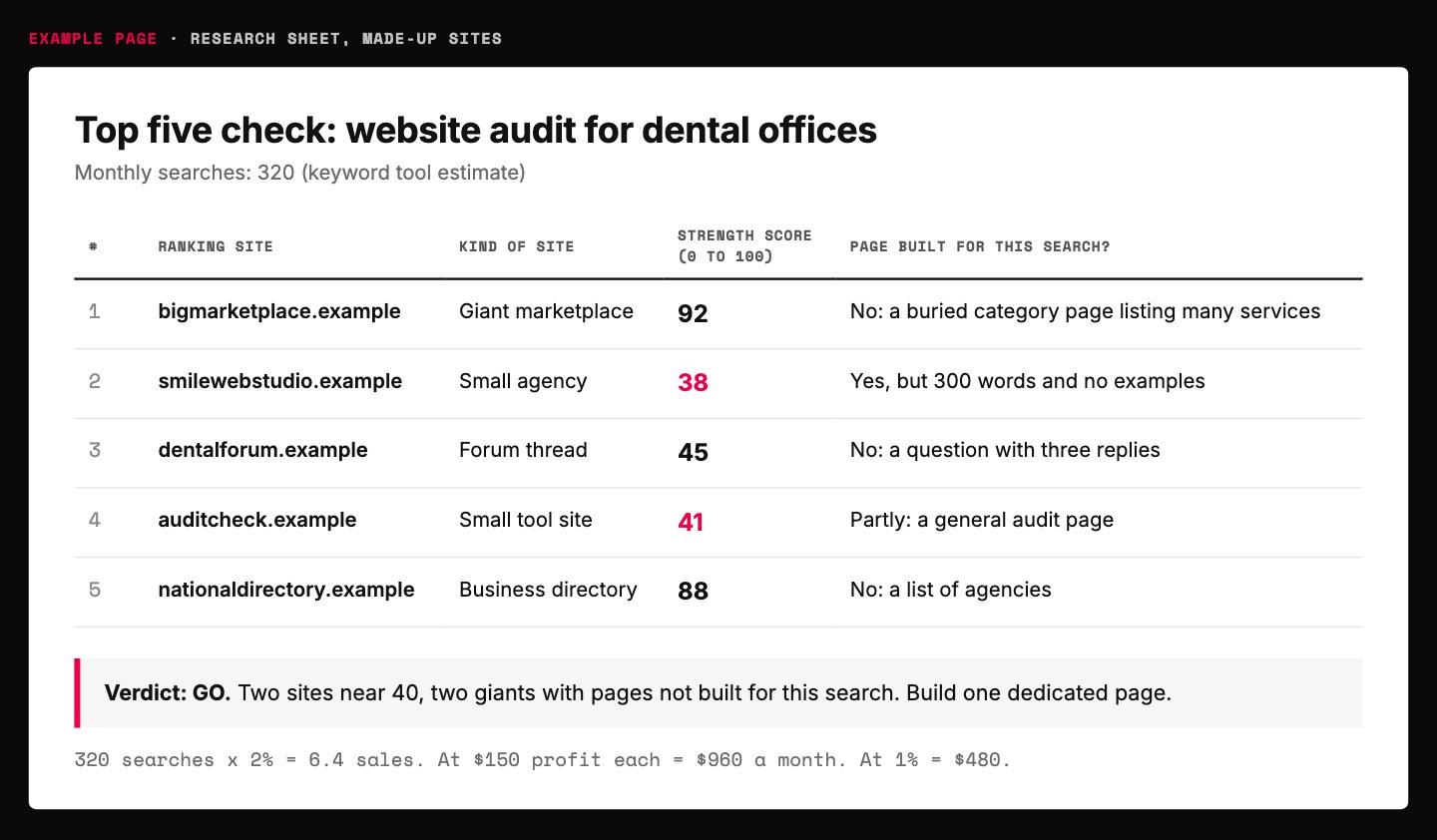
- A giant, but its page is a buried list. It ranks on the site's strength alone.
- Near 40 with a thin page. A better page can pass it.
- A forum thread in the top five means nobody built a real answer yet.
- Not all five are 80 or above, so the search is open.
- Run the math too. It still pays at 1 percent, so write the page.
Example page built for this article with a made-up brand and made-up sites
How can a small business get backlinks for free? Make public data useful
Get free links by taking dull public data and making it easy to read. Reporters and researchers link to whoever made the numbers usable.
A backlink is a link from another site to yours. Search engines read each one as a vote for your page.
Start at Data.gov. It lists datasets on almost anything, from vehicle registrations to lottery results.
Most of it looks terrible. Raw spreadsheets, no charts, no story. That is your opening.
Work made by the US federal government has no copyright. US copyright law says so. State and city datasets can carry their own terms, so read the license line first.
Pick data your buyers care about. Turn it into a clean table, a chart and a short plain summary. Put it on its own page.
Then tell people. Email the writers who covered the topic before, and show them the clearer version.
Want to go further? Ask for records that are not online yet. A Freedom of Information Act request lets anyone ask a federal agency for its records.
For example, one online language school learned the US State Department had made courses in more than 150 languages. Many were not online. The school asked the Library of Congress for them through a FOIA request.
It scanned the microfilm and put every course on its site. One teaches cavalry commands from the World War II years. Academics link to the collection, Harvard among them.
You cannot buy links like that. You can only earn them.
Turn ugly public data into a page people link to
- 1. Find the data Search Data.gov for a topic your buyers care about.
- 2. Check the terms Federal work is public domain. State and city data can carry their own terms.
- 3. Make it readable A clean table, one chart, a short plain summary.
- 4. Keep it pitch-free No ads, no sales banner. Teaching pages get the links.
- 5. Tell people Email writers who covered the topic before. Show them the clearer version.
The Two-Percent Math link step. Public-domain rule: 17 U.S. Code 105.
Example: one records request built a library academics link to
- A gap Find Government language courses in 150+ languages, many not online.
- A FOIA request Ask Filed with the Library of Congress.
- Microfilm to web Scan Every course scanned and published.
- Links nobody can buy Earn Academics link to it, Harvard among them.
Example numbers from another business. Not our results, and not verified by us.
Check who published a dataset and when, before you build a page on it
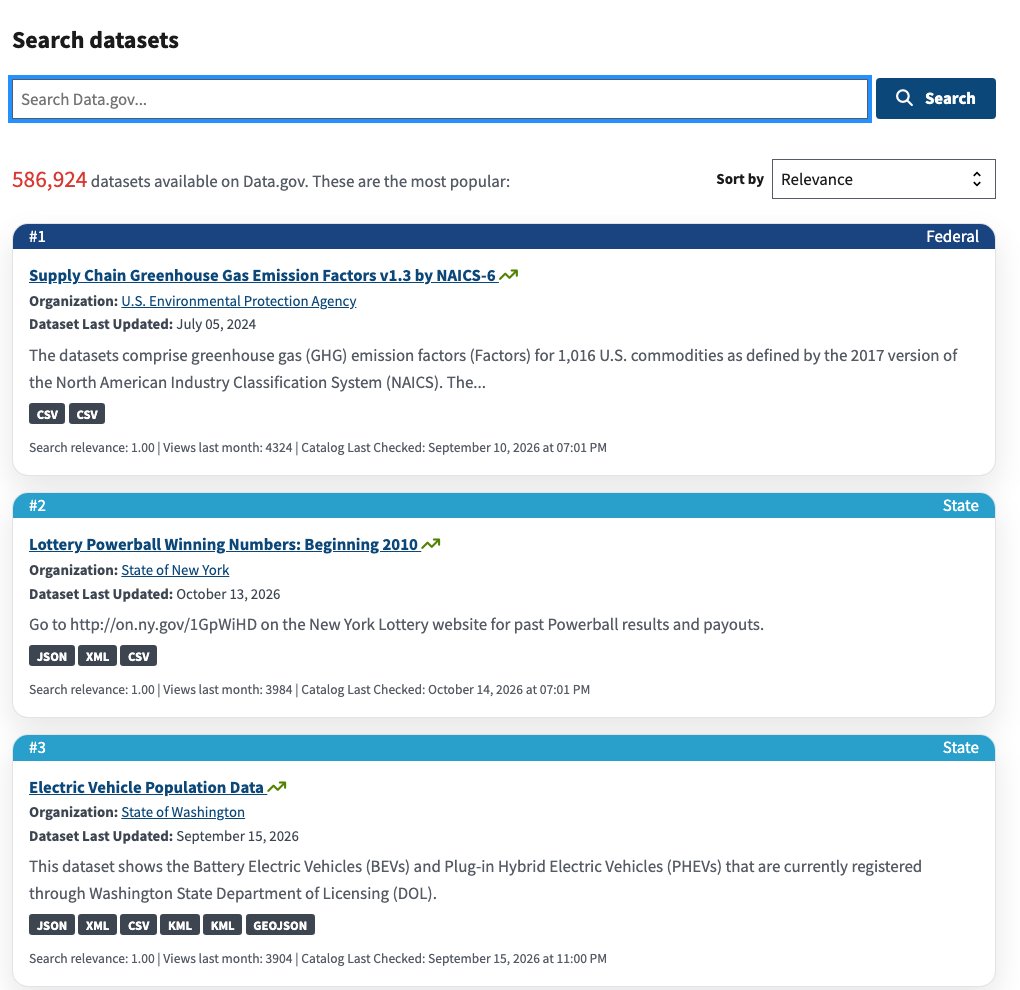
- Type a topic your buyers care about. Start broad, then narrow.
- Check who published it. Federal data is public domain. State and city data can carry their own terms.
- Pick data that is kept up to date, so your page stays useful.
- CSV is a spreadsheet. Turn it into a clean table, one chart and a short summary.
Screenshot of the Data.gov dataset catalog (public page). Federal works are public domain under 17 U.S. Code 105, taken 2026-10-17
Build the information page first and add the offer later
People link to pages that teach. They rarely link to pages that sell. So build the teaching page first.
No ads, no pitch, no booking banner. Just the best page on the subject. Link to it from your main site so Google finds it.
Once it has earned links, add your offer. Links on other sites tend to stay where they are for years.
Our rule: keep the teaching. Add the offer under it, never in place of it. A page that tricks the people who linked to it does not deserve their links.
Think of a strong page like land downtown. You may not know what to build on it yet. It still gains value.
For example, one owner holds a site that went viral early in the pandemic. Its strength score is 65. It has thousands of backlinks, and has nothing for sale on it.
A matching domain name alone will not rank. A site named after the search still needs links.
The name is like the sign on a shop door. Links are what bring people inside.
Building the page itself? Our guide to problem pages covers how to write one that turns readers into buyers.
People link to pages that teach, so build that page first
| Sales page from day one | Information page first |
|---|---|
| A pitch at the top | The best answer on the subject |
| Few people want to link to it | Writers and researchers link to it |
| Has to buy its traffic | Earns links for years |
| Offer is the whole page | Offer added later, under the teaching |
Our comparison. Our rule: keep the teaching when you add the offer.
City pages and mass pages need real data on every page
Every page you publish must carry something no other page has. This is where most cheap SEO dies.
The cheap move is one page per city with a swapped photo and a paragraph written by AI. Google's spam policies call pages built to rank for many similar searches doorway abuse.
The fix is data. Show real city-level numbers on each city page. Now each page is different, and each one helps someone.
Mass pages, made by the thousand from one spreadsheet, follow the same rule, plus one more. They work only on a site that already has strong links.
For example, one language site built millions of verb pages from a single spreadsheet. Only 30 to 40 percent of them rank near the top. At that size, that is still a huge stream of visits.
It used one main page per verb, sub-pages under it, and canonical tags to show Google which page is the main one. On a brand-new site, the same pages would sit unseen.
Before you build at scale, read our programmatic SEO guardrails.
How to get your site wiped out in four easy steps:
1. Spin one article into 500 versions and post them everywhere.
2. Let a bot drop your links in blog comments.
3. Make a page for every city with the same paragraph.
4. Publish ten million AI pages on a site nobody links to.
That list is not a joke. For example, one language school did the first two and lost its whole site to Google's 2012 Penguin update. The owner walked in one morning, and the business was gone.
SEO shortcuts can work for a while. Then Google catches them, and you lose more than you gained.
A city page earns its place with data only that city has
| Thin city page | Useful city page | |
|---|---|---|
| What changes per city | The photo and one AI paragraph | Real local numbers |
| Why it exists | To rank for a city name | To help someone in that city |
| Google's view | Doorway abuse in its spam policies | Unique value on every page |
| Works on a new site? | No | Yes, if the data is real |
Sources: Google Search Central, Spam policies (doorway abuse); the method in this guide.
How long does SEO take for a new business? Six to twelve months
In a small niche, expect six to twelve months before you know if a page works. In a crowded niche, expect two to three years.
That is slow. So should you run ads instead? If you have money and need answers fast, ads test an idea quicker.
With no budget, start with search. Our hub-and-spoke SEO guide shows how to group those pages so they help each other rank.
For example, one language school started with $2,000 in the bank and a five-page site. Within six months, that site earned more than its physical schools.
Once search works, each new customer costs nothing in ad spend. That is why it is the profit channel.
It also matters if you ever sell the business. Buyers ask early: if the ads stopped tomorrow, what would sales do?
A business that gets every customer from one channel is worth less. One estimate: service businesses sell for 3.5 to 7 times profit, and a one-channel business for 2 to 3 times.
Ads are one way to get customers. Search is a second way. A business with only one way is shaky.
Google's own guide to helpful content says to write for people first, not for rankings. Pages like that keep paying long after you write them.
Six to twelve months in a small niche, two to three years in a crowded one
- Pick and build Week 1 Run the math, check the top five, build one page.
- Earn links Months 1 to 6 Public data pages, outreach to writers.
- Small niche verdict Months 6 to 12 You know if the page works.
- Crowded niche verdict Years 2 to 3 Competitive terms take this long.
The Two-Percent Math timeline.
One channel can cut what a business is worth
| Business | Sale price, in years of profit | How sure |
|---|---|---|
| Service business, several channels | 3.5 to 7 times | One estimate; not verified by us |
| Any business with one channel | 2 to 3 times | One estimate; not verified by us |
Example numbers from another business. Not our results, and not verified by us.
Run the Two-Percent Math with AI
Paste the prompt below into your preferred AI. It asks for your service, your profit per sale and the ways buyers search.
It never invents a search count or a site score. It looks them up if it can browse, or asks you, and says which.
Then it sorts every term into write, wait or skip. Check its numbers before you build anything.
New to the basics? Google's SEO starter guide explains how search finds and shows pages.
Want a second pair of eyes on your list? Send it to us.
Paste into your preferred AI. It asks what you sell and how buyers search, then marks each term write, wait or skip.
Act as an SEO analyst for a small service business with no ad budget. Use the Two-Percent Math to pick which searches to write for.

Ask me one at a time, with the example:
1. What do you sell, and at what price? (Example: a flat-fee website audit, $500)
2. What does one sale cost you to deliver? (Example: $350)
3. List the ways a buyer might type your problem into Google. (Example: "website audit for dentists", "why is my site slow")
4. A competitor's website, if you know one. (Example: competitor.example)

Numbers: never invent a search count or a site score. If you can browse, look up monthly searches and the top five results' strength scores (Moz Domain Authority, Ahrefs Domain Rating or Semrush Authority Score) and say where each came from. If you cannot, ask me for them.

Rules:
- Profit per sale = price minus delivery cost.
- Monthly prize = monthly searches x 0.02 x profit per sale. Rerun at 0.01. Mark any term that only pays at 2 percent as thin.
- Band: 100 to 1,000 monthly searches. Below 100 only if each sale is large. Above 1,000, expect funded competitors.
- Top five check: all five at 80 or more out of 100 = skip. Several near 40 = go. A giant ranking with a buried page that is not about this exact search = go, with one dedicated page.
- One search, one page. Every page needs something no other page has (real data, a worked example, a clear answer).
- Links: suggest one public dataset (Data.gov) or public record my buyers would care about. Federal data is public domain; check state and city terms.
- Never suggest buying links, spun articles, or copy-paste city pages.
- Time: six to twelve months in a small niche, two to three years if crowded.

Show your math, then answer:
Profit per sale: $
Table: term | searches | prize at 2% | prize at 1% | top five verdict | write, wait or skip
Best term to write first, and why:
One dataset to turn into a link page:
Next three actions: 1. 2. 3.
Three steps for this week
1. List 20 ways a buyer might type your problem. Pull the monthly searches for each.
2. Run the prompt. Keep the terms in the band that still pay at 1 percent.
3. Check the top five for your best term. Build one dedicated page for it, with something on it nobody else has.
Not sure what goes on that page? Start with where real content comes from. Then make sure the price behind it holds up with offer economics before launch.
The giant store still owns the flamingo search. For now.
Nobody looks after its page. You will look after yours.

Filip Kovacevic is the founder of Anar Agency in Phoenix. He spent five years running SEO, Meta ads, email, and content for medical practices across the United States, and now does the same work for healthcare, home-service, legal, and professional-service businesses, alongside AI implementation. More from Filip →
Talk it through in 15 minutes
Bring one question from this article. We will tell you what we would do, whether or not you hire us.
Book a 15-Min Chat →