Problem Pages: How to Write a Problem-Aware Landing Page

A problem-aware landing page opens with the problem your buyer already feels, in their own words. Most buyers know what is wrong but not what the fix is called. So the page names the problem, explains why it happens, gives a free check, says what fixing it takes, shows real proof, and asks once.
What is a problem-aware landing page?
A builder near Detroit had a condo problem. The condos were good, built for retirees who wanted a smaller home. Sales were weak.
Buyers kept bringing up one thing, and it was not the kitchen. It was their dining room table.
As Harvard Business Review tells it, buyers said they could move once they knew what to do with that table. So the builder stopped adding features and started helping with the move. Sales took off.
The table was the real problem. The condo was just the product.
A problem-aware landing page is a page for someone who knows what is wrong but not what the fix is called. We call it a problem page. It opens with the problem, in the words the buyer uses.
Most service pages do the opposite. They open with the product.
A product page waits for decided buyers; a problem page meets everyone else
| Product page | Problem page |
|---|---|
| Headline: what we sell | Headline: what is going wrong, in the buyer's words |
| Written for people who know the product's name | Written for people who only know the problem |
| Opens with features and plans | Opens with why the problem happens |
| Asks early, often above the headline | Asks once, after help and proof |
| Reviews praise the product | Reviews say what changed |
Our comparison, from the method in this guide.
Nobody searches for your product name
Product pages are written from the company's side. They use the company's name for things. They are laid out the way the company is organized.
Buyers search from their own side. Google's SEO starter guide says people new to a topic search with different words than experts do.
For example, picture an office whose Wi-Fi drops every afternoon. The manager does not type "managed IT services." She types what is happening to her.
Product pages make a second mistake. They explain how the thing works before the reader knows why it matters. We call that explaining too early.
Take a funnel audit, a review of the steps from ad to sale. Nobody wakes up wanting an audit. They wake up with a funnel that works but stopped growing, and an ad bill that keeps climbing.
If you sell the audit, you only reach people who already want one. If you name the stuck funnel, you reach everyone who has one.
A product page reads like a menu. A problem page reads like a doctor telling you what is wrong.
The product name and the buyer's words are rarely the same
| What the company sells | What the buyer says or types |
|---|---|
| Managed IT services | "Office wifi keeps dropping every afternoon" |
| Funnel audit | "Our funnel works but stopped growing" |
| Kitchen remodel | "Our kitchen is too small to cook in" |
| Growth marketing | "I need more members" |
Illustrative examples, not survey data.
The Problem Page is a page built around one problem a buyer already feels, in the words they use. Six parts, in order: the problem as the headline, specific enough that the wrong reader leaves; the two or three real causes; a check the reader can run alone in about ten minutes; what fixing it involves, honest about what they can do themselves; proof of change from real customers; and one ask, placed after the proof. Collect the words from first calls, emails, reviews and search queries, build one page per problem, most common first, and never explain the product before the problem.
Step 1: Collect the problem in the buyer's own words
Your best headline is already in your inbox. Buyers wrote it to you in their first email or said it on the first call.
Pull 20 of those first messages. Use call notes, contact forms, reviews and chat logs. Add the queries from the Search Console performance report, which lists what people typed before they found you.
Copy their words exactly. Do not clean them up. "The wifi keeps dropping" beats "intermittent connectivity" every time.
Then sort them. Which problem shows up most? That is your first page.
Watch for marketer words. Owners rarely say they want to scale. Marketers do.
For example, a gym owner says "I need more members." A parent types "karate classes near me," not a slogan.
One page, one problem. Two problems on one page means neither buyer feels seen. If you are not sure which kind of problem you are dealing with, sort it first with the four problem types.
Let AI do the sorting. Paste the messages in and ask it to group them by problem, using only the buyers' exact phrases. The prompt at the end does this for you.
Your buyers have already written your headlines; here is where to find them
| Where | What to copy | Why it works |
|---|---|---|
| First calls | The first sentence they say | Unrehearsed, in their words |
| Contact forms and emails | The subject line and first line | Written before they knew your terms |
| Reviews | What was wrong before | Names the problem and the change |
| Search Console queries | What they typed to find you | Shows the words that bring visits |
Our method. Search Console queries: Google Search Console Help, Performance report.
Buyers do not talk like marketers, so the page should not either
| Marketer words | Buyer words |
|---|---|
| Scale | "More members" |
| Intermittent connectivity | "The wifi keeps dropping" |
| Conversion optimization | "People visit and nobody calls" |
| Solutions | The thing that is actually broken |
Illustrative examples, our comparison.
Step 2: Write a headline only you could say, to one person
Most visitors read the headline and little else. In a Nielsen Norman Group study, 79 percent of test users scanned new pages. Only 16 percent read word by word.
So the headline does most of the work. It names one problem, for one kind of person.
Test it like this. Could a competitor put their name on it? If yes, it is too generic.
Make it specific enough that the wrong person leaves. That sounds like losing buyers, but it wins you the right ones.
For example, one coaching page for company founders says up front that it only works with leaders running $10 million businesses or bigger. Smaller founders leave. The ones who stay know the page is about them.
Use numbers your reader can picture reaching. An ad that brags about a karate school growing from 120 to 300 students loses most owners, because most schools are nowhere near 120. A small-town school going from 30 to 150 feels possible.
Visitors follow what researchers call information scent: clues that a page leads where they want to go. Their own words are the strongest clue. Google often builds the blue search link from your main heading too, so the same words help you in search too.
Most visitors scan; few read every word
- Test users who always scanned a new page 79
- Test users who read word by word 16
Source: Nielsen Norman Group, How Users Read on the Web (1997 study).
Each rung up, more of the wrong readers leave and the right ones stay
- "Quality IT Solutions" Any IT company could sign it.
- "Managed IT Services for Small Business" Names the product. Still written from the inside.
- "Office Wi-Fi Drops Every Afternoon?" The problem, in the buyer's words.
- "Office Wi-Fi drops every afternoon? Find the cause in 10 minutes" Problem plus a promise. Only offices with this problem keep reading.
Illustrative headlines, our method.
Build the page in six parts: help first, ask last
The Problem Page is a page built around one problem a buyer already feels, laid out in six parts, in this order.
1. The problem as the headline: in their words, from step 1.
2. Why it happens: the two or three real causes. This is where the reader decides you know what you are talking about.
3. A check they can run alone: something that takes ten minutes, without you. Give it away.
4. What fixing it involves: say which fixes they can do themselves and which need a pro.
5. Proof of change: real customers saying what is different now.
6. One ask: one next step, for the people who would rather hand it over.
Four parts help, one proves and one sells. Google's helpful content guidance asks the same thing: will the reader leave feeling they learned enough to reach their goal?
Notice what is missing: your company history, your process chart and your price plans. They can sit lower on the page, or on the product page.
Visitors also bring questions they never ask out loud. A problem page answers most of them. Our guide to the unasked questions covers the rest.
Six parts: four help, one proves, one asks
- 1. The problem The headline, in the buyer's words.
- 2. Why it happens The two or three real causes.
- 3. A free check Ten minutes, no help needed.
- 4. What fixing it takes Honest about do-it-yourself versus a pro.
- 5. Proof of change Real customers saying what is different now.
- 6. One ask One next step, after the proof.
The Problem Page, as set out in this guide.
Example: one Wi-Fi problem, mapped to all six parts
| Part | Example line on the page |
|---|---|
| 1. The problem | Office Wi-Fi drops every afternoon? |
| 2. Why it happens | Three usual causes: too many devices on one router, old cabling, a crowded channel. |
| 3. A free check | Walk the office with a phone at 3 p.m. Does the drop follow one room? |
| 4. What fixing it takes | Moving the router is a job for you. Rewiring is not. |
| 5. Proof of change | A real customer quote about what changed. Never a made-up one. |
| 6. One ask | Book a 15-minute call to find your cause. |
Illustrative example page, built for this guide.
One problem page, top to bottom: help first, one ask last
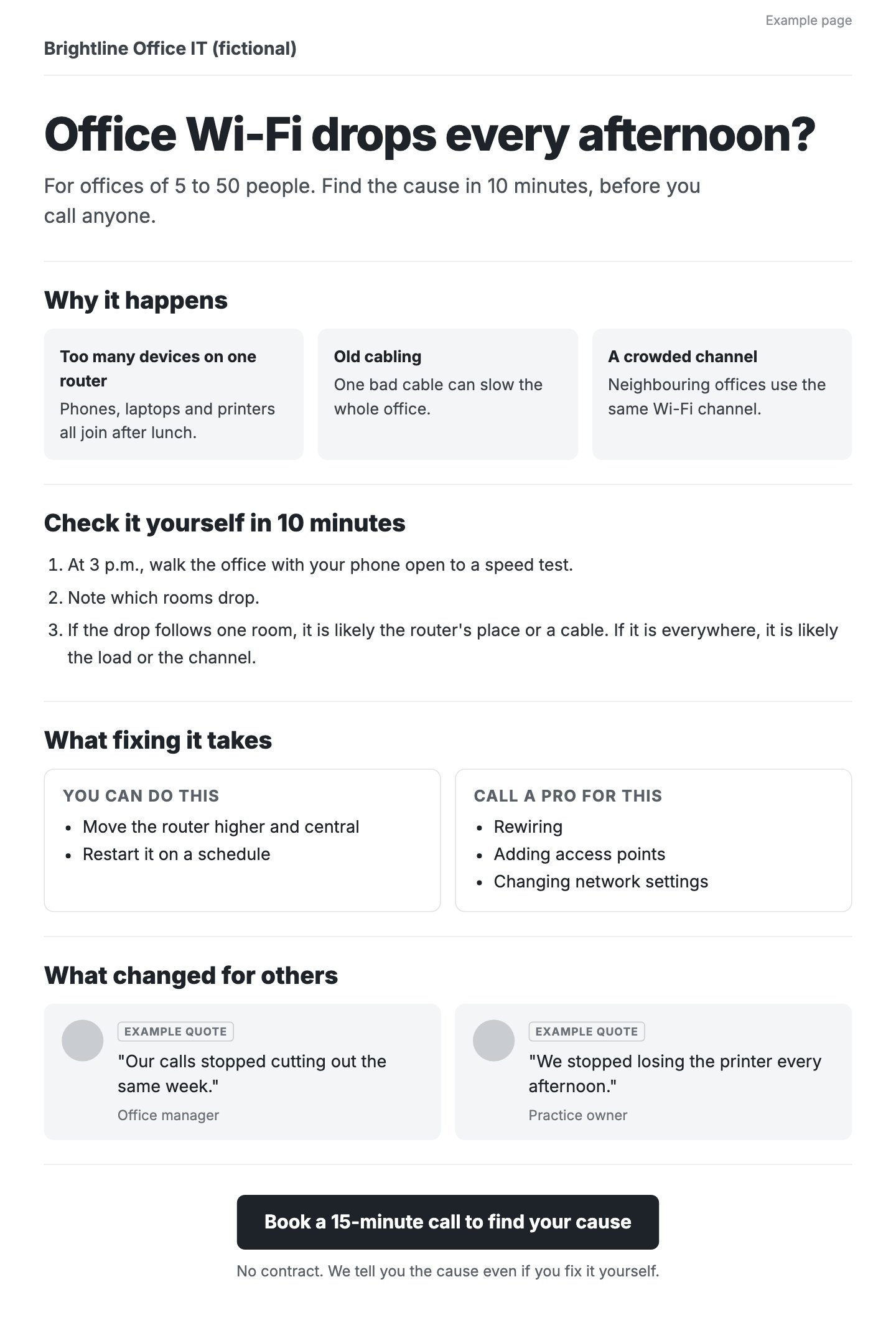
- The problem, in the words a buyer would type.
- Says who it is for, so the wrong reader leaves.
- The free check. Give it away.
- Honest about what they can do alone.
- One ask, after the proof. Nothing above the headline.
Example page built for this article with a made-up brand. The company and the quotes are fictional and labeled as examples.
Will giving away the fix cost you customers?
Rarely. Part three, the free check, scares most owners. They worry it gives the business away.
It does the opposite: it wins you customers.
Picture three readers. The first fixes it alone. They were never going to pay you, and now they like you.
The second reads the check and thinks, I do not have time for this. That reader is your customer.
The third tries, gets halfway, and gets stuck. Now they know exactly who understands the problem: you.
This is the idea behind jobs to be done, made famous by Clayton Christensen. People do not want your service. They want a job done.
A product page talks about what they would buy. A problem page talks about the job they need done.
A vague page does not keep your secrets safe. It just sends the buyer to a competitor who explained it. We go deeper on this in selling outcomes, not deliverables.
Giving the fix away costs you one reader and wins you three
- Tries, gets stuck Now knows exactly who understands the problem.
- Fixes it alone Was never going to pay. Now likes you.
- Calls right away The check proved you know the problem.
- Hires you to save time Knows the fix, would rather hand it over.
Our framework.
Prove the change, then ask once
Most testimonials praise the product. That is the weakest proof you can show.
For example, one supplement brand sent about 100 bottles to paid video creators. Every video described the product. Not one described a change in someone's life.
A product testimonial says "great service, nice team." A change testimonial says what is different now. "Our calls stopped dropping the same week."
To get that quote, ask the right question. "What was going wrong before you called us, and what is different now?"
Use real customers only, with their permission. If you paid or gave anything for a review, the FTC's endorsement guidance says to disclose it. More on building proof in the proof grid.
Then ask once. One button, after the proof, when the reader already agrees. A button above the headline asks for a yes before the reader even knows what the page is about.
Research on choice overload, where too many options stall people, is mixed. But a second button never helped anyone decide, so we use one button.
How to write a page nobody calls, in four easy steps:
1. Open with your company name and the year you were founded.
2. Explain your seven-step process before anyone knows why they need it.
3. Put a Book Now button above the headline. Ask early and often.
4. Add three reviews about how nice your team is. Then wonder why the hell nobody calls.

Proof that sells says what changed, not what the product is
| Product testimonial | Change testimonial |
|---|---|
| "Great service, nice team." | "Our calls stopped dropping the same week." |
| Talks about you | Talks about their life before and after |
| Could be about any company | Names the problem the page is about |
| Came from "Can you leave us a review?" | Came from "What was wrong before, and what is different now?" |
Illustrative quotes, our comparison.
One ask, after the proof, when the reader already agrees
| Where the button sits | What the reader knows by then | Our call |
|---|---|---|
| Above the headline | Nothing yet | Remove it |
| After the causes | That you understand the problem | Too early for most |
| After the proof | The problem, the fix and that it worked for others | Put the one ask here |
Our rule, from the method in this guide.
Build one page per problem, fast, with AI
One problem page is a start. The goal is one page for each problem buyers bring you, most common first.
This is where AI helps most. It sorts your buyer quotes into problems, drafts each page in the six parts, and flags lines that slip into product talk.
Do not wait for perfect. A plain page that names the right problem beats a beautiful page that names the wrong one.
The page is only half the job. The ads, posts and emails that send people to it do the other half. Each one should name the same problem the page names, as we show in ad-to-page alignment.
Run Google ads? Then this helps you a second way. Google's landing page experience rating looks at how relevant and useful the page is to the person who clicked.
Speak the user's language. That is one of ten usability rules designers have used for decades, and it applies to every heading you write.
Read your search queries again each month. New phrases mean new pages. If a page shows up in search and still gets no clicks, read the page-two problem.
One page per problem, refreshed from what buyers keep saying
- Collect First messages, reviews and search queries.
- Sort AI groups them into problems, in buyers' exact words.
- Draft One page per problem, six parts each.
- Publish Plain beats perfect. Point one ad or post at it.
- Reread New phrases each month mean new pages.
Our process.
Write your first problem page with AI this week
Paste the prompt below into your preferred AI. It asks for your buyers' words, sorts them into problems, and drafts one page in the six parts.
It never invents a quote or a result. Where you have no real proof yet, it leaves a marked gap for you to fill.
1. Pull 20 first messages from buyers and paste them in.
2. Publish the page for the problem they named most.
3. Point one ad or post at it that names the same problem.
Want to check the rest of your funnel too? Run the conversion-first audit, or send us your page.
The builder did not need a better condo. It needed to talk about the table.
Talk about the product, and buyers wait. Talk about their problem, and they move.
Paste into your preferred AI. It asks for what buyers said to you, finds the most common problem, and drafts the six-part page.
Act as a conversion copywriter. Help me write one problem page: a page built around one problem my buyer already feels, in their own words.

Ask me one at a time, with the example:
1. What do you sell, and to whom? (Example: IT support for small offices)
2. Paste 5 to 20 things buyers said or wrote when they first contacted me: call notes, emails, reviews, search terms. (Example: "the wifi keeps dropping every afternoon")
3. What usually causes that problem? (Example: an overloaded router, old cabling, a crowded channel)
4. What can a buyer check alone in about 10 minutes? (Example: does the drop follow one room?)
5. Real customer quotes about what changed after I helped. (Example: "Calls stopped cutting out the same week")
6. My one next step. (Example: book a 15-minute call)

Rules:
- Group the quotes into problems. Pick the one said most often. One page, one problem.
- Use the buyer's words. Never my product name, and no marketer words like "solutions" or "scale".
- Headline: the problem as the buyer says it, specific enough that the wrong buyer leaves.
- Never explain how my service works before the page shows why the problem matters.
- Order: 1 headline, 2 why it happens (two or three causes), 3 a free check they can run alone, 4 what fixing it involves, honest about what they can do themselves, 5 proof of change, 6 one ask.
- One ask only, after the proof. No button above the headline.
- Proof: only quotes I gave you. Never invent a quote, number or result. If I gave none, write [ADD REAL QUOTE].
- If a quote came from a customer who was paid or given anything, say the page must disclose it.
- No fake urgency, no countdowns.

Output:
Problems found: [most common first, in their words]
Chosen problem:
Headline and subhead:
The six parts, drafted:
Product words you replaced:
Next three actions: 1. 2. 3.

Filip Kovacevic is the founder of Anar Agency in Phoenix. He spent five years running SEO, Meta ads, email, and content for medical practices across the United States, and now does the same work for healthcare, home-service, legal, and professional-service businesses, alongside AI implementation. More from Filip →
Talk it through in 15 minutes
Bring one question from this article. We will tell you what we would do, whether or not you hire us.
Book a 15-Min Chat →