Which Customer Data Can Go Into AI? The Building Test for Marketing Engineers
Yes, for most of it, once you sort it field by field. Ask four questions about each field: who it could hurt, whether it can point to one person, what you promised, and whether it is your edge. Then send it as is, hide the personal parts, send only a summary, or keep it in-house.
Is it safe to put customer data into AI? Sort it first
A marketer exports 4,000 support tickets on a Thursday afternoon. She wants an AI assistant to find the top five complaints. Easy job, right?
Ticket 312 holds a card number. Ticket 1,880 mentions a divorce.
Nobody planned to send either one. Both now sit on someone else's computer.
So, is it safe to put customer data into AI? For most of it, yes, once you sort it. The real work is deciding which fields leave the building, before the upload.
Leaving the building means any copy that lands on a computer you do not control. An AI vendor's server counts. So does a browser add-on that sends text to its maker.

Ask which fields may leave, not whether the tool is safe
| Tool-first question | Data-first question |
|---|---|
| Is this AI tool safe? | Which fields may leave, and in what form? |
| One yes for the whole company | One answer per field |
| Trusts the vendor's promise | Sends less, so the promise matters less |
| Checked after the upload | Checked in the export |
Our comparison.
Judge the data before you judge the vendor
Most teams ask the wrong question first. They ask whether the AI tool is safe.
A vendor's promise matters. It is the second check, not the first.
Chip Huyen says it plainly in AI Engineering: once data goes to an outside model, no method stops every slip. Guardrails only lower the odds.
Promises also move. Her book recalls a video-call company that quietly changed its terms to train AI on user data, and the backlash that followed.
Then there is your own promise. Your privacy policy told customers what you would do with their data. Sending it somewhere new can break that promise, even if the vendor is perfect.
The famous case is the phone maker that restricted AI tools after staff pasted internal code into a public chatbot. That is a habits problem, and our shadow AI guide covers it. This guide covers the rows.
How to hand your customer list to a stranger in four easy steps:
1. Export the whole CRM, because filtering takes ten whole minutes.
2. Paste it into whatever AI tab is open.
3. Read the vendor's privacy page after the upload, if ever.
4. Call it a pilot.
That is not a pilot. It is a data transfer with a nicer name.
A vendor's promise answers one question; you answer the other three
| Question | Who answers it |
|---|---|
| Will the vendor protect what we send? | The vendor's contract and terms |
| Should this field be sent at all? | You, with the Building Test |
| Did we promise our customers something else? | Your privacy policy and contracts |
| What if the vendor's terms change later? | You, by sending less in the first place |
Our framework. Terms can change: Chip Huyen, AI Engineering, chapter 4.
The Building Test is a four-question check for every field of customer data before it reaches an outside AI. Who gets hurt if it goes public? Can it point to one person, alone or combined with other fields?
What did we promise, by law, contract or our own policy? Is it our edge? Each field then takes the loosest lane that passes all four: send as is, mask the personal parts, send only a summary written by a model you run yourself, or stay home.
Grey cases are priced with chance times cost. A legal or contract no is never priced away, and anything the AI infers about a person goes through the test again.
The Building Test asks four questions about every field
The Building Test is our four-question check for customer data before any of it reaches an outside AI. Run it per field, not per company. A field is one kind of detail: an email, a ticket body, a price quoted.
Who gets hurt if this field goes public? Think money, health, legal trouble, private words and social standing. The Trustworthy Online Controlled Experiments authors ask experimenters nearly the same thing about their data.
Can it point to one person? A name does. So do many fields that look harmless, as the next section shows.
What did we promise? Laws, client contracts, confidentiality agreements and your own privacy policy all count. If any of them says no, the answer is no.
Is it our edge? Some data hurts no customer but helps every competitor. Price tests, win and loss notes, margin by client.
Four questions. About a minute per field. The answers pick a lane.
Four questions decide where each field may go
- 1. Who gets hurt? Money, health, legal trouble, private words, social standing.
- 2. Can it point to one person? Alone, or combined with the other fields in the file.
- 3. What did we promise? Laws, client contracts, confidentiality agreements, our own privacy policy.
- 4. Is it our edge? Price tests, win and loss notes, margins, plans.
The Building Test, our framework. Question 1 follows the harm list in Kohavi, Tang and Xu, Trustworthy Online Controlled Experiments.
Can a file with no names still point to one person?
Often, yes. Removing names is the start of the job, not the end.
The same experiment book splits data into three kinds. Identified data carries names, ID numbers or phone numbers. Pseudonymous data swaps those for a random ID, like a cookie.
Anonymized data is different again. Someone has checked it and shown that tracing a row back to a person is very unlikely.
Their warning matters most. Calling data anonymous does not make it anonymous. People can still be traced back.
Picture a ticket with no name. A dentist in a small town asks for a refund on a given date. Three plain facts, one person.
Our reading: AI raises this risk. A model is very good at joining small clues into one answer. It is Sherlock Holmes with no day off.
So we treat any field that could narrow a row to one person as identified. It stays that way until a real check says otherwise.
Removing names moves data up one rung, not to the top
- Identified Names, ID numbers, phone numbers. Points straight at a person.
- Pseudonymous A random ID in place of the name. Can still be traced back.
- Anonymized Checked, and tracing a row back to a person is very unlikely.
Kohavi, Tang and Xu, Trustworthy Online Controlled Experiments, sidebar on user identifiers.
Harmless-looking fields point to one person once they are combined
| Field | Looks like | Points to one person when |
|---|---|---|
| Zip code | A place | Combined with a birth date and a job |
| Order date and amount | A sale | Matched against one bank statement |
| Ticket text | A complaint | It names a street, a pet or an employer |
| Cookie ID | A random string | Joined to a login or an email list |
| Job title | A role | The company has one person with that title |
Example rows, ours. Built on the identified, pseudonymous and anonymized split in Trustworthy Online Controlled Experiments.
Route every field into one of four lanes
Every field ends up in one of four lanes. Pick the loosest lane that passes all four questions.
Send. Public or harmless fields go to an approved AI as they are. Published reviews, ad copy, product names.
Mask. The field travels with its personal parts swapped for placeholders, like [PHONE NUMBER]. The key that swaps them back never leaves your systems; our AI governance framework shows the full pattern.
Summary only. The raw file stays home. A model you run yourself reads it and writes a short, fixed set of fields, and only those leave.
Stay home. The field never reaches an outside AI in any form. Card numbers, passwords, health details, anything a contract forbids.
Where do you strip? At the very first step the data touches.
Andy Grove made this a rule in High Output Management: catch a defect at its lowest-value stage. Reject the bad egg at delivery, not on the customer's plate.
Data works the same way, in our reading. A name removed in the export costs nothing. A name found on a vendor's server costs a lot.
Grove also set one hard exception. When a defect could cause total failure, like a bad part in a pacemaker, you never let it pass to save money. We hold health and money fields at the gate the same way.
Each field takes the loosest lane that passes all four questions
| Lane | What leaves | Example fields | Check |
|---|---|---|---|
| Send | The field as it is | Published reviews, ad copy, product names | Spot check |
| Mask | The field with placeholders; the key stays home | Ticket text with names and phone numbers | Sampled every batch |
| Summary only | A fixed set of fields written by your own model | Call recordings, interview notes | Sampled every batch |
| Stay home | Nothing | Card numbers, passwords, health details | Gate: never released |
Our framework. Masking with a reverse map: Chip Huyen, AI Engineering, chapter 10.
Harm and traceability together pick the lane
- Summary only Sensitive words with nobody attached. Your own model writes the fields.
- Stay home Health, money, passwords tied to a person. Never sent.
- Send Public or harmless. Goes as it is.
- Mask Harmless content, but it names someone. Swap the names first.
Our framework.
The AI gets placeholders; the key that swaps them back stays home
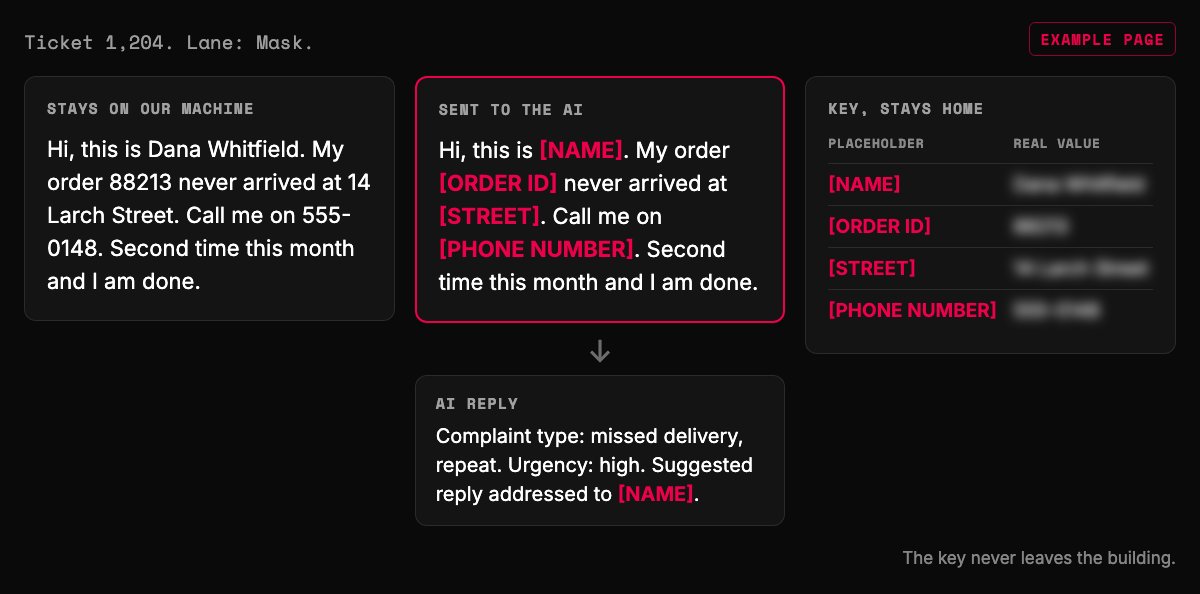
- The raw ticket never leaves the machine you control.
- Personal parts are swapped for placeholders before anything is sent.
- The key that swaps the real values back stays home too.
- The AI still does the useful work: it never needed the name.
Example page built for this article with a made-up customer. The Mask lane is the Building Test in section 4; masking with a reverse map follows Chip Huyen, AI Engineering, chapter 10.
Price the grey cases with chance times cost
Most fields sort themselves. A few sit on the line, and arguing about them burns a week.
Price them instead. Douglas Hubbard and Richard Seiersen teach the move in How to Measure Anything in Cybersecurity Risk: expected loss is the chance of an event times its cost.
Then compare lanes by their return on control. That is the loss a control removes, divided by what the control costs, minus one.
Here is a worked example with made-up inputs. Say raw sales call notes sent as they are carry a 5 percent yearly chance of a costly exposure, at about $200,000. Expected loss: $10,000 a year.
Masking cuts the chance to 1 percent for $2,000 a year. It removes $8,000 of expected loss, a 300 percent return.
A local setup that keeps the notes fully in-house removes about $10,000. But it costs $12,000 a year to run and maintain. That is a return of minus 17 percent.
In this example, masking wins. Change the inputs and the answer can flip. That is the point.
Two limits. The math settles grey cases, never a legal no. For the company-wide risk list, use the ten-row method in the governance framework above.
Example: masking returns 300 percent; a local setup loses money
Raw sales call notes, a $200,000 cost if exposed
| Lane | Chance a year | Expected loss | Control cost a year | Return on control |
|---|---|---|---|---|
| Send as is | 5% | $10,000 | $0 | None |
| Mask | 1% | $2,000 | $2,000 | 300% |
| Local setup | About 0% | About $0 | $12,000 | Minus 17% |
Example inputs, ours. Expected loss and return on control from Hubbard and Seiersen, How to Measure Anything in Cybersecurity Risk.
Example: masking has the lowest total yearly cost
Expected loss left over plus the cost of the control
- Send as is 10000
- Mask 4000
- Local setup 12000
Example built from the inputs in the table above.
Keep your edge at home, even when no law asks
Privacy is half the test. The other half is advantage.
Gary Lilien and Arvind Rangaswamy coined marketing engineering for decisions made with data, models and judgment together. Their textbook adds a point most privacy guides skip. Models built on a firm's own knowledge are hard for rivals to see, so they are hard to copy.
That is where the edge lives. Today's marketing engineer also builds the systems those models run in. So the same person decides where that knowledge travels.
Our list of edge data is short. Win and loss notes, price tests and their results, margin by client, next quarter's offer. None of it hurts a customer, and all of it helps a rival.
Trust is also per vendor, not per category. Huyen notes that some strict companies send data to the biggest cloud providers but not to startups.
Write your approved list by name. Keep edge data off it unless you would show the contract to your board.
Edge data hurts no customer and helps every rival
| Edge data | Why a rival wants it | Lane we use |
|---|---|---|
| Win and loss notes | Shows where you beat them | Summary only |
| Price tests and results | Saves them the test | Stay home |
| Margin by client | Shows whom to poach | Stay home |
| Next quarter's offer | Lets them launch first | Stay home |
| Published reviews | Already public | Send |
Our examples. The advantage of firm-specific knowledge: Lilien, Rangaswamy and De Bruyn, Principles of Marketing Engineering and Analytics.
Let a local clerk read the raw file and a cloud strategist read the summary
The summary-only lane needs a model you run yourself. We call it the local clerk.
It reads the raw recording or ticket on a machine you control. Then it fills a fixed set of fields: objection, product area, price mentioned, next step, and a summary with the names removed.
Only those fields go to the cloud strategist, the strongest outside model you have. It reads 200 clean summaries and writes the positioning memo.
Why not do it all locally? Because a model you run yourself is usually weaker at judgment.
Bloomberg once trained its own 50-billion-parameter model for finance, partly so sensitive work could stay in-house. Research Huyen cites found a general model, released the same month, beat it on finance tests. Millions in compute, beaten the same month.
So keep the raw data local. Send the thinking out. Running the clerk yourself also means far less filtering, because nothing raw is sent at all.
One rule keeps the split honest. The field list is the contract. If a field is not on it, it does not leave the machine.
This is how a customer truth system can run on sensitive sales calls without the calls going anywhere.
The raw file stays home; only fixed fields travel
- 1. Raw file stays home Recording, ticket or transcript on a machine you control.
- 2. Local clerk fills the fields Objection, product area, price mentioned, next step, a summary with names removed.
- 3. A script checks the fields No names, numbers or extra fields. Anything off the list is dropped.
- 4. Cloud strategist reads clean rows The strongest outside model writes the memo from 200 summaries.
Our pipeline.
Bloomberg built its own model for sensitive work; a general model released the same month beat it
- Parameters in Bloomberg's in-house finance model 50
- GPU hours to train it 1.3
- Estimated compute cost, before data costs $1.3M to $2.6M
Chip Huyen, AI Engineering, chapter 7, citing Wu et al. and Li et al.
Treat what the AI writes back as customer data too
Outputs can be more sensitive than inputs. An AI that reads purchases can guess a pregnancy, an illness or a money problem.
The Hacking Growth authors retell the classic warning. Target's coupons for baby clothes reached a teenager before her father knew she was pregnant.
Nobody typed the word pregnant. The system inferred it.
Our rule: any tag an AI creates about a person goes back through the Building Test. It passes before it is stored, sent or used in an ad.
Some privacy laws count these guesses as personal information in their own right. The dated box below has the current wording.
A guess about a person is still about a person.
What an AI infers about a person is new sensitive data
| What went in | What the AI can infer | Treat the inference as |
|---|---|---|
| Purchase history | A pregnancy or an illness | Health data: stay home |
| Support tickets | Money trouble | Sensitive: mask or summary only |
| Call recordings | A divorce or a layoff | Private words: summary only, nobody attached |
| Website visits | A job hunt | Personal: mask before any use in ads |
Our examples. The coupon case: Ellis and Brown, Hacking Growth.
Check the boundary with samples, not trust
A boundary you never check is a guess. But checking every file by hand kills the job.
Grove's answer was variable inspection. Check more often when problems show up, and less often after weeks without one.
In his monitoring example, three failed samples in a row stop the line. We borrow that number.
Our check plan for the mask and summary lanes has four rules. Start at 20 hand-checked outputs per batch, field by field. After four clean weeks, drop to 10.
Any miss sends you back to 20, plus a fix to the rule that missed. Three misses in a row stop the job until someone finds the cause.
Who checks? Someone who did not build the job. Nobody should grade their own homework.
The full method is in how to evaluate AI agents.
Check more when misses appear, less after clean weeks
- Start Hand-check 20 outputs per batch, field by field.
- Four clean weeks Drop to 10 per batch.
- Any miss Back to 20, and fix the rule that missed.
- Three misses in a row Stop the job until someone finds the cause.
Our rule, built on variable inspection and the three-failed-samples example in Andy Grove, High Output Management.
What do privacy laws and vendor terms change?
They change the answer to question three. The method stays the same.
Laws differ by country and by state, and they keep changing. Health data, money data and data about people in Europe usually carry the strictest rules.
The current legal wording, the vendor terms worth reading, and the local tools we use all sit in the dated box below. If your data is regulated, take your draft boundary to counsel; our healthcare and med spa work starts there.
Write your data boundary with AI
Paste the prompt below into your preferred AI. Describe your data, never paste it.
It asks for field names and made-up examples, one question at a time. Then it runs the Building Test on every field and returns a one-page boundary with lanes, reasons, owners and a check plan.
Paste into your preferred AI. It asks five questions about one data set, then sorts every field into a lane.
Act as a data privacy planner for a marketing team. Help me decide which customer data may go to an outside AI tool, using the Building Test.

Never ask me to paste real customer data. Ask for field names and made-up examples only.

Ask me one question at a time, with the example:
1. Which data set, and for what job? (Example: 3,000 support tickets, to find the top complaints)
2. Every field in it. (Example: ticket ID, email, ticket text, order total, date)
3. Who is in the data, and where do they live? (Example: shoppers in the US and the EU)
4. What did we promise them, and what do our contracts say? (Example: privacy policy says we share data only with service providers)
5. Which AI tools are approved, on what terms? (Example: one business account, no training on our data)

For each field, ask four questions:
A. Who gets hurt if it goes public? (money, health, legal trouble, private words, social standing)
B. Can it point to one person, alone or combined with other fields?
C. Does a law, a contract or our own policy say no?
D. Is it our edge? (prices, win and loss notes, margins, plans)

Pick the loosest lane that passes all four:
- Send: as is.
- Mask: personal parts swapped for placeholders; the key stays with us.
- Summary only: a model we run ourselves reads it; only fixed fields leave.
- Stay home: never goes to an outside AI.

Rules:
- A legal or contract no is final. Never price it away.
- Anything the AI infers about a person is a new field. Test it too.
- For grey cases, show chance times cost for each lane. Ask me for the inputs; never invent them.
- If you can browse, check the current privacy rules for my regions and my AI vendor's current data terms, and say what you found. If not, list what I must check.
- This is not legal advice.

Output:
1. Table: field, lane, reason, owner
2. Check plan: hand-check 20 outputs per batch, 10 after four clean weeks, back to 20 on any miss, stop after three misses in a row
3. Questions for counsel
4. Next three actions
What the prompt produces: every field gets one lane, one reason and one owner
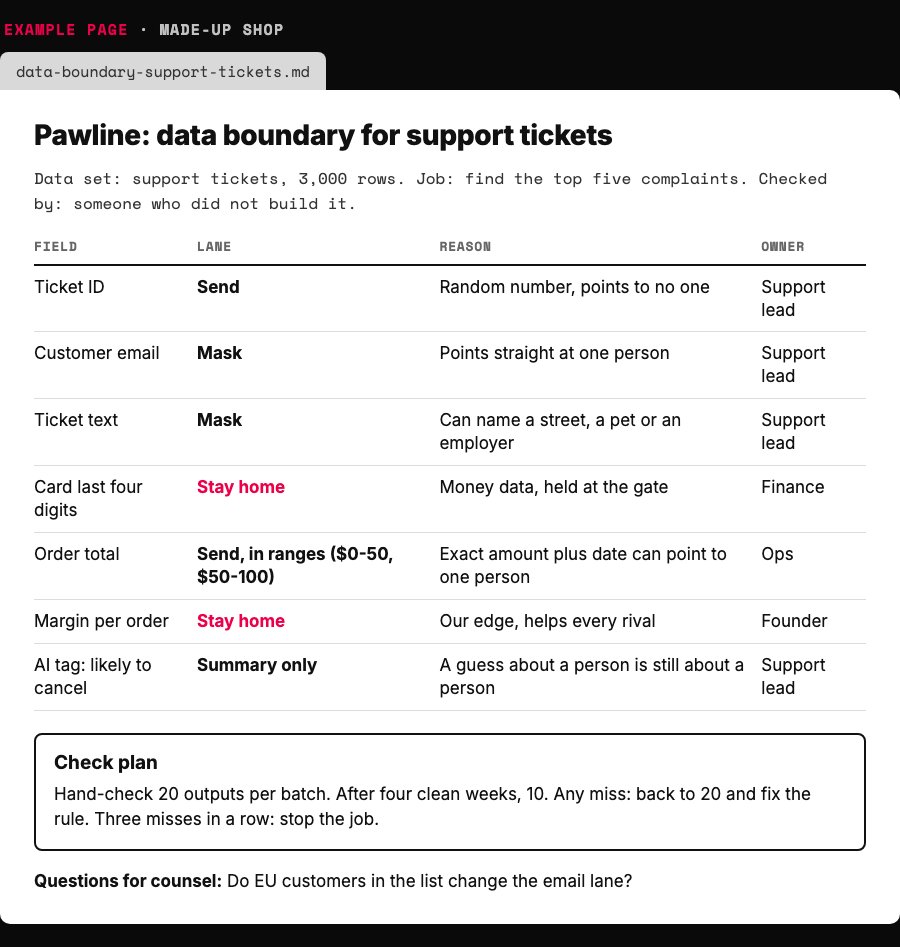
- One lane per field, never one answer for the whole file.
- Harmless alone, traceable combined: send it in ranges.
- No law asks for this one. It stays home because it is the edge.
- What the AI infers about a person goes through the test too.
- The boundary ships with its check plan, not just its rules.
Example page built for this article with a made-up shop. Lanes, questions and the check plan are the Building Test in sections 2 to 9; every row is an illustration, not data.
Do three things this week
1. List the three data sets your team most wants to give an AI. Write each field on its own line.
2. Run the prompt and print the boundary. Read every Stay home line aloud to the person who owns that data.
3. Fix the first step. Mask or strip in the export itself, so the raw file never reaches an AI tab.
Remember ticket 312, the one with the card number? Under this boundary it gets masked in the export. The AI never sees it.
Next, decide where the clean data lives and what may read it, with the marketing engineering stack. Customer data also leaves through the events you send to ad platforms, which server-side conversion tracking covers.
Before you buy hardware to save money, check the bill with AI cost controls. Most teams find it smaller than they feared.
The safest lock in the building is the one on the export button.

Filip Kovacevic is the founder of Anar Agency in Phoenix. He spent five years running SEO, Meta ads, email, and content for medical practices across the United States, and now does the same work for healthcare, home-service, legal, and professional-service businesses, alongside AI implementation. More from Filip →
Want the boundary and the local clerk built for you?
Bring the one data set you are nervous about. In 15 minutes we will tell you which lane each field belongs in and what the split pipeline would look like.
See how we build them →Want to do this work yourself? See how we train marketing engineers.