How We Run an Agency as Marketing Engineers: The Maker Never Checks Its Own Work

Quality check AI marketing work by splitting the maker from the checker. The tool or person that made the work never grades it. Run cheap code checks first, then a second reviewer working from a written list, then a named person who approves anything costly.
If you cannot write down what wrong looks like, do not automate it yet.
How do you quality check AI marketing work?
In a busy Boston restaurant, every plate stops at a counter before it reaches a table. The chef or her sous chef checks it against the order ticket. Sometimes they taste it.
On the night Atul Gawande counted, at least 5 percent went back to the line. He tells the story in The Checklist Manifesto.
Most AI marketing has no counter. The tool that wrote the ad also tells you the ad is good. That is a player calling his own fouls.
This guide shows how we run Anar Agency as marketing engineers, and how to quality check AI marketing work with one rule. The maker never checks its own work.
A marketing engineer is a marketer who builds systems instead of assets, as our definition of a marketing engineer sets out. This page is the worked example: the role, run inside a real agency.
Short version? Every system gets a maker, a checker that is not the maker, and a named person who signs off on anything costly.
One kitchen checks every plate, and sends some back
- plate checked against the order ticket before it leaves Every
- of plates sent back on the night they were counted 5
The Checklist Manifesto, Atul Gawande, on Rialto in Boston
Why can't the maker grade its own work?
The Builder-Never-Grades Rule is our name for one habit: whatever makes the work never decides whether the work is good.
Why so strict? Makers love their own work.
In Hacking Growth, Sean Ellis and Morgan Brown warn that commitment to an idea bends a team's judgment. Pressure and emotion do the bending.
AI has the same flaw in a new form. The model that wrote a draft brings the same blind spots when it reads that draft. It misses what it missed the first time.
Accountants fixed this long ago. Separation of duties means no one person both does a task and approves it.
The idea is old. What changed is the price of a second pair of eyes.
A script costs almost nothing to run. A second AI reader costs a little more.
So skipping the check is a choice. Not a budget problem.

Split the maker from the checker, and bad work stops early
| Maker grades itself | Builder-Never-Grades |
|---|---|
| The AI that wrote the ad reviews the ad | A different model or person reviews it from a written list |
| Shares every blind spot of the draft | Brings its own blind spots, not the maker's |
| Nothing is ever sent back | The send-back rate is tracked |
| A person sees everything, or nothing | A person sees only what survived the cheap checks |
Builder-Never-Grades Rule, Anar. Root idea: separation of duties
Give every marketing system three roles that never overlap: a maker that does the work, a checker that is not the maker, and a named person who approves anything costly. Order the checks by cost: code checks first, a second reader with a written list next, and the person last, on only what survived. If you cannot write what wrong looks like, the task is not ready to automate.
Track the send-back rate, and turn every miss that gets through into a new check.
Run the cheap checks first: code, then a second reader, then a person
Run the cheapest check first, and let a person see only what survives.
Code goes first. A code check is a small script that answers yes or no: does every link open, does every number carry a date, does the price match the price list?
Scripts are fast, cheap and never tired. They also cannot judge tone. So they are never the only check.
A second reader goes next. That means a different model or a different person, working from a written list of what good looks like.
One AI lab's guide to grading AI agents sorts graders into the same three kinds: code, model and human. It adds a warning we agree with: a model grader needs checking against people before you trust it.
A person goes last. Their time is the most expensive link in the chain. Spend it on judgment, not typos.
How much should that person check? Depends on the price of a wrong call.
A wrong tag is cheap. A wrong price, claim or customer message is not.
That cost rule comes from the marketing engineering textbook by Gary Lilien and his co-authors. For grading whole agents, see how to evaluate AI agents.
Run the cheapest check first, and save people for judgment
- Code check A script answers yes or no. Links open, numbers carry dates, prices match the list.
- Second reader A different model or person, working from a written list of what good looks like.
- Named person Approves anything costly, and sees only what survived the first two.
Builder-Never-Grades Rule, Anar
Each checker is good at something the others miss
| Checker | Speed and cost | Good at | Blind to |
|---|---|---|---|
| Code | Fast, close to free | Rules with a yes or no answer | Tone, judgment, anything not written as a rule |
| Second model | Fast, a little more | Nuance and open-ended writing | Needs checking against people before you trust it |
| Person | Slow, the most costly | Setting the standard, costly calls | Typos at volume, tired Friday reviews |
Grader types from one AI lab's guide to evaluating agents. Good at and blind to columns are Anar's reading
If you cannot write what wrong looks like, do not automate it
Write the check before you build the maker. If you cannot write it, the task is not ready.
Most teams do it backwards. They build the maker, ship it, and hope a checker shows up later. It never does.
Gawande learned how to build a good check from Dan Boorman, who designs checklists at Boeing. Pick a clear pause point. Keep it to five to nine killer items, the steps most dangerous to skip.
Keep the wording plain. Keep it under about 90 seconds to run. Then test it on real work, because first drafts fall apart.
Now cut what never gets missed. Boeing's cargo-door checklist leaves out calling the control tower, because pilots virtually never forget that step.
The same cut works on AI instructions, in our reading. Drop the rules the model already follows. Keep the ones it skips.
Then give every agent a contract. Michael Gerber's The E-Myth Revisited defines a Position Contract: the results to hit, the work the role owns, the standards it is judged by, and a signature.
For an agent, the signature belongs to a named person. That person answers for what the agent ships. The full brief is in the agent job spec.
Last, run the task by hand from the written steps before you automate it. David Jenyns makes the same call in SYSTEMology: do it manually, get it right, then automate.
Write the check in four moves before you build anything
- Pick the pause point The exact moment the check runs. Example: before the report is sent.
- List the killer items Five to nine steps most dangerous to skip. Plain words.
- Cut what never fails Drop anything the maker always gets right.
- Test it on real work First drafts fall apart. Fix the list until it catches real misses.
The Checklist Manifesto, Atul Gawande, on Dan Boorman's checklist rules. Marketing use is Anar's reading
A Position Contract turns an agent into a role someone answers for
Example: an agent that drafts the Monday lead report
| Part | What it says |
|---|---|
| Results to hit | A report on the marketing lead's desk by 10 a.m. Monday |
| Work it owns | Pull leads and spend, draft the summary, flag any week-over-week swing |
| Standards it is judged by | Lead counts match the CRM, every number has a date, no claim without a number |
| Signature | The marketing lead, who answers for what ships |
Position Contract parts from The E-Myth Revisited, Michael Gerber. The agent example is Anar's, for illustration
Our own ad numbers show why the checker matters
Here is a real example from our own ad account. Anar's Meta lead ads ran across 16 campaigns on about $9,190 of spend.
Leads from med spa owners cost about $19 each. Contractors cost about $60 to $62. A broad "business owner" audience cost $181 a lead.
Even the pricier niche beat broad about 3 to 1. Med spa leads cost about a tenth as much.
Broad is the audience a builder likes. It reaches the most people. It feels safe.
The verdict came from somewhere else: the raw cost per lead, pulled through Meta's reporting API and read by audience. That pull is the checker.
Your numbers will differ. The rule will not.
Grade the work with a number the maker did not produce.
Niche audiences cost a fraction of broad per lead
Cost per lead from Anar's own Meta lead ads, by audience
- Med spa owners 19
- Contractors ($60 to $62) 61
- Broad business owners 181
Anar's own Meta lead-gen ads, May to November 2025, about $9,190 across 16 campaigns. Meta API pull 2026-09-22
Where does an agency fit if growth is too important to delegate?
An agency fits when it builds the maker and the checker, while the client keeps the number and the final sign-off.
Hacking Growth is blunt about outside help. Its authors call growth too important to delegate, because consultants often lack the authority, time or drive to finish the hard work.
We agree with half of that. Outsiders should never own growth.
But Ellis was the outsider in his own best story. After his engagement at Dropbox ended, the company went nine more months without hiring a full-time marketer.
That is the test of good outside help. The system keeps running after the outsider leaves.
So the client helps write the checks. Lilien's marketing engineering textbook makes the case: people accept a model's decision more readily when their own inputs shaped it.
Can a creative task survive that handoff? In Clockwork, Mike Michalowicz tells how two copywriters at North Star Messaging + Strategy did it.
They noticed they asked every client the same questions. They turned the answers into a voice code: stories, what goes unsaid, even punctuation.
They tried the code first on a forgiving client. Soon their writers stopped asking them questions. Handoff done.
Filip, our founder, ran operations for five years at a medical-niche marketing agency, across 10 vein clinic brands and other practices. In health marketing a wrong claim is costly, so the second reader is never optional.
An agency should install the system, never own the growth
| Agency owns growth | Agency installs the system |
|---|---|
| Agency picks the number it reports | Client owns the number |
| Agency grades its own work | The client's number grades the work |
| Work stops when the agency leaves | The system keeps running after the handoff |
| Client is told the results | Client helps write the checks |
Our reading of Hacking Growth (Ellis and Brown) on outside experts, and of Lilien et al. on stakeholder inputs
Hand off one box at a time, and only once its manual works
- Draw the finished chart Step 1 Every role the business will need, even if one person fills them all today.
- Write the contracts Step 2 Results, work, standards and a signature for each box.
- Run it by hand Step 3 Do the work from the written steps until the steps alone get the result.
- Hand off the box Step 4 To a person or an agent, with its checker in place.
- Move to the next box Step 5 Only the faces change. The work stays the same.
Built on the org chart and Position Contracts in The E-Myth Revisited (Gerber). Agents in the boxes are Anar's addition
Three fake checks, and how to spot each one
A fake check looks like a review and catches nothing. Want to ship AI work nobody checked, in four easy steps?
Step one: ask the AI to write the ad. Step two: paste the ad back into the same chat and ask if it is good.
Step three: it says yes, with five bullet points of praise. Step four: call that your review process and go home early.
That is not a review. It is a mirror.
The first fake is the same model with the same context. The symptom: the reviewer agrees with nearly everything. The fix: a different model or person, working from the written list, not the chat history.
The second fake is a reviewer with no list. The symptom: notes about vibes, never about rules. The fix: write the five to nine killer items first.
The third fake is the rubber stamp. The symptom: the approver has never sent anything back. The fix: track the send-back rate, the share of work a check returns.
The Boston kitchen sent back at least 5 percent on the night it was counted. We do not claim 5 percent is the right rate for marketing.
But zero is the wrong rate. An approver who never says no is a signature, not a check.
Only a separate checker with a written list counts
- Self-audit The maker ticks its own boxes. Catches typos, misses blind spots.
- Real check Different reader, written rules, tracked send-backs.
- Mirror Same AI, same chat, says yes. No check at all.
- Vibe review A second pair of eyes with no rules. Inconsistent.
Builder-Never-Grades Rule, Anar
Every miss that gets through becomes a new check
When a mistake slips past the checks, do not just fix the work. Add a check so that mistake cannot pass again.
Investor Mohnish Pabrai did this with a list of mistakes, his own and other investors'. It grew into about seventy matching checks, as Gawande reports.
The North Star founders did it too. Before their first four-week break, they kept a list of what broke and wrote a procedure for each one.
Put the check in the tool, not in a memo. Gerber's team spent three weeks on memos, meetings and signs to keep blue ink off white walls. Then a four-inch clear collar around each whiteboard fixed it at once.
Three weeks of memos. One piece of plastic. Engineers call that kind of fix poka-yoke, or mistake-proofing.
A rule in a memo needs someone to remember it. A check in the tool does not.
Keep the list short and current. Jenyns describes an ads agency that posted hundreds of procedures on a wall. It flopped, because digital marketing changed almost daily.
Close every project with two questions from the completion checklist in Tiago Forte's Building a Second Brain. Did the goal pan out, and why? Which pieces can the next project reuse?
Reusable pieces live in a growth repo. The weekly growth cockpit memo reports what the checks caught.
Every miss that gets through becomes a new check
- Make The maker does the work
- Check Code, second reader, person
- Ship Only what survived goes out
- Log the miss Anything that slipped through, written down
- Add a check One new line on the list, or a guard in the tool
Builder-Never-Grades Rule, Anar. Mistake-list idea from The Checklist Manifesto, Atul Gawande
A mistakes ledger turns each slip into one new check
Example entries for an AI-drafted email program
| What slipped through | Where it was caught | New check |
|---|---|---|
| An offer price that had changed | A customer reply | Code: every price must match the current price list |
| A claim with no proof behind it | The second reader, late | List item: every claim cites a number or a quote |
| The same subject line two weeks running | The weekly memo | Code: no repeat of the last eight subject lines |
Illustrative example. Ledger method adapted from Mohnish Pabrai's mistake list in The Checklist Manifesto, Atul Gawande
Log each miss once, and turn it into one new check
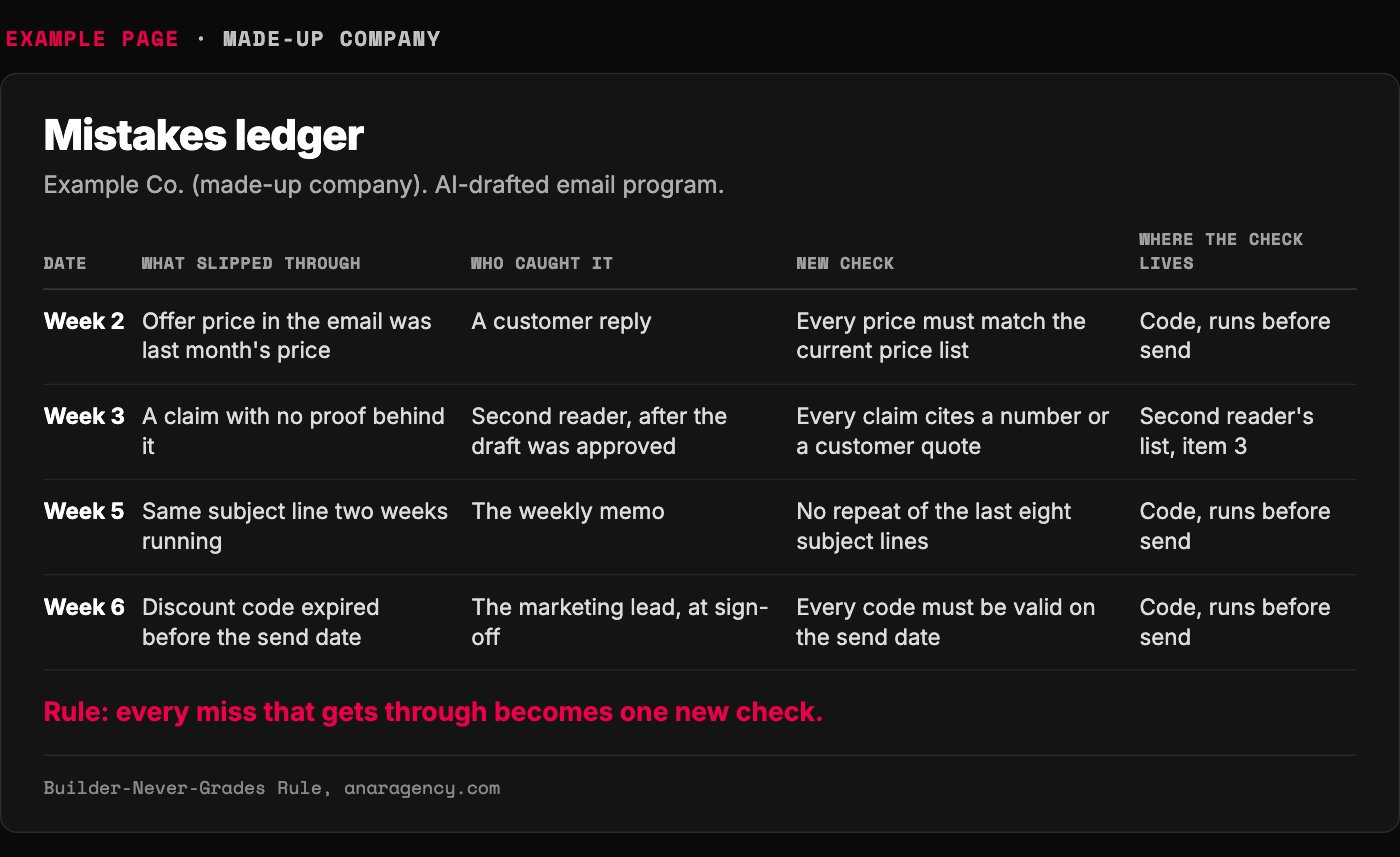
- The worst checker is the customer. Log it the same day.
- Put the check in the tool when you can. A memo needs someone to remember it.
- One miss, one new line. The list grows only from real slips.
- This is the repeat loop: make, check, ship, log the miss, add a check.
Example page built for this article with a made-up brand. Ledger method adapted from Mohnish Pabrai's mistake list in The Checklist Manifesto, Atul Gawande
Build your first Builder-Never-Grades card with AI
The prompt below builds the card for one task. Paste it into your preferred AI and answer its questions.
It names the maker, writes the code checks, drafts the second reader's list, and names the person who signs. If you cannot say what wrong looks like, it stops and tells you so.
This week, pick the one marketing task your team repeats every week. Build its card, run the checks for four weeks, and count the send-backs.
Want to know where your other systems stand? The marketing engineering audit scores them, and how to measure a marketing engineer grades each one on what buyers did.
Rather have the first system and its checker built for you? That is our marketing engineering work.
Prefer to build it yourself? Start with our marketing engineer training.
Remember the counter in that Boston kitchen? The cooks are good. The plates still stop.
Talent makes the work. The checker decides what ships.
Paste into your preferred AI. It asks seven questions, then writes the checks, the approver and the number to watch.
Act as a careful reviewer who sets up quality checks for marketing work. Use only the rules below and my answers. Never invent a number, a task or a result; if something is missing, ask me.

Ask one question at a time, show the example, and wait:
1. What one marketing task repeats every week? (Example: the Monday lead report)
2. What does it read? Name each input. (Example: last week's leads from the CRM, spend from the ad accounts)
3. Who or what makes it? (Example: an AI agent drafts it)
4. What does wrong look like? List every way it has gone wrong or could. (Example: lead counts that do not match the CRM, a number with no date)
5. What does a wrong version cost if it reaches a client or a customer? (Example: the owner cuts a campaign that was working)
6. Who signs off before it leaves the team, and by when? (Example: the marketing lead, by 10 a.m. Monday)
7. What number should this task move? (Example: hours spent building the report)

Rules:
- The maker never checks its own work. The second reader is a different model or a different person, working from a written list, never from the maker's chat history.
- Order the checks by cost: code checks first (yes or no rules a script can test), then the second reader, then the person.
- Keep each list to 5 to 9 items: the steps most dangerous to skip. Drop anything that never gets missed.
- If I cannot describe what wrong looks like, say the task is not ready to automate, and stop.
- Costly mistakes (a price, a claim, a message to customers, spending money) always need a named person to approve.
- Track the send-back rate: the share of work any check returns. If it stays at zero, warn me the check may be a rubber stamp.
- Every miss that gets past the checks becomes a new check.

Show your reasoning briefly, then use exactly this format:
TASK:
MAKER:
CODE CHECKS (yes or no):
SECOND READER AND THEIR LIST:
PERSON WHO SIGNS, AND BY WHEN:
NUMBER TO WATCH:
SEND-BACK RATE TO TRACK:
NOT READY BECAUSE: (only if it fails)
NEXT THREE ACTIONS:
A finished card names one maker, three checks and a send-back rate
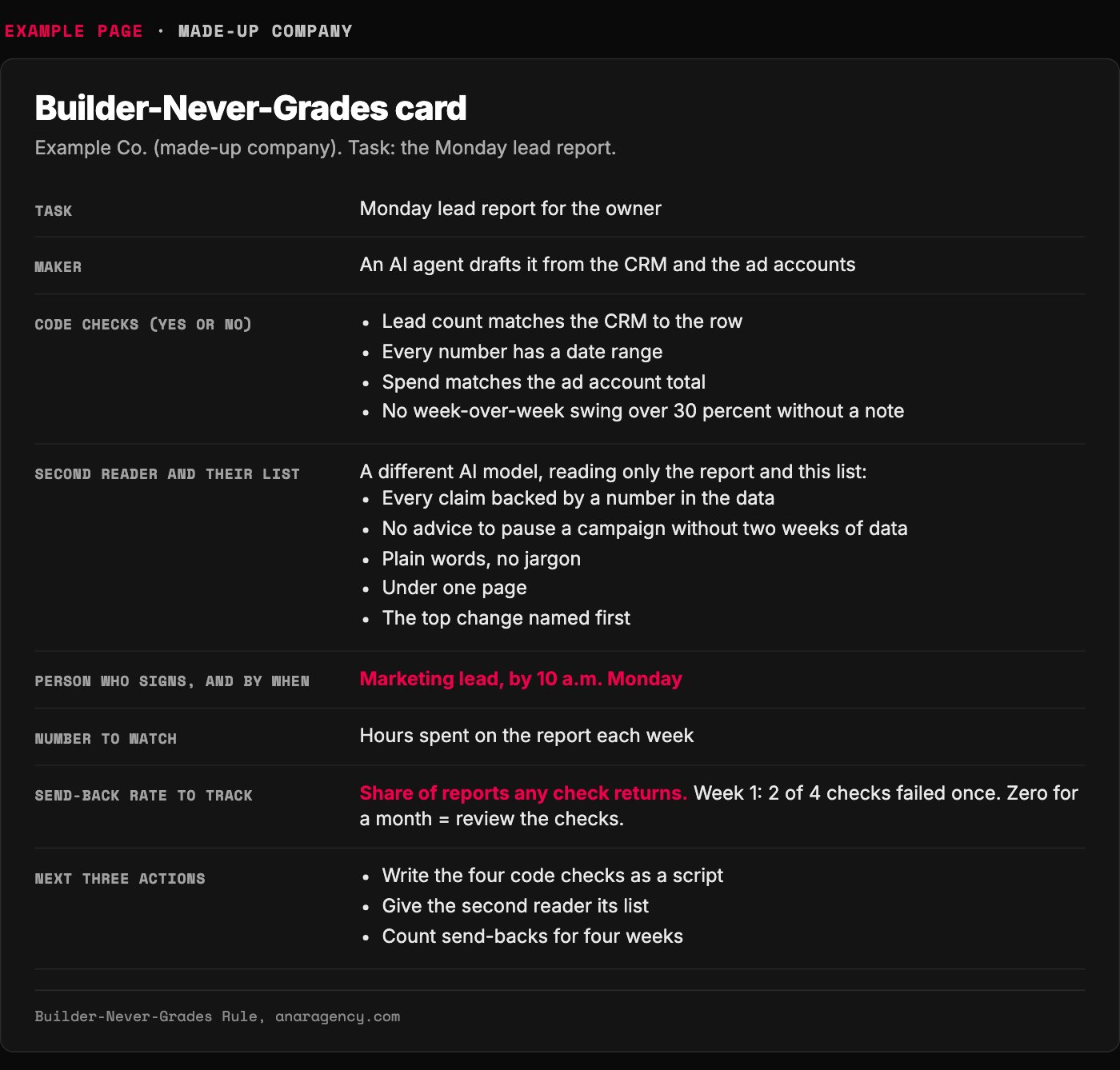
- One maker. It never reviews its own report.
- Code checks run first: cheap, yes or no, never tired.
- The second reader is a different model with a written list, not the maker's chat.
- A named person signs, and sees only what survived the first two checks.
- If nothing ever gets sent back, the check is probably a rubber stamp.
Example page built for this article with a made-up brand. Method: the Builder-Never-Grades Rule, Anar

Filip Kovacevic is the founder of Anar Agency in Phoenix. He spent five years running SEO, Meta ads, email, and content for medical practices across the United States, and now does the same work for healthcare, home-service, legal, and professional-service businesses, alongside AI implementation. More from Filip →
Want one system and its checker running in your company?
Bring one number you want to move. In 15 minutes we will tell you which system we would build first, what would check it, and how you would know it worked.
See how we build them →Want to do this work yourself? See how we train marketing engineers.